

The journey to becoming an engineer in India begins with cracking the JEE Main Exam. Every year, lakhs of aspiring engineers prepare for this entrance examination that opens doors to prestigious engineering institutions across the country. Therefore, a clear understanding of the JEE Main Exam structure, combined with a strong, consistent study plan, matters so much.
This guide is your go-to handbook for understanding the JEE Main exam. You’ll find everything you need in one place, from eligibility, registration steps, study plans, and tips to score a high percentile this year. By the time you reach the end, you’ll know exactly what to expect and how to move forward with confidence.
What Makes the JEE Main Exam So Important?

JEE Main (Joint Entrance Examination Main) is a national-level entrance test conducted by the National Testing Agency (NTA). It’s one of India’s largest and most competitive entrance exams for undergraduate engineering programs. It serves as the gateway to NITs, IIITs, and other Centrally Funded Technical Institutes (CFTIs). Additionally, your performance in JEE Main determines eligibility for JEE Advanced, which leads to the IITs.
Earlier, it was a single exam, but now it’s held twice a year (in January and April) to give candidates more opportunities to improve their scores.
The exam has three papers:
- Paper 1 (B.E./B.Tech): For admission to Undergraduate Engineering programs. This is the most popular paper.
- Paper 2A (B.Arch): For Bachelor of Architecture programs.
- Paper 2B (B.Planning): For Bachelor of Planning programs.
|
Paper Type
|
Subjects
|
Mode
|
Duration
|
No. of Questions
|
|---|---|---|---|---|
|
Paper 1 (B.E./B.Tech.)
|
Physics, Chemistry, Mathematics
|
Online
|
3 Hours
|
90 (75 to answer)
|
|
Paper 2 (B.Arch.)
|
Maths, Aptitude, Drawing
|
Offline/CBT
|
3 Hours
|
77
|
|
Paper 2 (B.Planning)
|
Maths, Aptitude, Planning
|
CBT
|
3 Hours
|
100
|
However, for the vast majority of students, the focus is on Paper 1.
The JEE Mains Exam Pattern (Paper 1: B.E./B.Tech)
Understanding the JEE Mains pattern is the first step toward smart preparation. In particular, knowing the marking scheme helps you strategise your attempts to maximise your score and avoid negative marking.
|
Particulars
|
Details
|
|---|---|
|
Exam Mode
|
Computer-Based Test (CBT)
|
|
Duration
|
3 Hours
|
|
Subjects
|
Physics, Chemistry, and Mathematics
|
|
Total Questions
|
75 Questions (25 from each subject)
|
|
Question Types
|
Multiple Choice Questions (MCQs) and Questions with Numerical Value Answers
|
|
Total Marks
|
300 Marks (100 Marks per subject)
|
|
Marking Scheme
|
+4 for every correct answer, -1 for every incorrect answer (Negative Marking)
|
|
Language Options
|
English, Hindi, and regional languages (Assamese, Bengali, Gujarati, Kannada, Marathi, Malayalam, Odia, Punjabi, Tamil, Telugu, and Urdu)
|
For example, in each subject (Physics, Chemistry, and Maths), there are two sections:
- Section A: 20 MCQs (Multiple Choice Questions).
- Section B: 10 Numerical Value Questions, out of which candidates must attempt any 5.
Consequently, the total number of questions to be attempted is 20 + 5 = 25 per subject, making it 25 × 3 = 75 questions in total.
JEE Main and Advanced: What Next?

Clearing the JEE Main Exam is the first hurdle. After clearing JEE Mains what next is a common question. The answer depends on your performance:
- For NITs, IIITs, and GFTIs: Your JEE Main score/rank is used for direct admission through centralised counselling.
- For IITs (Indian Institutes of Technology): The top 2,50,000 successful candidates in the JEE Main are eligible to appear for the JEE Advanced exam. Therefore, the JEE Main is the crucial qualifying test for the JEE Advanced test series.
JEE Main Eligibility: Who Can Apply
The National Testing Agency (NTA), which conducts the exam, has set a few essential rules that every candidate must meet. Before you start preparing or filling out the JEE Main application form, it’s important to understand the JEE exam eligibility.
|
Eligibility Component
|
Required Details
|
|---|---|
|
Academic Qualification
|
Must have passed Class 12th or an equivalent examination.
|
|
Year of Passing
|
Must have passed Class 12th in the year of the exam or the two preceding years
(e.g., for the 2026 exam, candidates must have passed in 2024, 2025, or be appearing in 2026).
|
|
Number of Attempts
|
A candidate can appear for the JEE Main for three consecutive years starting from the year of passing Class 12.
|
|
Age Limit
|
There is no age limit set by the NTA for appearing in the JEE Main.
|
|
Compulsory Subjects
|
For B.E./B. Tech, candidates must have passed Class 12 with Physics and Mathematics as mandatory subjects, along with one of Chemistry/Biology/Biotechnology/Technical Vocational subjects.
|
Important Note on Admission: However, simply clearing the exam is not enough for admission to top institutes like NITs, IIITs, and CFTIs. You must secure at least 75% marks in the Class 12th board exam (or be in the top 20 percentile of the respective board). This is reduced to 65% marks for SC/ST candidates.
What Is the JEE Main Registration Process?
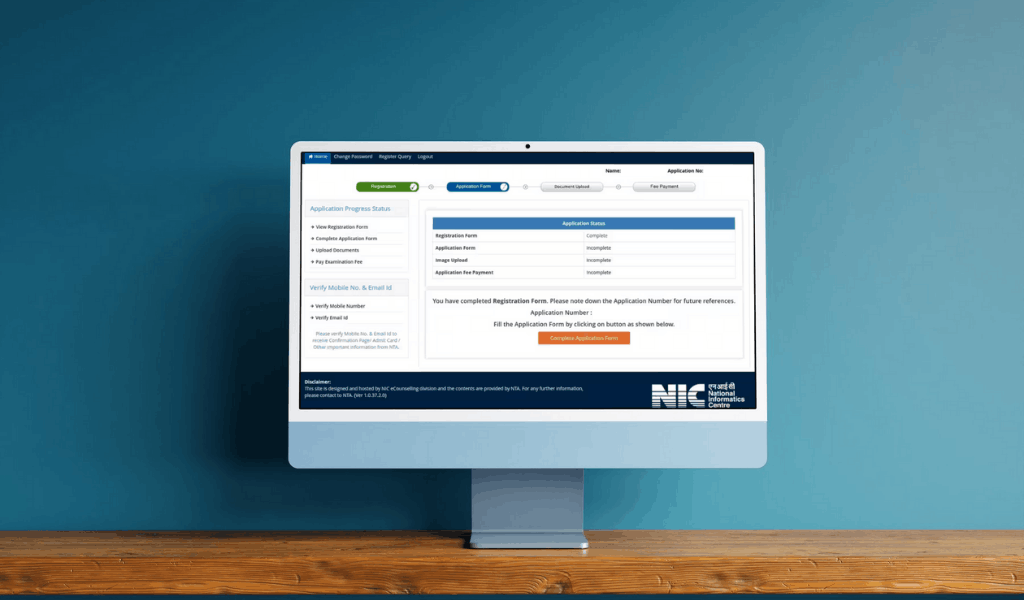
The JEE Main registration process is conducted entirely online through the official NTA website. Therefore, understanding the process thoroughly ensures a smooth application experience.
Important Documents Required
Before starting the registration for JEE Main, gather all the necessary documents required for JEE Main registration:
|
Document Type
|
Specifications
|
|---|---|
|
Photograph
|
Recent passport-size color photo (10-200 KB, JPG/JPEG format)
|
|
Signature
|
Clear signature on white paper (4-30 KB, JPG/JPEG format)
|
|
Category Certificate
|
SC/ST/OBC-NCL certificate (if applicable)
|
|
PwD Certificate
|
Disability certificate (if applicable)
|
|
Class 10 Marksheet
|
For date of birth verification
|
|
Class 12 Marksheet
|
For qualification verification
|
|
Aadhaar Card
|
For identity verification
|
|
Valid Email ID
|
For communication
|
|
Mobile Number
|
For OTP verification
|
Registration Process
As mentioned earlier, the registration for JEE Main is done entirely online via the JEE Main official site (NTA website). Now, follow these simple steps given below for a smooth JEE Main registration.
Important Note: Before you begin, read the official Information Bulletin carefully. It explains all rules, eligibility criteria, and important instructions.
Step 1: Visit the Official Website
Visit the JEE Main official site (JEE Main – NTA). This is where you’ll find the JEE Main registration link during the registration period.
Step 2: Create an Account
- Create your account on the official JEE Main website.
- Enter your basic details, set a password, and choose a security question.
- After submitting, you will receive a system-generated application number.
- Keep this safe, as you will need it for both sessions of JEE Main 2026 and for every future login.
Step 3: Fill the Application Form
Log in using your credentials and start filling out the JEE application form. The form includes several sections:
Complete the form by entering:
- Personal information
- Academic details
- Exam paper selection
- Choice of exam cities
Step 4: Upload Documents
Upload all documents required for JEE registration in the specified format and size. Ensure that the images are clear and meet the technical requirements.
- Recent colour photo (JPG/JPEG, 10–200 kb)
- Signature (JPG/JPEG, 10–100 kb)
- Class 10 certificate/marksheet (PDF, 50–300 kb)
- Identity proof, if needed (JPG/JPEG, 10–200 kb)
- PwD/UDID certificate, if applicable (PDF, 50–300 kb)
All uploads must be clear and readable.
Step 5: Pay the Application Fee
The JEE Main form cost varies based on category and paper choice:
Paper 1 (B.E./B.Tech) OR Paper 2A (B.Arch) OR Paper 2B (B.Planning)
|
Category
|
Gender
|
Fee in India (₹)
|
Fee Outside India (₹)
|
|---|---|---|---|
|
General
|
Male
|
1000
|
5000
|
|
Female
|
800
|
4000
|
|
|
Gen-EWS / OBC-NCL
|
Male
|
900
|
4500
|
|
Female
|
800
|
4000
|
|
|
SC / ST / PwD / PwBD
|
Male
|
500
|
2500
|
|
Female
|
500
|
2500
|
|
|
Third Gender
|
--
|
500
|
3000
|
Combination of Papers
(Paper 1 + Paper 2A) / (Paper 1 + Paper 2B) / (Paper 1 + Paper 2A + Paper 2B) / (Paper 2A + Paper 2B)
|
Category
|
Gender
|
Fee in India (₹)
|
Fee Outside India (₹)
|
|---|---|---|---|
|
General / Gen-EWS / OBC-NCL
|
Male
|
2000
|
10000
|
|
Female
|
1600
|
8000
|
|
|
SC / ST / PwD / PwBD
|
Male
|
1000
|
5000
|
|
Female
|
1000
|
5000
|
|
|
Third Gender
|
--
|
1000
|
5000
|
Note: Service charges and GST (as applicable) will be charged separately by the bank.
Step 5: Save the Confirmation Page
Download and save the Confirmation Page and note the application number printed on it.
You will need these for:
- Future logins
- Exam-related communication
- Admit card download
Keep both documents stored safely.
The Expert Preparation Strategy for Scoring High in JEE Main

The true battle for a high rank in the JEE Main Exam is won through smart, disciplined, and consistent preparation. Therefore, your strategy should cover everything from building concepts to regular practice and continuous self-assessment.
1. Understanding the Syllabus and Concepts
NCERT First: Start by thoroughly mastering the NCERT textbooks for all three subjects. Especially, in chemistry, many questions are directly picked from the NCERT text.
Conceptual Clarity: In addition, focus on understanding the core concepts rather than just memorising formulas. For instance, a strong understanding of the underlying principles allows you to tackle tricky, application-based questions.
High-Weightage Topics: Nevertheless, be smart about resource allocation. Dedicate more time to high-weightage topics.
|
Subject
|
High-Weightage Topics
|
|---|---|
|
Mathematics
|
Vector Algebra and 3D Geometry, Calculus (Differential Equations and Definite Integrals), Probability, Limit, Continuity and Differentiability, Binomial Theorem, Applications of Derivatives
|
|
Physics
|
Gravitation, Current Electricity, Thermodynamics, Ray Optics, Electromagnetism, Electrostatic Potential and Capacitance, and Dual Nature of Radiation and Matter
|
|
Chemistry
|
Organic Chemistry (especially Reactions), Chemical Bonding, Solutions, Equilibrium, Coordination Compounds , Amines, s-Block Elements and p-Block Elements (Inorganic Chemistry)
|
Based on the past 5 years’ papers
2. The Power of Practice and Revision
Consistent practice and regular revision are the twin pillars of a successful JEE Mains preparation.
- Solving JEE Previous Year Papers: Solving JEE previous year papers is non-negotiable. Specifically, they help you understand the question pattern, the difficulty level, and the recurring concepts. Furthermore, aim to solve at least the last 5 to 7 years’ papers.
- JEE Mains Sample Paper and Mock Tests: Consequently, the importance of an online JEE mock test cannot be overstated. They are essential for:
- Improving your speed and accuracy.
- Practising time management under exam-like pressure.
- Identifying your weak areas for targeted revision.
- Note-Making and Revision: Prepare short, clear notes for quick revision. Focus on formulas, important reactions, and tricky concepts. Set aside a fixed time every day to revise older topics.
Many online JEE platforms, such as Super Tutor, offer structured mock tests, PYQs, practice quiz and many other JEE Main learning tools that make this practice smoother and more consistent.
Maximising Your Score on Exam Day

Your performance on exam day is the climax of months of hard work and effort. Therefore, a solid exam-taking strategy is critical to convert your preparation into a top percentile.
Time Management During the Exam
The JEE Main timing requires you to complete 75 questions in 180 minutes, which is roughly 2.4 minutes per question. Hence, a strategy is necessary.
1. The Three-Pass Strategy:
- First Pass (60-70 minutes): Attempt all the easy and quick questions (direct formulas, facts, and very familiar problems). This builds confidence and secures easy marks.
- Second Pass (70-80 minutes): Tackle questions that require moderate calculation and a bit more time.
- Third Pass (30-40 minutes): Return to the questions you marked as difficult or time-consuming. As a result, this prevents you from getting stuck on one problem.
2. Subject Order: Start with your strongest subject (often Chemistry, as it can be the quickest and most scoring), followed by Physics, and then Mathematics, which is usually the most time-consuming.
3. Handling Numerical Value Questions: Furthermore, remember to attempt only 5 out of the 10 numerical questions in Section B of each subject. Choose the ones you are most confident about to avoid negative marking.
Avoiding Common Mistakes
- Don’t Guess Wildly: Since the exam has negative marking, only attempt questions where you have a high degree of confidence. Otherwise, random guessing will lower your overall score.
- Read Carefully: Indeed, misreading the question (e.g., Incorrect vs. Correct, or Not Required) is a major source of silly mistakes. Read every question at least twice.
- Maintain Composure: If you encounter a tough question, don’t panic. Instead, skip it quickly and move on. Moreover, remember that the toughest JEE Advanced paper doesn’t define your entire preparation, focus on maximising your attempts on doable questions.
How to Stay in the Game Even If You Start Late

Perhaps you’re beginning your JEE Main preparation later than planned. That’s okay. With a focused and efficient strategy, you can still make strong progress. Instead of stressing about the entire syllabus, follow this approach:
1. High-Weightage Topics Only: Refer to the weightage analysis (mentioned in Section 3) and dedicate your limited time to those core chapters that contribute the most marks. For example, in Physics, focus heavily on Modern Physics and Current Electricity; in Maths, master Vector Algebra and 3D Geometry.
2. Learn and Practice Simultaneously: Don’t spend too much time on passive reading. Afterwards, as soon as you grasp a concept, move directly to solving questions from that chapter from JEE previous year papers. This immediate application solidifies your learning and saves time.
3. Mock Tests are Non-Negotiable: For a late starter, the online JEE mock test becomes your primary learning tool. Therefore, take a full-length mock test every 3-4 days (or even more frequently closer to the exam).
- Analyze: After each test, spend time analyzing your mistakes. Understand why you got them wrong. Was it a concept gap, a calculation error, or a time issue?
- Revise: Immediately revise the concepts where you made errors. This is called ‘reverse learning’ and is highly effective when time is short.
4. Target the Cut-Off: Initially, aim to secure a score that clears the JEE Main cut-off and qualifies you for JEE Advanced (if that is your goal), or gets you a decent NIT/IIIT. After that, you can push for a higher rank.
|
Time Allocation
|
Focus Activity
|
Key Outcome
|
|---|---|---|
|
60%
|
Learning High-Weightage Concepts & Solving PYQ's
|
Conceptual Clarity & Pattern Recognition
|
|
30%
|
Taking & Analyzing JEE Mains Mock Test
|
Speed, Accuracy, and Identifying Weaknesses
|
|
10%
|
Revision of Formulas and Short Notes
|
Retention of Key Information
|
Beyond JEE Main: Other Exams and Future Planning

While JEE Main is one of the most important engineering entrance exams, it isn’t the only route to a top college. Exams like BITSAT, VITEEE, SRMJEEE, and various state-level CETs also offer strong opportunities for engineering and science students. Being aware of these options helps you plan better and reduces pressure by giving you multiple pathways.
Preparing for JEE Advanced
Once you’re confident with the JEE Main syllabus, you can gradually include JEE Advanced practice material in your study routine. The topics are largely the same, but the questions are more analytical, concept-heavy, and application-driven. This shift requires deeper understanding and sharper problem-solving skills, so build this phase only after you have a solid grip on JEE Main-level concepts.
Conclusion
The journey to crack the JEE Main is a marathon, not a sprint. Consequently, consistency, self-belief, and smart work are far more effective than long, unfocused hours. Focus on building a strong foundation, practising regularly, and revising diligently.
Remember, this exam tests more than academic knowledge. It measures your patience, your discipline, and your ability to think under pressure. The best preparation plan is the one you shape around your strengths, your pace, and the resources that genuinely help you learn better.
Ultimately, success in JEE Main belongs to students who prepare with clarity, practice with purpose, and stay confident even when the journey feels challenging. Keep moving forward, stay focused on your dream, and give your best effort throughout.
If you prefer guided practice, platforms like Super Tutor can support your preparation with organised mock tests, targeted practice, and helpful insights that save time and keep your studies on track.
Wishing you all the very best as you work toward your dream rank!