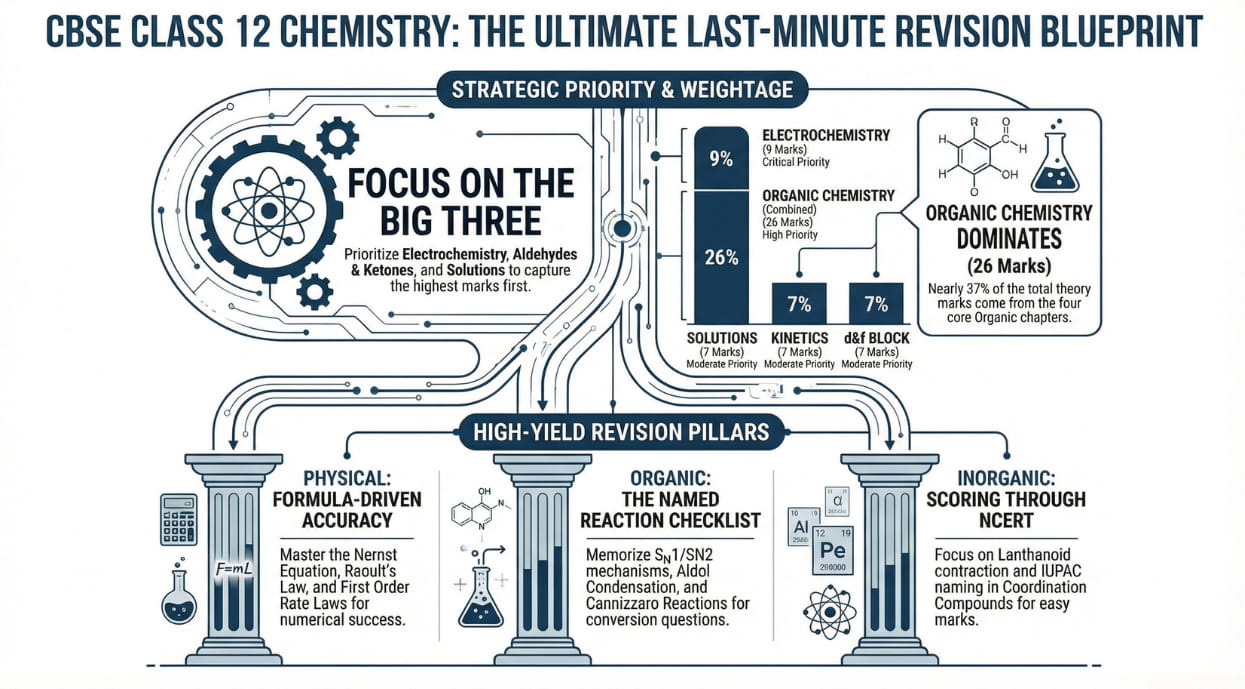
- Chapter-wise important formulas
- Organic named reactions list
- Physical chemistry numericals focus
- Inorganic NCERT-based revision points
- Unit-wise weightage for smart prioritisation
- 24-hour and 3-hour emergency revision plans
Quick formulas, key concepts and shortcuts
Open the Class 12 Chemistry formula sheet Get all exam preparation and revision tools in one placeStudy slides, revision notes, mock exams, flashcards, and much more.
Explore Now On Super TutorChapter-wise Breakdown of Class 12 Chemistry Notes
 Our chemistry cheat sheet class 12 follows the latest syllabus and covers all 10 core chapters. Click the links below to jump to specific sections:
- Solutions: Raoult’s Law, Colligative Properties, and Van’t Hoff Factor.
- Electrochemistry: Nernst Equation, Gibbs Energy, and Kohlrausch's Law.
- Chemical Kinetics: Rate Laws, Order of Reaction, and Arrhenius Equation.
- The d- and f-Block Elements: Transition elements, Lanthanoid Contraction.
- Coordination Compounds: IUPAC Naming, VBT, and Crystal Field Theory.
- Haloalkanes and Haloarenes: Nucleophilic Substitution ($S_N1$ & $S_N2$).
- Alcohols, Phenols and Ethers: Dehydration and Electrophilic Substitution.
- Aldehydes, Ketones and Carboxylic Acids: Nucleophilic Addition and Acidity trends.
- Amines: Basicity of Amines and Hoffmann Bromamide Degradation.
- Biomolecules: Structures of Carbohydrates, Proteins, and Nucleic Acids.
CBSE Class 12 Chemistry Unit-Wise Weightage
These are the unit marks from the 2025-26 curriculum. Check the 2026-27 curriculum on cbseacademic.nic.in for any change before you plan around them.

Understanding the marks distribution helps you prioritize your revision. Focus on high-weightage chapters like Electrochemistry and Aldehydes & Ketones first.
| Unit No. | Unit Name | Marks |
|---|---|---|
| I | Solutions | 7 |
| II | Electrochemistry | 9 |
| III | Chemical Kinetics | 7 |
| IV | d- and f-Block Elements | 7 |
| V | Coordination Compounds | 7 |
| VI | Organic Chemistry (Chapters 6-9 Combined) | 26 |
| X | Biomolecules | 7 |
| Total | 70 |
Our Courses
CBSE | ICSE | STATE BOARDS | JEE | NEET | GUJCET | BITSAT | SRMJEE | VITEEE | MET | & More | CBSE | ICSE | STATE BOARDS | JEE | NEET | GUJCET | BITSAT | SRMJEE | VITEEE | MET | & More |Priority Order for Last-Minute Revision
If time is limited, then follow this order:- Electrochemistry
- Aldehydes, Ketones & Carboxylic Acids
- Solutions
- Chemical Kinetics
- Coordination Compounds
- d- and f-Block
- Biomolecules
- Remaining Organic chapters
PHYSICAL CHEMISTRY – Formula Focus Section
Physical Chemistry is formula-driven. Therefore, revise formulas repeatedly. 1. Solutions (7 Marks) Important formulas:- Molarity = moles / volume (L)
- Molality = moles / kg solvent
- ΔTb = Kb × m
- ΔTf = Kf × m
- π = MRT
- van’t Hoff factor (i)
- E°cell = E°cathode − E°anode
- ΔG° = −nFE°
- E = E° − (0.0591/n) log Q
- Λm = κ × 1000 / C
- Nernst equation numericals
- Relation between K and E°
- Kohlrausch’s Law
Because of high weightage, this section is critical in your chemistry cheat sheet class 12 revision.
3. Chemical Kinetics (7 Marks) Key formulas:- k = 2.303/t log (A₀/A)
- t½ (First order) = 0.693/k
- Units of rate constant
- Order vs molecularity
- Graph-based numericals
INORGANIC CHEMISTRY – NCERT Based Direct Questions
Inorganic is memory-based. However, it is scoring if revised properly. 4. d- and f-Block (7 Marks) Revise:- Variable oxidation states
- Colour due to d–d transition
- KMnO₄ reactions
- K₂Cr₂O₇ reactions
- Lanthanoid contraction
- IUPAC naming
- Oxidation number
- Magnetic moment: μ = √n(n+2)
- VBT (inner vs outer orbital)
- Geometrical isomerism
- Linkage isomerism
ORGANIC CHEMISTRY CHEAT SHEET CLASS 12 (26 Marks Total)
Since Organic carries the highest weightage, this organic chemistry cheat sheet section is extremely important.Students often search for:- organic chemistry cheat sheet pdf
- organic chemistry cheat sheet class 12
- named reactions list class 12
- SN1 vs SN2 mechanism
- Wurtz Reaction
- Finkelstein Reaction
- Swarts Reaction
- Lucas Test
- Kolbe’s Reaction
- Reimer–Tiemann Reaction
- Williamson Ether Synthesis
- Aldol Condensation
- Cannizzaro Reaction
- Clemmensen Reduction
- Wolff–Kishner Reduction
- Hell–Volhard–Zelinsky Reaction
- Gabriel Phthalimide Synthesis
- Carbylamine Test
- Hinsberg Test
- Diazonium salt reactions
- Glucose structure
- Proteins
- Vitamins
- DNA basics
24-Hour Revision Strategy (Before Exam)
 Morning → Revise Physical Chemistry formulasAfternoon → Revise Organic Chemistry cheat sheetEvening → Coordination + d/f BlockNight → Read NCERT summary onceImportantly, sleep at least 6 hours.
3-Hour Emergency Revision Plan
Hour 1 → Electrochemistry + SolutionsHour 2 → Organic Chemistry cheat sheet class 12Hour 3 → Coordination compoundsIf time is extremely limited, then this structure saves maximum marks.
Structured. Simplified. Scoring-focused.
Your quick revision guide is ready.
Open the Class 12 Chemistry formula sheet
Stuck on a question?
Preparing for boards or entrance exams? Need quick revision notes anytime? Try Super Tutor for FREE
Why This Chemistry Cheat Sheet Class 12 Is Effective
Because:- It covers the complete 70-mark syllabus
- It follows official weightage
- It prioritizes high-scoring chapters
- It includes an organic chemistry cheat sheet
- It gives emergency revision plans
FAQs
Yes. The Class 12 Chemistry formula sheet on Super Tutor Resources is free to open, and the Super Tutor app has chapter-wise cheat sheets, revision notes and flashcards.
Super Tutor puts chapter-wise cheat sheets, revision notes, flashcards, practice quizzes and an AI doubt solver in one app, so your last-minute revision stays in one place.
For Class 12 boards, 2–3 focused hours daily for Chemistry is enough if you revise smartly. Instead of rereading full chapters, use a Chemistry Cheat Sheet Class 12 to revise formulas, mechanisms, and key reactions quickly. Super Tutor’s flashcards and quick revision notes help you cover more in less time.
You should revise every chapter at least 3 times before the boards.
1st revision → Concept clarity
2nd revision → PYQs and numericals
3rd revision → Only cheat sheet + important reactions
Super Tutor makes this easier with ready-made revision summaries and mock tests aligned to the CBSE Class 12 syllabus.
During the final revision, prioritize based on weightage. Organic Chemistry carries the highest marks, followed by Electrochemistry and Coordination Compounds. A structured Chemistry Cheat Sheet Class 12 helps you revise high-scoring chapters first. Start with the high-weightage chapters and work down the list.
Yes, for the final 24 hours, you should avoid new learning and revise only formulas, named reactions, NCERT points, and important conversions. A well-structured Chemistry Cheat Sheet Class 12 from Super Tutor is designed exactly for this purpose, helping you revise faster without confusion.
Super Tutor combines cheat sheets, flashcards, PYQs, mock tests, AI doubt solving, and syllabus-based revision plans in one place. This ensures your Chemistry Cheat Sheet Class 12 revision is focused, exam-oriented, and aligned with the latest CBSE marking pattern.