The Midnight Visitor
Bihar Board · Class 10 · English
NCERT Solutions for The Midnight Visitor — Bihar Board Class 10 English.
Interactive on Super Tutor
Studying The Midnight Visitor? Get the full interactive chapter.
Quizzes, flashcards, AI doubt-solver and a step-by-step study plan — built for ncert solutions and more.
1,000+ Class 10 students started this chapter today
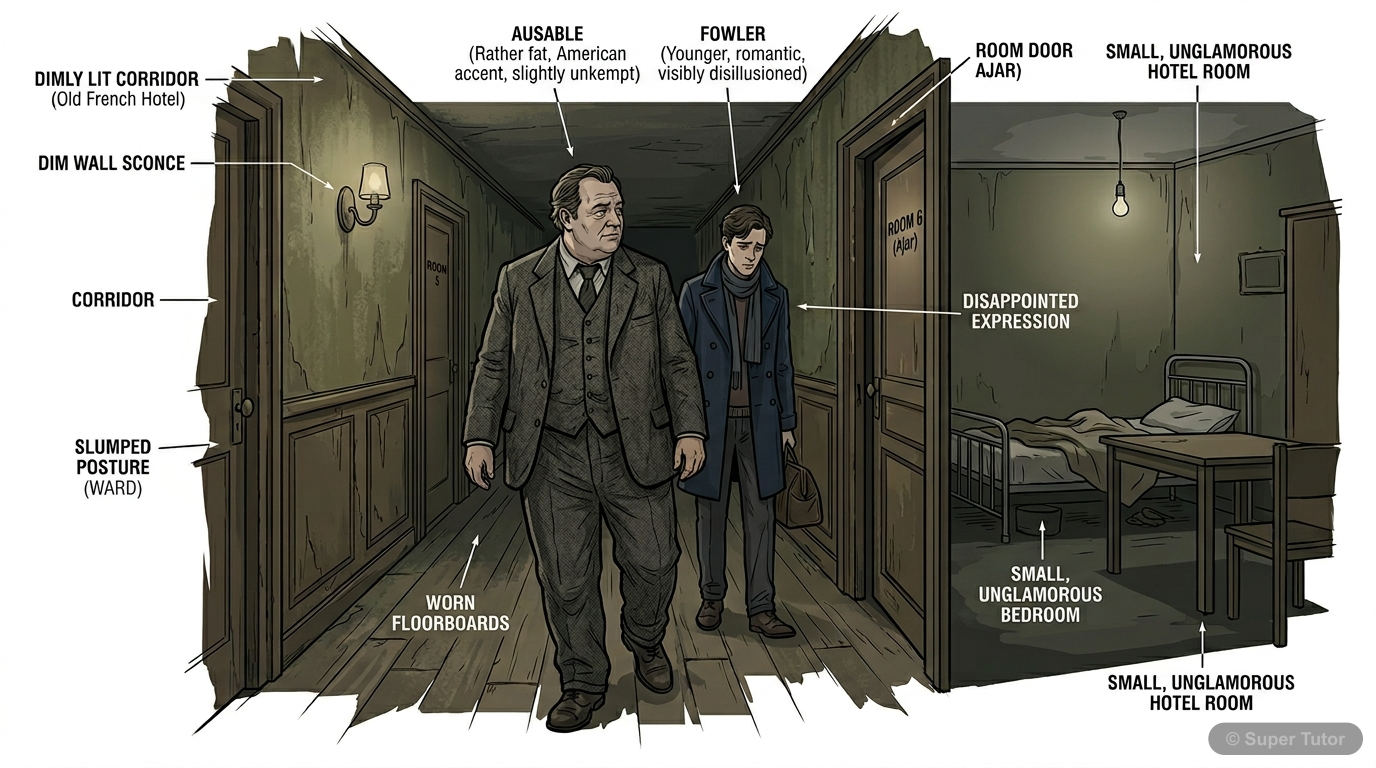
Super Tutor has 5+ illustrations like this for The Midnight Visitor alone — flashcards, concept maps, and step-by-step visuals.
See them allThink about it
1"Ausable did not fit any description of a secret agent Fowler had ever read." What do secret agents in books and films look like, in your opinion? Discuss in groups or in class some stories or movies featuring spies, detectives and secret agents, and compare their appearance with that of Ausable in this story.Show solution
The question asks us to compare the conventional image of a secret agent (from books and films) with Ausable's appearance in the story.
Concept:
This is a discussion-based question requiring personal opinion and textual reference.
Answer:
In books and films, secret agents are typically portrayed as:
- Tall, lean, and handsome with sharp, alert eyes.
- Impeccably dressed — often in suits or stylish clothing.
- Mysterious, cool, and calm under pressure.
- Physically fit, agile, and skilled in combat.
- Carrying sophisticated gadgets and weapons.
Famous examples include James Bond — suave, well-dressed, and dashing. Sherlock Holmes is lean and sharp-featured with a piercing gaze. Hercule Poirot is neat and precise in appearance. Miss Marple, though ordinary-looking, is sharp-minded.
Ausable, in contrast:
- Is a very fat man, short of breath.
- Has a large, sloppy body.
- Speaks with a mixture of American and French accents.
- Lives in a rather ordinary, small room in a French hotel.
- Looks completely prosaic and unimpressive — nothing like the glamorous spies of fiction.
Conclusion: Ausable shatters the stereotype of a secret agent. He is the complete opposite of the dashing, glamorous spy of popular fiction. Yet, as the story shows, his greatest weapon is his sharp, quick-thinking mind — proving that real intelligence lies in the brain, not in appearance.
2How does Ausable manage to make Max believe that there is a balcony attached to his room? Look back at his detailed description of it. What makes it a convincing story?Show solution
Ausable convinces Max — and even Fowler — that there is a balcony outside the window of his hotel room, though no such balcony actually exists.
Concept:
This question tests our understanding of how Ausable uses quick thinking and a detailed, believable narrative to create a convincing lie.
Answer:
Ausable makes his story convincing through the following details:
1. Historical explanation: He tells Max that the balcony belongs to the next apartment and that his room was once part of a larger unit. This gives the story a logical, historical background that is difficult to immediately disprove.
2. Personal grievance: He says he has complained about the balcony to the management because someone had entered his room through it before. This personal detail makes the story sound genuine and lived-in.
3. Casual, irritated tone: Ausable does not sound like he is making up a story. He speaks in an annoyed, matter-of-fact way — as if the balcony is a real nuisance to him. This natural tone adds to the believability.
4. Consistency: He does not contradict himself. The story is told smoothly and without hesitation.
5. Max's own fear: Max is already nervous and on guard. When the knock at the door comes (the waiter), Max panics and believes it could be the police. In his frightened state, he steps back toward the window — and falls, believing the balcony is there.
Conclusion: The story is convincing because it is detailed, logically structured, delivered calmly, and takes advantage of Max's own fear and the unexpected knock at the door. Ausable's presence of mind turns a simple lie into a fatal trap for Max.
3Looking back at the story, when do you think Ausable thought up his plan for getting rid of Max? Do you think he had worked out his plan in detail right from the beginning? Or did he make up a plan taking advantage of events as they happened?Show solution
Ausable is confronted by Max, an armed spy, in his hotel room. By the end of the story, Max falls to his death (or at least falls from the window) believing there is a balcony below.
Concept:
This question asks us to analyse Ausable's thinking process — whether his plan was pre-meditated or improvised.
Answer:
It is most likely that Ausable made up his plan on the spot, taking advantage of events as they happened. Here is the reasoning:
1. The balcony story was improvised: When Max appeared, Ausable immediately invented the story of the balcony. There was no way he could have planned this in advance, since he could not have known Max would be in his room.
2. The knock at the door was unplanned: The waiter's knock was a coincidence — it was simply the waiter delivering drinks that Ausable had ordered earlier. Ausable cleverly used this unexpected event by telling Max it was probably the police, increasing Max's panic.
3. Ausable's calm demeanour: Throughout the encounter, Ausable remains calm and unhurried. This suggests he is a man of great mental agility who can think clearly under pressure and use whatever is available to him.
However, one could also argue that a seasoned secret agent like Ausable is always mentally prepared. His habit of observing his surroundings (he knew there was no balcony, but could pretend there was one) shows a trained, alert mind.
Conclusion: Ausable did not have a detailed plan from the beginning. He improvised brilliantly, using the layout of the room, his knowledge of Max's nervous state, and the accidental knock at the door to construct a plan on the spot. This is the hallmark of true presence of mind.
Talk about it
1In this story, Ausable shows great 'presence of mind,' or the ability to think quickly, and act calmly and wisely, in a situation of danger and surprise. Give examples from your own experience, or narrate a story, which shows someone's presence of mind.Show solution
This is a discussion and expression-based question. Students are expected to narrate a real or imagined incident that demonstrates presence of mind.
Sample Answer / Model Narration:
Definition: Presence of mind means the ability to remain calm and think clearly in a sudden, dangerous, or unexpected situation, and to act wisely and quickly.
Example from experience (model answer):
Once, during a school picnic, a classmate suddenly began to choke on a piece of food. Everyone around panicked and did not know what to do. However, our Physical Education teacher remained completely calm. He quickly performed the Heimlich manoeuvre — standing behind the student, wrapping his arms around him, and giving sharp upward thrusts to the abdomen. Within seconds, the piece of food was dislodged and the student could breathe again.
Had the teacher panicked like the rest of us, the situation could have turned very serious. His presence of mind — born out of training and mental preparedness — saved the day.
Lesson: Presence of mind is not a gift that only a few people have. It can be developed through knowledge, training, and the habit of staying calm. As the story of Ausable shows, a calm mind is the most powerful weapon one can have.
2Discuss what you would do in the situations described below. Remember that presence of mind comes out of a state of mental preparedness.
- A small fire starts in your kitchen.
- A child starts to choke on a piece of food.
- An electrical appliance starts to hiss and gives out sparks.
- A bicycle knocks down a pedestrian.
- It rains continuously for more than twenty-four hours.
- A member of your family does not return home at the usual or expected time.Show solution
This is a discussion-based activity. The aim is to think about emergency responses in advance so that one is mentally prepared. Below are suggested responses for each situation.
---
(i) A small fire starts in your kitchen:
- Do not panic.
- If the fire is small (e.g., on a gas stove), turn off the gas supply immediately.
- Smother the fire with a lid, a wet cloth, or a fire extinguisher. Never use water on a grease fire.
- If the fire spreads, evacuate everyone from the house and call the fire brigade (dial 101 in India).
- Do not open windows, as oxygen feeds the fire.
---
(ii) A child starts to choke on a piece of food:
- Stay calm and act quickly.
- Encourage the child to cough forcefully — this may dislodge the object.
- If coughing does not help, perform back blows: bend the child forward and give up to 5 firm blows between the shoulder blades with the heel of your hand.
- If that fails, perform the Heimlich manoeuvre (abdominal thrusts).
- Call emergency services (dial 112) if the child loses consciousness.
---
(iii) An electrical appliance starts to hiss and gives out sparks:
- Do not touch the appliance with bare hands.
- Immediately switch off the main power supply / circuit breaker.
- Unplug the appliance using a dry cloth or rubber gloves if safe to do so.
- Keep others away from the area.
- Call an electrician before using the appliance again.
---
(iv) A bicycle knocks down a pedestrian:
- Stop immediately and check on the injured person.
- Do not move the person if a spinal or neck injury is suspected.
- Call an ambulance (dial 108 in India) or arrange for immediate medical help.
- Keep the person warm and calm; control any bleeding with a clean cloth.
- Note down the details of the incident if needed for a police report.
---
(v) It rains continuously for more than twenty-four hours:
- Monitor weather updates and flood warnings from official sources.
- Move to higher ground or upper floors if flooding is likely.
- Store drinking water, food, medicines, and important documents in waterproof bags.
- Avoid walking or driving through flooded areas.
- Contact local disaster management authorities if evacuation is needed.
---
(vi) A member of your family does not return home at the usual or expected time:
- First, try to contact them on their mobile phone.
- Contact their workplace, school, or the place they were visiting.
- Ask neighbours or friends if they have any information.
- If there is no response for a significant period, contact the local police station and file a missing person report.
- Stay calm and keep communication lines open.
---
Conclusion: All these situations require mental preparedness. If we have thought about these scenarios in advance and know the basic steps to follow, we are far less likely to panic and far more likely to act effectively — just as Ausable did in the story.
Stuck on a step?
Ask Super Tutor AI to explain any solution on this page in a simpler way — free, 24x7.
Ask a Doubt FreeFrequently Asked Questions
What are the important topics in The Midnight Visitor for Bihar Board Class 10 English?
How to score full marks in The Midnight Visitor — Bihar Board Class 10 English?
Where can I get free NCERT Solutions for The Midnight Visitor Class 10 English?
Sources & Official References
Content is aligned to the official syllabus. Refer to the board website for the latest curriculum.
More resources for The Midnight Visitor
Important Questions
Practice with board exam-style questions
Syllabus
What topics to cover
Revision Notes
Key points for last-minute revision
Study Plan
Step-by-step plan to ace this chapter
Flashcards
Quick-fire cards for active recall
Formula Sheet
All formulas in one place
Chapter Summary
Understand the chapter at a glance
Practice Quiz
Test yourself with a quick quiz
Concept Maps
See how topics connect visually
For serious students
Get the full The Midnight Visitor chapter — for free.
Quizzes, flashcards, AI doubt-solver and a step-by-step study plan for Bihar Board Class 10 English.