In the Kingdom of Fools
CBSE · Class 9 · English
NCERT Solutions for In the Kingdom of Fools — CBSE Class 9 English.
Interactive on Super Tutor
Studying In the Kingdom of Fools? Get the full interactive chapter.
Quizzes, flashcards, AI doubt-solver and a step-by-step study plan — built for ncert solutions and more.
1,000+ Class 9 students started this chapter today
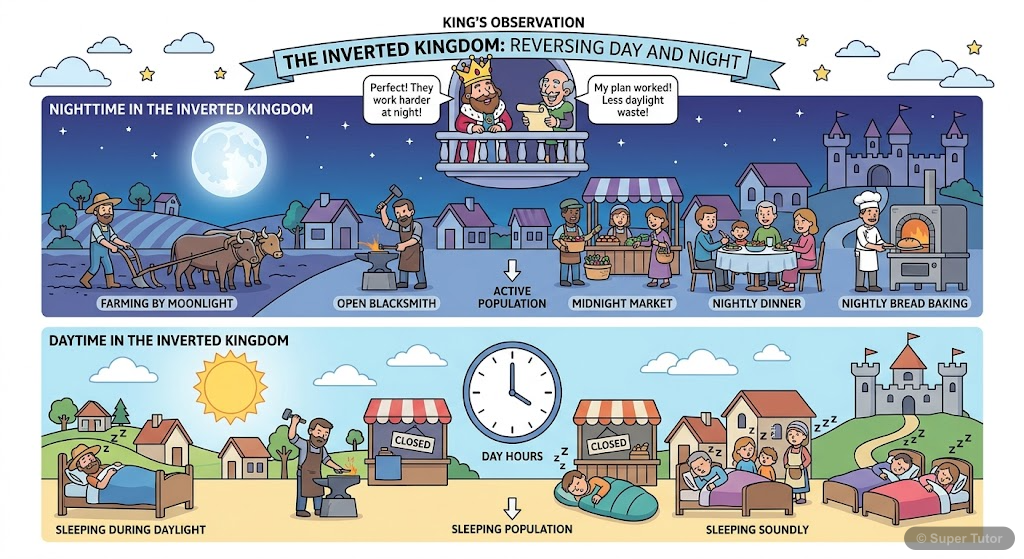
This is just one of 11+ visuals inside Super Tutor's In the Kingdom of Fools chapter
Explore the full setTHINK ABOUT IT
1What are the two strange things the guru and his disciple find in the Kingdom of Fools?Show solution
Answer:
The two strange things they find in the Kingdom of Fools are:
1. Everything is done at night, not during the day. The king had ordered that everyone must work only at night and sleep during the day. Anyone who disobeyed would be punished with death.
2. Everything costs the same — one duddu (a small coin). Whether one buys a small bunch of bananas or a large sack of rice, the price is the same — one duddu. This means that cheap and expensive goods are all sold at the same price.
These two things are completely contrary to normal, sensible practice, which is why the kingdom is called the Kingdom of Fools.
2Why does the disciple decide to stay in the Kingdom of Fools? Is it a good idea?Show solution
Reason for staying:
The disciple decides to stay because he finds the kingdom very attractive from a material point of view. Since everything costs only one duddu, he can eat as much as he wants — cheap food in large quantities. He is particularly tempted by the abundance of food available at very low prices.
Was it a good idea?
No, it was not a good idea. The guru wisely warns the disciple that it is a kingdom of fools and that both the king and his ministers are foolish. He cautions that one can never tell what they will do next, making it a dangerous place to live. The disciple ignores this wise advice and stays back, which eventually leads him into serious trouble — he is arrested and sentenced to death for a crime he did not commit. This proves that the guru's warning was absolutely correct and the disciple's decision to stay was unwise.
3Name all the people who are tried in the king's court, and give the reasons for their trial.Show solution
The following people are tried in the king's court, one after another:
| Person Tried | Reason for Trial |
|---|---|
| The merchant | His wall was weak and it fell on the thief, killing him. |
| The bricklayer | He had built the weak wall that collapsed. |
| The dancing girl | She had walked up and down the street distracting the bricklayer with her jingling anklets, causing him to build a weak wall. |
| The goldsmith | He had made the dancing girl walk up and down repeatedly by not delivering her jewellery on time, thus causing the distraction. |
| The disciple's (a man's) father | The goldsmith claimed that the father of the disciple (a merchant who had since died) had once kept him waiting, which caused the delay. The disciple, who had inherited his father's house, was therefore held responsible. |
Thus, the disciple (the guru's student) is ultimately tried and sentenced to death, even though he was entirely innocent of the original crime.
4Who is the real culprit according to the king? Why does he escape punishment?Show solution
The real culprit according to the king:
According to the king, the original thief is the real culprit, because he was the one who had come to rob the merchant's house and was killed when the wall fell on him.
Why does he escape punishment?
The thief escapes punishment because he is already dead — he was killed when the merchant's wall collapsed on him. Since he cannot be executed again, the king looks for someone else to put to death. The king then decides that anyone who fits the stake (i.e., is the right size to be impaled on it) must be executed. The disciple, being a well-fed, plump young man, fits the stake perfectly, and so he is sentenced to death in place of the real culprit.
5What are the Guru's words of wisdom? When does the disciple remember them?Show solution
The Guru's words of wisdom:
The guru had warned the disciple: *"This is a kingdom of fools. Don't stay here. They will do foolish things and you can never tell what they will do to you."* He advised the disciple to leave the place immediately because the king and his ministers were all fools and their actions were unpredictable and dangerous.
When does the disciple remember them?
The disciple remembers the guru's words of wisdom when he is arrested and sentenced to death. He is taken to be executed for a crime he had no part in — simply because he happened to fit the stake meant for execution. It is at this desperate moment, facing death, that he recalls his guru's wise warning and desperately calls out to his guru to save him. This shows that the guru's advice was completely correct and the disciple should have heeded it from the very beginning.
6How does the guru manage to save his disciple's life?Show solution
How the guru saves the disciple:
The guru, being a man of great wisdom, uses his knowledge of the foolishness of the king to devise a clever plan. He arrives at the scene and whispers a secret to his disciple. He tells him that whoever dies on the stake at that auspicious moment will be reborn as the king in the next life, and the second person to die will be reborn as the king's chief minister.
The disciple, now understanding the plan, loudly declares that he wants to die first so that he can become the king in the next life. The guru also claims he wants to die first for the same reason.
When the foolish king hears this, he becomes greedy and does not want anyone else to become king — even in the next life. He secretly consults his minister, and both of them decide that they themselves should be the ones to die on the stake so that they can return as king and minister in the next life.
The king and minister disguise themselves, send the disciple and the guru away, and take their places on the stake, thus dying in their place.
In this way, the guru uses the king's own foolishness and greed against him, and cleverly saves his disciple's life without any violence or confrontation.
TALK ABOUT IT
1In Shakespeare's plays the fool is not really foolish. If you have read or seen Shakespeare's plays such as King Lear, As You Like It, Twelfth Night, you may talk about the role of the fool. Do you know any stories in your language about wise fools, such as Tenali Rama or Gopal Bhar?Show solution
The Fool in Shakespeare's Plays:
In Shakespeare's plays, the 'fool' or jester is actually one of the wisest characters. For example:
- In *King Lear*, the Fool constantly speaks the truth to the king through jokes, riddles, and songs. He is the only one who dares to tell Lear that he has made a terrible mistake by dividing his kingdom. His 'foolishness' is actually deep wisdom.
- In *As You Like It*, Touchstone the fool makes witty and insightful observations about life, love, and society.
- In *Twelfth Night*, Feste the fool is more intelligent than most of the other characters and sees through their pretensions.
Thus, in Shakespeare, the fool represents wisdom disguised as foolishness.
Wise Fools in Indian Tradition:
- Tenali Rama was the court jester of King Krishnadevaraya of Vijayanagara. He used his wit and intelligence to solve complex problems, expose greedy priests, and help the poor — always through clever, humorous means.
- Gopal Bhar was the court jester of the Nawab of Bengal. Like Tenali Rama, he used humour and quick thinking to deliver justice and expose hypocrisy.
- Birbal, the minister of Emperor Akbar, is another example of a 'wise fool' whose clever answers and witty solutions are celebrated in countless folk tales.
Conclusion:
The theme of the 'wise fool' is universal. These characters teach us that true wisdom often comes in unexpected forms, and that humour and apparent simplicity can be powerful tools for speaking truth to power.
Stuck on a step?
Ask Super Tutor AI to explain any solution on this page in a simpler way — free, 24x7.
Ask a Doubt FreeFrequently Asked Questions
What are the important topics in In the Kingdom of Fools for CBSE Class 9 English?
How to score full marks in In the Kingdom of Fools — CBSE Class 9 English?
Where can I get free NCERT Solutions for In the Kingdom of Fools Class 9 English?
Sources & Official References
- NCERT Official — ncert.nic.in
- CBSE Academic — cbseacademic.nic.in
- CBSE Official — cbse.gov.in
- National Education Policy 2020 — education.gov.in
Content is aligned to the official syllabus. Refer to the board website for the latest curriculum.
More resources for In the Kingdom of Fools
Important Questions
Practice with board exam-style questions
Syllabus
What topics to cover
Revision Notes
Key points for last-minute revision
Study Plan
Step-by-step plan to ace this chapter
Flashcards
Quick-fire cards for active recall
Formula Sheet
All formulas in one place
Chapter Summary
Understand the chapter at a glance
Practice Quiz
Test yourself with a quick quiz
Concept Maps
See how topics connect visually
For serious students
Get the full In the Kingdom of Fools chapter — for free.
Quizzes, flashcards, AI doubt-solver and a step-by-step study plan for CBSE Class 9 English.