Linear Equations in two Variables
CBSE · Class 9 · Mathematics
NCERT Solutions for Linear Equations in two Variables — CBSE Class 9 Mathematics.
Interactive on Super Tutor
Studying Linear Equations in two Variables? Get the full interactive chapter.
Quizzes, flashcards, AI doubt-solver and a step-by-step study plan — built for ncert solutions and more.
1,000+ Class 9 students started this chapter today
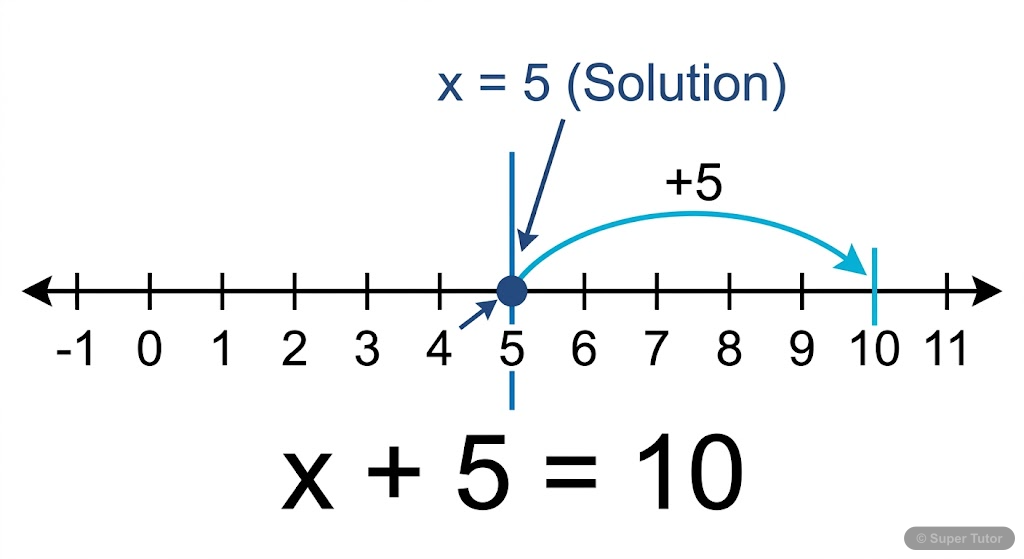
This is just one of 5+ visuals inside Super Tutor's Linear Equations in two Variables chapter
Explore the full setExercise 4.1
1The cost of a notebook is twice the cost of a pen. Write a linear equation in two variables to represent this statement. (Take the cost of a notebook to be ₹x and that of a pen to be ₹y).Show solution
Statement: The cost of a notebook is twice the cost of a pen.
Forming the equation:
This can be written in standard form as:
or equivalently .
Answer: The required linear equation in two variables is (or ).
2Express the following linear equations in the form and indicate the values of , and in each case:
(i)
(ii)
(iii)
(iv)
(v)
(vi)
(vii)
(viii) Show solution
(i)
Rewriting:
Here, .
---
(ii)
This is already in the required form:
Here, .
---
(iii)
Rewriting:
Here, .
---
(iv)
Rewriting: , i.e.,
Here, .
---
(v)
Rewriting: , i.e.,
Here, .
---
(vi)
Rewriting:
Here, .
---
(vii)
Rewriting:
Here, .
---
(viii)
Rewriting: , i.e.,
Here, .
Exercise 4.2
1Which one of the following options is true, and why? has
(i) a unique solution,
(ii) only two solutions,
(iii) infinitely many solutionsShow solution
Reason: The equation is a linear equation in two variables and . For every real value we assign to , we get a corresponding real value of . Since there are infinitely many real numbers to substitute for , the equation has infinitely many solutions.
For example:
- → solution
- → solution
- → solution
Thus, a linear equation in two variables always has infinitely many solutions.
2Write four solutions for each of the following equations:
(i)
(ii)
(iii) Show solution
| | | Solution |
|-----|--------------|----------|
| | | |
| | | |
| | | |
| | | |
Four solutions: .
---
(ii) , so .
| | | Solution |
|-----|-----------------|----------|
| | | |
| | | |
| | | |
| | | |
Four solutions: .
---
(iii) , so (choose values of ).
| | | Solution |
|-----|----------|----------|
| | | |
| | | |
| | | |
| | | |
Four solutions: .
3Check which of the following are solutions of the equation and which are not:
(i)
(ii)
(iii)
(iv)
(v) Show solution
---
(i) :
is not a solution.
---
(ii) :
is not a solution.
---
(iii) :
is a solution.
---
(iv) :
is not a solution.
---
(v) :
is not a solution.
4Find the value of , if is a solution of the equation .Show solution
Concept: If is a solution, then substituting and must satisfy the equation.
Substituting:
Answer: The value of is .
Stuck on a step?
Ask Super Tutor AI to explain any solution on this page in a simpler way — free, 24x7.
Ask a Doubt FreeFrequently Asked Questions
What are the important topics in Linear Equations in two Variables for CBSE Class 9 Mathematics?
How to score full marks in Linear Equations in two Variables — CBSE Class 9 Mathematics?
Where can I get free NCERT Solutions for Linear Equations in two Variables Class 9 Mathematics?
Sources & Official References
- NCERT Official — ncert.nic.in
- CBSE Academic — cbseacademic.nic.in
- CBSE Official — cbse.gov.in
- National Education Policy 2020 — education.gov.in
Content is aligned to the official syllabus. Refer to the board website for the latest curriculum.
More resources for Linear Equations in two Variables
Important Questions
Practice with board exam-style questions
Syllabus
What topics to cover
Revision Notes
Key points for last-minute revision
Study Plan
Step-by-step plan to ace this chapter
Flashcards
Quick-fire cards for active recall
Formula Sheet
All formulas in one place
Chapter Summary
Understand the chapter at a glance
Practice Quiz
Test yourself with a quick quiz
Concept Maps
See how topics connect visually
For serious students
Get the full Linear Equations in two Variables chapter — for free.
Quizzes, flashcards, AI doubt-solver and a step-by-step study plan for CBSE Class 9 Mathematics.