Atoms and Molecules
CBSE · Class 9 · Science
Most important questions from Atoms and Molecules for CBSE Class 9 Science board exam 2026. MCQs, short answer, and long answer questions with marks.
Interactive on Super Tutor
Studying Atoms and Molecules? Get the full interactive chapter.
Quizzes, flashcards, AI doubt-solver and a step-by-step study plan — built for important questions and more.
1,000+ Class 9 students started this chapter today
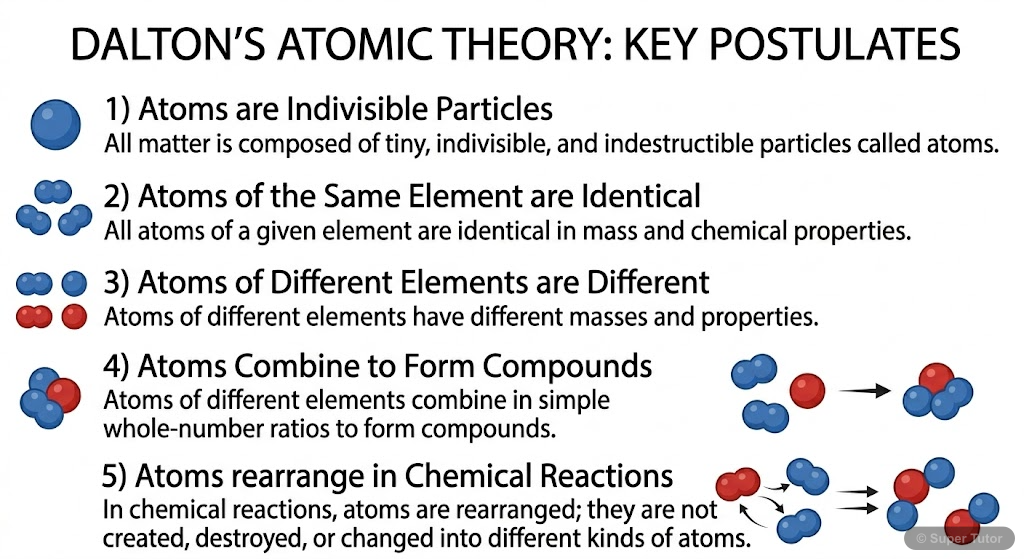
This is just one of 12+ visuals inside Super Tutor's Atoms and Molecules chapter
Explore the full setSample Questions
Which of the following are postulates of Dalton's Atomic Theory?
Show answer
All matter is made of tiny particles called atoms, Atoms are indivisible and cannot be created or destroyed, Atoms of the same element are identical in mass, Atoms combine in simple whole number ratios
Dalton's atomic theory has several postulates including that all matter is made of atoms, atoms are indivisible, atoms of the same element are identical, and they combine in simple ratios. However, most atoms cannot exist independently in nature.
Which of the following molecules are diatomic?
Show answer
Oxygen (O₂), Hydrogen (H₂), Nitrogen (N₂)
Diatomic molecules contain exactly two atoms. O₂, H₂, and N₂ are diatomic. Argon is monoatomic (single atom) and ozone is triatomic (three atoms).
What is the atomicity of phosphorus (P₄)?
Show answer
4
Atomicity is the number of atoms in a molecule. Phosphorus exists as P₄ molecules, so its atomicity is 4. This is also called tetra-atomic.
In water (H₂O), the ratio of hydrogen to oxygen by mass is:
Show answer
1:8
In water, the mass ratio of hydrogen to oxygen is always 1:8. This demonstrates the Law of Constant Proportions - elements in a compound are always present in definite proportions by mass.
+25 more questions available
Practice AllFrequently Asked Questions
What are the important topics in Atoms and Molecules for CBSE Class 9 Science?
How to score full marks in Atoms and Molecules — CBSE Class 9 Science?
How many important questions are there in Atoms and Molecules?
Sources & Official References
- NCERT Official — ncert.nic.in
- CBSE Academic — cbseacademic.nic.in
- CBSE Official — cbse.gov.in
- National Education Policy 2020 — education.gov.in
Content is aligned to the official syllabus. Refer to the board website for the latest curriculum.
More resources for Atoms and Molecules
Syllabus
What topics to cover
Revision Notes
Key points for last-minute revision
Study Plan
Step-by-step plan to ace this chapter
Flashcards
Quick-fire cards for active recall
Formula Sheet
All formulas in one place
Chapter Summary
Understand the chapter at a glance
Practice Quiz
Test yourself with a quick quiz
Concept Maps
See how topics connect visually
NCERT Solutions
Every textbook question solved step by step
For serious students
Get the full Atoms and Molecules chapter — for free.
Quizzes, flashcards, AI doubt-solver and a step-by-step study plan for CBSE Class 9 Science.