Power-sharing & Federalism
Haryana Board · Class 10 · Social Science
Flashcards for Power-sharing & Federalism — Haryana Board Class 10 Social Science. Quick Q&A cards covering key concepts, definitions, and formulas.
Interactive on Super Tutor
Studying Power-sharing & Federalism? Get the full interactive chapter.
Quizzes, flashcards, AI doubt-solver and a step-by-step study plan — built for flashcards and more.
1,000+ Class 10 students started this chapter today
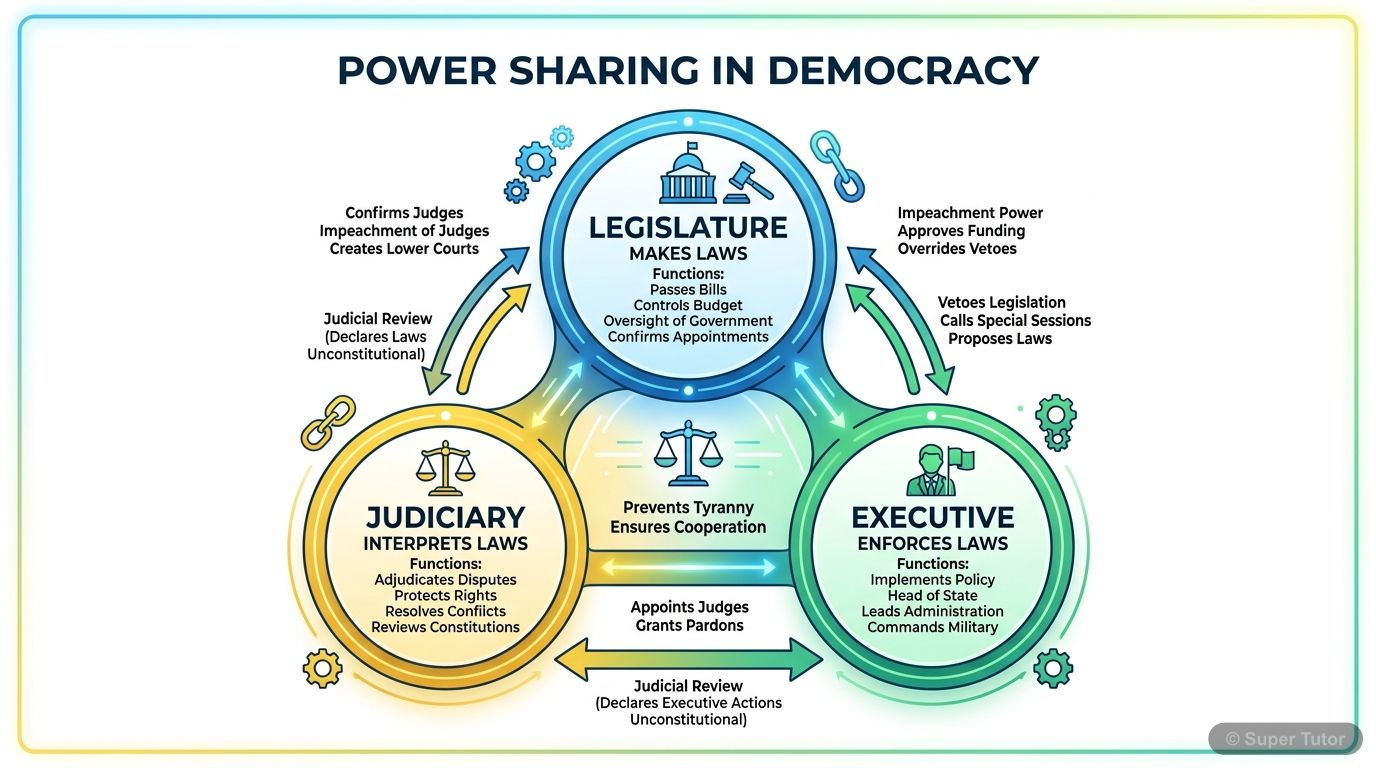
Learn better with visuals Super Tutor has hundreds of illustrations like this across every chapter — all free to try.
Get startedWhat is the ethnic composition of Belgium and why does it create challenges?
Answer
Belgium has 59% Dutch-speaking (Flemish), 40% French-speaking (Wallonia), and 1% German-speaking people. In Brussels, 80% speak French and 20% speak Dutch. This creates tension because the Dutch major…
How did Sri Lanka's majoritarian policies lead to civil war?
Answer
Sri Lanka (74% Sinhala, 18% Tamil) adopted majoritarian measures: 1956 Act made Sinhala the only official language, preferential policies for Sinhalas in jobs/education, constitution protected Buddhis…
Describe Belgium's innovative power-sharing arrangement.
Answer
Belgium's model includes: 1) Equal Dutch and French ministers in central government, 2) Many central powers given to state governments, 3) Brussels has separate government with equal representation, 4…
What is majoritarianism and why is it problematic?
Answer
Majoritarianism is the belief that the majority community should rule by disregarding minority wishes. It's problematic because it leads to alienation of minorities, social conflict, and can result in…
What are the two main reasons why power-sharing is desirable in democracy?
Answer
1) Prudential reasons: Reduces conflict between social groups, ensures political stability, prevents tyranny of majority. 2) Moral reasons: Power-sharing is the spirit of democracy - people have right…
Compare the outcomes in Belgium and Sri Lanka regarding power-sharing.
Answer
Belgium: Adopted accommodation, complex but successful power-sharing, avoided conflict, became EU headquarters. Sri Lanka: Followed majoritarianism, led to Tamil alienation, civil war, thousands kille…
What is horizontal division of power? Give examples.
Answer
Horizontal division means power shared among different organs at the same level - legislature, executive, judiciary. Each checks the others creating balance. Example: In India, ministers are responsib…
Explain vertical division of power with Indian examples.
Answer
Vertical division means power shared between higher and lower levels of government. In India: Central/Union Government (entire country), State Governments (provinces), and local governments (municipal…
+12 more flashcards available
Practice AllFrequently Asked Questions
What are the important topics in Power-sharing & Federalism for Haryana Board Class 10 Social Science?
How to score full marks in Power-sharing & Federalism — Haryana Board Class 10 Social Science?
How many flashcards are available for Power-sharing & Federalism?
Sources & Official References
Content is aligned to the official syllabus. Refer to the board website for the latest curriculum.
More resources for Power-sharing & Federalism
Important Questions
Practice with board exam-style questions
Syllabus
What topics to cover
Revision Notes
Key points for last-minute revision
Study Plan
Step-by-step plan to ace this chapter
Formula Sheet
All formulas in one place
Chapter Summary
Understand the chapter at a glance
Practice Quiz
Test yourself with a quick quiz
Concept Maps
See how topics connect visually
NCERT Solutions
Every textbook question solved step by step
For serious students
Get the full Power-sharing & Federalism chapter — for free.
Quizzes, flashcards, AI doubt-solver and a step-by-step study plan for Haryana Board Class 10 Social Science.