The Rattrap
Haryana Board · Class 12 · English
NCERT Solutions for The Rattrap — Haryana Board Class 12 English.
Interactive on Super Tutor
Studying The Rattrap? Get the full interactive chapter.
Quizzes, flashcards, AI doubt-solver and a step-by-step study plan — built for ncert solutions and more.
1,000+ Class 12 students started this chapter today
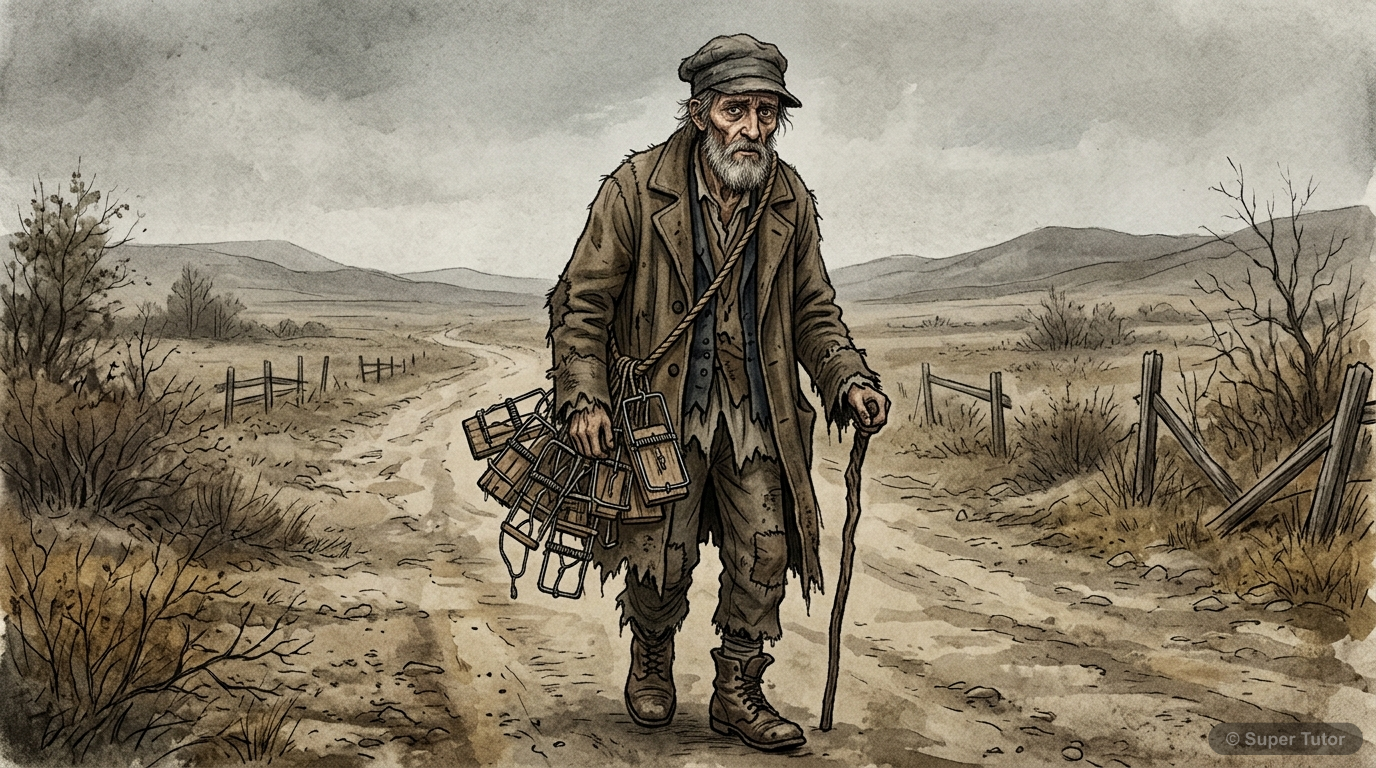
Learn better with visuals Super Tutor has hundreds of illustrations like this across every chapter — all free to try.
Get startedThink as you read (Pages 34–35)
1From where did the peddler get the idea of the world being a rattrap?Show solution
Answer: One day, as the peddler was plodding along the road, thinking of his rattraps, he was struck by the idea that the whole world was nothing but a big rattrap. He got this idea from his own trade — he sold rattraps made of wire. Just as a rattrap offers cheese and pork as bait to lure rats, the world too offers riches, joys, shelter, food, heat, and clothing as bait. As soon as anyone lets himself be tempted by these baits, the rattrap closes in on him and everything comes to an end. Thus, the very nature of his work — making and selling rattraps — gave him this philosophical idea.
2Why was he amused by this idea?Show solution
Answer: The peddler was amused by the idea of the world being a rattrap because it gave him a sense of satisfaction and even a kind of malicious pleasure. He thought of all the people he knew who were already caught in the rattrap — those who had let themselves be lured by riches, joys, and comforts. The idea that he, a poor and wretched peddler, could see through the deceptive nature of the world while others could not, gave him a feeling of superiority. This thought kept him company and amused him during his long, lonely walks.
3Did the peddler expect the kind of hospitality that he received from the crofter?Show solution
Answer: No, the peddler did not expect the kind of hospitality he received from the crofter. He was used to a hard and lonely life, often being turned away from doors. When he knocked at the crofter's door and asked for shelter, he was pleasantly surprised to be welcomed in. The crofter not only gave him shelter for the night but also offered him supper, tobacco to smoke, and played cards (mjolis) with him. This warm and generous hospitality was completely unexpected for the peddler.
4Why was the crofter so talkative and friendly with the peddler?Show solution
Answer: The crofter was so talkative and friendly with the peddler because he was very lonely. He lived all by himself in his small cottage and had no one to talk to. The peddler's arrival gave him a rare opportunity for company and conversation. He was so happy to have someone to talk to that he was extremely generous and hospitable. He shared his food, his tobacco, and even played cards with the peddler. His loneliness made him crave human company, which is why he was so warm and friendly.
5Why did he show the thirty kroner to the peddler?Show solution
Answer: The crofter showed the thirty kronor to the peddler because he wanted to be believed. He had told the peddler that he had recently sold the milk of his cow and received thirty kronor for it. However, he felt that the peddler might not believe him, so in order to prove that he was telling the truth and not boasting, he took out the leather pouch in which he kept the money and showed the three ten-kronor notes to the peddler. It was an act of innocent trust and a desire to be taken seriously.
6Did the peddler respect the confidence reposed in him by the crofter?Show solution
Answer: No, the peddler did not respect the confidence reposed in him by the crofter. The very next morning, after the crofter had gone to work, the peddler returned to the cottage. He smashed a windowpane, put his hand in, took hold of the leather pouch, and stole the thirty kronor. He then carefully hung the empty pouch back in its place and walked away with the money. This act of theft was a complete betrayal of the trust and hospitality the crofter had shown him. The peddler allowed himself to be tempted by the 'bait' — just like a rat caught in a rattrap.
Think as you read (Pages 37–38)
1What made the peddler think that he had indeed fallen into a rattrap?Show solution
Answer: After stealing the money, the peddler turned off the road and went into the forest to avoid being caught. However, he soon found himself hopelessly lost. The paths in the forest twisted back and forth, and no matter how much he walked, he could not find his way out. He kept going around in the same part of the forest. It was late December and darkness was descending. He was tired, cold, and desperate. At this point, he recalled his own philosophy about the world being a rattrap. He realised that the thirty kronor had been the bait, and just like a rat, he had been tempted by it and was now trapped — the forest had closed in on him like an impenetrable prison. This made him think that he had indeed fallen into a rattrap.
2Why did the ironmaster speak kindly to the peddler and invite him home?Show solution
Answer: The ironmaster spoke kindly to the peddler and invited him home because he mistook the peddler for an old regimental comrade named Captain von Stahle. The forge was dimly lit, and the ironmaster could not see the peddler's face clearly. The peddler was in a wretched condition — ragged and dirty — and the ironmaster assumed that his old friend had fallen on hard times. Out of sympathy and old friendship, he invited the peddler to come home with him to spend Christmas. He felt it was his duty to help an old comrade who was in such a miserable state.
3Why did the peddler decline the invitation?Show solution
Answer: The peddler declined the invitation because he was afraid. He knew that he was not the person the ironmaster thought he was — he was not Captain von Stahle. Moreover, he had just stolen thirty kronor from the crofter and was carrying the stolen money. He feared that if he went to the ironmaster's well-lit house, his true identity would be discovered and he would be handed over to the police. He felt it was safer to stay in the forge. He told the ironmaster that it would not be proper for him to go to the manor house, and politely refused the invitation.
Think as you read (Pages 41–42)
1What made the peddler accept Edla Willmansson's invitation?Show solution
Answer: The peddler accepted Edla Willmansson's invitation primarily because of her compassionate and sincere manner. Unlike her father, Edla did not mistake him for someone else — she could sense that he was afraid and that he was perhaps a thief or an escaped criminal. Yet she looked at him with genuine sympathy and compassion. Most importantly, she assured him that he would be free to leave whenever he wished, and that no harm would come to him. She said, 'You may be sure, Captain, that you will be allowed to leave us just as freely as you came.' This assurance of safety and her warm, non-judgmental attitude inspired confidence in the peddler, and he agreed to go with her.
2What doubts did Edla have about the peddler?Show solution
Answer: When Edla lifted the peddler's hat and looked at him, she immediately noticed that he was frightened. She was perceptive enough to realise that his fear was not ordinary. She thought to herself: 'Either he has stolen something or else he has escaped from jail.' She had serious doubts about his true identity and character. She suspected he was not the Captain von Stahle her father believed him to be, and that he might be a criminal of some kind. Despite these doubts, she chose to extend her hospitality to him, driven by compassion.
3When did the ironmaster realise his mistake?Show solution
Answer: The ironmaster realised his mistake the next morning when the peddler was cleaned up, given a bath, his hair was combed, and he was dressed in a good suit of clothes. In the clear light of day and in his clean, well-dressed state, the peddler looked nothing like Captain von Stahle. The ironmaster looked at him carefully and realised that the man was a complete stranger — not his old friend at all. He was shocked and embarrassed at his own error.
4What did the peddler say in his defence when it was clear that he was not the person the ironmaster had thought he was?Show solution
Answer: When the ironmaster confronted him and threatened to call the sheriff, the peddler calmly said in his own defence that he had never pretended to be anyone other than a poor peddler. He pointed out that he had not asked to come to the manor house — it was the ironmaster who had insisted on inviting him. He had even declined the invitation at first. He said that the whole situation was the ironmaster's own mistake, not his. He also said that since he had not actually taken anything from the ironmaster, he should simply be allowed to leave in peace, just as he had come. He offered to put on his own rags again and go away quietly.
5Why did Edla still entertain the peddler even after she knew the truth about him?Show solution
Answer: Edla still entertained the peddler even after knowing the truth because she was a compassionate and empathetic person. She had already noticed his fear and suspected he might be a thief or a fugitive, yet she had invited him with a genuine promise of safety and hospitality. She felt that it would be wrong to break that promise. She argued with her father that they had given the man their word that he could stay, and it would be cruel to turn him away on Christmas Eve. She also felt genuinely sorry for him — he was clearly a poor, lonely man who had nowhere to go. Her kindness was unconditional and not based on his social status or identity.
Think as you read (Page 42 — Final Section)
1Why was Edla happy to see the gift left by the peddler?Show solution
Answer: Edla was happy to see the gift left by the peddler for two reasons. First, she had been feeling sad and guilty at church after learning that a rattrap peddler had robbed one of the old crofters of the ironworks. She feared that the man she had sheltered was the same thief. Second, when she opened the package, she found a small rattrap containing the three ten-kronor notes — the very money that had been stolen from the crofter — along with a letter. This showed her that her kindness had not been wasted. The peddler had been moved by her goodness and had chosen to return the stolen money and redeem himself. The gift was proof that her compassion had succeeded in transforming a thief, which gave her great joy and satisfaction.
2Why did the peddler sign himself as Captain von Stahle?Show solution
Answer: The peddler signed himself as 'Captain von Stahle' as a mark of gratitude and as a symbol of his transformation. Throughout his stay at the manor, Edla had treated him with dignity and respect, addressing him as 'Captain' even though she knew he was not one. This respectful treatment had given him a sense of self-worth and had 'raised him to captain' — it had given him the moral strength to overcome his dishonest impulses. By signing as 'Captain von Stahle', he acknowledged that Edla's kindness had elevated him and given him the power to clear himself of wrongdoing. It was his way of honouring the identity she had bestowed upon him and of showing that her faith in him had not been misplaced.
Understanding the Text
1How does the peddler interpret the acts of kindness and hospitality shown by the crofter, the ironmaster and his daughter?Show solution
Answer: The peddler interprets the acts of kindness differently in each case:
The Crofter's hospitality: The crofter's warm welcome, food, tobacco, and card-playing are genuine acts of human kindness born out of loneliness. However, the peddler fails to honour this trust. He is tempted by the thirty kronor — the 'bait' — and steals the money, betraying the crofter's confidence. He interprets the crofter's openness as an opportunity for personal gain.
The Ironmaster's invitation: The ironmaster invites the peddler home out of a mistaken sense of old friendship and sympathy. The peddler is initially suspicious and declines, fearing exposure. He is aware that the ironmaster's kindness is based on a misidentification and is therefore not genuine in the truest sense. When the truth is revealed, the ironmaster turns hostile, confirming the peddler's distrust.
Edla's compassion: Edla's kindness is different — it is unconditional, perceptive, and genuine. She knows he may be a criminal yet treats him with dignity and compassion. This selfless goodness deeply moves the peddler. He interprets her kindness as a true act of human grace, and it transforms him. He returns the stolen money and redeems himself, signing his letter as 'Captain von Stahle' to honour the identity she gave him.
Thus, only Edla's kindness succeeds in bringing out the good in the peddler.
2What are the instances in the story that show that the character of the ironmaster is different from that of his daughter in many ways?Show solution
Answer: The following instances highlight the differences between the ironmaster and Edla:
1. Basis of invitation: The ironmaster invites the peddler home based on a mistaken identity — he thinks the peddler is his old regimental comrade. His kindness is conditional and based on self-interest (nostalgia for an old friend). Edla, on the other hand, invites the peddler knowing he is a stranger and possibly a criminal, purely out of compassion.
2. Reaction to the truth: When the ironmaster discovers the peddler is not Captain von Stahle, he immediately turns hostile and threatens to call the sheriff. Edla, however, insists that the peddler be allowed to stay, arguing that they had given their word and it would be wrong to break it.
3. Attitude at church: At church, the ironmaster is quick to believe the worst about the peddler when he hears about the robbery, and sarcastically remarks about the silver spoons. Edla is saddened and feels responsible.
4. Perception: The ironmaster is impulsive and superficial in his judgements. Edla is perceptive — she senses the peddler's fear from the very beginning and responds with empathy rather than suspicion.
In short, the ironmaster is impulsive, class-conscious, and self-serving, while Edla is compassionate, principled, and genuinely humane.
3The story has many instances of unexpected reactions from the characters to others' behaviour. Pick out instances of these surprises.Show solution
Answer: The following are key instances of unexpected reactions:
1. The crofter's generosity: It is unexpected that a poor, lonely crofter would so warmly welcome a ragged stranger, share his food and tobacco, play cards with him, and even show him his savings. This level of trust from a stranger is surprising.
2. The peddler's theft: After receiving such warm hospitality, the peddler's decision to steal the thirty kronor is a shocking betrayal. The reader does not expect him to repay kindness with theft.
3. The peddler's refusal of the ironmaster's invitation: When a rich ironmaster offers a poor peddler shelter and comfort, one would expect the peddler to accept eagerly. His refusal is unexpected.
4. Edla's insistence on keeping the peddler: After the truth about the peddler is revealed, the expected reaction would be to throw him out. Edla's insistence on honouring their promise and letting him stay is a pleasant surprise.
5. The ironmaster's change of heart: The ironmaster, who was ready to call the sheriff, is persuaded by his daughter to let the peddler stay — an unexpected softening.
6. The peddler's final act of redemption: The most surprising and touching moment is when the peddler, who had stolen the money, leaves it behind in a rattrap as a Christmas gift for Edla, along with a letter. This act of honesty and gratitude is completely unexpected from a thief.
4What made the peddler finally change his ways?Show solution
Answer: It was Edla Willmansson's unconditional kindness and compassion that finally made the peddler change his ways. Several factors contributed to this transformation:
1. Genuine compassion: Edla treated the peddler with dignity and respect, addressing him as 'Captain' even though she suspected he was a criminal. She looked at him with compassion rather than suspicion or contempt.
2. Unconditional trust: She assured him that he was free to leave whenever he wished, and that no harm would come to him. This promise was kept even after the truth was revealed.
3. A sense of belonging: For the first time, the peddler experienced warmth, good food, and human company without any ulterior motive on the part of his host. He was treated as a human being with dignity.
4. The Christmas spirit: The festive atmosphere and Edla's invitation to return next Christmas if he wished gave him a sense of hope and a place in the world.
All these factors together stirred the peddler's conscience. He realised that Edla's goodness had 'raised him to captain' and given him the moral strength to resist the rattrap of the world. He returned the stolen money and redeemed himself.
5How does the metaphor of the rattrap serve to highlight the human predicament?Show solution
Answer: The metaphor of the rattrap is the philosophical core of the story and serves to highlight the universal human predicament in the following ways:
1. The world as a trap: Just as a rattrap uses cheese or pork as bait to lure rats to their doom, the world uses riches, joys, shelter, food, and warmth as bait to lure human beings. Once a person is tempted by these material comforts, the trap closes and he is caught — he loses his freedom, his integrity, and ultimately his happiness.
2. Universal applicability: The metaphor applies not just to the poor peddler but to all human beings. The crofter is trapped by his pride in his thirty kronor; the ironmaster is trapped by his nostalgia and class pride; even the peddler himself is trapped by the temptation of the stolen money.
3. The peddler's own entrapment: The peddler, who invented the metaphor, ironically falls into the very trap he described. He steals the thirty kronor — the bait — and finds himself lost in the forest, trapped like a rat. This is a powerful illustration of how even those who are aware of life's traps can fall into them.
4. Hope of escape: The metaphor also suggests that escape is possible — through human goodness and compassion, as demonstrated by Edla. The final image of the rattrap containing the returned money is symbolic: the trap that once imprisoned the peddler now becomes the vehicle of his redemption.
Thus, the rattrap metaphor universalises the theme and gives the story its philosophical depth.
6The peddler comes out as a person with a subtle sense of humour. How does this serve in lightening the seriousness of the theme of the story and also endear him to us?Show solution
Answer: Despite the serious philosophical theme of the story, the peddler's subtle sense of humour lightens the narrative and makes him a more endearing character:
1. The rattrap philosophy itself: The peddler's idea of the world as a rattrap, while deeply philosophical, also has a wry, ironic quality. He takes a kind of malicious pleasure in thinking of all the people caught in the world's trap — this dark humour reveals a sharp, observant mind beneath his ragged exterior.
2. Irony of his own situation: When the peddler himself falls into the 'rattrap' by stealing the money and getting lost in the forest, the reader sees the irony — the man who invented the metaphor becomes its victim. This self-aware irony is a form of humour.
3. The letter to Edla: The peddler's farewell letter is written with a gentle, self-deprecating humour. He refers to himself as 'a rat who would have been caught in this world's rattrap' and signs himself grandly as 'Captain von Stahle'. The contrast between his humble reality and the grand signature is quietly amusing.
4. Endearing quality: His humour shows that despite his poverty and dishonesty, the peddler is an intelligent, self-aware, and sensitive human being. It makes the reader sympathise with him and root for his redemption.
Thus, the peddler's humour serves as a counterbalance to the story's serious themes, making it both entertaining and thought-provoking.
Talking about the Text
1The reader's sympathy is with the peddler right from the beginning of the story. Why is this so? Is the sympathy justified?Show solution
Why the reader sympathises with the peddler from the beginning:
The reader's sympathy is engaged from the very first description of the peddler. He is portrayed as a man who has fallen on extremely hard times — he is poor, homeless, and leads a wretched existence. He makes rattraps from wire and sells them, but earns barely enough to survive. He is forced to beg and steal just to keep himself alive. He has no family, no friends, and no fixed abode. He is often turned away from doors and must sleep in the open or in barns. His loneliness and misery are vividly described, and the reader naturally feels compassion for him.
Furthermore, the peddler is shown to be an intelligent and philosophical man. His idea of the world as a rattrap shows a sharp, observant mind. This intellectual quality makes him more than just a stereotypical criminal — he is a complex human being who has been reduced to theft by circumstances.
Is the sympathy justified?
Yes, the sympathy is largely justified. While the peddler does steal from the crofter — which is morally wrong — his theft is born of desperation rather than malice. He is a victim of poverty and social neglect. Moreover, his ultimate act of returning the money and writing the letter to Edla shows that he has a conscience and a capacity for goodness. He is not irredeemably bad — he is a human being who, when treated with dignity and compassion, responds with honesty and gratitude. The story suggests that people are not inherently evil; circumstances and the lack of human warmth can drive them to wrongdoing.
2The story also focuses on human loneliness and the need to bond with others.Show solution
The theme of human loneliness runs throughout 'The Rattrap' and is central to understanding the behaviour of several characters:
1. The peddler's loneliness: The peddler leads a completely isolated existence. He has no home, no family, and no friends. He walks alone on empty roads, sleeps in barns, and is often turned away. His philosophical musings about the rattrap are a product of this loneliness — he has nothing but his own thoughts for company.
2. The crofter's loneliness: The crofter lives alone in his cottage. His wife is dead and his cow is his only companion. When the peddler arrives, the crofter is so overjoyed to have company that he becomes excessively generous and trusting. His loneliness makes him vulnerable — he shows the peddler his savings, which leads to his being robbed.
3. The ironmaster's loneliness: The ironmaster too seems lonely. He lives in a large manor house and his excitement at meeting what he thinks is an old comrade suggests that he misses the bonds of friendship from his younger days.
4. The healing power of human connection: Edla's genuine warmth and companionship are what ultimately transform the peddler. When he is treated as a human being worthy of care and respect, his better nature emerges. This shows that human beings need to bond with others — isolation and rejection can lead to moral degradation, while compassion and connection can lead to redemption.
The story thus powerfully illustrates that loneliness is a trap in itself, and that human kindness is the key to breaking free from it.
3Have you known/heard of an episode where a good deed or an act of kindness has changed a person's view of the world?Show solution
This is an open-ended discussion question. Students are encouraged to share personal experiences or stories they have heard. Here is a sample response:
There is a well-known story of a young man who had decided to end his life and was walking to a bridge. On the way, a stranger smiled at him and asked if he needed help carrying his bag. That small act of kindness — being noticed and treated with care by a stranger — made the young man reconsider. He later said that the stranger's simple act of kindness had saved his life.
Similarly, in many real-life accounts, prisoners who were treated with respect and given opportunities for education and skill development have gone on to lead honest, productive lives after their release. The common thread in all such stories is that when a person is treated with dignity and compassion, it awakens their own sense of self-worth and their capacity for goodness.
The story of 'The Rattrap' itself is a fictional example of this truth — Edla's kindness transforms a thief into an honest man, at least for that moment.
4The story is both entertaining and philosophical.Show solution
Entertaining aspects:
1. The story has a strong narrative drive with interesting plot twists — the theft, the peddler getting lost in the forest, the case of mistaken identity, and the final surprise of the returned money.
2. The characters are vivid and memorable — the lonely crofter, the impulsive ironmaster, the compassionate Edla, and the complex peddler.
3. The irony of the peddler falling into his own 'rattrap' is both amusing and dramatic.
4. The letter at the end, signed 'Captain von Stahle', is a charming and touching conclusion.
Philosophical aspects:
1. The central metaphor of the rattrap raises deep questions about the nature of the world, human temptation, and the traps of material desire.
2. The story explores themes of loneliness, redemption, the power of compassion, and the capacity for human transformation.
3. It raises the question of whether people are inherently good or bad, and suggests that circumstances and human treatment play a crucial role in shaping behaviour.
4. The contrast between the ironmaster's conditional kindness and Edla's unconditional compassion raises philosophical questions about the true nature of goodness.
Thus, the story works on two levels simultaneously — as an engaging narrative and as a meditation on the human condition.
Working with Words
1The man selling rattraps is referred to by many terms such as 'peddler, stranger' etc. Pick out all such references to him. What does each of these labels indicate of the context or the attitude of the people around him?Show solution
Answer: The following are the various labels used for the peddler and what each indicates:
| Label | Context / Attitude Indicated |
|---|---|
| Peddler | The most neutral and factual description — refers to his occupation of selling rattraps. Used by the narrator to describe him objectively. |
| Stranger | Used when he is seen by others who do not know him — indicates his outsider status and the distance between him and the people he meets. |
| The man | A generic, impersonal reference — suggests his anonymity and lack of social identity. |
| Captain / Captain von Stahle | Used by the ironmaster (out of mistaken identity) and by Edla (out of respect and compassion). Indicates a higher social status being conferred upon him — first by error, then by genuine regard. |
| The rattrap peddler | Used to identify him specifically in the context of the robbery — connects him to his crime and his trade. |
| A rat | Used by the peddler himself in his letter — a self-deprecating reference that connects him to the central metaphor of the story. |
| The fellow | Used by the ironmaster's valet — indicates a dismissive, lower-class attitude towards the peddler. |
| Guest | Used when he is staying at the manor — indicates the temporary elevation of his status due to Edla's hospitality. |
These varied labels reflect the changing perceptions of the peddler and highlight the theme of identity and social status in the story.
2You came across the words plod, trudge, stagger in the story. These words indicate movement accompanied by weariness. Find five other such words with a similar meaning.Show solution
Answer: Five other words that indicate movement accompanied by weariness or difficulty:
1. Shuffle — to walk slowly, dragging one's feet without lifting them properly; suggests exhaustion or old age.
2. Lumber — to move in a slow, heavy, awkward way; suggests great effort.
3. Totter — to walk or move in an unsteady way, as if about to fall; suggests weakness or fatigue.
4. Hobble — to walk with difficulty, typically because of pain or injury.
5. Shamble — to walk slowly and awkwardly, dragging one's feet; suggests a lack of energy or purpose.
Additional examples: *limp, crawl, drag oneself, slog, wade* (through difficulty).
Noticing Form
1Pick out other examples of the use of reflexive pronouns from the story and notice how they are used.Show solution
Answer: Here are additional examples of reflexive pronouns from the story, with an explanation of their use:
1. 'He had let himself be fooled by a bait and had been caught.'
— *Himself* refers back to the subject 'he' (the peddler). It signals that the action (being fooled) was done to the same person who is the subject. (Reflexive use)
2. 'He raised himself.'
— *Himself* refers back to 'he'. The peddler is the one raising himself — the action is performed on the subject by the subject. (Reflexive use)
3. 'He made them himself at odd moments.'
— *Himself* is used for emphasis — it stresses that he, and no one else, made the rattraps. (Emphatic use)
4. '...a day may come when you yourself may want to get a big piece of pork.'
— *Yourself* is used for emphasis — it stresses that even 'you' (the listener) might one day be in the same position. (Emphatic use)
5. 'She went up and lifted his hat herself.' *(implied in context)*
— If used, *herself* would emphasise that Edla personally performed the action. (Emphatic use)
Summary of uses:
- Reflexive use: When the subject and object of the verb are the same person (e.g., 'he raised himself').
- Emphatic use: When the reflexive pronoun is used to stress that a particular person (and no one else) performed the action (e.g., 'he made them himself').
Thinking about Language
1Pick out other such phrases and words from the story that are peculiar to the terminology of ironworks.Show solution
Answer: The following words and phrases from the story are specific to the terminology of ironworks:
1. 'The maw of the furnace' — refers to the opening of the furnace where fuel (charcoal) is fed; 'maw' means a large, voracious opening.
2. 'Master blacksmith' — the head craftsman who works with iron and metal in the forge.
3. 'Apprentice' — a young person learning the trade of blacksmithing.
4. 'The forge' — the workshop where iron is heated and shaped.
5. 'Pig iron' — crude iron as it comes from the blast furnace, before it is refined; the peddler uses a piece of pig iron as a pillow.
6. 'Iron mill' — the factory or plant where iron is processed and manufactured.
7. 'Hammer strokes' — the sound of hammers beating on iron in the mill; the peddler hears this sound and follows it out of the forest.
8. 'Charcoal' — the fuel used in the furnace of an iron mill.
9. 'Furnace' — the large oven used to heat iron to very high temperatures.
10. 'Ironmaster' — the owner or manager of an iron mill.
2Mjolis is a card game of Sweden. Name a few indoor games played in your region. 'Chopar' could be an example.Show solution
Answer: The following are some indoor games commonly played in different regions of India:
1. Chopar / Chaupar — A traditional Indian board game played with cowrie shells as dice, similar to Ludo. It is mentioned in the Mahabharata.
2. Carrom — A popular board game played across India, where players flick a striker to pocket coins into corner pockets.
3. Kabaddi (indoor version) — While usually played outdoors, a simplified version is sometimes played indoors.
4. Gilli-Danda — A traditional game played with a small stick (gilli) and a larger stick (danda); has indoor variants.
5. Pachisi — An ancient Indian cross-and-circle board game, considered the national game of India; it is the precursor to Ludo.
6. Teen Patti — A popular Indian card game, especially during festivals like Diwali.
7. Antakshari — A popular indoor singing game where participants must sing a song beginning with the last letter of the previous song.
8. Snakes and Ladders (Saanp Seedi) — A traditional Indian board game with moral lessons embedded in its design.
3A crofter is a person who rents or owns a small farm especially in Scotland. Think of other uncommon terms for 'a small farmer' including those in your language.Show solution
Answer: The following are uncommon or region-specific terms for 'a small farmer':
English terms:
1. Crofter — Scotland; a person who rents a small farm (croft).
2. Yeoman — Historical English term for a small landowner who farmed his own land.
3. Smallholder — British English term for a person who owns or rents a small piece of agricultural land.
4. Peasant farmer — A general term for a poor farmer who works a small plot of land.
5. Tenant farmer — A farmer who rents land from a landlord.
6. Husbandman — An archaic English term for a farmer, especially one who cultivates the land.
Indian/Regional terms:
1. Kisan (Hindi/Urdu) — A general term for a farmer or peasant.
2. Ryot (from Persian/Urdu 'ra'iyyat') — A term used in colonial India for a peasant farmer, especially a tenant.
3. Kunbi — A term used in Maharashtra for a farmer belonging to the cultivating community.
4. Vellalar — A term used in Tamil Nadu for a landowning farming community.
5. Halwaha — A term used in parts of Bihar and eastern UP for a landless agricultural labourer who ploughs the fields.
6. Marginal farmer — A modern administrative term in India for a farmer who owns less than one hectare of land.
Stuck on a step?
Ask Super Tutor AI to explain any solution on this page in a simpler way — free, 24x7.
Ask a Doubt FreeFrequently Asked Questions
What are the important topics in The Rattrap for Haryana Board Class 12 English?
How to score full marks in The Rattrap — Haryana Board Class 12 English?
Where can I get free NCERT Solutions for The Rattrap Class 12 English?
Sources & Official References
Content is aligned to the official syllabus. Refer to the board website for the latest curriculum.
More resources for The Rattrap
Important Questions
Practice with board exam-style questions
Syllabus
What topics to cover
Revision Notes
Key points for last-minute revision
Study Plan
Step-by-step plan to ace this chapter
Flashcards
Quick-fire cards for active recall
Formula Sheet
All formulas in one place
Chapter Summary
Understand the chapter at a glance
Practice Quiz
Test yourself with a quick quiz
Concept Maps
See how topics connect visually
For serious students
Get the full The Rattrap chapter — for free.
Quizzes, flashcards, AI doubt-solver and a step-by-step study plan for Haryana Board Class 12 English.