Aunt Jennifer's Tigers
Jharkhand Board · Class 12 · English
NCERT Solutions for Aunt Jennifer's Tigers — Jharkhand Board Class 12 English.
Interactive on Super Tutor
Studying Aunt Jennifer's Tigers? Get the full interactive chapter.
Quizzes, flashcards, AI doubt-solver and a step-by-step study plan — built for ncert solutions and more.
1,000+ Class 12 students started this chapter today
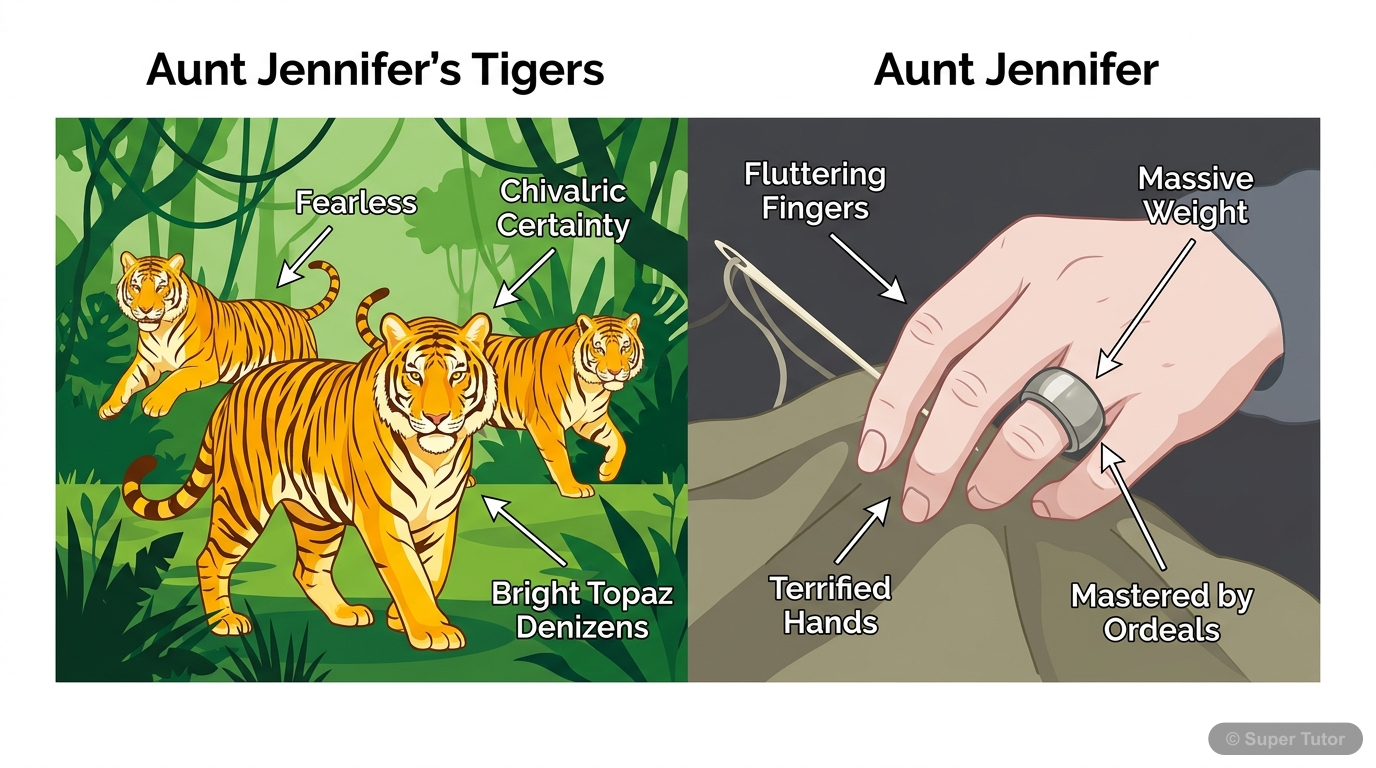
Learn better with visuals Super Tutor has hundreds of illustrations like this across every chapter — all free to try.
Get startedThink it out — Aunt Jennifer's Tigers
1How do 'denizens' and 'chivalric' add to our understanding of the tiger's attitudes?Show solution
Explanation:
- The word 'denizens' means inhabitants or permanent residents. By calling the tigers 'denizens of a world of green', the poet suggests that the tigers belong naturally and confidently to their world — the forest. They are not intruders or outsiders; they are at home, moving with complete ease and authority. This conveys a sense of freedom and natural dominance.
- The word 'chivalric' means courtly, brave, and noble — qualities associated with medieval knights. By describing the tigers as 'chivalric', the poet elevates them to the status of proud, fearless, and dignified beings. They do not cower before men; instead, they move with a noble, knightly confidence.
Together, these two words paint the tigers as free, fearless, powerful, and dignified — qualities that stand in sharp contrast to Aunt Jennifer's own oppressed and timid existence. The tigers embody everything Aunt Jennifer herself cannot be in her real life.
2Why do you think Aunt Jennifer's hands are 'fluttering through her wool' in the second stanza? Why is she finding the needle so hard to pull?Show solution
Explanation:
- The word 'fluttering' suggests nervousness, anxiety, and weakness. Aunt Jennifer's hands are not steady or confident — they tremble like the wings of a frightened bird. This physical trembling is a reflection of her inner state: she is a woman weighed down by fear, oppression, and the burdens of her marriage.
- She finds the needle hard to pull because of the 'massive weight of Uncle's wedding band' on her hand. The wedding ring, which is supposed to be a symbol of love and union, has become a symbol of bondage and subjugation. The weight is not merely physical — it is the emotional and psychological burden of a patriarchal marriage that has crushed her spirit.
In short, Aunt Jennifer's fluttering hands and difficulty with the needle symbolise her oppression, fear, and the exhausting weight of her marital life. Even a simple creative act becomes difficult under the burden of her circumstances.
3What is suggested by the image 'massive weight of Uncle's wedding band'?Show solution
Explanation:
A wedding band (ring) is physically a small, light object. Yet the poet describes it as having a 'massive weight' — this is clearly not a literal, physical weight but a symbolic one.
The image suggests:
1. The burden of marriage: The wedding ring represents the institution of marriage, which for Aunt Jennifer has been a source of oppression rather than love or companionship.
2. Patriarchal dominance: The ring is specifically called 'Uncle's wedding band', not Aunt Jennifer's — this subtly indicates that the marriage belongs to the husband, and Aunt Jennifer is bound by his authority and control.
3. Loss of freedom and identity: The 'massive weight' implies that Aunt Jennifer has been crushed under the responsibilities, fears, and subjugation that her marriage has imposed upon her. She has lost her individuality and freedom.
4. Psychological oppression: Even in the act of creating something beautiful (embroidery), she cannot escape the weight of her marital bondage — it sits on her hand, literally interfering with her creative expression.
Conclusion: The image powerfully conveys that marriage, instead of being a partnership of equals, has been a heavy, suffocating burden for Aunt Jennifer.
4Of what or of whom is Aunt Jennifer terrified with in the third stanza?Show solution
Explanation:
In the third stanza, Aunt Jennifer is terrified of:
1. Her husband (Uncle): He represents patriarchal authority and dominance. Throughout her life, she has been 'mastered by' him — the word 'mastered' clearly indicates that she has been controlled and subjugated by her husband.
2. The institution of marriage itself: The 'ordeals' she is 'ringed' with refer to the trials and sufferings of her married life. The marriage has been a source of terror and oppression for her.
3. The permanence of her oppression: Even in death, her hands remain 'terrified' and 'ringed with ordeals' — suggesting that the fear and subjugation have become so deeply ingrained in her that even death cannot free her hands from the mark of her suffering.
Conclusion: Aunt Jennifer is terrified of the dominating male authority in her life — her husband — and of the oppressive institution of marriage that has controlled and diminished her throughout her existence. The terror is so profound that it outlasts even her life.
5What are the 'ordeals' Aunt Jennifer is surrounded by, why is it significant that the poet uses the word 'ringed'? What are the meanings of the word 'ringed' in the poem?Show solution
The 'Ordeals':
The ordeals Aunt Jennifer is surrounded by refer to:
- The oppression and subjugation she has suffered in her marriage.
- The fear and terror imposed by her dominating husband.
- The loss of freedom, identity, and self-expression throughout her life.
- The physical and psychological burden of being a woman in a patriarchal society.
- The inability to live freely — she could only express her desire for freedom through her embroidered tigers, not in real life.
Significance of the word 'Ringed':
The use of the word 'ringed' is highly significant because it carries multiple meanings simultaneously (it is a pun / polysemy):
1. Encircled/Surrounded: Aunt Jennifer is surrounded and enclosed by her ordeals — she is trapped within them, unable to escape.
2. The wedding ring: 'Ringed' directly echoes the 'wedding band' mentioned earlier. The ring of marriage has been the source of her ordeals — she is literally and symbolically bound by it even in death.
3. Permanence of oppression: Even after death, her hands remain 'ringed' — suggesting that the oppression was so total that it has left a permanent mark on her, like a ring that cannot be removed.
Conclusion: The word 'ringed' brilliantly ties together the symbol of the wedding ring and the idea of being trapped, showing that Aunt Jennifer's marriage and its ordeals have encircled and defined her entire existence — even beyond death.
6Why do you think Aunt Jennifer created animals that are so different from her own character? What might the poet be suggesting, through this difference?Show solution
Reason for the contrast:
Aunt Jennifer creates tigers that are the complete opposite of herself because:
1. Wish fulfilment / Escapism: The tigers represent everything she wishes she could be but cannot — free, fearless, and undominated. Through her art, she lives out the life she is denied in reality.
2. Subconscious rebellion: Unable to openly rebel against her oppressive husband and the patriarchal system, Aunt Jennifer channels her suppressed desire for freedom and power into her creative work. The tigers are her silent protest.
3. Art as liberation: Even though her hands flutter with fear in real life, through the needle and wool she creates beings of absolute confidence and dignity — art becomes the only space where she is truly free.
What the poet suggests through this difference:
- Adrienne Rich uses this contrast to highlight the tragic gap between a woman's inner desires and her outer reality in a patriarchal society.
- The difference suggests that oppressed individuals often find refuge in art and imagination when real life offers no freedom.
- It also suggests the power of creative expression — even a subjugated woman can create images of strength and freedom.
- The poet may also be commenting on the broader condition of women who are forced to suppress their true selves and can only express their authentic desires indirectly.
Conclusion: The contrast between Aunt Jennifer and her tigers is the emotional and thematic heart of the poem — it speaks to the universal human longing for freedom and dignity.
7Interpret the symbols found in this poem.Show solution
1. The Tigers:
- The tigers symbolise freedom, fearlessness, power, and dignity.
- They represent everything Aunt Jennifer desires but cannot have — the ability to move through the world without fear, with confidence and pride.
- They also symbolise the ideal of an unoppressed existence — a life free from patriarchal control.
- The tigers are 'bright topaz' — the colour gold/yellow symbolises energy, vitality, and strength.
2. The Wedding Band / Ring:
- The 'massive weight of Uncle's wedding band' symbolises the oppressive institution of marriage and patriarchal dominance.
- It represents the loss of freedom and identity that Aunt Jennifer has suffered as a wife.
- The ring, normally a symbol of love, here becomes a symbol of bondage and subjugation.
3. Aunt Jennifer's Hands:
- Her fluttering, terrified hands symbolise her fear, anxiety, and oppression.
- Even in death, her hands remain 'terrified' — symbolising that oppression has become a permanent part of her identity.
4. The Embroidery / Panel:
- The act of embroidering symbolises creative expression as a form of silent rebellion.
- The panel is the only space where Aunt Jennifer can express her true self and her desire for freedom.
5. The Colour Green ('world of green'):
- Green symbolises nature, life, and freedom — the natural world where the tigers roam freely, unrestrained.
6. The Men beneath the tree:
- The men 'beneath the tree' whom the tigers do not fear symbolise patriarchal authority — the very authority that Aunt Jennifer herself is terrified of.
Conclusion: Through these symbols, Rich constructs a powerful feminist critique of patriarchy and the oppression of women within marriage.
8Do you sympathise with Aunt Jennifer? What is the attitude of the speaker towards Aunt Jennifer?Show solution
Do we sympathise with Aunt Jennifer?
Yes, as readers we deeply sympathise with Aunt Jennifer because:
- She is a woman who has been dominated, controlled, and oppressed throughout her life by her husband and the institution of marriage.
- She has been denied the freedom, confidence, and dignity that she so beautifully creates in her tigers.
- Even in death, she cannot escape the mark of her oppression — her hands remain 'terrified' and 'ringed with ordeals'.
- She never openly rebels; she suffers silently, channelling her pain into art — this quiet suffering evokes deep sympathy.
The Attitude of the Speaker:
The speaker (the poet, Adrienne Rich) displays a complex, multi-layered attitude towards Aunt Jennifer:
1. Sympathy and compassion: The speaker clearly feels for Aunt Jennifer's suffering. The description of her 'fluttering' hands, the 'massive weight' of the wedding band, and her 'terrified' hands in death all convey the speaker's empathy.
2. Admiration: Despite her oppression, Aunt Jennifer creates tigers of extraordinary power and beauty. The speaker admires this creative act of silent resistance.
3. A sense of tragedy: The speaker views Aunt Jennifer's life as deeply tragic — a woman of creative power and inner longing, crushed by the weight of patriarchal marriage.
4. Feminist critique (implied): Through Aunt Jennifer's story, the speaker critiques the institution of marriage and the patriarchal system that robs women of their freedom and identity. The attitude is not merely personal sympathy but a broader political statement about the condition of women.
Conclusion: The speaker's attitude is one of profound sympathy, admiration for Aunt Jennifer's creative spirit, and a feminist anger at the social structures that have oppressed her.
Stuck on a step?
Ask Super Tutor AI to explain any solution on this page in a simpler way — free, 24x7.
Ask a Doubt FreeFrequently Asked Questions
What are the important topics in Aunt Jennifer's Tigers for Jharkhand Board Class 12 English?
How to score full marks in Aunt Jennifer's Tigers — Jharkhand Board Class 12 English?
Where can I get free NCERT Solutions for Aunt Jennifer's Tigers Class 12 English?
Sources & Official References
Content is aligned to the official syllabus. Refer to the board website for the latest curriculum.
More resources for Aunt Jennifer's Tigers
Important Questions
Practice with board exam-style questions
Syllabus
What topics to cover
Revision Notes
Key points for last-minute revision
Study Plan
Step-by-step plan to ace this chapter
Flashcards
Quick-fire cards for active recall
Formula Sheet
All formulas in one place
Chapter Summary
Understand the chapter at a glance
Practice Quiz
Test yourself with a quick quiz
Concept Maps
See how topics connect visually
For serious students
Get the full Aunt Jennifer's Tigers chapter — for free.
Quizzes, flashcards, AI doubt-solver and a step-by-step study plan for Jharkhand Board Class 12 English.