Kings, Farmers and Towns (Early States and Economies) (c.600 BCE-600 CE)
Karnataka Board · Class 12 · History
Quick revision notes for Kings, Farmers and Towns (Early States and Economies) (c.600 BCE-600 CE) — Karnataka Board Class 12 History. Key concepts, formulas, and definitions for last-minute revision.
Interactive on Super Tutor
Studying Kings, Farmers and Towns (Early States and Economies) (c.600 BCE-600 CE)? Get the full interactive chapter.
Quizzes, flashcards, AI doubt-solver and a step-by-step study plan — built for revision notes and more.
1,000+ Class 12 students started this chapter today
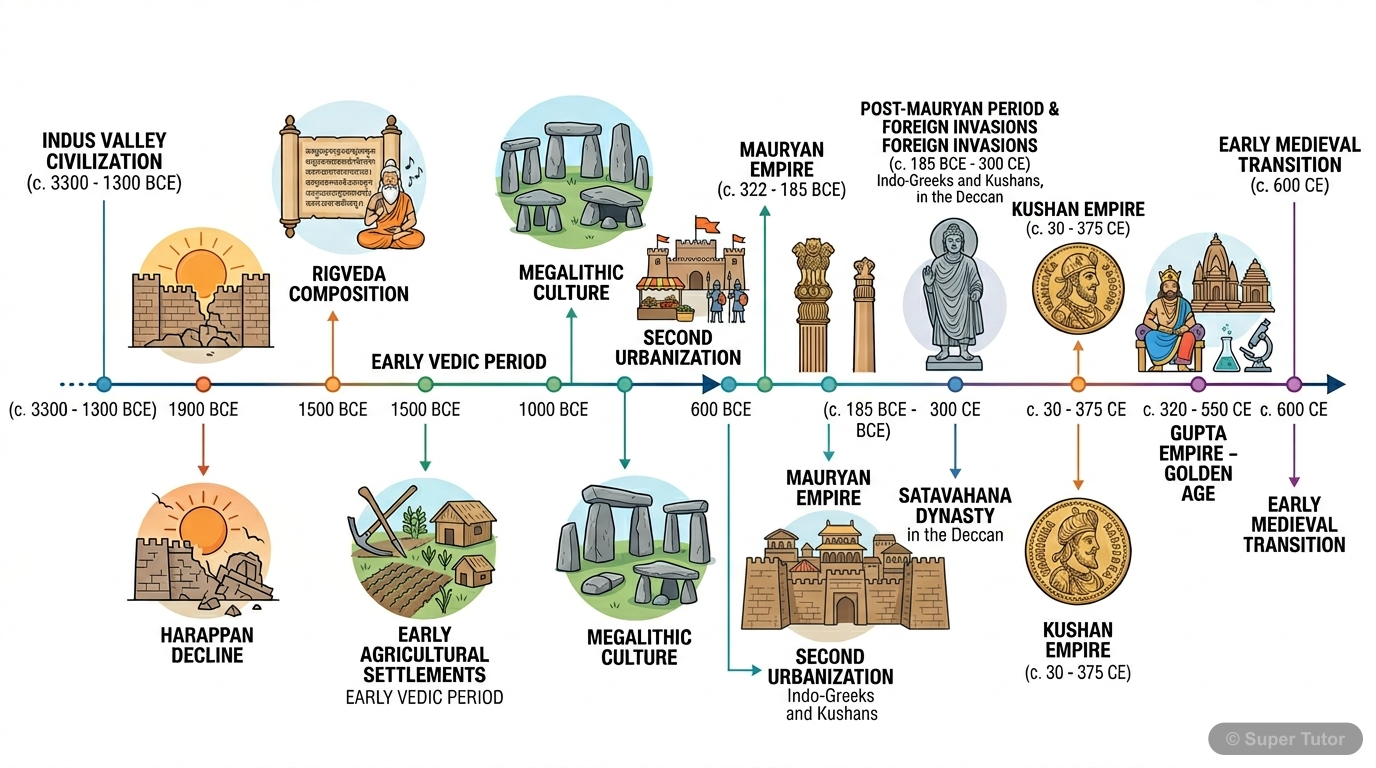
Learn better with visuals Super Tutor has hundreds of illustrations like this across every chapter — all free to try.
Get startedKey Topics to Revise
Sources and Historical Reconstruction
- James Prinsep deciphered Brahmi and Kharosthi scripts in 1830s, revolutionizing Indian epigraphy
- Discovery that 'Piyadassi' referred to Asoka opened new directions in political history research
- Inscriptions provide evidence of rulers' achievements, donations, and administrative policies
Mahajanapadas and Early States
- Sixth century BCE marked emergence of 16 mahajanapadas (great territories)
- Key mahajanapadas: Vajji, Magadha, Koshala, Kuru, Panchala, Gandhara, Avanti
- Two types of governance: kingdoms (ruled by kings) and ganas/sanghas (oligarchies)
Rise of Magadha and Mauryan Empire
- Magadha became most powerful mahajanapada (6th-4th centuries BCE)
- Advantages: fertile agriculture, iron mines (Jharkhand), elephants, river transport via Ganga
- Famous rulers: Bimbisara, Ajatasattu, Mahapadma Nanda
Asoka and Imperial Administration
- Asoka (c. 272/268-231 BCE) most famous Mauryan ruler
- Conquered Kalinga (coastal Orissa) in 8th regnal year
- Kalinga war caused massive casualties: 150,000 deported, 100,000 killed
Get complete notes with diagrams and examples
Full NotesKey Concepts
Frequently Asked Questions
What are the important topics in Kings, Farmers and Towns (Early States and Economies) (c.600 BCE-600 CE) for Karnataka Board Class 12 History?
How to score full marks in Kings, Farmers and Towns (Early States and Economies) (c.600 BCE-600 CE) — Karnataka Board Class 12 History?
Sources & Official References
- Karnataka SSLC — kseeb.kar.nic.in
- Dept of Pre-University Education, Karnataka
- National Education Policy 2020 — education.gov.in
Content is aligned to the official syllabus. Refer to the board website for the latest curriculum.
More resources for Kings, Farmers and Towns (Early States and Economies) (c.600 BCE-600 CE)
Important Questions
Practice with board exam-style questions
Syllabus
What topics to cover
Study Plan
Step-by-step plan to ace this chapter
Flashcards
Quick-fire cards for active recall
Formula Sheet
All formulas in one place
Chapter Summary
Understand the chapter at a glance
Practice Quiz
Test yourself with a quick quiz
Concept Maps
See how topics connect visually
NCERT Solutions
Every textbook question solved step by step
For serious students
Get the full Kings, Farmers and Towns (Early States and Economies) (c.600 BCE-600 CE) chapter — for free.
Quizzes, flashcards, AI doubt-solver and a step-by-step study plan for Karnataka Board Class 12 History.