My Mother at Sixty-six
Mizoram Board · Class 12 · English
NCERT Solutions for My Mother at Sixty-six — Mizoram Board Class 12 English.
Interactive on Super Tutor
Studying My Mother at Sixty-six? Get the full interactive chapter.
Quizzes, flashcards, AI doubt-solver and a step-by-step study plan — built for ncert solutions and more.
1,000+ Class 12 students started this chapter today
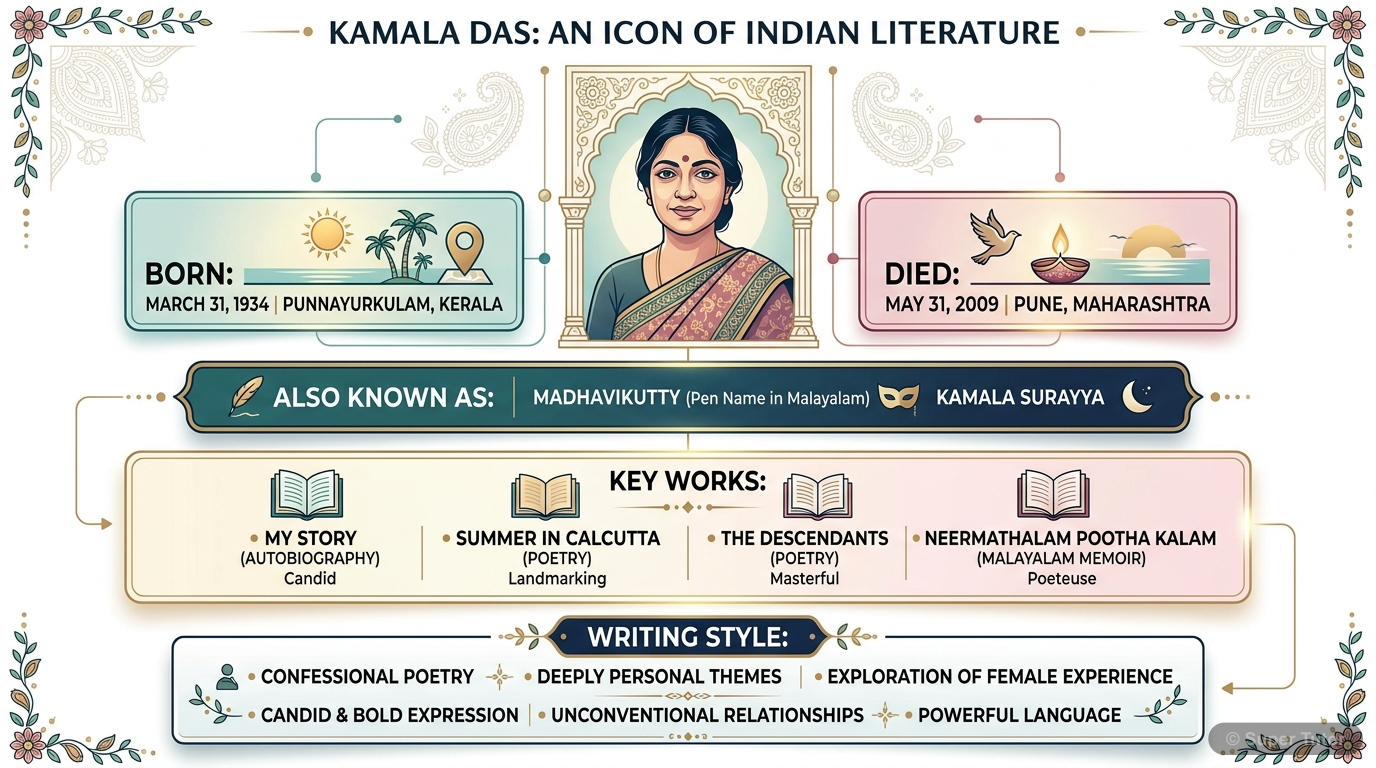
This is just one of 5+ visuals inside Super Tutor's My Mother at Sixty-six chapter
Explore the full setThink it out — My Mother at Sixty-six (Flamingo, Class 12)
1What is the kind of pain and ache that the poet feels?Show solution
Answer:
The pain and ache that the poet feels is the age-old, childhood fear of losing her mother — the fear of separation and, more deeply, the fear of her mother's death. The word *'familiar'* tells us this is not a new feeling; it is a dread she has carried since childhood. As a child she must have been anxious about being separated from her mother; now, as an adult, she confronts the same fear but in a far more serious form — the realisation that her ageing, frail mother may not live much longer. The sight of her mother's wan, pale face (compared to a 'late winter's moon') rekindles that deep-seated ache of potential, irreversible loss.
2Why are the young trees described as 'sprinting'?Show solution
Concept: The description is a result of kinetic imagery and relative motion — when one is inside a moving vehicle, stationary objects outside appear to rush past in the opposite direction.
Answer:
The young trees are described as 'sprinting' because the car is moving fast, making the trees appear to rush past the window in the opposite direction. However, the image carries a deeper symbolic meaning: the young, green, fast-moving trees are a contrast to the poet's old, still, and fading mother sitting beside her. The trees represent youth, energy, and vitality, while the mother represents old age and the slow approach of death. The juxtaposition highlights the painful difference between the vigour of youth and the frailty of old age.
3Why has the poet brought in the image of the merry children 'spilling out of their homes'?Show solution
Answer:
The image of merry children 'spilling out of their homes' is brought in to create a sharp contrast with the poet's mother. The children symbolise joy, life, energy, and new beginnings, whereas the mother represents old age, stillness, and the nearness of death. The word 'spilling' suggests an overflow of life and exuberance that cannot be contained — the very opposite of the mother's wan, withdrawn state. By placing these two images side by side, the poet intensifies the sense of loss and the inevitability of ageing and death. The outside world is full of life and movement, while the poet's inner world is shadowed by grief and fear.
4Why has the mother been compared to the 'late winter's moon'?Show solution
Concept: A simile is used here to convey the mother's physical and emotional state through a vivid natural image.
Answer:
The mother has been compared to the 'late winter's moon' because of the following similarities:
1. Paleness / Wan appearance: A late winter's moon is pale, dull, and lacks brightness — just as the mother's face is colourless and ashen due to old age.
2. Haziness / Obscurity: The winter moon is often shrouded in mist and appears hazy, suggesting the mother's life is becoming dim and fading.
3. Nearness to disappearance: A late winter's moon is close to being replaced by the sun (day), just as the mother is close to the end of her life.
4. Lack of warmth: A winter moon gives no warmth, reflecting the cold reality of old age and approaching death.
Thus, the simile effectively captures the physical frailty, pallor, and the sense of an imminent end that the poet perceives in her mother.
5What do the parting words of the poet and her smile signify?Show solution
Answer:
The parting words *'see you soon, Amma'* and the repeated smiling carry deep and layered significance:
1. Suppression of grief: The poet is inwardly overwhelmed by the fear that she may never see her mother alive again, yet she does not express this sorrow. The words and the smile are a conscious mask worn to hide her anguish.
2. Reassurance and hope: By saying 'see you soon', the poet tries to reassure her mother (and perhaps herself) that the parting is temporary and that they will meet again. It is an act of love — she does not want to burden her old, frail mother with her own fears.
3. The repeated smile ('smile and smile and smile'): The repetition of the word 'smile' suggests that the smile is forced and deliberate — not a natural expression of happiness but a brave, determined effort to appear cheerful. Each smile is an attempt to push back the tears.
4. The unsaid: The poem ends on what is left unsaid — the real fear, the real pain, the real possibility of final separation. The contrast between what the poet feels and what she says/does is the emotional core of the poem.
In essence, the parting words and the smile signify love expressed through restraint — the quiet, dignified courage of a daughter who chooses to give her mother comfort rather than sorrow at the moment of farewell.
Stuck on a step?
Ask Super Tutor AI to explain any solution on this page in a simpler way — free, 24x7.
Ask a Doubt FreeFrequently Asked Questions
What are the important topics in My Mother at Sixty-six for Mizoram Board Class 12 English?
How to score full marks in My Mother at Sixty-six — Mizoram Board Class 12 English?
Where can I get free NCERT Solutions for My Mother at Sixty-six Class 12 English?
Sources & Official References
Content is aligned to the official syllabus. Refer to the board website for the latest curriculum.
More resources for My Mother at Sixty-six
Important Questions
Practice with board exam-style questions
Syllabus
What topics to cover
Revision Notes
Key points for last-minute revision
Study Plan
Step-by-step plan to ace this chapter
Flashcards
Quick-fire cards for active recall
Formula Sheet
All formulas in one place
Chapter Summary
Understand the chapter at a glance
Practice Quiz
Test yourself with a quick quiz
Concept Maps
See how topics connect visually
For serious students
Get the full My Mother at Sixty-six chapter — for free.
Quizzes, flashcards, AI doubt-solver and a step-by-step study plan for Mizoram Board Class 12 English.