Financial Statements of a Company
Nagaland Board · Class 12 · Accountancy
Practice quiz for Financial Statements of a Company — Nagaland Board Class 12 Accountancy. MCQs and questions with answers to test your preparation.
Interactive on Super Tutor
Studying Financial Statements of a Company? Get the full interactive chapter.
Quizzes, flashcards, AI doubt-solver and a step-by-step study plan — built for practice quiz and more.
1,000+ Class 12 students started this chapter today
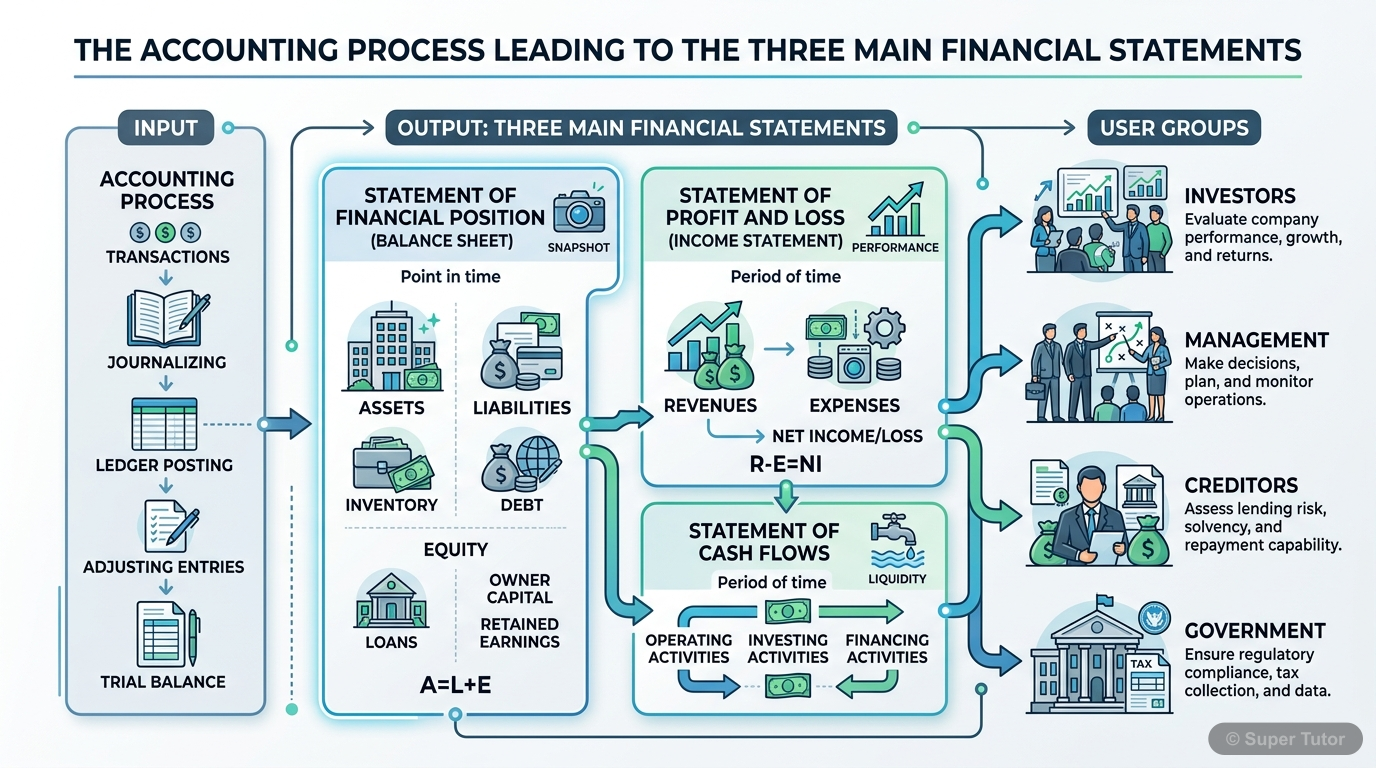
This is just one of 7+ visuals inside Super Tutor's Financial Statements of a Company chapter
Explore the full setQuick Quiz: Financial Statements of a Company
0/4Tap an answer to check it instantly. No sign-up needed for these 4.
What are the end products of the accounting process?
Financial statements are prepared on the basis of:
The primary objective of financial statements is to:
According to Schedule III of the Companies Act, 2013, the balance sheet format is:
Sample Questions
Which of the following are the main financial statements of a company?
Show answer
Balance Sheet, Statement of Profit and Loss, Cash Flow Statement
The three main financial statements are Balance Sheet (showing financial position), Statement of Profit and Loss (showing performance), and Cash Flow Statement (showing cash movements). Trial Balance and Bank Reconciliation are internal accounting documents, not financial statements.
Which of the following are components of Shareholders' Funds?
Show answer
Share Capital, Reserves and Surplus, Money received against Share Warrants
Shareholders' Funds include Share Capital, Reserves and Surplus, and Money received against Share Warrants. Trade Payables and Long-term Borrowings are liabilities, not part of shareholders' funds.
An asset is classified as current if it is expected to be realized within:
Show answer
Twelve months or operating cycle
As per Schedule III, an asset is classified as current if it is expected to be realized within twelve months from the reporting date or within the operating cycle, whichever is longer.
The term 'Sundry Debtors' has been replaced by:
Show answer
Trade Receivables
Schedule III has replaced the term 'Sundry Debtors' with 'Trade Receivables' to provide better clarity about amounts due from customers for goods sold or services rendered in the normal course of business.
+27 more questions available
Practice AllFrequently Asked Questions
What are the important topics in Financial Statements of a Company for Nagaland Board Class 12 Accountancy?
How to score full marks in Financial Statements of a Company — Nagaland Board Class 12 Accountancy?
Sources & Official References
Content is aligned to the official syllabus. Refer to the board website for the latest curriculum.
More resources for Financial Statements of a Company
Important Questions
Practice with board exam-style questions
Syllabus
What topics to cover
Revision Notes
Key points for last-minute revision
Study Plan
Step-by-step plan to ace this chapter
Flashcards
Quick-fire cards for active recall
Formula Sheet
All formulas in one place
Chapter Summary
Understand the chapter at a glance
Concept Maps
See how topics connect visually
NCERT Solutions
Every textbook question solved step by step
For serious students
Get the full Financial Statements of a Company chapter — for free.
Quizzes, flashcards, AI doubt-solver and a step-by-step study plan for Nagaland Board Class 12 Accountancy.