Consumer Protection
Nagaland Board · Class 12 · Business Studies
NCERT Solutions for Consumer Protection — Nagaland Board Class 12 Business Studies.
Interactive on Super Tutor
Studying Consumer Protection? Get the full interactive chapter.
Quizzes, flashcards, AI doubt-solver and a step-by-step study plan — built for ncert solutions and more.
1,000+ Class 12 students started this chapter today
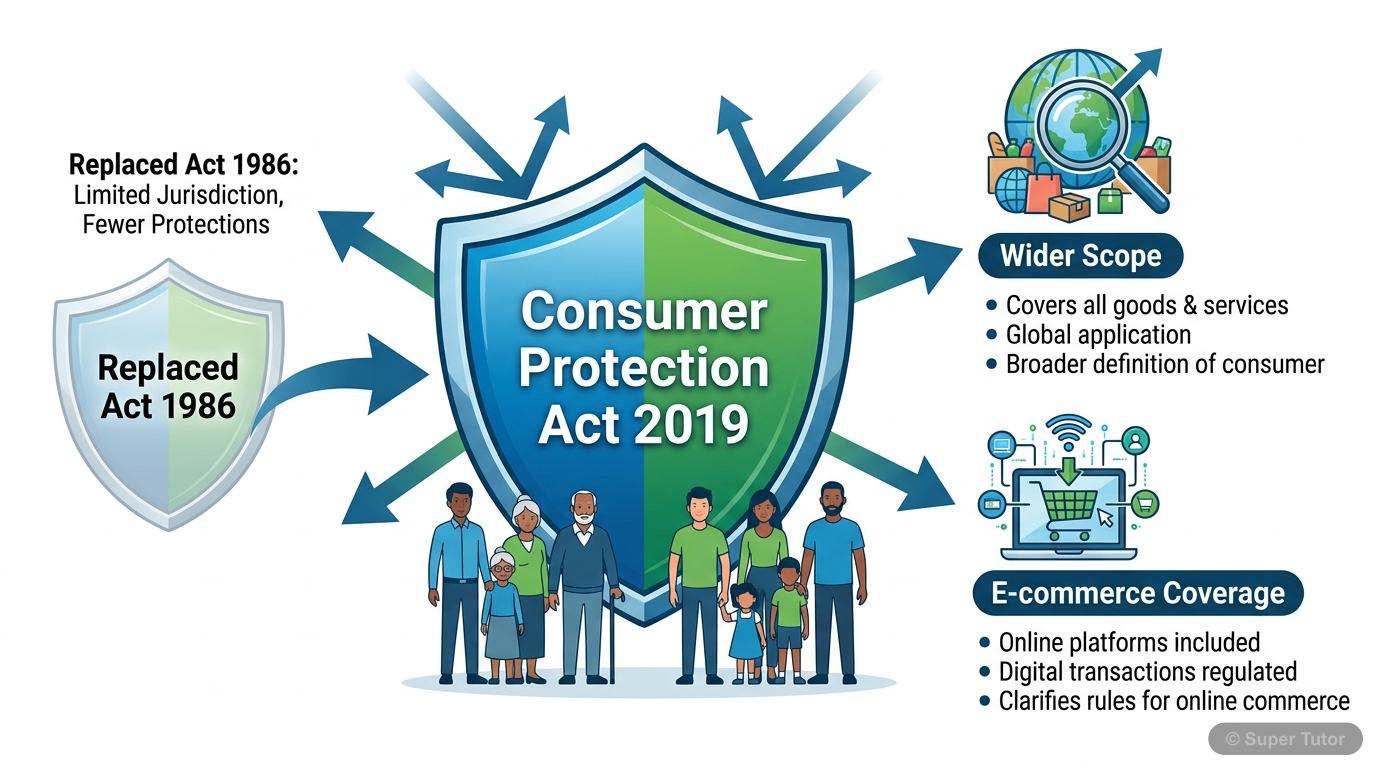
Super Tutor has 11+ illustrations like this for Consumer Protection alone — flashcards, concept maps, and step-by-step visuals.
See them allVery Short Answer Type
1Under which consumer right does a business firm set up consumer grievance cell?Show solution
Answer: A business firm sets up a consumer grievance cell under the Right to be Heard (also called Right to Representation).
Explanation: The Right to be Heard ensures that consumers' interests will receive due consideration at appropriate forums. Setting up a consumer grievance cell by a business firm is a practical implementation of this right, as it provides consumers a platform to voice their complaints and grievances and get them addressed.
2Which quality certification mark is used for agricultural products?Show solution
Explanation: AGMARK is a certification mark employed on agricultural products in India, assuring that they conform to a set of standards approved by the Directorate of Marketing and Inspection, an agency of the Government of India. It is governed by the Agricultural Produce (Grading and Marking) Act, 1937.
3What is the jurisdiction of cases that can be filed in a State Commission?Show solution
*(Note: These figures are as per the Consumer Protection Act, 2019. Under the earlier 1986 Act, the limit was above ₹20 lakh up to ₹1 crore.)*
Additionally, the State Commission also has appellate jurisdiction to hear appeals against orders of the District Commission within the State.
4State any two reliefs available to consumers under CPA.Show solution
1. Removal of Defect: The consumer court may direct the opposite party to remove the defect in the goods or deficiency in the services.
2. Replacement of Goods: The consumer court may order the replacement of defective goods with new goods of similar description which shall be free from any defect.
*(Other reliefs include: refund of price paid, payment of compensation for loss or injury suffered, discontinuation of unfair/restrictive trade practices, etc.)*
5Name the component of product mix that helps the consumer to exercise the right to information.Show solution
Explanation: A label on a product provides detailed information such as ingredients/contents, date of manufacture, expiry date, price, weight, directions for use, manufacturer's details, etc. This information enables consumers to make informed purchasing decisions, thereby exercising their Right to be Informed.
Short Answer Type
1Enumerate the various Acts passed by the Government of India which help in protection of consumers' interests.Show solution
Answer: The Government of India has passed the following Acts to protect consumers' interests:
1. The Consumer Protection Act, 1986 (amended as Consumer Protection Act, 2019): Provides a comprehensive framework for consumer protection including rights, redressal agencies, etc.
2. The Indian Contract Act, 1872: Governs the formation and enforcement of contracts, protecting consumers from unfair contract terms.
3. The Sale of Goods Act, 1930: Provides implied conditions and warranties in the sale of goods, protecting buyers.
4. The Essential Commodities Act, 1955: Controls production, supply, and distribution of essential commodities to prevent hoarding and black marketing.
5. The Agricultural Produce (Grading and Marking) Act, 1937: Provides for grading and marking of agricultural produce (AGMARK).
6. The Prevention of Food Adulteration Act, 1954: Prevents adulteration of food articles and ensures food safety.
7. The Standards of Weights and Measures Act, 1976: Ensures correct weights and measures are used in trade.
8. The Trade Marks Act, 1999: Protects consumers from counterfeit goods by regulating trademarks.
9. The Competition Act, 2002: Prevents monopolistic and restrictive trade practices that harm consumers.
10. The Bureau of Indian Standards Act, 1986: Provides for the ISI mark and BIS hallmark, ensuring quality standards for goods.
2What are the responsibilities of a consumer?Show solution
Answer: The responsibilities of a consumer are as follows:
1. Be Aware: A consumer should be aware of his/her rights and should not be a passive recipient. He/she must gather information about goods and services before purchasing.
2. Beware of Advertisements: A consumer should not be misled by false or misleading advertisements and should think critically before making a purchase.
3. Buy Standardised Goods: A consumer should look for quality certification marks like ISI, AGMARK, Hallmark, etc., while purchasing goods.
4. Assert Yourself: A consumer should be assertive and bold enough to ensure that he/she gets a fair deal. He/she should not hesitate to complain if something is wrong.
5. File Complaints for Redressal: A consumer should file a complaint in the appropriate consumer court in case of a genuine grievance, rather than remaining silent.
6. Be an Ethical Consumer: A consumer should purchase only legal goods and services and should not encourage black marketing or purchase of spurious goods.
7. Insist on Cash Memo/Receipt: A consumer should always ask for a cash memo or receipt as proof of purchase, which is essential for filing a complaint.
8. Respect the Environment: A consumer should be conscious of the environmental impact of his/her consumption and avoid wasteful consumption.
3Who can file a complaint in a consumer court?Show solution
Answer: The following persons/entities can file a complaint in a consumer court:
1. A Consumer: Any person who buys goods or hires services for consideration (payment) can file a complaint. This includes the user of such goods/services if done with the buyer's approval.
2. Any Recognised Consumer Association: A voluntary consumer organisation registered under the Companies Act or any other law can file a complaint on behalf of consumers.
3. The Central Government or State Government: They can file a complaint on behalf of consumers.
4. One or More Consumers on Behalf of Numerous Consumers: Where there are numerous consumers having the same interest, one or more of them can file a complaint with the permission of the consumer court.
5. A Legal Heir or Representative: In case of death of a consumer, his/her legal heir or representative can file a complaint.
Note: A complaint can be filed against a defective product, deficiency in service, unfair trade practice, or restrictive trade practice adopted by a trader or service provider.
4FSSAI (Food Safety and Standards Authority of India) has made a proposal for hotels and other food outlets to declare the kind of oil/fat used in cooking each of the food items on their menus. Name and explain the Consumer Right being reinforced by this proposal.Show solution
Consumer Right Being Reinforced: Right to be Informed
Explanation:
The Right to be Informed means that consumers have the right to be informed about the quality, quantity, potency, purity, standard, and price of goods and services so as to protect themselves against unfair trade practices.
In this case, by requiring hotels and food outlets to declare the kind of oil/fat used in cooking:
- Consumers will be able to make informed choices about the food they consume.
- People with specific health conditions (e.g., heart disease, high cholesterol) or dietary preferences (e.g., vegetarians, those avoiding trans fats) can make healthier and more suitable choices.
- It prevents hotels from using substandard or harmful oils without the consumer's knowledge.
- It empowers consumers to protect their health by being aware of what goes into their food.
Thus, this proposal reinforces the Right to be Informed, which is one of the six consumer rights provided under the Consumer Protection Act.
5Who is a consumer as per CPA?Show solution
Answer: As per the Consumer Protection Act, 2019, a consumer is defined as any person who:
1. Buys any goods for a consideration (price) which has been paid or promised, or partly paid and partly promised, or under any system of deferred payment. It includes any user of such goods other than the person who buys such goods, provided such use is made with the approval of the buyer.
2. Hires or avails of any service for a consideration which has been paid or promised, or partly paid and partly promised, or under any system of deferred payment. It includes any beneficiary of such service other than the person who hires or avails of the service, provided such service is availed of with the approval of the first-mentioned person.
Who is NOT a Consumer:
- A person who obtains goods for resale or for any commercial purpose is NOT a consumer.
- However, a person who buys goods for self-employment (earning livelihood) is considered a consumer.
Example: If a person buys a refrigerator for personal use at home, he/she is a consumer. But if a shopkeeper buys goods for resale, he/she is not a consumer under CPA.
Long Answer Type
1Explain the importance of consumer protection from the point of view of a business.Show solution
Answer: Consumer protection is not only important for consumers but also for businesses. The following points explain its importance from the point of view of a business:
1. Long-term Interest of Business:
Every business needs customers to survive and grow. A satisfied customer is a loyal customer who will return and also recommend the business to others. Consumer protection helps build customer loyalty and goodwill, which is essential for the long-term success and profitability of a business. Businesses that exploit consumers may earn short-term profits but will lose customers in the long run.
2. Business Uses Society's Resources:
Business enterprises use resources — natural, human, and financial — that belong to society. Therefore, they have an obligation to serve society, including consumers, in a responsible manner. Consumer protection is a way of giving back to society and using its resources responsibly.
3. Social Responsibility:
A business is a part of society and has social responsibilities towards various stakeholders, including consumers. Protecting consumer interests is a part of the social responsibility of business. A socially responsible business earns a good reputation and public trust.
4. Moral Justification:
It is morally wrong to exploit consumers through adulteration, false advertising, overcharging, or selling substandard goods. Businesses have a moral duty to be honest and fair in their dealings with consumers. Consumer protection aligns with ethical business conduct.
5. Avoids Government Intervention:
If businesses do not protect consumer interests voluntarily, the government may intervene through strict regulations, inspections, and penalties. Such intervention can disrupt business operations and increase compliance costs. By voluntarily protecting consumers, businesses can avoid unnecessary government interference and operate more freely.
Conclusion: Consumer protection is thus in the best interest of business as it leads to customer satisfaction, goodwill, long-term profitability, and a positive image in society.
2Explain the rights and responsibilities of consumer?Show solution
## RIGHTS OF A CONSUMER
The Consumer Protection Act, 1986 (now 2019) provides for the following six consumer rights:
1. Right to Safety:
Consumers have the right to be protected against goods and services that are hazardous to life and property. For example, electrical appliances should meet safety standards so that they do not cause harm to users.
2. Right to be Informed:
Consumers have the right to be informed about the quality, quantity, potency, purity, standard, and price of goods and services. This helps them make informed decisions and protects them from unfair trade practices. Labels on products serve this purpose.
3. Right to Choose:
Consumers have the right to access a variety of goods and services at competitive prices. They should not be forced to buy a particular brand or product. This right protects consumers from monopolistic practices.
4. Right to be Heard:
Consumers have the right to be heard and to be assured that their interests will receive due consideration at appropriate forums. This includes the right to be represented in government policy-making bodies and the right to file complaints.
5. Right to Seek Redressal:
Consumers have the right to seek redressal against unfair trade practices or unscrupulous exploitation. They can approach consumer courts (District Forum, State Commission, National Commission) for compensation and other reliefs.
6. Right to Consumer Education:
Consumers have the right to acquire knowledge and skills to be informed consumers throughout their lives. Consumer education helps them understand their rights and make better decisions.
---
## RESPONSIBILITIES OF A CONSUMER
Along with rights, consumers must also fulfil the following responsibilities:
1. Be Aware: A consumer should be aware of his/her rights and gather complete information about goods and services before purchasing.
2. Beware of Misleading Advertisements: Consumers should not be misled by false or exaggerated claims in advertisements.
3. Buy Standardised Goods: Consumers should look for quality marks like ISI, AGMARK, Hallmark, FPO, etc., while purchasing goods.
4. Assert Yourself: Consumers should be bold and assertive in ensuring a fair deal and should not hesitate to complain.
5. File Complaints: Consumers should file complaints in the appropriate consumer court in case of genuine grievances rather than remaining silent.
6. Be an Ethical Consumer: Consumers should purchase only legal goods and services and avoid encouraging black marketing or purchase of spurious goods.
7. Insist on Cash Memo: Consumers should always ask for a cash memo or receipt as proof of purchase.
8. Respect the Environment: Consumers should be conscious of the environmental impact of their consumption choices.
Conclusion: Rights and responsibilities go hand in hand. A responsible consumer who is aware of his/her rights can contribute to a fair and ethical marketplace.
3What are various ways in which the objective of consumer protection can be achieved?Show solution
Answer: The objective of consumer protection can be achieved through the following ways:
1. Self-Regulation by Business:
Responsible businesses voluntarily adopt fair trade practices, maintain quality standards, provide accurate information, and handle consumer complaints efficiently. Many companies have set up consumer grievance cells and toll-free helplines. Self-regulation is the most effective and cost-efficient way of consumer protection as it avoids the need for external intervention.
2. Business Associations:
Trade and industry associations like the Confederation of Indian Industry (CII), Federation of Indian Chambers of Commerce and Industry (FICCI), and Associated Chambers of Commerce and Industry of India (ASSOCHAM) frame codes of conduct for their members. These codes ensure that member businesses follow ethical practices and protect consumer interests.
3. Consumer Awareness:
An informed consumer is the best protection against exploitation. When consumers are aware of their rights, they can make better purchasing decisions, demand quality goods, and seek redressal when wronged. Consumer awareness can be spread through education, media campaigns, and consumer organisations.
4. Consumer Organisations:
Non-governmental organisations (NGOs) and consumer organisations play a vital role in protecting consumer interests. They:
- Educate consumers about their rights.
- Test products for quality and publish results.
- File complaints on behalf of consumers.
- Lobby the government for stronger consumer protection laws.
- Publish journals and magazines to spread consumer awareness.
Examples: Consumer Guidance Society of India (CGSI), Voice (Voluntary Organisation in Interest of Consumer Education), CERC (Consumer Education and Research Centre).
5. Government:
The government protects consumers through:
- Legislative measures: Enacting laws like the Consumer Protection Act, 2019, Essential Commodities Act, Prevention of Food Adulteration Act, etc.
- Administrative measures: Setting up regulatory bodies like FSSAI, BIS, etc.
- Judicial measures: Establishing consumer courts (District Forum, State Commission, National Commission) for redressal of consumer grievances.
- Educational measures: Spreading consumer awareness through campaigns like 'Jago Grahak Jago'.
Conclusion: Consumer protection is a shared responsibility of businesses, consumers, consumer organisations, and the government. A combination of all these approaches is needed to effectively protect consumer interests.
4Explain the redressal mechanism available to consumers under the Consumer Protection Act, 2019.Show solution
Answer: The Consumer Protection Act, 2019 provides for a three-tier quasi-judicial redressal mechanism for consumers. These are:
---
### 1. District Consumer Disputes Redressal Commission (District Commission)
- Jurisdiction: Handles complaints where the value of goods/services and compensation claimed does not exceed ₹1 crore.
- Composition: Headed by a President (who is or has been a District Judge) and at least two other members.
- Procedure: A complaint can be filed by the consumer. The opposite party is given notice and an opportunity to be heard. The commission passes an appropriate order.
- Appeal: An appeal against the District Commission's order can be filed before the State Commission within 45 days.
---
### 2. State Consumer Disputes Redressal Commission (State Commission)
- Jurisdiction: Handles complaints where the value of goods/services and compensation claimed exceeds ₹1 crore but does not exceed ₹10 crore.
- Composition: Headed by a President (who is or has been a Judge of the High Court) and at least four other members.
- Appellate Jurisdiction: Also hears appeals against orders of the District Commission.
- Appeal: An appeal against the State Commission's order can be filed before the National Commission within 30 days.
---
### 3. National Consumer Disputes Redressal Commission (National Commission)
- Jurisdiction: Handles complaints where the value of goods/services and compensation claimed exceeds ₹10 crore.
- Composition: Headed by a President (who is or has been a Judge of the Supreme Court) and at least four other members.
- Appellate Jurisdiction: Also hears appeals against orders of the State Commission.
- Appeal: An appeal against the National Commission's order can be filed in the Supreme Court of India within 30 days.
---
### Reliefs Available to Consumers
The consumer courts can grant the following reliefs:
1. Removal of defect in goods.
2. Replacement of defective goods.
3. Refund of the price paid.
4. Payment of compensation for loss or injury suffered.
5. Removal of deficiency in services.
6. Discontinuation of unfair/restrictive trade practices.
7. Withdrawal of hazardous goods from sale.
8. Payment of adequate costs to the complainant.
---
Conclusion: The three-tier redressal mechanism provides an accessible, affordable, and speedy system for consumers to seek justice against exploitation, without the need for expensive and time-consuming civil court proceedings.
5Explain the role of consumer organisations and NGOs in protecting and promoting consumer's interest.Show solution
Answer: Consumer organisations and Non-Governmental Organisations (NGOs) play a very important role in protecting and promoting the interests of consumers. Their key roles are as follows:
1. Educating Consumers:
Consumer organisations educate consumers about their rights and responsibilities through seminars, workshops, publications, and campaigns. They help consumers understand how to make informed choices and how to seek redressal when wronged.
2. Collecting and Publishing Information:
They collect, process, and disseminate information on various issues of consumer interest. They publish journals, magazines, and reports that provide comparative information about products and services, helping consumers make better decisions.
3. Testing Products:
Consumer organisations conduct independent tests on products to check their quality, safety, and value for money. They publish the results so that consumers can make informed choices. For example, Consumer Voice and CERC regularly test products.
4. Filing Complaints:
Consumer organisations can file complaints in consumer courts on behalf of consumers, especially in cases of widespread consumer exploitation. This is particularly helpful for individual consumers who may not have the resources or knowledge to fight legal battles on their own.
5. Lobbying for Consumer Rights:
They lobby the government and regulatory bodies to enact and enforce stronger consumer protection laws and policies. They represent consumer interests in policy-making forums.
6. Providing Legal Aid:
Some consumer organisations provide legal assistance to consumers who wish to file complaints in consumer courts. They guide consumers through the legal process.
7. Encouraging Research:
They encourage and support research on consumer issues such as product safety, pricing, quality, and consumer behaviour. This research helps in identifying areas where consumer protection needs to be strengthened.
8. Creating Awareness about Malpractices:
Consumer organisations expose unfair trade practices, adulteration, overcharging, and other malpractices through media and public campaigns, thereby putting pressure on businesses to act responsibly.
Examples of Consumer Organisations in India:
- Consumer Guidance Society of India (CGSI), Mumbai
- Voice (Voluntary Organisation in Interest of Consumer Education), New Delhi
- Consumer Education and Research Centre (CERC), Ahmedabad
- Common Cause, New Delhi
- Akhil Bharat Grahak Panchayat, Pune
Conclusion: Consumer organisations and NGOs serve as watchdogs of consumer interests. They bridge the gap between consumers and businesses/government, and play a crucial role in creating a fair and transparent marketplace.
6Mrs. Mathur sent a jacket to a laundry shop in January 2018. The jacket was purchased at a price of ₹4,500. She had previously sent the jacket for dry cleaning with Shine Dry Cleaners and the jacket was cleaned well. However, she noticed that her jacket had white discoloration marks when she collected the jacket this time. On informing the dry cleaner, Mrs. Mathur received a letter confirming that discolouration indeed appeared after the jacket was dry cleaned. She contacted the dry cleaner multiple times and requested for compensation for discoloured jacket but to no avail. Upon Consumer court's intervention, Shine Dry Cleaners agreed to compensate Rs. 2,500 to Mrs. Mathur for the discoloured jacket.
(a) Which right was exercised by Mrs. Mathur at the first instance.
(b) Name and explain the right which helped Mrs. Mathur to avail the compensation.
(c) State which consumer responsibility has been fulfilled by Mrs. Mathur in the above case.
(d) State any other two responsibilities to be assumed by the consumers.Show solution
---
(a) Right exercised by Mrs. Mathur at the first instance:
At the first instance, Mrs. Mathur exercised the Right to be Heard.
Explanation: When Mrs. Mathur noticed the discolouration and informed the dry cleaner, she was exercising her right to be heard — i.e., the right to voice her complaint and have her grievance considered by the service provider. She contacted the dry cleaner multiple times to get her complaint addressed, which is an exercise of this right.
---
(b) Right which helped Mrs. Mathur to avail the compensation:
The right that helped Mrs. Mathur avail compensation is the Right to Seek Redressal.
Explanation: The Right to Seek Redressal means that consumers have the right to seek redressal against unfair trade practices or unscrupulous exploitation. When the dry cleaner refused to compensate despite repeated requests, Mrs. Mathur approached the consumer court. The court intervened and directed Shine Dry Cleaners to pay ₹2,500 as compensation. This right ensures that consumers are not left without remedy when they suffer a loss due to deficiency in service.
---
(c) Consumer responsibility fulfilled by Mrs. Mathur:
Mrs. Mathur fulfilled the responsibility of Filing a Complaint / Asserting Herself.
Explanation: Instead of silently accepting the loss, Mrs. Mathur took the initiative to contact the dry cleaner multiple times and ultimately approached the consumer court to seek justice. This reflects the consumer responsibility of being assertive and filing a complaint when wronged, rather than remaining passive. A consumer who does not complain indirectly encourages exploitation.
---
(d) Any other two responsibilities to be assumed by consumers:
1. Insist on Cash Memo/Receipt: A consumer should always ask for a cash memo, bill, or receipt at the time of purchase or availing a service. This serves as proof of transaction and is essential for filing a complaint in a consumer court.
2. Buy Standardised Goods: A consumer should look for quality certification marks such as ISI, AGMARK, Hallmark, FPO, etc., while purchasing goods. This ensures that the goods meet prescribed quality and safety standards, reducing the risk of getting defective or substandard products.
Project Work
1Visit a consumer organisation in your town. List down the various functions performed by it.Show solution
Name of Organisation Visited (Example): Consumer Guidance Society of India (CGSI) / Local Consumer Forum
Functions Observed/Recorded:
1. Consumer Education: Conducting workshops, seminars, and awareness camps to educate consumers about their rights and responsibilities.
2. Product Testing: Testing products for quality, safety, and value for money, and publishing the results in journals or reports.
3. Filing Complaints: Assisting consumers in filing complaints in consumer courts and providing legal guidance.
4. Publication of Journals: Publishing newsletters, magazines, or reports on consumer issues, product comparisons, and market surveys.
5. Lobbying: Representing consumer interests before government bodies and regulatory authorities to advocate for stronger consumer protection laws.
6. Helpline Services: Operating consumer helplines to address queries and complaints from consumers.
7. Exposing Malpractices: Identifying and publicising unfair trade practices, adulteration, overcharging, and other forms of consumer exploitation.
8. Research: Conducting research on consumer issues and publishing findings to help consumers and policymakers.
Conclusion: Consumer organisations play a vital role in empowering consumers and creating a fair marketplace. Students should document their actual observations during the visit.
2Collect some newspaper cuttings of some consumer cases and the rulings given therein.Show solution
Instructions for Students:
1. Read newspapers (e.g., The Hindu, Times of India, Hindustan Times) regularly and look for news related to consumer court cases.
2. Cut out relevant articles and paste them in your project file.
3. For each cutting, note the following:
- Name of the Case / Parties Involved
- Nature of Complaint (defective product, deficiency in service, unfair trade practice, etc.)
- Consumer Court (District Forum / State Commission / National Commission)
- Ruling/Order Passed (compensation awarded, replacement ordered, etc.)
Model Example (for reference):
| Particulars | Details |
|---|---|
| Case | Consumer vs. XYZ Airlines |
| Nature of Complaint | Flight delayed by 6 hours; no compensation or information provided |
| Forum | District Consumer Disputes Redressal Commission |
| Ruling | Airline directed to pay ₹15,000 as compensation for mental agony and ₹5,000 as litigation costs |
Conclusion: Collecting and analysing real consumer cases helps students understand how the consumer redressal mechanism works in practice and the types of reliefs available to consumers.
Stuck on a step?
Ask Super Tutor AI to explain any solution on this page in a simpler way — free, 24x7.
Ask a Doubt FreeFrequently Asked Questions
What are the important topics in Consumer Protection for Nagaland Board Class 12 Business Studies?
How to score full marks in Consumer Protection — Nagaland Board Class 12 Business Studies?
Where can I get free NCERT Solutions for Consumer Protection Class 12 Business Studies?
Sources & Official References
Content is aligned to the official syllabus. Refer to the board website for the latest curriculum.
More resources for Consumer Protection
Important Questions
Practice with board exam-style questions
Syllabus
What topics to cover
Revision Notes
Key points for last-minute revision
Study Plan
Step-by-step plan to ace this chapter
Flashcards
Quick-fire cards for active recall
Formula Sheet
All formulas in one place
Chapter Summary
Understand the chapter at a glance
Practice Quiz
Test yourself with a quick quiz
Concept Maps
See how topics connect visually
For serious students
Get the full Consumer Protection chapter — for free.
Quizzes, flashcards, AI doubt-solver and a step-by-step study plan for Nagaland Board Class 12 Business Studies.