Determination of Income and Employment
Nagaland Board · Class 12 · Economics
Flashcards for Determination of Income and Employment — Nagaland Board Class 12 Economics. Quick Q&A cards covering key concepts, definitions, and formulas.
Interactive on Super Tutor
Studying Determination of Income and Employment? Get the full interactive chapter.
Quizzes, flashcards, AI doubt-solver and a step-by-step study plan — built for flashcards and more.
1,000+ Class 12 students started this chapter today
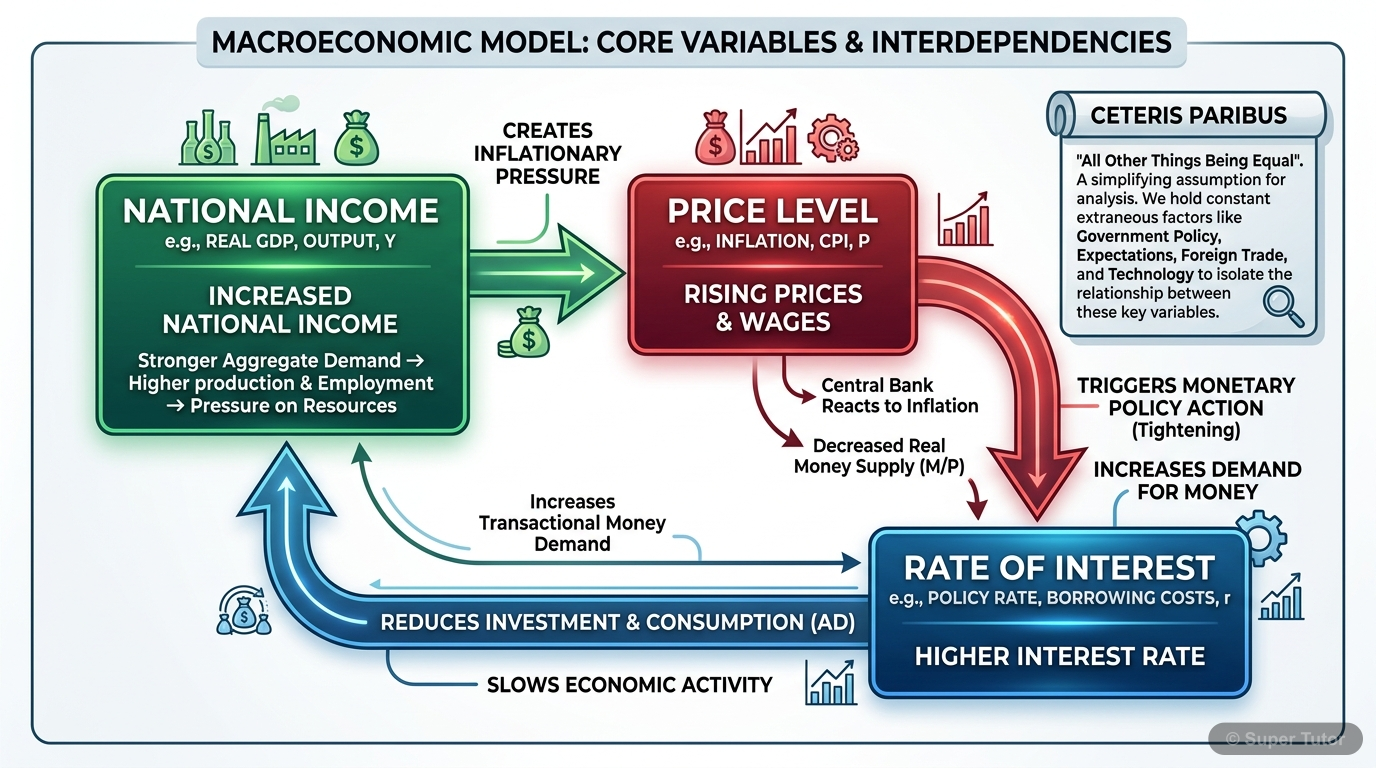
Super Tutor has 12+ illustrations like this for Determination of Income and Employment alone — flashcards, concept maps, and step-by-step visuals.
See them allWhat is the difference between ex-ante and ex-post in macroeconomic analysis?
Answer
Ex-ante refers to planned or intended values (what is planned to happen), while ex-post refers to actual or realized values (what actually happened). For example, if a producer plans to add Rs 100 to …
Define consumption function and write its mathematical form.
Answer
Consumption function describes the relationship between consumption and income. It is written as C = C̄ + cY, where C is total consumption, C̄ is autonomous consumption (consumption when income is zer…
What is Marginal Propensity to Consume (MPC)? What are its possible values?
Answer
MPC is the change in consumption per unit change in income. It is denoted by 'c' and equals ΔC/ΔY. MPC can take values between 0 and 1 (inclusive). MPC = 0 means no change in consumption with income c…
If MPC = 0.8, what is MPS? Explain the relationship between MPC and MPS.
Answer
If MPC = 0.8, then MPS = 0.2. The relationship is MPC + MPS = 1, or MPS = 1 - MPC. This is because any change in income is either consumed or saved, so the sum of marginal propensities to consume and …
What is autonomous consumption? Give an example.
Answer
Autonomous consumption (C̄) is the consumption that occurs even when income is zero. It represents basic subsistence needs that must be met regardless of income level. For example, if C = 100 + 0.8Y, …
Define Average Propensity to Consume (APC) and Average Propensity to Save (APS).
Answer
APC is consumption per unit of income, calculated as C/Y. APS is savings per unit of income, calculated as S/Y. The relationship is APC + APS = 1, since income is either consumed or saved.
What is investment in macroeconomic terms? How is it represented in the simple model?
Answer
Investment is addition to the stock of physical capital (machines, buildings, roads) and changes in inventory. In the simple model, investment is assumed to be autonomous (independent of income level)…
Write the aggregate demand function for a two-sector economy and explain its components.
Answer
AD = C̄ + Ī + cY, where AD is aggregate demand, C̄ is autonomous consumption, Ī is autonomous investment, c is MPC, and Y is income. The autonomous components (C̄ + Ī) can be combined as A, making it …
+16 more flashcards available
Practice AllFrequently Asked Questions
What are the important topics in Determination of Income and Employment for Nagaland Board Class 12 Economics?
How to score full marks in Determination of Income and Employment — Nagaland Board Class 12 Economics?
How many flashcards are available for Determination of Income and Employment?
Sources & Official References
Content is aligned to the official syllabus. Refer to the board website for the latest curriculum.
More resources for Determination of Income and Employment
Important Questions
Practice with board exam-style questions
Syllabus
What topics to cover
Revision Notes
Key points for last-minute revision
Study Plan
Step-by-step plan to ace this chapter
Formula Sheet
All formulas in one place
Chapter Summary
Understand the chapter at a glance
Practice Quiz
Test yourself with a quick quiz
Concept Maps
See how topics connect visually
NCERT Solutions
Every textbook question solved step by step
For serious students
Get the full Determination of Income and Employment chapter — for free.
Quizzes, flashcards, AI doubt-solver and a step-by-step study plan for Nagaland Board Class 12 Economics.