The Market as a Social Institution
Nagaland Board · Class 12 · Sociology
Summary of The Market as a Social Institution for Nagaland Board Class 12 Sociology. Key concepts, important points, and chapter overview.
Interactive on Super Tutor
Studying The Market as a Social Institution? Get the full interactive chapter.
Quizzes, flashcards, AI doubt-solver and a step-by-step study plan — built for chapter summary and more.
1,000+ Class 12 students started this chapter today
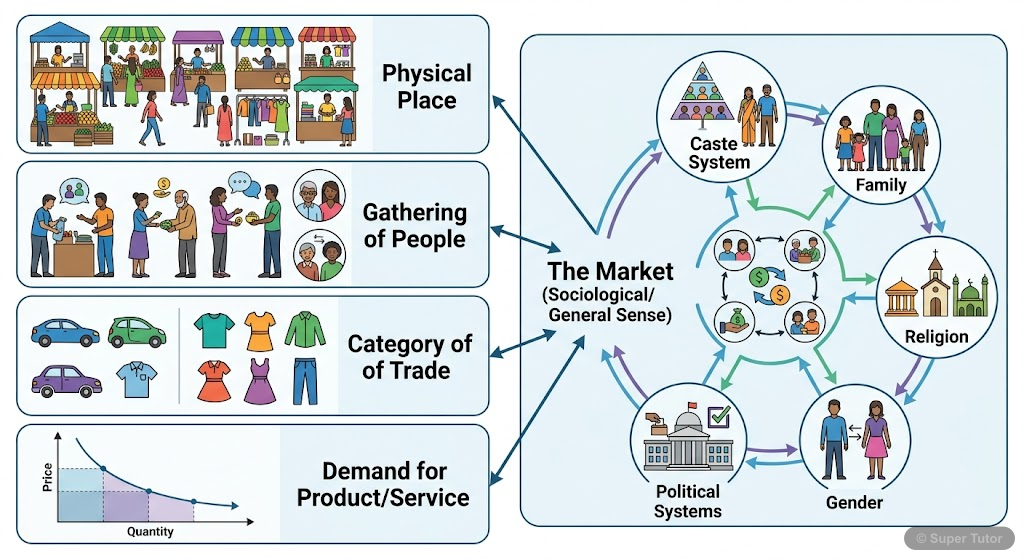
This is just one of 12+ visuals inside Super Tutor's The Market as a Social Institution chapter
Explore the full setOverview
This chapter explores how markets function not just as economic institutions but as social institutions embedded in cultural contexts. While we commonly think of markets as places where goods are bought and sold, sociology reveals that markets are shaped by social relationships, community networks,
Key Concepts
Markets are not just economic spaces
Markets are not just economic spaces but social institutions shaped by cultural norms, community relationships, and social structures. They operate wi
Economic activities are embedded within social
Economic activities are embedded within social relationships and cultural contexts rather than operating as separate, autonomous systems. This concept
Periodic markets in tribal and rural
Periodic markets in tribal and rural areas that serve both economic and social functions. These markets bring together people from surrounding village
Caste
Caste-based trading communities like Marwaris, Nakarattars, and various Vaisya groups that organize business activities through kinship and community
The process by which things
The process by which things that were previously not traded in markets become commodities that can be bought and sold. Examples include labor, educati
Learning Objectives
- Understand the concept of market as a social institution beyond its economic function
- Analyze how markets are socially embedded in Indian society
- Examine the relationship between traditional business communities and market organization
- Explore the impact of colonialism on Indian markets and trading systems
- Understand the process of commodification in capitalist societies
Frequently Asked Questions
What are the important topics in The Market as a Social Institution for Nagaland Board Class 12 Sociology?
How to score full marks in The Market as a Social Institution — Nagaland Board Class 12 Sociology?
Sources & Official References
Content is aligned to the official syllabus. Refer to the board website for the latest curriculum.
More resources for The Market as a Social Institution
Important Questions
Practice with board exam-style questions
Syllabus
What topics to cover
Revision Notes
Key points for last-minute revision
Study Plan
Step-by-step plan to ace this chapter
Flashcards
Quick-fire cards for active recall
Formula Sheet
All formulas in one place
Practice Quiz
Test yourself with a quick quiz
Concept Maps
See how topics connect visually
NCERT Solutions
Every textbook question solved step by step
For serious students
Get the full The Market as a Social Institution chapter — for free.
Quizzes, flashcards, AI doubt-solver and a step-by-step study plan for Nagaland Board Class 12 Sociology.