Introducing Indian Society
Nagaland Board · Class 12 · Sociology
Flashcards for Introducing Indian Society — Nagaland Board Class 12 Sociology. Quick Q&A cards covering key concepts, definitions, and formulas.
Interactive on Super Tutor
Studying Introducing Indian Society? Get the full interactive chapter.
Quizzes, flashcards, AI doubt-solver and a step-by-step study plan — built for flashcards and more.
1,000+ Class 12 students started this chapter today
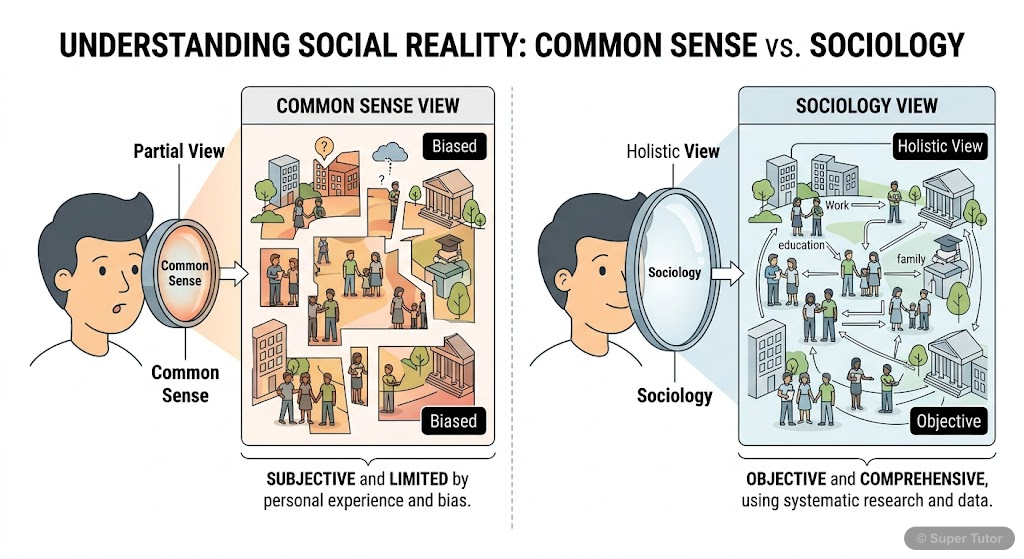
Super Tutor has 5+ illustrations like this for Introducing Indian Society alone — flashcards, concept maps, and step-by-step visuals.
See them allWhat makes Sociology different from other subjects that students learn in school?
Answer
Unlike other subjects where students start from zero, everyone already knows something about society before studying Sociology. This prior knowledge is both an advantage (students aren't afraid of the…
Define 'common sense' in sociological terms and explain why it can be problematic.
Answer
Common sense is our prior knowledge about society acquired from our particular social group and environment. It's problematic because it's 'partial' in two ways: (1) incomplete - shows only part of so…
What is self-reflexivity in sociology?
Answer
Self-reflexivity is the ability to reflect upon yourself and look at yourself 'from the outside'. It involves turning your gaze (usually directed outward) back towards yourself with critical self-insp…
What percentage of India's population consists of young people (17-18 years and younger)?
Answer
About 40% of India's population consists of young people aged 17-18 and younger, making youth a significant demographic group in Indian society.
According to C. Wright Mills, what is the difference between 'personal troubles' and 'social issues'?
Answer
Personal troubles are individual worries, problems, or concerns that affect one person (like family relationships or job worries). Social issues are about large groups and social patterns, not individ…
What are the different types of social identities that can locate you on India's 'social map'?
Answer
Age group (young people), regional/linguistic community (like Gujarati or Telugu speakers), economic class (based on family income and occupation), religious community, caste or tribe, and other socia…
What is India's current population ranking globally and what is projected for the future?
Answer
India is currently the second most populous country in the world. In a few decades, it is projected to overtake China and become the most populous country in the world.
What are the three basic building blocks or institutions of Indian society discussed in the textbook?
Answer
The three basic building blocks of Indian society are: (1) Caste, (2) Tribe, and (3) Family. These institutions form the foundation for understanding other aspects of Indian society.
+12 more flashcards available
Practice AllFrequently Asked Questions
What are the important topics in Introducing Indian Society for Nagaland Board Class 12 Sociology?
How to score full marks in Introducing Indian Society — Nagaland Board Class 12 Sociology?
How many flashcards are available for Introducing Indian Society?
Sources & Official References
Content is aligned to the official syllabus. Refer to the board website for the latest curriculum.
More resources for Introducing Indian Society
Important Questions
Practice with board exam-style questions
Syllabus
What topics to cover
Revision Notes
Key points for last-minute revision
Study Plan
Step-by-step plan to ace this chapter
Formula Sheet
All formulas in one place
Chapter Summary
Understand the chapter at a glance
Practice Quiz
Test yourself with a quick quiz
Concept Maps
See how topics connect visually
NCERT Solutions
Every textbook question solved step by step
For serious students
Get the full Introducing Indian Society chapter — for free.
Quizzes, flashcards, AI doubt-solver and a step-by-step study plan for Nagaland Board Class 12 Sociology.