Patterns of Social Inequality and Exclusion
Nagaland Board · Class 12 · Sociology
Complete topic list for Patterns of Social Inequality and Exclusion in Nagaland Board Class 12 Sociology. Key concepts, sub-topics, and what to focus on for board exams.
Interactive on Super Tutor
Studying Patterns of Social Inequality and Exclusion? Get the full interactive chapter.
Quizzes, flashcards, AI doubt-solver and a step-by-step study plan — built for syllabus and more.
1,000+ Class 12 students started this chapter today
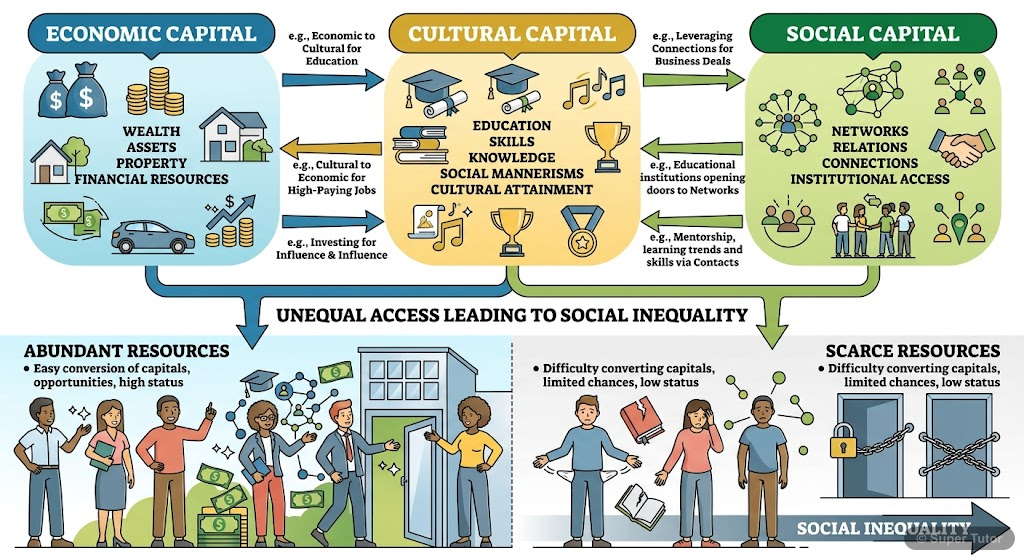
This is just one of 12+ visuals inside Super Tutor's Patterns of Social Inequality and Exclusion chapter
Explore the full setTopics in Patterns of Social Inequality and Exclusion
Understanding Social Inequality and Exclusion
- Social inequality refers to unequal access to social resources like money, property, education, health, and power
- Three forms of capital: Economic (material assets), Cultural (education/status), Social (networks/contacts)
- Social stratification is a society-wide system that ranks categories of people in a hierarchy
Caste-Based Inequality and Dalits
- Caste system legitimizes discrimination based on birth and traditional occupation
- Historical correlation between caste status and economic status remains strong at macro level
- Untouchability is extreme form involving exclusion, humiliation-subordination, and exploitation
Other Backward Classes (OBCs)
- Constitutionally recognized as 'socially and educationally backward classes'
- More diverse group than Dalits or Adivasis, defined negatively by what they are not
- Include service and artisanal castes from lower rungs of caste hierarchy
Adivasis and Tribal Communities
- Term 'Adivasi' means 'original inhabitants', coined in 1930s as political assertion
- Boundaries between 'tribe' and 'caste' are porous due to long historical interactions
- Colonial period: forest rights severed, forced into wage labor or illegal forest use
Key Concepts
Frequently Asked Questions
What are the important topics in Patterns of Social Inequality and Exclusion for Nagaland Board Class 12 Sociology?
How to score full marks in Patterns of Social Inequality and Exclusion — Nagaland Board Class 12 Sociology?
Sources & Official References
Content is aligned to the official syllabus. Refer to the board website for the latest curriculum.
More resources for Patterns of Social Inequality and Exclusion
Important Questions
Practice with board exam-style questions
Revision Notes
Key points for last-minute revision
Study Plan
Step-by-step plan to ace this chapter
Flashcards
Quick-fire cards for active recall
Formula Sheet
All formulas in one place
Chapter Summary
Understand the chapter at a glance
Practice Quiz
Test yourself with a quick quiz
Concept Maps
See how topics connect visually
NCERT Solutions
Every textbook question solved step by step
For serious students
Get the full Patterns of Social Inequality and Exclusion chapter — for free.
Quizzes, flashcards, AI doubt-solver and a step-by-step study plan for Nagaland Board Class 12 Sociology.