Biotechnology and its Applications
Odisha Board · Class 12 · Biology
NCERT Solutions for Biotechnology and its Applications — Odisha Board Class 12 Biology.
Interactive on Super Tutor
Studying Biotechnology and its Applications? Get the full interactive chapter.
Quizzes, flashcards, AI doubt-solver and a step-by-step study plan — built for ncert solutions and more.
1,000+ Class 12 students started this chapter today
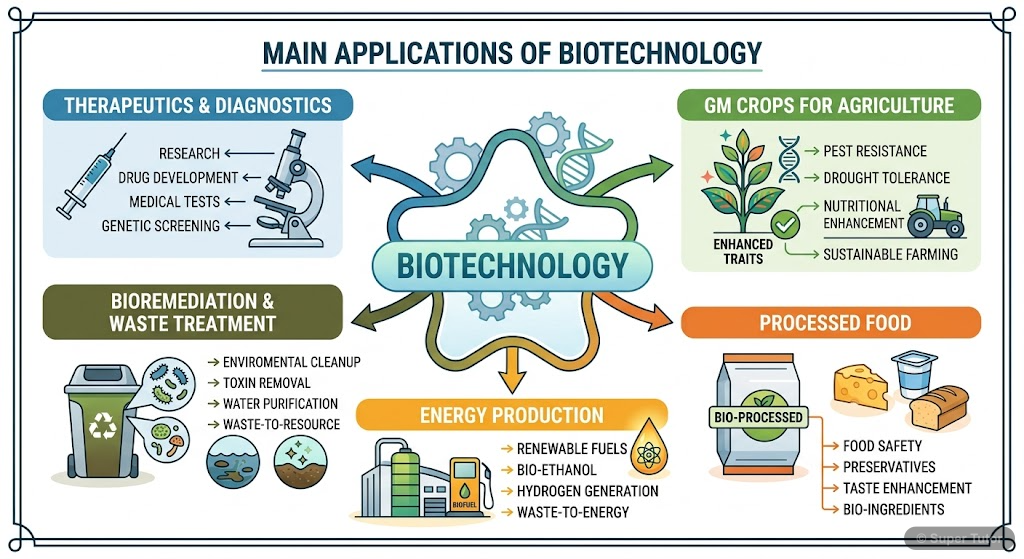
Super Tutor has 12+ illustrations like this for Biotechnology and its Applications alone — flashcards, concept maps, and step-by-step visuals.
See them allEXERCISES — Biotechnology and its Applications
1Which part of the plant is best suited for making virus-free plants and why?Show solution
Viruses spread systemically through the vascular tissue of plants, but they do not infect the apical meristem (shoot tip) because the meristematic cells divide rapidly and viruses cannot keep pace with the fast-dividing cells. Also, the vascular tissue (phloem) is not yet differentiated in the meristem region, so the virus cannot reach there.
Answer:
The shoot apical meristem (meristematic tip / apical dome) is best suited for making virus-free plants.
Reason:
1. Meristematic cells are actively and rapidly dividing; viruses cannot infect them as fast as the cells divide.
2. The vascular system (through which viruses travel) is absent or not yet differentiated in the apical meristem.
3. When explants from the shoot apex are cultured in vitro (meristem culture), the regenerated plants are free from viral infection.
This technique is widely used to produce virus-free varieties of potato, sugarcane, banana, etc.
2What is the major advantage of producing plants by micropropagation?Show solution
Major Advantages:
1. Rapid mass multiplication: A very large number of plants (thousands to millions) can be produced from a single explant in a short period of time.
2. True-to-type plants (somaclonal uniformity): All plants produced are genetically identical to the parent plant (clones), ensuring uniformity.
3. Year-round production: Plants can be produced throughout the year, independent of season.
4. Disease-free plants: Meristem culture can produce virus-free and pathogen-free plants.
5. Conservation of rare/endangered species: Rare plants can be multiplied and conserved.
6. Space-saving: Large numbers of plants can be raised in a small laboratory space.
Most significant advantage: It allows production of a large number of genetically identical, disease-free plants in a short time — something not possible through conventional vegetative propagation.
3Find out what the various components of the medium used for propagation of an explant in vitro are?Show solution
Components of the tissue culture medium (e.g., Murashige and Skoog medium):
| Component | Examples / Role |
|---|---|
| Macronutrients (inorganic salts) | Nitrogen (NO₃⁻, NH₄⁺), Phosphorus, Potassium, Calcium, Magnesium, Sulphur — for general plant nutrition |
| Micronutrients (trace elements) | Iron, Manganese, Zinc, Boron, Copper, Molybdenum — required in small amounts |
| Carbon source (energy source) | Sucrose (2–3%) — since explants cannot photosynthesize sufficiently |
| Vitamins | Thiamine (B₁), Nicotinic acid, Pyridoxine (B₆) — for metabolic activities |
| Plant growth regulators (PGRs) | Auxins (e.g., IAA, 2,4-D) — promote cell elongation and root formation; Cytokinins (e.g., BAP, kinetin) — promote cell division and shoot formation |
| Amino acids | Glycine, glutamine — as nitrogen source |
| Gelling agent | Agar (0.8–1%) — to solidify the medium for solid cultures |
| Water | Distilled/deionised water — solvent for all components |
| pH | Adjusted to 5.7–5.8 |
Note: The ratio of auxin to cytokinin determines organogenesis — high auxin:cytokinin promotes rooting; high cytokinin:auxin promotes shoot formation; equal ratio promotes callus formation.
4Crystals of Bt toxin produced by some bacteria do not kill the bacteria themselves because —
(a) bacteria are resistant to the toxin
(b) toxin is immature;
(c) toxin is inactive;
(d) bacteria encloses toxin in a special sac.Show solution
Justification:
The Bt toxin (δ-endotoxin) is produced by *Bacillus thuringiensis* as an inactive protoxin (pro-form) and stored as crystalline inclusions (parasporal crystals) inside the bacterial cell. Since the toxin is in its inactive (protoxin) form inside the bacterium, it does not harm the bacterium itself.
When ingested by a susceptible insect larva, the alkaline pH of the insect's midgut (pH ~10) solubilises the crystals, and the inactive protoxin is converted to the active toxin by gut proteases. The active toxin then binds to the epithelial cells of the midgut, creates pores, causes cell swelling and lysis, leading to the death of the insect larva.
Thus, the bacteria are not killed because the toxin remains inactive (as protoxin) inside the bacterial cell.
5What are transgenic bacteria? Illustrate using any one example.Show solution
Transgenic bacteria are bacteria into which a foreign gene (from another organism) has been introduced using recombinant DNA technology, enabling them to express a new (foreign) protein or acquire a new trait.
How they are made:
- The gene of interest is isolated from the donor organism.
- It is inserted into a suitable vector (e.g., plasmid).
- The recombinant vector is introduced into the host bacterium (e.g., *E. coli*).
- The bacterium expresses the foreign gene and produces the desired protein.
Example — Production of Human Insulin (Humulin):
1. Human insulin is normally produced by β-cells of the islets of Langerhans in the pancreas.
2. Insulin consists of two polypeptide chains — Chain A and Chain B — linked by disulphide bonds.
3. Using rDNA technology:
- The gene for insulin A-chain and B-chain were chemically synthesised.
- Each chain gene was separately introduced into plasmids and cloned in *E. coli*.
- *E. coli* expressed the genes and produced the respective chains.
- The two chains were extracted, purified, and combined by creating disulphide bonds to form functional human insulin.
4. This recombinant human insulin, called Humulin, was first produced by Eli Lilly (USA) in 1982.
Significance: Humulin is identical to human insulin, does not cause immune reactions, and is free from risk of animal-borne infections (unlike earlier pig/cow-derived insulin).
6Compare and contrast the advantages and disadvantages of production of genetically modified crops.Show solution
ADVANTAGES:
| S.No. | Advantage | Example |
|---|---|---|
| 1. | Increased crop yield — improved growth and productivity | Bt cotton, Bt brinjal |
| 2. | Pest resistance — crops express insecticidal proteins, reducing pesticide use | Bt crops expressing Cry proteins |
| 3. | Herbicide tolerance — crops can withstand herbicide application | Herbicide-tolerant soybean |
| 4. | Abiotic stress tolerance — tolerance to drought, cold, salinity | Drought-tolerant maize |
| 5. | Improved nutritional quality — enhanced vitamins, minerals, proteins | Golden Rice (β-carotene/Vitamin A) |
| 6. | Reduced post-harvest losses — delayed ripening, longer shelf life | Flavr Savr tomato |
| 7. | Reduced dependence on chemical pesticides — environmentally friendly | Bt crops |
| 8. | Phytoremediation — plants engineered to remove heavy metals from soil | Tobacco with mercury tolerance |
DISADVANTAGES:
| S.No. | Disadvantage | Concern |
|---|---|---|
| 1. | Potential health risks — allergenicity, toxicity of novel proteins | Unknown long-term effects on humans |
| 2. | Loss of biodiversity — monoculture of GM crops may displace native varieties | Genetic erosion |
| 3. | Gene flow to wild relatives — transgenes may spread to wild plants creating 'superweeds' | Ecological imbalance |
| 4. | Ethical concerns — 'playing God', patenting of life forms | Biopiracy, corporate monopoly |
| 5. | Resistance development in pests — insects may develop resistance to Bt toxin over time | Reduced effectiveness |
| 6. | Harm to non-target organisms — Bt toxin may affect beneficial insects like bees | Ecological disruption |
| 7. | Economic concerns — high cost of GM seeds, dependence on seed companies | Farmer exploitation |
Conclusion: While GM crops offer significant benefits in food security and agriculture, their large-scale adoption requires careful risk assessment, regulation, and ethical consideration.
7What are Cry proteins? Name an organism that produces it. How has man exploited this protein to his benefit?Show solution
Cry proteins (also called δ-endotoxins or Bt toxins) are insecticidal proteins encoded by cry genes. They are produced as inactive protoxin crystals (parasporal crystals) during the sporulation phase of the bacterium.
Organism that produces Cry proteins:
*Bacillus thuringiensis* (Bt) — a gram-positive, soil-dwelling bacterium.
Mechanism of action:
1. Cry proteins are produced as inactive protoxins.
2. When ingested by a susceptible insect larva, the alkaline pH of the midgut solubilises the crystals.
3. Gut proteases convert the protoxin into the active toxin.
4. The active toxin binds to specific receptors on the epithelial cells of the midgut.
5. It creates pores/holes in the cell membrane, causing cell swelling, lysis, and ultimately death of the insect larva.
Different Cry proteins are specific to different insects:
- CryIAc and CryIIAb → target bollworms (cotton pests)
- CryIAb → target corn borer
- CryIIIAb → target Colorado potato beetle
- CryIVB → target mosquito larvae
How man has exploited Cry proteins:
1. Bt crops (Transgenic crops): The *cry* genes have been isolated from *B. thuringiensis* and introduced into crop plants using rDNA technology.
- Bt cotton — contains *cryIAc* and *cryIIAb* genes — resistant to bollworms.
- Bt corn — contains *cryIAb* gene — resistant to corn borer.
- Bt brinjal — resistant to fruit and shoot borer.
2. Biopesticides: Spore-crystal mixtures of *B. thuringiensis* are used as biological pesticides (sprayed on crops) — an eco-friendly alternative to chemical pesticides.
Benefit: Reduced use of chemical pesticides → lower cost of cultivation, less environmental pollution, and safer food.
8What is gene therapy? Illustrate using the example of adenosine deaminase (ADA) deficiency.Show solution
Gene therapy is a technique used to correct a gene defect in an individual by:
- Inserting a functional (normal) copy of the defective gene into the target cells, OR
- Replacing a defective mutant allele with a functional one.
It is used to treat hereditary (genetic) diseases where a gene is absent or non-functional.
Illustration — ADA (Adenosine Deaminase) Deficiency:
Background:
- ADA deficiency is caused by the deletion/mutation of the gene encoding the enzyme Adenosine Deaminase.
- ADA is crucial for the functioning of the immune system (specifically T-lymphocytes).
- Without ADA, toxic metabolites accumulate and destroy T-cells, leading to Severe Combined Immunodeficiency (SCID) — the child cannot fight infections.
Steps in Gene Therapy for ADA deficiency:
Outcome: The introduced lymphocytes produce functional ADA enzyme, restoring immune function.
Limitation: This is not a permanent cure because the introduced lymphocytes have a finite life span. The patient requires periodic infusion of engineered lymphocytes.
Permanent cure possibility: If the ADA gene is introduced into cells at the early embryonic stage, it could provide a permanent cure, as all cells derived from that embryo would carry the functional gene.
Alternative treatment: Enzyme replacement therapy — injection of ADA enzyme — but it is expensive and not permanent.
9Diagrammatically represent the experimental steps in cloning and expressing a human gene (say the gene for growth hormone) into a bacterium like E. coli?Show solution
**Steps in Cloning and Expressing Human Growth Hormone Gene in *E. coli*:
Step 1: Isolation of the gene of interest
Step 2: Cutting the gene and vector with restriction endonuclease
Step 3: Ligation — Formation of Recombinant DNA
Step 4: Transformation into *E. coli*
Step 5: Selection of transformants
Step 6: Expression of the gene
Step 7: Extraction and purification
Diagrammatic Representation (described):
```
Human cell
|
| (extract mRNA → reverse transcriptase)
↓
cDNA of GH gene
|
| (cut with restriction enzyme)
↓
Gene with sticky ends
+
Plasmid vector (cut with same enzyme)
|
| (DNA Ligase)
↓
Recombinant Plasmid
|
| (Transformation into E. coli)
↓
Transformed E. coli
|
| (Culture, expression)
↓
Recombinant Human Growth Hormone
```
Note:** The recombinant human growth hormone produced is identical to the natural hormone and is used to treat growth hormone deficiency (dwarfism) in children.
10Can you suggest a method to remove oil (hydrocarbon) from seeds based on your understanding of rDNA technology and chemistry of oil?Show solution
Seed oils (e.g., in groundnut, soybean, mustard) are triglycerides — esters of glycerol and fatty acids. They are synthesised in seeds through specific enzymatic pathways. Key enzymes involved include fatty acid synthase, desaturases, and acyl transferases.
Method using rDNA Technology — RNA Interference (RNAi) / Gene Silencing:
Approach 1 — Antisense RNA / RNAi technology:
1. Identify the key gene(s) encoding enzymes responsible for oil (fatty acid/triglyceride) biosynthesis in seeds (e.g., the gene for fatty acid synthase or acyl-ACP thioesterase).
2. Using rDNA technology, introduce a complementary (antisense) sequence of this gene into the plant.
3. The antisense RNA produced will bind to the mRNA of the oil-synthesis gene, forming a double-stranded RNA (dsRNA).
4. This triggers RNA interference (RNAi) — the dsRNA is degraded by the RISC complex, silencing the gene.
5. As a result, the enzyme for oil synthesis is not produced → oil is not synthesised in seeds.
Approach 2 — Knockout of oil biosynthesis genes:
1. Using rDNA technology, the gene(s) encoding key enzymes in the fatty acid biosynthesis pathway can be knocked out (deleted or disrupted).
2. This prevents the formation of triglycerides in seeds.
Approach 3 — Overexpression of lipase gene:
1. Introduce a gene encoding lipase (an enzyme that breaks down triglycerides) under a seed-specific promoter.
2. The lipase will degrade the oil within the seed itself.
Most practical method: RNAi-mediated silencing of the key oil biosynthesis gene is the most widely used approach in modern biotechnology to alter oil content in seeds.
Application: This approach is already used to produce low-erucic acid canola (rapeseed) and high-oleic soybean by modifying fatty acid desaturase genes.
11Find out from internet what is golden rice.Show solution
Definition:
Golden Rice is a variety of rice (*Oryza sativa*) that has been genetically modified to produce β-carotene (a precursor of Vitamin A) in the edible endosperm (grain). It appears golden-yellow in colour due to the accumulation of β-carotene, hence the name.
Why was it developed?
Vitamin A deficiency (VAD) is a major public health problem in developing countries, especially in Asia and Africa, causing:
- Night blindness and permanent blindness (especially in children)
- Weakened immune system
- Increased mortality in children
Normal rice does not produce β-carotene in its endosperm.
How was it made?
Golden Rice was developed by Ingo Potrykus and Peter Beyer in the late 1990s.
Two genes were introduced into rice:
1. Psy gene (phytoene synthase) — from daffodil (*Narcissus pseudonarcissus*) or maize
2. CrtI gene (carotene desaturase) — from the bacterium *Erwinia uredovora*
These genes enable the rice endosperm to synthesise β-carotene through the carotenoid biosynthesis pathway.
Golden Rice 2:
An improved version (Golden Rice 2) was developed using the *psy* gene from maize, which produces 23 times more β-carotene than the original Golden Rice.
Significance:
- Provides Vitamin A to populations dependent on rice as a staple food.
- A cost-effective, sustainable solution to Vitamin A deficiency.
- Does not require changes in dietary habits.
Controversy:
Golden Rice remains controversial due to concerns about GM food safety, environmental impact, and corporate control of food supply.
12Does our blood have proteases and nucleases?Show solution
Explanation:
1. Proteases in blood:
- Blood does contain some proteolytic enzymes, but they are present in inactive forms (zymogens/proenzymes), e.g., prothrombin (inactive form of thrombin), plasminogen (inactive form of plasmin).
- These are activated only under specific conditions (e.g., during blood clotting or fibrinolysis).
- Active proteases in blood would be harmful as they would digest blood proteins and plasma proteins.
- Therefore, active proteases are NOT normally present in blood.
2. Nucleases in blood:
- Blood plasma contains very low levels of DNase and RNase activity.
- However, significant active nucleases are not normally present in circulating blood.
- If nucleases were present in blood, they would degrade the nucleic acids of blood cells and other cells.
Relevance to Biotechnology:
This is why recombinant proteins (like insulin, gene therapy vectors) can be administered intravenously — they are not immediately degraded by proteases or nucleases in the blood.
However, oral administration of protein drugs is a problem because the digestive system (stomach and intestine) contains active proteases (pepsin, trypsin, chymotrypsin) and nucleases that would degrade the protein/DNA before absorption.
Conclusion: Blood does not have significant active proteases and nucleases under normal physiological conditions, which is essential for maintaining the integrity of blood proteins and cellular DNA/RNA.
13Consult internet and find out how to make orally active protein pharmaceutical. What is the major problem to be encountered?Show solution
Most protein-based drugs (e.g., insulin, growth hormone, interferon) are currently administered by injection (parenteral route) because proteins are degraded in the gastrointestinal (GI) tract when taken orally.
Major Problem:
The major problem with oral administration of protein pharmaceuticals is:
1. Degradation by digestive enzymes: The stomach contains pepsin (acidic pH ~2) and the intestine contains trypsin, chymotrypsin, elastase, peptidases — these proteases rapidly degrade the protein drug before it can be absorbed.
2. Acidic pH of stomach: The low pH (1.5–3.5) of gastric juice denatures and inactivates most proteins.
3. Poor absorption: Large protein molecules cannot easily cross the intestinal epithelium (poor permeability).
4. First-pass metabolism: Even if absorbed, proteins may be degraded in the liver before reaching systemic circulation.
Methods to make proteins orally active:
1. Microencapsulation / Nanoparticle delivery:
- Proteins are enclosed in biodegradable polymeric nanoparticles or liposomes that protect them from gastric acid and enzymes.
- The capsule dissolves in the intestine, releasing the protein for absorption.
2. Enteric coating:
- Coating the drug with a pH-sensitive polymer that resists gastric acid but dissolves at the higher pH of the intestine.
3. Use of protease inhibitors:
- Co-administering protease inhibitors along with the protein drug to prevent enzymatic degradation.
4. Chemical modification of proteins:
- PEGylation (attaching polyethylene glycol) — protects protein from proteolysis and increases stability.
- Cyclisation or introduction of non-natural amino acids to make proteins resistant to proteases.
5. Mucoadhesive systems:
- Formulations that adhere to the intestinal mucosa, increasing contact time and absorption.
6. Transgenic plants producing edible vaccines/proteins:
- Genes for therapeutic proteins are expressed in edible plant parts (e.g., banana, tomato) — when eaten, the protein is released in the gut.
- Example: Edible vaccines in banana for hepatitis B.
7. Absorption enhancers:
- Chemicals that temporarily increase intestinal permeability to allow protein absorption.
Conclusion:
The major problem is proteolytic degradation of the protein in the GI tract (by pepsin, trypsin, chymotrypsin) and the acidic environment of the stomach. Overcoming these barriers while maintaining protein bioactivity and ensuring sufficient absorption remains the central challenge in developing orally active protein pharmaceuticals.
Stuck on a step?
Ask Super Tutor AI to explain any solution on this page in a simpler way — free, 24x7.
Ask a Doubt FreeFrequently Asked Questions
What are the important topics in Biotechnology and its Applications for Odisha Board Class 12 Biology?
How to score full marks in Biotechnology and its Applications — Odisha Board Class 12 Biology?
Where can I get free NCERT Solutions for Biotechnology and its Applications Class 12 Biology?
Sources & Official References
Content is aligned to the official syllabus. Refer to the board website for the latest curriculum.
More resources for Biotechnology and its Applications
Important Questions
Practice with board exam-style questions
Syllabus
What topics to cover
Revision Notes
Key points for last-minute revision
Study Plan
Step-by-step plan to ace this chapter
Flashcards
Quick-fire cards for active recall
Formula Sheet
All formulas in one place
Chapter Summary
Understand the chapter at a glance
Practice Quiz
Test yourself with a quick quiz
Concept Maps
See how topics connect visually
For serious students
Get the full Biotechnology and its Applications chapter — for free.
Quizzes, flashcards, AI doubt-solver and a step-by-step study plan for Odisha Board Class 12 Biology.