Coordination Compounds
Odisha Board · Class 12 · Chemistry
Most important questions from Coordination Compounds for Odisha Board Class 12 Chemistry board exam 2026. MCQs, short answer, and long answer questions with marks.
Interactive on Super Tutor
Studying Coordination Compounds? Get the full interactive chapter.
Quizzes, flashcards, AI doubt-solver and a step-by-step study plan — built for important questions and more.
1,000+ Class 12 students started this chapter today
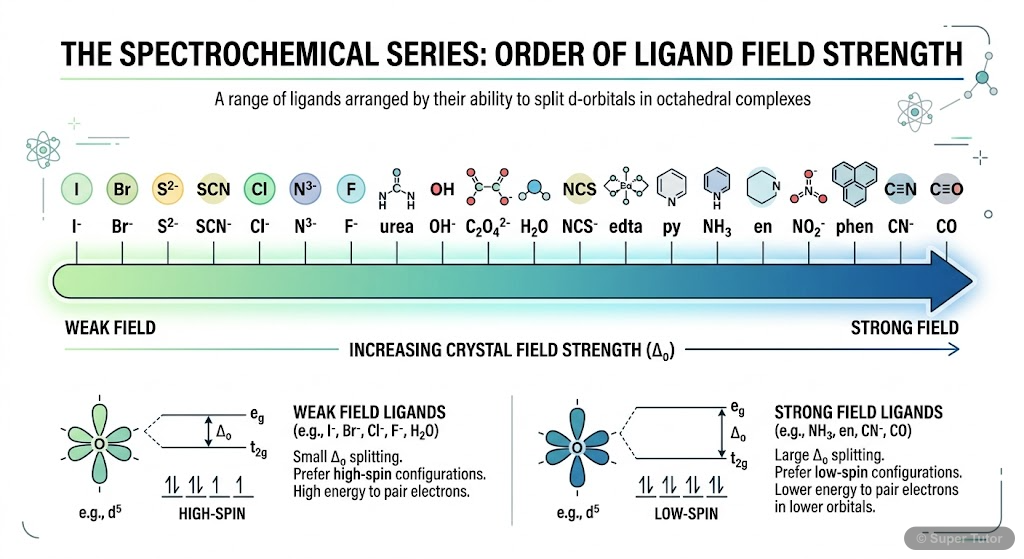
Super Tutor has 22+ illustrations like this for Coordination Compounds alone — flashcards, concept maps, and step-by-step visuals.
See them allSample Questions
Which of the following are characteristics of ligands? (Select all correct answers)
Show answer
They donate electron pairs to the central metal, They can be ions or neutral molecules, They form coordinate bonds with metals
Ligands are species that donate electron pairs to form coordinate bonds with central metal atoms/ions. They can be anions (like Cl-), neutral molecules (like NH3, H2O), or even cations in rare cases. They are not always negatively charged - NH3 and H2O are neutral ligands.
Which of the following correctly describes the naming rules for coordination compounds? (Select all correct answers)
Show answer
Ligands are named before the metal, Anionic ligands end in -o, The metal in an anionic complex ends in -ate, Oxidation state is shown in Roman numerals, Cation is always named first
All these are correct IUPAC naming rules: ligands come before metal in naming, anionic ligands end in -o (chloro, cyano), metals in anionic complexes end in -ate (ferrate, chromate), oxidation states use Roman numerals in parentheses, and cations are named first regardless of charge.
Which theory explains the color of coordination compounds?
Show answer
Crystal Field theory
Crystal Field Theory explains the color of coordination compounds through d-d electronic transitions. When ligands approach the metal ion, d orbitals split into different energy levels. Light absorption occurs when electrons transition between these split d orbitals, giving rise to color.
In octahedral complexes, d orbitals split into which two sets?
Show answer
t2g and eg
In octahedral crystal field, the five d orbitals split into two sets: t2g (lower energy, containing dxy, dxz, dyz) and eg (higher energy, containing dx2-y2, dz2). The t2g orbitals are directed between the ligands while eg orbitals point directly toward the ligands.
+87 more questions available
Practice AllFrequently Asked Questions
What are the important topics in Coordination Compounds for Odisha Board Class 12 Chemistry?
How to score full marks in Coordination Compounds — Odisha Board Class 12 Chemistry?
How many important questions are there in Coordination Compounds?
Sources & Official References
Content is aligned to the official syllabus. Refer to the board website for the latest curriculum.
More resources for Coordination Compounds
Syllabus
What topics to cover
Revision Notes
Key points for last-minute revision
Study Plan
Step-by-step plan to ace this chapter
Flashcards
Quick-fire cards for active recall
Formula Sheet
All formulas in one place
Chapter Summary
Understand the chapter at a glance
Practice Quiz
Test yourself with a quick quiz
Concept Maps
See how topics connect visually
NCERT Solutions
Every textbook question solved step by step
For serious students
Get the full Coordination Compounds chapter — for free.
Quizzes, flashcards, AI doubt-solver and a step-by-step study plan for Odisha Board Class 12 Chemistry.