The Theory of the Firm Under Perfect Competition
Odisha Board · Class 12 · Economics
Flashcards for The Theory of the Firm Under Perfect Competition — Odisha Board Class 12 Economics. Quick Q&A cards covering key concepts, definitions, and formulas.
Interactive on Super Tutor
Studying The Theory of the Firm Under Perfect Competition? Get the full interactive chapter.
Quizzes, flashcards, AI doubt-solver and a step-by-step study plan — built for flashcards and more.
1,000+ Class 12 students started this chapter today
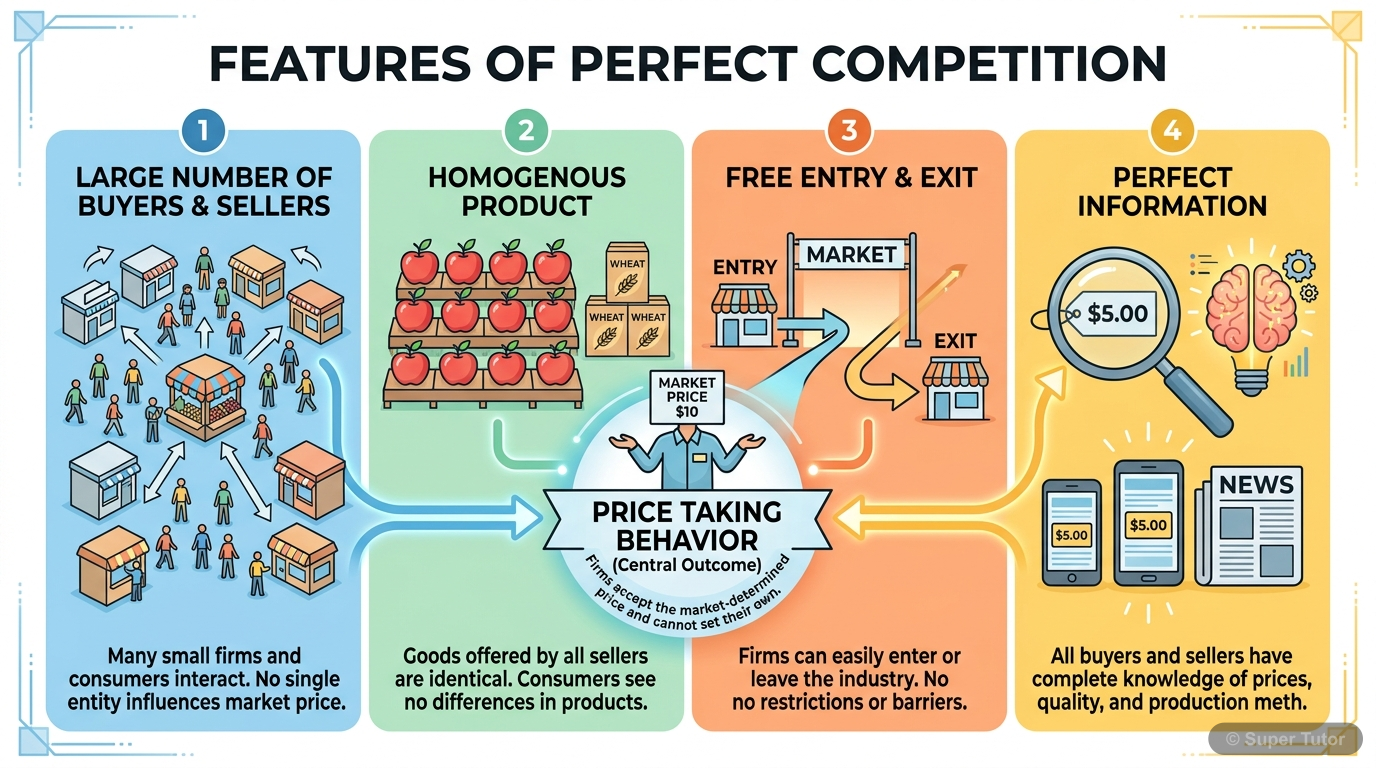
Learn better with visuals Super Tutor has hundreds of illustrations like this across every chapter — all free to try.
Get startedWhat are the four defining features of a perfectly competitive market?
Answer
1. Large number of buyers and sellers 2. Homogeneous (identical) products 3. Free entry and exit of firms 4. Perfect information These features lead to price-taking behavior where no individual buyer…
What is price-taking behavior?
Answer
Price-taking behavior means: - Firms believe they cannot sell anything if they set price above market price - Firms can sell as much as they want at or below market price - Buyers cannot get anything …
Define Total Revenue (TR) and write its formula.
Answer
Total Revenue (TR) is the total amount earned by a firm from selling its output. Formula: TR = P × Q Where: - P = Market price per unit - Q = Quantity sold by the firm Example: If price = Rs 10 and…
What is Average Revenue (AR) for a perfectly competitive firm?
Answer
Average Revenue (AR) = Total Revenue ÷ Quantity AR = TR/Q = (P × Q)/Q = P For a price-taking firm, Average Revenue equals the market price. The AR curve is a horizontal line at the market price lev…
What is Marginal Revenue (MR) and how is it calculated?
Answer
Marginal Revenue (MR) is the additional revenue earned from selling one more unit of output. MR = Change in TR ÷ Change in Q For a perfectly competitive firm: MR = P (market price) This is because …
For a perfectly competitive firm, what is the relationship between P, AR, and MR?
Answer
For a perfectly competitive firm: P = AR = MR All three are equal to the market price because: - AR = TR/Q = P - MR = Change in TR/Change in Q = P - The firm is a price-taker This creates a horizon…
Define profit and write its formula.
Answer
Profit (π) is the difference between total revenue and total cost. Formula: π = TR - TC Where: - π = Profit (Greek letter pi) - TR = Total Revenue - TC = Total Cost Profit represents the firm's net…
What are the three conditions for profit maximization?
Answer
For maximum profit at quantity q₀: 1. P = MC (Price equals Marginal Cost) 2. MC must be non-decreasing (rising) at q₀ 3. Short run: P ≥ AVC Long run: P ≥ AC All three conditions must be satisfied…
+16 more flashcards available
Practice AllFrequently Asked Questions
What are the important topics in The Theory of the Firm Under Perfect Competition for Odisha Board Class 12 Economics?
How to score full marks in The Theory of the Firm Under Perfect Competition — Odisha Board Class 12 Economics?
How many flashcards are available for The Theory of the Firm Under Perfect Competition?
Sources & Official References
Content is aligned to the official syllabus. Refer to the board website for the latest curriculum.
More resources for The Theory of the Firm Under Perfect Competition
Important Questions
Practice with board exam-style questions
Syllabus
What topics to cover
Revision Notes
Key points for last-minute revision
Study Plan
Step-by-step plan to ace this chapter
Formula Sheet
All formulas in one place
Chapter Summary
Understand the chapter at a glance
Practice Quiz
Test yourself with a quick quiz
Concept Maps
See how topics connect visually
NCERT Solutions
Every textbook question solved step by step
For serious students
Get the full The Theory of the Firm Under Perfect Competition chapter — for free.
Quizzes, flashcards, AI doubt-solver and a step-by-step study plan for Odisha Board Class 12 Economics.