Theory of Consumer Behavior
Odisha Board · Class 12 · Economics
NCERT Solutions for Theory of Consumer Behavior — Odisha Board Class 12 Economics.
Interactive on Super Tutor
Studying Theory of Consumer Behavior? Get the full interactive chapter.
Quizzes, flashcards, AI doubt-solver and a step-by-step study plan — built for ncert solutions and more.
1,000+ Class 12 students started this chapter today
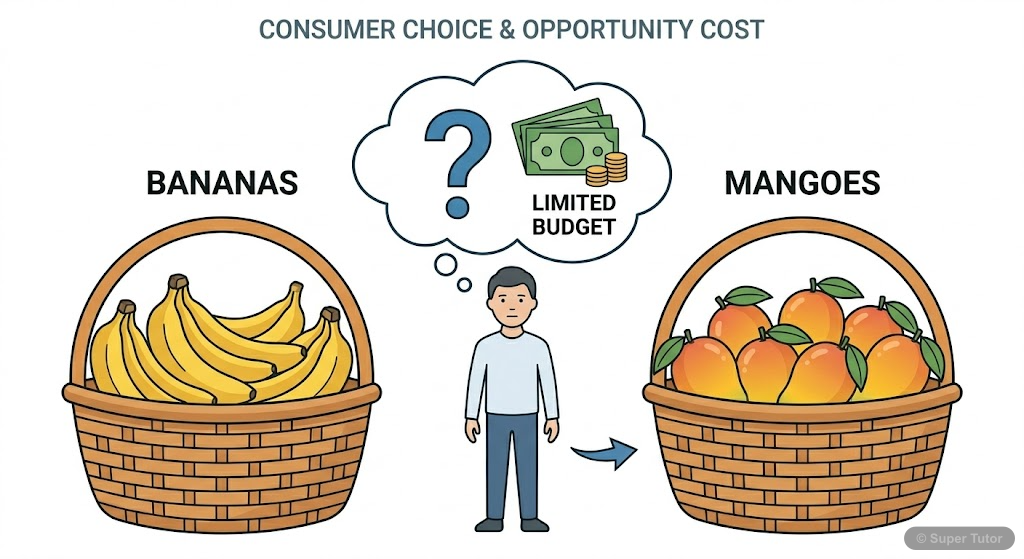
This is just one of 24+ visuals inside Super Tutor's Theory of Consumer Behavior chapter
Explore the full setExercises — Theory of Consumer Behavior
1What do you mean by the budget set of a consumer?Show solution
Definition: The budget set of a consumer is the collection of all bundles of goods that the consumer can buy with her given income at the prevailing market prices.
Explanation: If a consumer has income and the prices of two goods are and , then the budget set consists of all bundles such that:
In other words, it includes all affordable combinations — those that cost exactly (on the budget line) as well as those that cost less than (inside the budget line). The budget set is also called the opportunity set of the consumer.
2What is budget line?Show solution
Mathematical Expression: If the consumer's income is and prices of good 1 and good 2 are and respectively, the budget line is:
Key Points:
- All bundles lying on the budget line exhaust the consumer's entire income.
- The budget line is the boundary of the budget set.
- It can be rewritten as: , which is a straight line with slope and vertical intercept .
3Explain why the budget line is downward sloping.Show solution
Explanation:
The equation of the budget line is:
Rearranging:
The slope of the budget line is , which is negative (since both p_1 > 0 and p_2 > 0).
Intuitive Reason: The consumer has a fixed income . If she wants to consume more of good 1, she must spend more on good 1, and since her income is fixed, she must reduce her expenditure on good 2, thereby consuming less of good 2. Thus, as increases, must decrease — making the budget line downward (negatively) sloping.
Conclusion: The budget line is downward sloping because of the constraint of a fixed income — consuming more of one good necessarily means consuming less of the other good.
4A consumer wants to consume two goods. The prices of the two goods are Rs 4 and Rs 5 respectively. The consumer's income is Rs 20.
(i) Write down the equation of the budget line.
(ii) How much of good 1 can the consumer consume if she spends her entire income on that good?
(iii) How much of good 2 can she consume if she spends her entire income on that good?
(iv) What is the slope of the budget line?Show solution
- Price of good 1:
- Price of good 2:
- Consumer's income:
Let = quantity of good 1 and = quantity of good 2.
(i) Equation of the Budget Line:
(ii) Maximum consumption of good 1:
If the consumer spends her entire income on good 1, then :
The consumer can consume 5 units of good 1.
(iii) Maximum consumption of good 2:
If the consumer spends her entire income on good 2, then :
The consumer can consume 4 units of good 2.
(iv) Slope of the budget line:
The slope of the budget line is (or ).
5How does the budget line change if the consumer's income increases to Rs 40 but the prices remain unchanged?Show solution
- ,
- New income:
New Budget Line:
Effect on the Budget Line:
- New horizontal intercept (max ): units (earlier it was 5 units)
- New vertical intercept (max ): units (earlier it was 4 units)
- Slope remains unchanged:
Conclusion: When income doubles from Rs 20 to Rs 40 with prices unchanged, the budget line shifts outward (to the right) in a parallel manner. The slope remains the same (), but the consumer can now afford more of both goods. The budget set expands.
6How does the budget line change if the price of good 2 decreases by a rupee but the price of good 1 and the consumer's income remain unchanged?Show solution
- ,
- New price of good 2:
New Budget Line:
Effect on the Budget Line:
- Horizontal intercept (max ): units — unchanged
- New vertical intercept (max ): units (earlier it was 4 units) — increases
- New slope: (earlier it was )
Conclusion: When the price of good 2 falls, the budget line rotates outward around the horizontal intercept (the point on the -axis stays fixed at 5 units, but the point on the -axis moves upward from 4 to 5 units). The budget line becomes less steep (slope changes from to in absolute terms it becomes steeper — from to ). The consumer can now afford more of good 2.
7What happens to the budget set if both the prices as well as the income double?Show solution
- Original: , ,
- New: , ,
New Budget Line:
Dividing both sides by 2:
This is identical to the original budget line.
Verification:
- New horizontal intercept: units (same as before)
- New vertical intercept: units (same as before)
- New slope: (same as before)
Conclusion: When both prices and income double simultaneously, the budget set remains unchanged. This is because the purchasing power of the consumer does not change — the ratio of income to prices stays the same. The budget line is exactly the same as before.
8Suppose a consumer can afford to buy 6 units of good 1 and 8 units of good 2 if she spends her entire income. The prices of the two goods are Rs 6 and Rs 8 respectively. How much is the consumer's income?Show solution
- Quantity of good 1: units
- Quantity of good 2: units
- Price of good 1:
- Price of good 2:
- The consumer spends her entire income on this bundle.
Formula:
Calculation:
The consumer's income is Rs 100.
9Suppose a consumer wants to consume two goods which are available only in integer units. The two goods are equally priced at Rs 10 and the consumer's income is Rs 40.
(i) Write down all the bundles that are available to the consumer.
(ii) Among the bundles that are available to the consumer, identify those which cost her exactly Rs 40.Show solution
- Price of good 1:
- Price of good 2:
- Income:
- Both goods available only in integer units.
Budget Constraint: , i.e., , where
(i) All bundles available to the consumer (i.e., , non-negative integers):
There are 15 bundles in total.
(ii) Bundles that cost exactly Rs 40 (i.e., ):
These 5 bundles lie exactly on the budget line and exhaust the consumer's entire income of Rs 40.
10What do you mean by 'monotonic preferences'?Show solution
In other words: If bundle and bundle , then the consumer prefers over if:
- and , with at least one strict inequality.
Implication: Monotonic preferences mean that the consumer always prefers more to less — having more of a good (without having less of any other good) always makes the consumer better off.
Example: If bundle is compared with , a consumer with monotonic preferences will prefer because it has more of good 1 and the same amount of good 2.
Key implication for indifference curves: Monotonicity implies that indifference curves are downward sloping.
11If a consumer has monotonic preferences, can she be indifferent between the bundles (10, 8) and (8, 6)?Show solution
- Bundle A =
- Bundle B =
- The consumer has monotonic preferences.
Analysis:
Comparing the two bundles:
- Good 1: Bundle A has 10 units > 8 units in Bundle B.
- Good 2: Bundle A has 8 units > 6 units in Bundle B.
Bundle A has strictly more of both goods compared to Bundle B.
Conclusion: According to the definition of monotonic preferences, the consumer strictly prefers the bundle with more of both goods. Therefore, the consumer will strictly prefer bundle over bundle .
No, a consumer with monotonic preferences cannot be indifferent between and . She will always prefer over .
12Suppose a consumer's preferences are monotonic. What can you say about her preference ranking over the bundles (10, 10), (10, 9) and (9, 9)?Show solution
Bundles:
- Bundle A =
- Bundle B =
- Bundle C =
Comparison:
A vs B: vs
- Good 1: equal (10 = 10)
- Good 2: 10 > 9
- Bundle A has more of good 2 and no less of good 1 → A is preferred to B.
B vs C: vs
- Good 1: 10 > 9
- Good 2: equal (9 = 9)
- Bundle B has more of good 1 and no less of good 2 → B is preferred to C.
Conclusion (by transitivity):
The consumer's preference ranking is: is most preferred, followed by , and is least preferred.
13Suppose your friend is indifferent to the bundles (5, 6) and (6, 6). Are the preferences of your friend monotonic?Show solution
- Bundle A =
- Bundle B =
- The friend is indifferent between A and B.
Check for Monotonicity:
Comparing the two bundles:
- Good 1: Bundle B has 6 units > 5 units in Bundle A.
- Good 2: Both bundles have 6 units (equal).
Bundle B has strictly more of good 1 and the same amount of good 2 compared to Bundle A.
According to monotonic preferences, if one bundle has more of at least one good and no less of the other, the consumer should strictly prefer that bundle. Therefore, the friend should strictly prefer over .
However, the friend is indifferent between them, which violates the condition of monotonic preferences.
Conclusion: No, the preferences of the friend are NOT monotonic.
14Suppose there are two consumers in the market for a good and their demand functions are as follows:
for any price less than or equal to 20, and at any price greater than 20.
for any price less than or equal to 15 and at any price greater than 15.
Find out the market demand function.Show solution
Concept: Market demand = Sum of individual demands at each price.
Case 1: When p > 20
Case 2: When 15 < p \leq 20
Case 3: When
Market Demand Function:
15Suppose there are 20 consumers for a good and they have identical demand functions:
for any price less than or equal to and at any price greater than .
What is the market demand function?Show solution
- Number of consumers = 20
- Each consumer has identical demand:
Concept: Market demand = Number of consumers Individual demand (when consumers are identical).
Case 1: When
Case 2: When p > \dfrac{10}{3}
Market Demand Function:
16Consider a market where there are just two consumers and suppose their demands for the good are given as follows:
| p | d1 | d2 |
|---|---|---|
| 1 | 9 | 24 |
| 2 | 8 | 20 |
| 3 | 7 | 18 |
| 4 | 6 | 16 |
| 5 | 5 | 14 |
| 6 | 4 | 12 |
Calculate the market demand for the good.Show solution
Calculation:
| Price () | | | Market Demand |
|---|---|---|---|
| 1 | 9 | 24 | |
| 2 | 8 | 20 | |
| 3 | 7 | 18 | |
| 4 | 6 | 16 | |
| 5 | 5 | 14 | |
| 6 | 4 | 12 | |
The market demand at each price level is shown in the last column. As price increases, market demand decreases, which is consistent with the Law of Demand.
17What do you mean by a normal good?Show solution
Mathematical Expression: For a normal good, the income effect is positive:
\frac{\Delta q}{\Delta M} > 0
where is the quantity demanded and is the income.
Explanation: When a consumer's income rises, she can afford more of the good, and she actually chooses to buy more of it. Most goods that we consume in daily life are normal goods.
Examples: Clothing, branded food items, electronics, furniture — demand for all these goods rises as income increases.
Key Point: For a normal good, the income effect and the substitution effect both work in the same direction (both lead to increased demand when price falls), making the demand curve downward sloping.
18What do you mean by an 'inferior good'? Give some examples.Show solution
Mathematical Expression: For an inferior good, the income effect is negative:
\frac{\Delta q}{\Delta M} < 0
where is the quantity demanded and is the income.
Explanation: As a consumer's income rises, she shifts away from inferior goods and substitutes them with better-quality (normal) goods. Conversely, when income falls, she consumes more of inferior goods as they are cheaper alternatives.
Examples:
1. Coarse grains (like jowar, bajra) — as income rises, people shift to wheat/rice.
2. Low-quality cooking oil — replaced by better oils as income increases.
3. Public bus transport — people shift to private vehicles as income rises.
4. Second-hand goods — demand falls as income increases.
Note: Whether a good is inferior or normal depends on the consumer's income level and preferences — a good can be normal at low income levels and inferior at higher income levels.
19What do you mean by substitutes? Give examples of two goods which are substitutes of each other.Show solution
Explanation: Substitute goods are those that can be used in place of each other to satisfy the same need or want. When the price of one good rises, consumers switch to the other (cheaper) good, increasing its demand.
Mathematical Condition: For substitute goods:
\frac{\Delta d_x}{\Delta p_y} > 0
where is the demand for good and is the price of good .
Examples:
1. Tea and Coffee — If the price of tea rises, consumers may switch to coffee, increasing the demand for coffee.
2. Pepsi and Coca-Cola — If the price of Pepsi rises, consumers may shift to Coca-Cola.
3. Butter and Margarine — These can be used in place of each other.
Key Point: Substitutes compete with each other in the market. They have a positive cross-price elasticity of demand.
20What do you mean by complements? Give examples of two goods which are complements of each other.Show solution
Explanation: Complementary goods are those that are used together to satisfy a want. They are consumed jointly, so a rise in the price of one reduces its demand, which in turn reduces the demand for the other as well.
Mathematical Condition: For complementary goods:
\frac{\Delta d_x}{\Delta p_y} < 0
where is the demand for good and is the price of good .
Examples:
1. Car and Petrol — If the price of petrol rises sharply, demand for cars may fall.
2. Bread and Butter — They are consumed together; if the price of bread rises, demand for butter may fall.
3. Pen and Ink — Used together; a rise in the price of ink reduces demand for pens.
Key Point: Complements have a negative cross-price elasticity of demand.
21Explain price elasticity of demand.Show solution
Formula:
where = change in quantity demanded, = change in price, = original price, = original quantity.
Key Properties:
1. Pure number: Elasticity is dimensionless (has no units) because it is a ratio of two percentages.
2. Generally negative: Since demand and price move in opposite directions (Law of Demand), is typically negative.
Types based on value:
| Value of | Type | Meaning |
|---|---|---|
| |e_D| > 1 | Elastic | Demand changes proportionately more than price |
| |e_D| < 1 | Inelastic | Demand changes proportionately less than price |
| | Unitary elastic | Demand changes proportionately equal to price |
| | Perfectly inelastic | Demand does not change with price |
| | Perfectly elastic | Demand is infinitely responsive to price |
Relationship with Expenditure:
- If e_D < -1 (elastic): Price and expenditure move in opposite directions.
- If e_D > -1 (inelastic): Price and expenditure move in the same direction.
- If (unitary): Expenditure remains unchanged.
22Consider the demand for a good. At price Rs 4, the demand for the good is 25 units. Suppose price of the good increases to Rs 5, and as a result, the demand for the good falls to 20 units. Calculate the price elasticity.Show solution
- Original price:
- New price:
- Original demand: units
- New demand: units
Step 1: Calculate changes.
Step 2: Apply the formula.
The price elasticity of demand is .
Interpretation: Since |e_D| = 0.8 < 1, the demand is price inelastic — a 1% increase in price leads to only a 0.8% decrease in quantity demanded.
23Consider the demand curve . What is the elasticity at price ?Show solution
- Demand function:
- Price:
Step 1: Find quantity demanded at .
Step 2: Find (the slope of the demand function).
So .
Step 3: Apply the elasticity formula.
The price elasticity of demand at price is (unitary elastic).
Interpretation: At this price, a 1% change in price leads to exactly a 1% change in quantity demanded in the opposite direction. Total expenditure remains unchanged at this point.
24Suppose the price elasticity of demand for a good is . If there is a increase in the price of the good, by what percentage will the demand for the good go down?Show solution
- Price elasticity of demand:
- Percentage increase in price:
Formula:
Calculation:
The demand for the good will go down by .
Interpretation: Since |e_D| = 0.2 < 1, the demand is highly inelastic. A 5% rise in price causes only a 1% fall in demand.
25Suppose the price elasticity of demand for a good is . How will the expenditure on the good be affected if there is a increase in the price of the good?Show solution
- Price elasticity of demand:
- Percentage increase in price =
Step 1: Find the percentage change in quantity demanded.
So demand falls by .
Step 2: Analyze the effect on expenditure.
Expenditure
Using the relationship:
Alternatively, using the formula:
Since e_D = -0.2 > -1, the demand is inelastic. When demand is inelastic, price and total expenditure move in the same direction.
A increase in price with only a decrease in quantity means the price effect dominates.
Conclusion: The expenditure on the good will increase by approximately .
This is consistent with the rule: when e_D > -1 (inelastic demand), an increase in price leads to an increase in total expenditure.
26Suppose there was a decrease in the price of a good, and as a result, the expenditure on the good increased by . What can you say about the elasticity of demand?Show solution
- Percentage change in price: (decrease)
- Percentage change in expenditure: (increase)
Step 1: Find the percentage change in quantity demanded.
Since :
So quantity demanded increased by .
Step 2: Calculate the price elasticity of demand.
Step 3: Interpret the result.
Since and |e_D| = 1.5 > 1, the demand is price elastic.
Conclusion: The price elasticity of demand is . The demand is elastic (|e_D| > 1). This is consistent with the observation that when price decreased, expenditure increased — which happens when demand is elastic (price and expenditure move in opposite directions when e_D < -1).
Stuck on a step?
Ask Super Tutor AI to explain any solution on this page in a simpler way — free, 24x7.
Ask a Doubt FreeFrequently Asked Questions
What are the important topics in Theory of Consumer Behavior for Odisha Board Class 12 Economics?
How to score full marks in Theory of Consumer Behavior — Odisha Board Class 12 Economics?
Where can I get free NCERT Solutions for Theory of Consumer Behavior Class 12 Economics?
Sources & Official References
Content is aligned to the official syllabus. Refer to the board website for the latest curriculum.
More resources for Theory of Consumer Behavior
Important Questions
Practice with board exam-style questions
Syllabus
What topics to cover
Revision Notes
Key points for last-minute revision
Study Plan
Step-by-step plan to ace this chapter
Flashcards
Quick-fire cards for active recall
Formula Sheet
All formulas in one place
Chapter Summary
Understand the chapter at a glance
Practice Quiz
Test yourself with a quick quiz
Concept Maps
See how topics connect visually
For serious students
Get the full Theory of Consumer Behavior chapter — for free.
Quizzes, flashcards, AI doubt-solver and a step-by-step study plan for Odisha Board Class 12 Economics.