काले मेघा पानी दे
Odisha Board · Class 12 · Hindi
Flashcards for काले मेघा पानी दे — Odisha Board Class 12 Hindi. Quick Q&A cards covering key concepts, definitions, and formulas.
Interactive on Super Tutor
Studying काले मेघा पानी दे? Get the full interactive chapter.
Quizzes, flashcards, AI doubt-solver and a step-by-step study plan — built for flashcards and more.
1,000+ Class 12 students started this chapter today
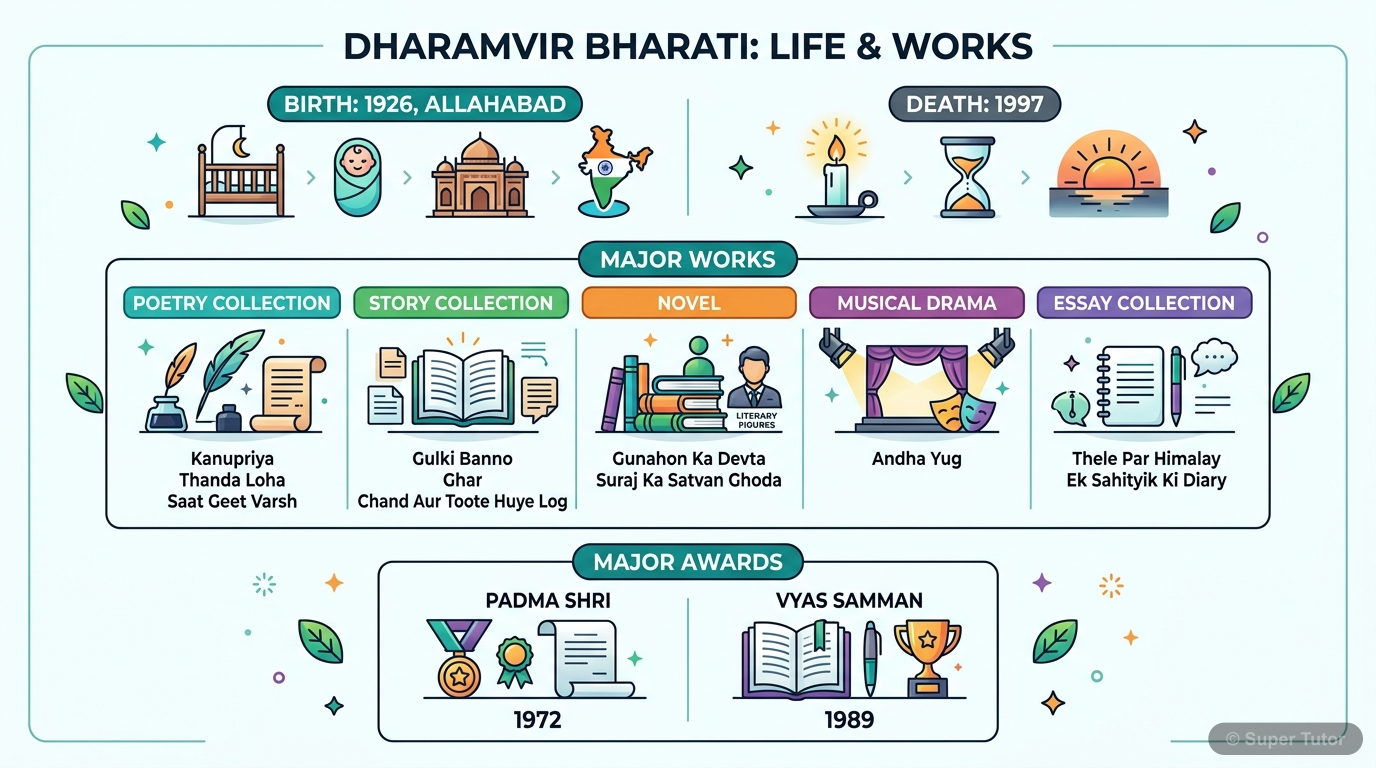
This is just one of 6+ visuals inside Super Tutor's काले मेघा पानी दे chapter
Explore the full setWho is the author of 'Kaale Megha Paani De' and what literary period does he represent?
Answer
Dharmavir Bharati (1926-1997) is the author. He represents post-independence Hindi literature and was a prominent writer known for works like 'Gunaho ka Devta', 'Suraj ka Saatvan Ghoda', and 'Andha Yu…
What are the two contrasting names given to the group of children performing rain rituals?
Answer
'Indra Sena' (positive name) and 'Medhak-Mandali' (negative name). Those who respected the ritual called them Indra Sena (army of Indra, the rain god), while those annoyed by their noise, nudity, and …
Analyze the main chant 'Kaale Megha Paani De, Gugri Phooti Bail Piyaasa, Paani De, Gud-dhaani De'.
Answer
This folk chant appeals to dark clouds for rain. 'Gugri phooti' (broken pitcher) and 'bail piyaasa' (thirsty bull) symbolize the desperate need for water. The mention of 'gud-dhaani' (jaggery and grai…
What internal conflict does the young narrator experience regarding the rain ritual?
Answer
The narrator, influenced by Arya Samaj values and scientific thinking, sees the ritual as superstition and waste of precious water during drought. However, he loves Jiji deeply and doesn't want to hur…
Who is Jiji and what role does she play in the narrator's life?
Answer
Jiji is an elderly woman, not the narrator's blood relative but older than his mother. She loves the narrator more than her own children. She represents traditional Indian values, rituals, and folk wi…
Explain Jiji's analogy of 'sowing seeds' to justify the water ritual.
Answer
Jiji compares pouring water on children to a farmer sowing seeds - spending 5-6 seer of good wheat to grow 30-40 maunds. She argues that sacrificing household water (seeds) will bring abundant rain (h…
What is the significance of the phrase 'tyaag ke bina daan nahin hota'?
Answer
Jiji's statement means 'there is no charity without sacrifice.' She explains that true donation happens when you give something you need yourself, not from abundance. This principle justifies using sc…
How does the author present the conflict between science and faith?
Answer
The author doesn't take a definitive stance. He presents the young narrator's scientific rationality against Jiji's faith-based wisdom. The memoir suggests both have validity - science has logic, fait…
+12 more flashcards available
Practice AllFrequently Asked Questions
What are the important topics in काले मेघा पानी दे for Odisha Board Class 12 Hindi?
How to score full marks in काले मेघा पानी दे — Odisha Board Class 12 Hindi?
How many flashcards are available for काले मेघा पानी दे?
Sources & Official References
Content is aligned to the official syllabus. Refer to the board website for the latest curriculum.
More resources for काले मेघा पानी दे
Important Questions
Practice with board exam-style questions
Syllabus
What topics to cover
Revision Notes
Key points for last-minute revision
Study Plan
Step-by-step plan to ace this chapter
Formula Sheet
All formulas in one place
Chapter Summary
Understand the chapter at a glance
Practice Quiz
Test yourself with a quick quiz
Concept Maps
See how topics connect visually
NCERT Solutions
Every textbook question solved step by step
For serious students
Get the full काले मेघा पानी दे chapter — for free.
Quizzes, flashcards, AI doubt-solver and a step-by-step study plan for Odisha Board Class 12 Hindi.