Moving Charges and Magnetism
Odisha Board · Class 12 · Physics
NCERT Solutions for Moving Charges and Magnetism — Odisha Board Class 12 Physics.
Interactive on Super Tutor
Studying Moving Charges and Magnetism? Get the full interactive chapter.
Quizzes, flashcards, AI doubt-solver and a step-by-step study plan — built for ncert solutions and more.
1,000+ Class 12 students started this chapter today
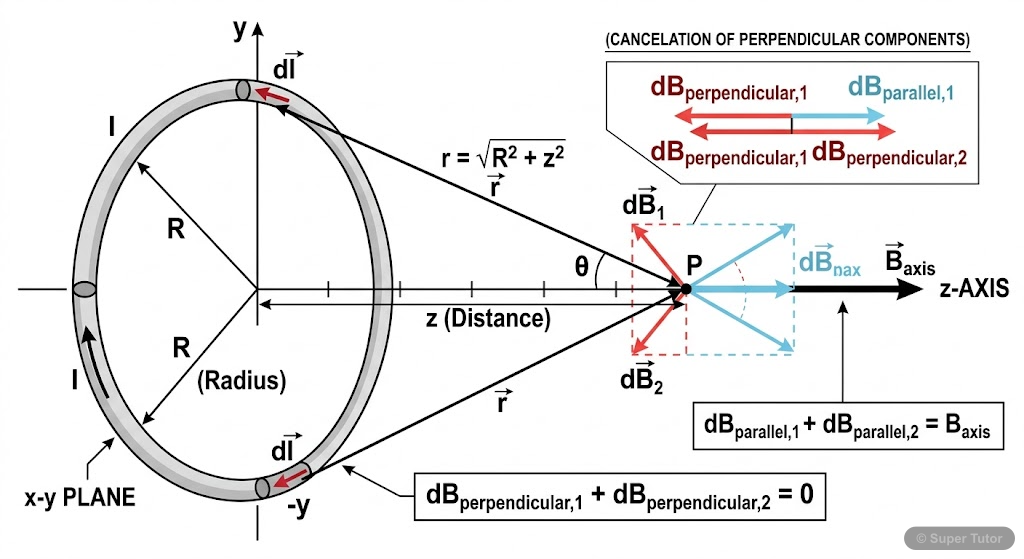
Super Tutor has 16+ illustrations like this for Moving Charges and Magnetism alone — flashcards, concept maps, and step-by-step visuals.
See them allEXERCISES — Moving Charges and Magnetism
4.1A circular coil of wire consisting of 100 turns, each of radius 8.0 cm carries a current of 0.40 A. What is the magnitude of the magnetic field B at the centre of the coil?Show solution
- Number of turns,
- Radius of coil,
- Current,
-
Formula used:
The magnetic field at the centre of a circular coil of turns is:
Calculation:
Answer: The magnitude of the magnetic field at the centre of the coil is .
4.2A long straight wire carries a current of 35 A. What is the magnitude of the field B at a point 20 cm from the wire?Show solution
- Current,
- Distance from wire,
-
Formula used:
The magnetic field at a perpendicular distance from a long straight wire is:
Calculation:
Answer: The magnitude of the magnetic field at a point 20 cm from the wire is .
4.3A long straight wire in the horizontal plane carries a current of 50 A in north to south direction. Give the magnitude and direction of B at a point 2.5 m east of the wire.Show solution
- Current, (flowing from North to South)
- Distance from wire, (point is to the East)
-
Formula used:
Calculation:
Direction:
Using the right-hand thumb rule: Point the thumb of the right hand in the direction of current (North to South, i.e., direction). The fingers curl from East (where the point is) in the downward direction.
Alternatively, using : The current is in the (South) direction, the point is in the (East) direction. The field direction is ...
More carefully: , i.e., vertically upward.
Answer: The magnitude of the magnetic field is and it is directed vertically upward (out of the horizontal plane).
4.4A horizontal overhead power line carries a current of 90 A in east to west direction. What is the magnitude and direction of the magnetic field due to the current 1.5 m below the line?Show solution
- Current, (flowing East to West)
- Distance below the line,
-
Formula used:
Calculation:
Direction:
The current flows from East to West (i.e., in the direction). The point is 1.5 m below the wire (i.e., in the direction).
Using the right-hand thumb rule: Point the thumb in the direction of current (East to West). The field lines form circles around the wire. At a point directly below the wire, the field is directed towards the South (i.e., direction).
Verification: (South). ✓
Answer: The magnitude of the magnetic field is and it is directed towards the South.
4.5What is the magnitude of magnetic force per unit length on a wire carrying a current of 8 A and making an angle of 30° with the direction of a uniform magnetic field of 0.15 T?Show solution
- Current,
- Angle between wire and magnetic field,
- Magnetic field,
Formula used:
The force on a current-carrying conductor is .
Therefore, force per unit length is:
Calculation:
Answer: The magnitude of the magnetic force per unit length on the wire is .
4.6A 3.0 cm wire carrying a current of 10 A is placed inside a solenoid perpendicular to its axis. The magnetic field inside the solenoid is given to be 0.27 T. What is the magnetic force on the wire?Show solution
- Length of wire,
- Current,
- Magnetic field inside solenoid,
- Angle between wire and field, (wire is perpendicular to the axis, and the field is along the axis)
Formula used:
Calculation:
Answer: The magnetic force on the wire is .
4.7Two long and parallel straight wires A and B carrying currents of 8.0 A and 5.0 A in the same direction are separated by a distance of 4.0 cm. Estimate the force on a 10 cm section of wire A.Show solution
- Current in wire A,
- Current in wire B,
- Separation between wires,
- Length of section considered,
-
Formula used:
The force per unit length between two parallel current-carrying wires is:
So the force on a length of wire A is:
Calculation:
Nature of force: Since the currents are in the same direction, the force is attractive.
Answer: The force on a 10 cm section of wire A is , and it is attractive (directed towards wire B).
4.8A closely wound solenoid 80 cm long has 5 layers of windings of 400 turns each. The diameter of the solenoid is 1.8 cm. If the current carried is 8.0 A, estimate the magnitude of B inside the solenoid near its centre.Show solution
- Length of solenoid,
- Number of layers = 5
- Turns per layer = 400
- Total number of turns,
- Current,
-
Number of turns per unit length:
Formula used:
The magnetic field inside a solenoid near its centre:
Calculation:
(Note: The diameter of the solenoid is not needed for this calculation as the field inside an ideal solenoid does not depend on its cross-sectional dimensions.)
Answer: The magnitude of the magnetic field inside the solenoid near its centre is .
4.9A square coil of side 10 cm consists of 20 turns and carries a current of 12 A. The coil is suspended vertically and the normal to the plane of the coil makes an angle of 30° with the direction of a uniform horizontal magnetic field of magnitude 0.80 T. What is the magnitude of torque experienced by the coil?Show solution
- Side of square coil,
- Number of turns,
- Current,
- Angle between normal to coil and magnetic field,
- Magnetic field,
Area of the coil:
Magnetic moment:
Formula used:
The torque on a current-carrying coil in a magnetic field:
Calculation:
Answer: The magnitude of the torque experienced by the coil is .
4.10Two moving coil meters, M₁ and M₂ have the following particulars:
(The spring constants are identical for the two meters.)
Determine the ratio of (a) current sensitivity and (b) voltage sensitivity of M₂ and M₁.Show solution
-
-
- Spring constants: (identical)
Concept:
For a moving coil galvanometer, the deflection is given by .
- Current sensitivity
- Voltage sensitivity
(a) Ratio of current sensitivity:
(b) Ratio of voltage sensitivity:
Answer:
(a) The ratio of current sensitivity of M₂ to M₁ is 1.4.
(b) The ratio of voltage sensitivity of M₂ to M₁ is 1.0 (they are equal).
4.11In a chamber, a uniform magnetic field of 6.5 G (1 G = 10⁻⁴ T) is maintained. An electron is shot into the field with a speed of 4.8 × 10⁶ m s⁻¹ normal to the field. Explain why the path of the electron is a circle. Determine the radius of the circular orbit. (e = 1.6 × 10⁻¹⁹ C, m_e = 9.1 × 10⁻³¹ kg)Show solution
- Magnetic field,
- Speed of electron,
- Charge of electron,
- Mass of electron,
- The velocity is normal to the field.
Why the path is circular:
The magnetic force on the electron is . Since , , so . This force is always perpendicular to the velocity of the electron (it is a centripetal force). Since the force does no work (it is always perpendicular to displacement), the speed remains constant. The direction of force changes continuously, always pointing towards the centre of the circular path. Hence, the electron moves in a circular orbit.
Radius of circular orbit:
The magnetic force provides the centripetal force:
Calculation:
Answer: The path of the electron is circular because the magnetic force is always perpendicular to its velocity. The radius of the circular orbit is .
4.12In Exercise 4.11 obtain the frequency of revolution of the electron in its circular orbit. Does the answer depend on the speed of the electron? Explain.Show solution
-
-
-
Formula used:
The cyclotron frequency (frequency of revolution) is:
Calculation:
Does the frequency depend on speed?
No, the frequency does not depend on the speed of the electron. This is because:
- The radius is proportional to .
- The time period , which is independent of .
- Therefore, is independent of the speed .
This is the fundamental principle exploited in the cyclotron.
Answer: The frequency of revolution of the electron is . The frequency does not depend on the speed of the electron.
4.13(a) A circular coil of 30 turns and radius 8.0 cm carrying a current of 6.0 A is suspended vertically in a uniform horizontal magnetic field of magnitude 1.0 T. The field lines make an angle of 60° with the normal of the coil. Calculate the magnitude of the counter torque that must be applied to prevent the coil from turning.
(b) Would your answer change, if the circular coil in (a) were replaced by a planar coil of some irregular shape that encloses the same area? (All other particulars are also unaltered.)Show solution
Given:
- Number of turns,
- Radius of coil,
- Current,
- Magnetic field,
- Angle between field lines and normal to coil,
Area of the coil:
Torque on the coil:
To prevent the coil from turning, the counter torque must be equal in magnitude:
Part (b):
No, the answer would not change. The torque on a planar current loop depends only on the magnetic moment , the magnetic field , and the angle between and . It does not depend on the shape of the loop, only on the area enclosed. Since the irregular planar coil encloses the same area , carries the same current , has the same number of turns , and is placed in the same field at the same angle, the torque (and hence the required counter torque) remains the same at .
Answer:
(a) The magnitude of the counter torque required is .
(b) No, the answer does not change, because torque depends only on the area of the loop, not its shape.
Stuck on a step?
Ask Super Tutor AI to explain any solution on this page in a simpler way — free, 24x7.
Ask a Doubt FreeFrequently Asked Questions
What are the important topics in Moving Charges and Magnetism for Odisha Board Class 12 Physics?
How to score full marks in Moving Charges and Magnetism — Odisha Board Class 12 Physics?
Where can I get free NCERT Solutions for Moving Charges and Magnetism Class 12 Physics?
Sources & Official References
Content is aligned to the official syllabus. Refer to the board website for the latest curriculum.
More resources for Moving Charges and Magnetism
Important Questions
Practice with board exam-style questions
Syllabus
What topics to cover
Revision Notes
Key points for last-minute revision
Study Plan
Step-by-step plan to ace this chapter
Flashcards
Quick-fire cards for active recall
Formula Sheet
All formulas in one place
Chapter Summary
Understand the chapter at a glance
Practice Quiz
Test yourself with a quick quiz
Concept Maps
See how topics connect visually
For serious students
Get the full Moving Charges and Magnetism chapter — for free.
Quizzes, flashcards, AI doubt-solver and a step-by-step study plan for Odisha Board Class 12 Physics.