Dual Nature of Radiation and Matter
Odisha Board · Class 12 · Physics
Practice quiz for Dual Nature of Radiation and Matter — Odisha Board Class 12 Physics. MCQs and questions with answers to test your preparation.
Interactive on Super Tutor
Studying Dual Nature of Radiation and Matter? Get the full interactive chapter.
Quizzes, flashcards, AI doubt-solver and a step-by-step study plan — built for practice quiz and more.
1,000+ Class 12 students started this chapter today
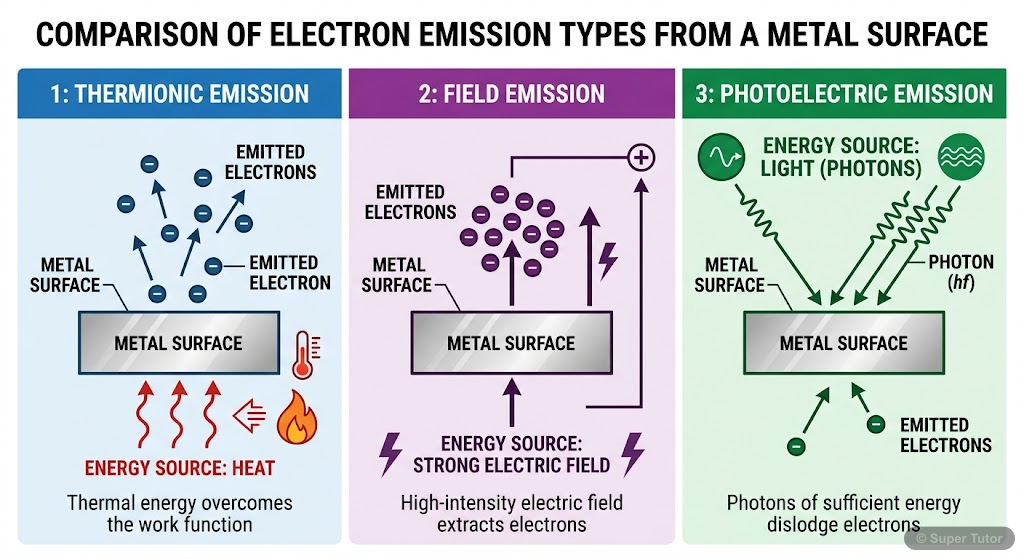
Learn better with visuals Super Tutor has hundreds of illustrations like this across every chapter — all free to try.
Get startedQuick Quiz: Dual Nature of Radiation and Matter
0/4Tap an answer to check it instantly. No sign-up needed for these 4.
What is the minimum energy required by an electron to escape from the surface of a metal called?
Who discovered the photoelectric effect?
What is the unit of work function?
According to Einstein's photoelectric equation, the maximum kinetic energy of photoelectrons depends on:
Sample Questions
Which of the following are types of electron emission? (Select all correct answers)
Show answer
Thermionic emission, Field emission, Photoelectric emission
The three main types of electron emission are: (1) Thermionic emission - by heating, (2) Field emission - by applying strong electric field, and (3) Photoelectric emission - by illuminating with light of suitable frequency.
What happens to the photoelectric current when the intensity of incident light is increased while keeping frequency constant?
Show answer
Current increases
Photoelectric current is directly proportional to the intensity of incident light. Higher intensity means more photons per second, leading to more photoelectrons being emitted per second, thus increasing the current.
Which of the following statements about threshold frequency are correct? (Select all correct answers)
Show answer
It is the minimum frequency for photoelectric emission, It depends on the nature of the metal, Below this frequency, no emission occurs regardless of intensity
Threshold frequency (ν₀) is the minimum frequency required for photoelectric emission. It depends on the work function and hence the nature of the metal. Below this frequency, no photoelectric emission occurs regardless of intensity.
The stopping potential in photoelectric effect is:
Show answer
Always negative
Stopping potential is the negative (retarding) potential applied to the collector plate to stop even the most energetic photoelectrons from reaching it. It must be negative to repel the negatively charged electrons.
+28 more questions available
Practice AllFrequently Asked Questions
What are the important topics in Dual Nature of Radiation and Matter for Odisha Board Class 12 Physics?
How to score full marks in Dual Nature of Radiation and Matter — Odisha Board Class 12 Physics?
Sources & Official References
Content is aligned to the official syllabus. Refer to the board website for the latest curriculum.
More resources for Dual Nature of Radiation and Matter
Important Questions
Practice with board exam-style questions
Syllabus
What topics to cover
Revision Notes
Key points for last-minute revision
Study Plan
Step-by-step plan to ace this chapter
Flashcards
Quick-fire cards for active recall
Formula Sheet
All formulas in one place
Chapter Summary
Understand the chapter at a glance
Concept Maps
See how topics connect visually
NCERT Solutions
Every textbook question solved step by step
For serious students
Get the full Dual Nature of Radiation and Matter chapter — for free.
Quizzes, flashcards, AI doubt-solver and a step-by-step study plan for Odisha Board Class 12 Physics.