The End of Bipolarity
Odisha Board · Class 12 · Political Science
NCERT Solutions for The End of Bipolarity — Odisha Board Class 12 Political Science.
Interactive on Super Tutor
Studying The End of Bipolarity? Get the full interactive chapter.
Quizzes, flashcards, AI doubt-solver and a step-by-step study plan — built for ncert solutions and more.
1,000+ Class 12 students started this chapter today
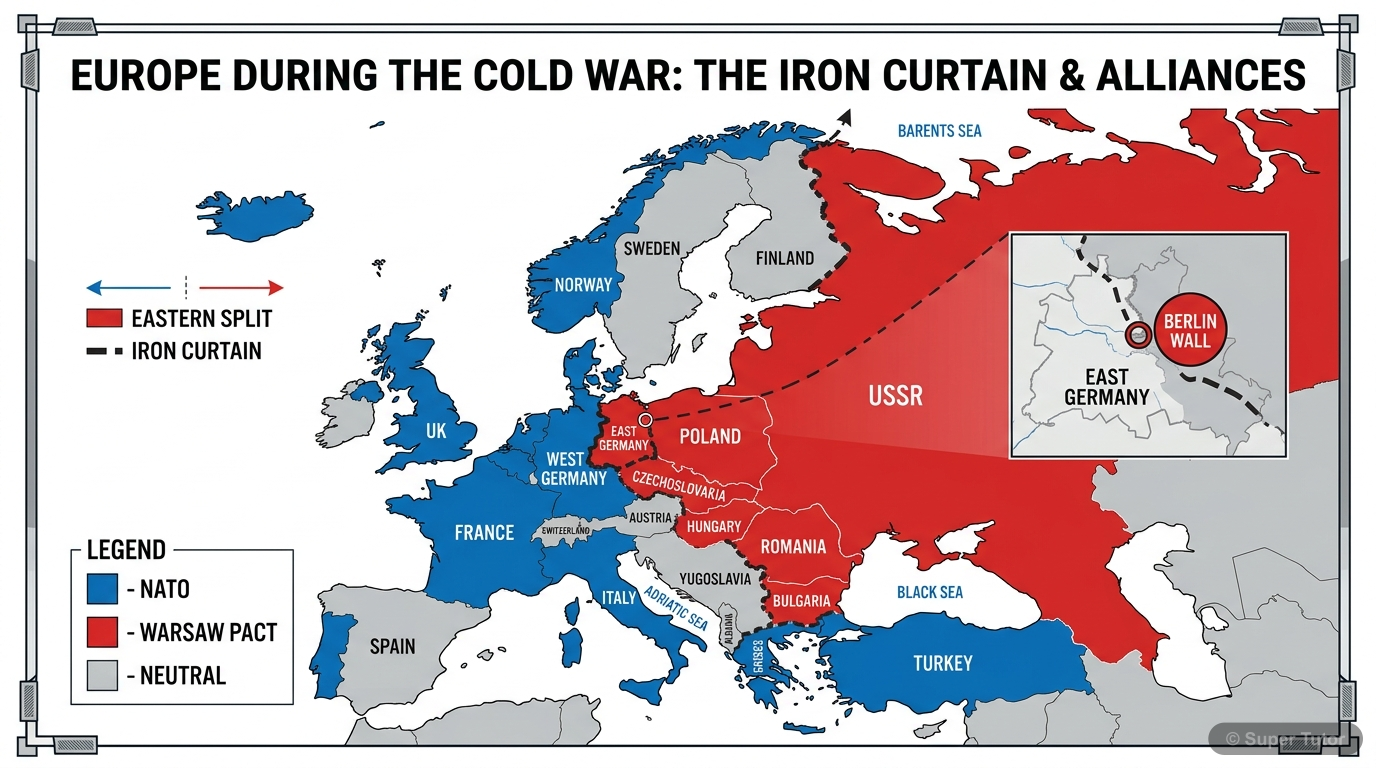
This is just one of 10+ visuals inside Super Tutor's The End of Bipolarity chapter
Explore the full setThe End of Bipolarity — Exercise Questions
1Which among the following statements that describe the nature of Soviet economy is wrong?
a. Socialism was the dominant ideology
b. State ownership/control existed over the factors of production
c. People enjoyed economic freedom
d. Every aspect of the economy was planned and controlled by the StateShow solution
Justification: In the Soviet economy, there was no economic freedom for individuals. The state owned and controlled all factors of production, every aspect of the economy was centrally planned, and socialism was the guiding ideology. Individual economic choices were severely restricted. Therefore, the statement that 'people enjoyed economic freedom' is wrong — it does not correctly describe the Soviet economy.
2Arrange the following in chronological order:
a. Soviet invasion of Afghanistan
b. Fall of the Berlin Wall
c. Disintegration of the Soviet Union
d. Russian RevolutionShow solution
| Event | Year |
|---|---|
| d. Russian Revolution | 1917 |
| a. Soviet invasion of Afghanistan | 1979 |
| b. Fall of the Berlin Wall | 1989 |
| c. Disintegration of the Soviet Union | 1991 |
So the correct order is: d → a → b → c
- The Russian Revolution took place in 1917, establishing the Bolshevik (Communist) government.
- The Soviet invasion of Afghanistan began in 1979.
- The Berlin Wall fell on 9 November 1989, symbolising the end of the Cold War.
- The Soviet Union disintegrated on 25 December 1991, when Gorbachev resigned and the USSR formally ceased to exist.
3Which among the following is NOT an outcome of the disintegration of the USSR?
a. End of the ideological war between the US and USSR
b. Birth of CIS
c. Change in the balance of power in the world order
d. Crises in the Middle EastShow solution
Justification: The crises in the Middle East were not a direct outcome of the disintegration of the USSR. The other three options — end of the ideological (Cold War) conflict between the US and USSR, birth of the Commonwealth of Independent States (CIS), and a fundamental change in the global balance of power (emergence of a unipolar world with the US as the sole superpower) — were all direct consequences of the Soviet disintegration. Middle East crises have their own historical, religious, and geopolitical roots independent of the USSR's collapse.
4Match the following:
i. Mikhail Gorbachev — a. Successor of USSR
ii. Shock Therapy — b. Military pact
iii. Russia — c. Introduced reforms
iv. Boris Yeltsin — d. Economic model
v. Warsaw — e. President of RussiaShow solution
| Column I | Column II |
|---|---|
| i. Mikhail Gorbachev | c. Introduced reforms |
| ii. Shock Therapy | d. Economic model |
| iii. Russia | a. Successor of USSR |
| iv. Boris Yeltsin | e. President of Russia |
| v. Warsaw | b. Military pact |
Explanation:
- Mikhail Gorbachev introduced the landmark reforms of *Glasnost* (openness) and *Perestroika* (restructuring) in the USSR in 1985.
- Shock Therapy was the economic model/prescription adopted by former Soviet republics to rapidly transition from a communist planned economy to a capitalist market economy.
- Russia is the principal successor state of the USSR.
- Boris Yeltsin became the first elected President of the Russian Federation.
- Warsaw Pact was the military alliance formed by the USSR and Eastern European socialist states in 1955 as a counter to NATO.
5Fill in the blanks.
a. The Soviet political system was based on __________ ideology.
b. __________ was the military alliance started by the USSR.
c. __________ party dominated the Soviet Union's political system.
d. __________ initiated the reforms in the USSR in 1985.
e. The fall of the __________ symbolised the end of the Cold War.Show solution
a. The Soviet political system was based on Marxist-Leninist (Communist/Socialist) ideology.
b. Warsaw Pact was the military alliance started by the USSR. (Formed in 1955)
c. Communist Party (CPSU — Communist Party of the Soviet Union) dominated the Soviet Union's political system.
d. Mikhail Gorbachev initiated the reforms in the USSR in 1985. (He introduced *Glasnost* and *Perestroika*)
e. The fall of the Berlin Wall symbolised the end of the Cold War. (The Berlin Wall fell on 9 November 1989)
6Mention any three features that distinguish the Soviet economy from that of a capitalist country like the US.Show solution
Three distinguishing features of the Soviet economy:
1. State Ownership vs. Private Ownership:
In the Soviet economy, the state owned and controlled all factors of production — land, labour, capital, and enterprises. There was no concept of private property in the means of production. In contrast, in the US capitalist economy, private individuals and corporations own the means of production.
2. Centrally Planned Economy vs. Market Economy:
The Soviet economy was a centrally planned economy — the state decided what to produce, how much to produce, and at what price to sell. There was no free market. The US economy, on the other hand, is driven by market forces of demand and supply, where prices are determined freely.
3. No Economic Freedom vs. Economic Freedom:
In the Soviet system, citizens had no economic freedom — they could not start private businesses, invest freely, or choose their occupation entirely. The US capitalist system guarantees economic freedom to individuals — freedom to own property, start businesses, and participate in the market.
Additional point (if needed):
- The Soviet economy eliminated unemployment through state-guaranteed jobs but at the cost of efficiency, whereas the US economy allows for competition and innovation but also unemployment.
Conclusion: The Soviet economy was socialist, state-controlled, and centrally planned, while the US economy is capitalist, privately owned, and market-driven.
7What were the factors that forced Gorbachev to initiate the reforms in the USSR?Show solution
Factors that forced Gorbachev to initiate reforms:
1. Economic Stagnation:
The Soviet economy had become stagnant and was unable to match the technological and economic progress of the West. The centrally planned economy was highly inefficient, with low productivity, poor quality of consumer goods, and a declining growth rate. The USSR was falling behind the US economically.
2. Technological and Scientific Backwardness:
The Soviet Union lagged far behind the West in technology, especially in the civilian sector. While it had military and space technology, consumer technology and information technology were underdeveloped. This gap was widening rapidly.
3. Unsustainable Military Expenditure:
The USSR was spending a disproportionately large share of its resources on the military to keep pace with the US in the arms race. This drained the economy and left little for civilian development and welfare.
4. Soviet Invasion of Afghanistan (1979):
The prolonged and costly war in Afghanistan (1979–1989) drained Soviet resources enormously and damaged its international image. It became a major burden — often called the 'Soviet Vietnam'.
5. Political Authoritarianism and Lack of Transparency:
The Soviet political system was highly authoritarian, corrupt, and lacked transparency. There was no freedom of expression or political participation. This bred public discontent and inefficiency.
6. Dissatisfaction among Soviet Republics:
Various Soviet republics were increasingly dissatisfied with Moscow's domination. Nationalist movements were growing in the Baltic states, Ukraine, and other republics, threatening the unity of the USSR.
7. Failure of the Communist Party:
The Communist Party had become corrupt and self-serving. It had lost touch with the people and was unable to deliver on its promises of equality and prosperity.
Conclusion: Faced with these deep-rooted crises, Gorbachev introduced *Glasnost* (political openness and freedom of expression) and *Perestroika* (economic restructuring) to modernise and save the Soviet system. However, these reforms ultimately accelerated the disintegration of the USSR.
8What were the major consequences of the disintegration of the Soviet Union for countries like India?Show solution
Major Consequences for India:
1. Loss of a Trusted Ally:
India lost its most reliable strategic partner. The USSR had consistently supported India on critical issues — including the Kashmir issue at the UN Security Council, during the 1971 Bangladesh Liberation War (Indo-Soviet Treaty of Peace, Friendship and Cooperation, 1971), and during various diplomatic crises.
2. Impact on Defence and Military:
India's military was heavily dependent on Soviet-supplied weapons and equipment. After the disintegration, spare parts became scarce and expensive. India had to diversify its arms procurement sources, though Russia continued to be the largest arms supplier.
3. Economic Impact:
India had a robust trade relationship with the USSR based on the Rupee-Rouble exchange mechanism. After disintegration, this arrangement collapsed, adversely affecting Indian exports. Many Indian companies lost their Soviet market.
4. Shift in Foreign Policy:
India had followed a policy of Non-Alignment, which was partly shaped by the existence of two superpowers. With the end of bipolarity, India had to reorient its foreign policy. India began to move closer to the United States and adopted the 'Look East' policy to engage with Southeast Asia.
5. Economic Liberalisation:
The collapse of the Soviet model of socialism reinforced the argument for economic liberalisation. India, which was already facing a balance of payments crisis in 1991, initiated major economic reforms (LPG — Liberalisation, Privatisation, Globalisation) partly inspired by the failure of the Soviet command economy.
6. Continued Relationship with Russia:
Despite the disintegration, India maintained strong ties with Russia as the successor state of the USSR. The two countries signed the Indo-Russian Strategic Partnership in 2000. Russia remains important for India in terms of arms supply, nuclear energy, space cooperation, and oil imports.
7. New Opportunities:
India gained opportunities to build relations with the newly independent Central Asian republics (Kazakhstan, Turkmenistan, Uzbekistan, etc.) for energy cooperation, trade, and strategic interests.
Conclusion: The disintegration of the USSR was a major geopolitical shock for India. While it created short-term difficulties, India successfully adapted by diversifying its foreign policy, initiating economic reforms, and building new partnerships while maintaining its traditional friendship with Russia.
9What was Shock Therapy? Was this the best way to make a transition from communism to capitalism?Show solution
Definition: Shock Therapy was the economic model/prescription adopted by Russia, Central Asian republics, and Eastern European countries after the collapse of the Soviet Union to rapidly transform their communist, centrally planned economies into capitalist, free-market economies.
Key Features of Shock Therapy:
- Rapid privatisation: State-owned enterprises were quickly sold off to private individuals and corporations. This led to the emergence of a class of 'oligarchs' who acquired state assets at throwaway prices.
- End of state subsidies: Government subsidies on food, housing, and essential goods were abruptly withdrawn.
- Opening up to foreign investment: Economies were opened to foreign capital and multinational corporations.
- Currency convertibility: Currencies were made freely convertible.
- Reduction of state control: The state's role in the economy was drastically reduced.
- It was called 'shock therapy' because it was a sudden, drastic, and rapid transition rather than a gradual one.
---
Part 2: Was Shock Therapy the Best Way?
No, Shock Therapy was NOT the best way to transition from communism to capitalism. It caused enormous hardship and had largely negative consequences:
Arguments Against Shock Therapy (Negative Consequences):
1. Economic Collapse: The rapid dismantling of the planned economy led to a virtual collapse of the economies of Russia and other republics. Russia's GDP fell drastically in the 1990s.
2. Rampant Poverty and Inequality: The withdrawal of state subsidies led to widespread poverty. A small group of oligarchs became extremely wealthy while the majority of the population was impoverished. Inequality increased sharply.
3. Unemployment: Privatisation led to mass unemployment as inefficient state enterprises were shut down without creating alternative employment.
4. Collapse of Social Services: Healthcare, education, and social security systems — which were well-developed under the Soviet system — collapsed due to lack of state funding.
5. Rise of the Mafia and Corruption: The rapid privatisation created a 'mafia capitalism' where organised crime and corruption flourished. State assets were grabbed by a few powerful individuals with political connections.
6. Currency Devaluation and Inflation: Many republics experienced hyperinflation and currency crises, wiping out the savings of ordinary citizens.
7. Food Insecurity: The removal of subsidies and disruption of the agricultural system led to food shortages in many areas.
A Better Alternative:
Many economists argue that a gradual, phased transition — as adopted by China — would have been more effective. China moved towards a market economy slowly, maintaining political stability and state control over key sectors, and achieved remarkable economic growth without the social chaos seen in Russia.
Conclusion: Shock Therapy was a painful and largely unsuccessful method of transition. While it was intended to quickly integrate these economies into the global capitalist system, it caused immense human suffering, economic collapse, and social instability. A more gradual and carefully managed transition would have been far more appropriate and humane.
10Write an essay for or against the following proposition: 'With the disintegration of the second world, India should change its foreign policy and focus more on friendship with the US rather than with traditional friends like Russia'.Show solution
*(India should NOT abandon its traditional friendship with Russia in favour of the US)*
Introduction:
The disintegration of the Soviet Union in 1991 fundamentally altered the global order. The world moved from bipolarity to unipolarity, with the United States emerging as the sole superpower. In this changed context, some argue that India should pivot its foreign policy entirely towards the US. However, this view is short-sighted and ignores the deep strategic, economic, and historical bonds that India shares with Russia. India's national interest is best served by maintaining and strengthening its relationship with Russia while also engaging constructively with the United States.
Arguments AGAINST abandoning Russia (i.e., FOR maintaining ties with Russia):
1. Historical and Tested Friendship:
India and the Soviet Union/Russia have shared a deep and tested friendship since the 1950s. The USSR supported India during its most critical moments — the 1971 Bangladesh Liberation War, the Kashmir issue at the UN, and various diplomatic crises. This is not a relationship that can or should be discarded lightly. Russia has been a reliable partner when India needed it most.
2. Defence and Military Cooperation:
India's military is heavily equipped with Russian-origin weapons and technology. Russia remains India's largest arms supplier. Shifting entirely to the US would be extremely expensive and would create serious gaps in India's defence preparedness. Moreover, the US has often placed conditions and restrictions on arms sales (e.g., sanctions under CAATSA), making it an unreliable defence partner.
3. Nuclear Energy and Space Cooperation:
Russia has been a crucial partner in India's nuclear energy programme and space research. Russia provided India with the cryogenic rocket engine when the US refused to do so under technology denial regimes. Such unconditional technological cooperation is invaluable.
4. Energy Security:
India is a major oil-importing nation. Russia and the Central Asian republics (Kazakhstan, Turkmenistan) are important sources of energy for India. Cooperation with these countries in oil and gas exploration is vital for India's energy security.
5. Strategic Autonomy:
India's foreign policy has always been guided by the principle of strategic autonomy — the ability to make independent decisions in its national interest. Becoming too dependent on the US would compromise this autonomy. The US has its own strategic interests which do not always align with India's (e.g., US relations with Pakistan, US pressure on India regarding Iran and Russia).
6. Multipolar World Order:
Both India and Russia support the idea of a multipolar world — a world with multiple centres of power rather than US dominance. This shared vision forms the basis of their strategic partnership. India's interests are better served in a multipolar world where it can exercise greater influence.
7. US is Not Always Reliable:
The US has a history of placing its own interests above those of its partners. It has imposed sanctions, withdrawn support, and pressured India on various issues (nuclear tests in 1998, relations with Iran, etc.). The US-Pakistan relationship has often been a source of tension with India.
Acknowledging the Importance of the US:
This does not mean India should ignore the United States. The US is the world's largest economy, a major trading partner, a source of technology and investment, and home to a large Indian diaspora. India has significantly improved its relations with the US in recent decades (civil nuclear deal of 2008, defence agreements, etc.). A strong relationship with the US is in India's interest.
Conclusion:
India's foreign policy should not be an either/or choice between Russia and the US. India's national interest demands that it maintain its strategic partnership with Russia while simultaneously building a strong relationship with the United States. India's traditional policy of non-alignment and strategic autonomy remains relevant even in the post-Cold War world. Abandoning a trusted friend like Russia in favour of an uncertain relationship with the US would be strategically unwise and contrary to India's long-term national interests. India must pursue a multi-vector foreign policy that engages all major powers on the basis of mutual benefit and national interest.
---
[Note: Students may also write the essay FOR the proposition, arguing that the US is the world's only superpower, offers economic and technological benefits, and that India must align with the dominant power. Both perspectives are valid for board examination purposes. The key is to present a coherent, well-argued essay with relevant examples.]
Stuck on a step?
Ask Super Tutor AI to explain any solution on this page in a simpler way — free, 24x7.
Ask a Doubt FreeFrequently Asked Questions
What are the important topics in The End of Bipolarity for Odisha Board Class 12 Political Science?
How to score full marks in The End of Bipolarity — Odisha Board Class 12 Political Science?
Where can I get free NCERT Solutions for The End of Bipolarity Class 12 Political Science?
Sources & Official References
Content is aligned to the official syllabus. Refer to the board website for the latest curriculum.
More resources for The End of Bipolarity
Important Questions
Practice with board exam-style questions
Syllabus
What topics to cover
Revision Notes
Key points for last-minute revision
Study Plan
Step-by-step plan to ace this chapter
Flashcards
Quick-fire cards for active recall
Formula Sheet
All formulas in one place
Chapter Summary
Understand the chapter at a glance
Practice Quiz
Test yourself with a quick quiz
Concept Maps
See how topics connect visually
For serious students
Get the full The End of Bipolarity chapter — for free.
Quizzes, flashcards, AI doubt-solver and a step-by-step study plan for Odisha Board Class 12 Political Science.