The Demographic Structure of the Indian Society
Odisha Board · Class 12 · Sociology
Summary of The Demographic Structure of the Indian Society for Odisha Board Class 12 Sociology. Key concepts, important points, and chapter overview.
Interactive on Super Tutor
Studying The Demographic Structure of the Indian Society? Get the full interactive chapter.
Quizzes, flashcards, AI doubt-solver and a step-by-step study plan — built for chapter summary and more.
1,000+ Class 12 students started this chapter today
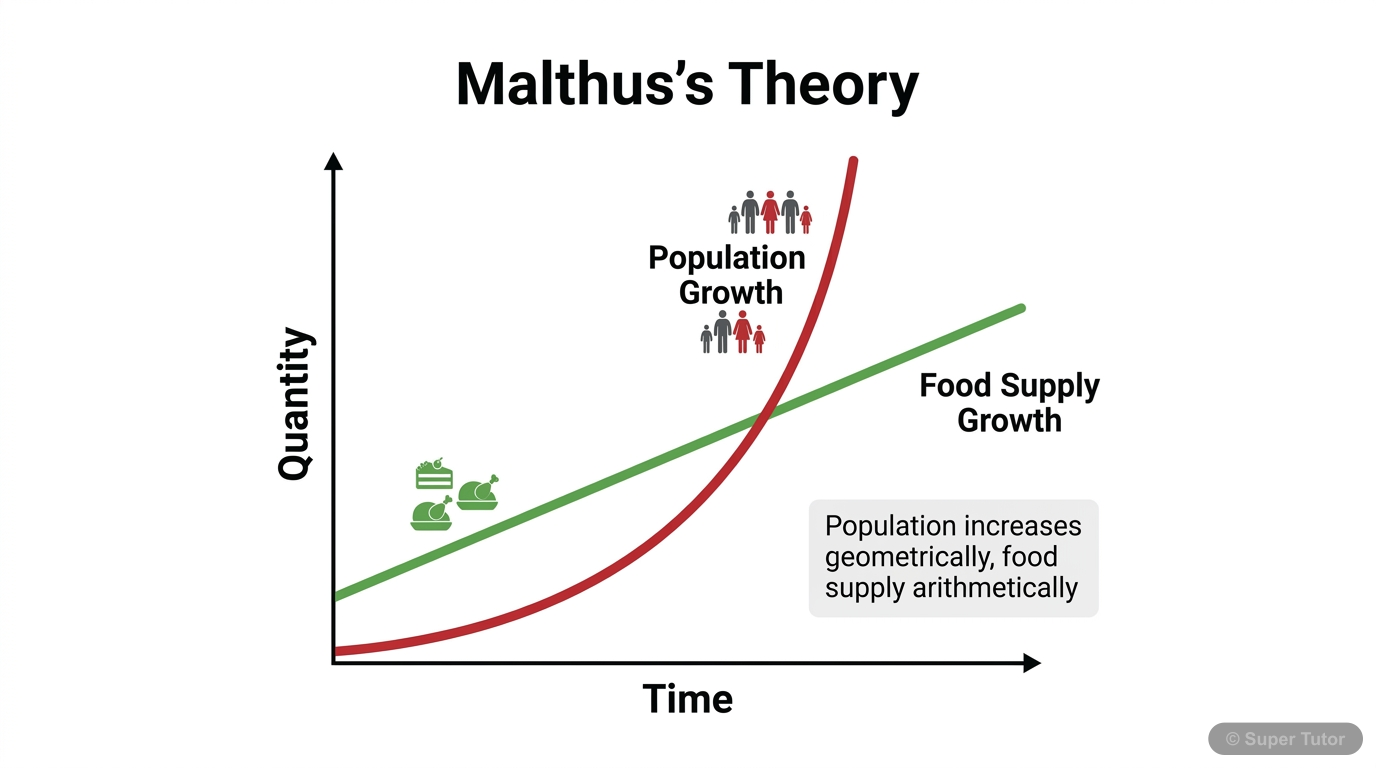
This is just one of 18+ visuals inside Super Tutor's The Demographic Structure of the Indian Society chapter
Explore the full setOverview
Demography is the systematic study of population, derived from Greek words 'demos' (people) and 'graphein' (describe). This chapter explores India's population characteristics, growth patterns, and demographic trends that shape our society. Understanding demographic structure is crucial as it influe
Key Concepts
A theory explaining population growth
A theory explaining population growth in three stages: Stage 1 - High birth and death rates with low growth; Stage 2 - Falling death rates but high bi
Thomas Malthus argued that population grows
Thomas Malthus argued that population grows geometrically (2,4,8,16...) while food production grows arithmetically (2,4,6,8...), leading to inevitable
The economic advantage gained when
The economic advantage gained when the working-age population (15-64 years) is larger than the dependent population (children and elderly). India has
Number of females per 1000 males
Number of females per 1000 males. India's sex ratio has been declining from 972 (1901) to 943 (2011). More alarming is the child sex ratio (0-6 years)
The distribution of population across different
The distribution of population across different age groups, typically shown as a pyramid with youngest at bottom and oldest at top. India has a young
Learning Objectives
- Understand the meaning and scope of demography and its importance in sociology
- Analyze India's population growth patterns and demographic transition
- Examine key demographic indicators like birth rate, death rate, fertility rate, and sex ratio
- Evaluate the demographic dividend and its implications for India's development
- Assess regional variations in demographic patterns across Indian states
Frequently Asked Questions
What are the important topics in The Demographic Structure of the Indian Society for Odisha Board Class 12 Sociology?
How to score full marks in The Demographic Structure of the Indian Society — Odisha Board Class 12 Sociology?
Sources & Official References
Content is aligned to the official syllabus. Refer to the board website for the latest curriculum.
More resources for The Demographic Structure of the Indian Society
Important Questions
Practice with board exam-style questions
Syllabus
What topics to cover
Revision Notes
Key points for last-minute revision
Study Plan
Step-by-step plan to ace this chapter
Flashcards
Quick-fire cards for active recall
Formula Sheet
All formulas in one place
Practice Quiz
Test yourself with a quick quiz
Concept Maps
See how topics connect visually
NCERT Solutions
Every textbook question solved step by step
For serious students
Get the full The Demographic Structure of the Indian Society chapter — for free.
Quizzes, flashcards, AI doubt-solver and a step-by-step study plan for Odisha Board Class 12 Sociology.