Chapter 3 of 10
NCERT Solutions

Reconstitution of a Partnership Firm – Admission of a Partner

Assam Board · Class 12 · Accountancy

NCERT Solutions for Reconstitution of a Partnership Firm – Admission of a Partner — Assam Board Class 12 Accountancy.

29 questions20 flashcards5 concepts

Interactive on Super Tutor

Studying Reconstitution of a Partnership Firm – Admission of a Partner? Get the full interactive chapter.

Quizzes, flashcards, AI doubt-solver and a step-by-step study plan — built for ncert solutions and more.

1,000+ Class 12 students started this chapter today

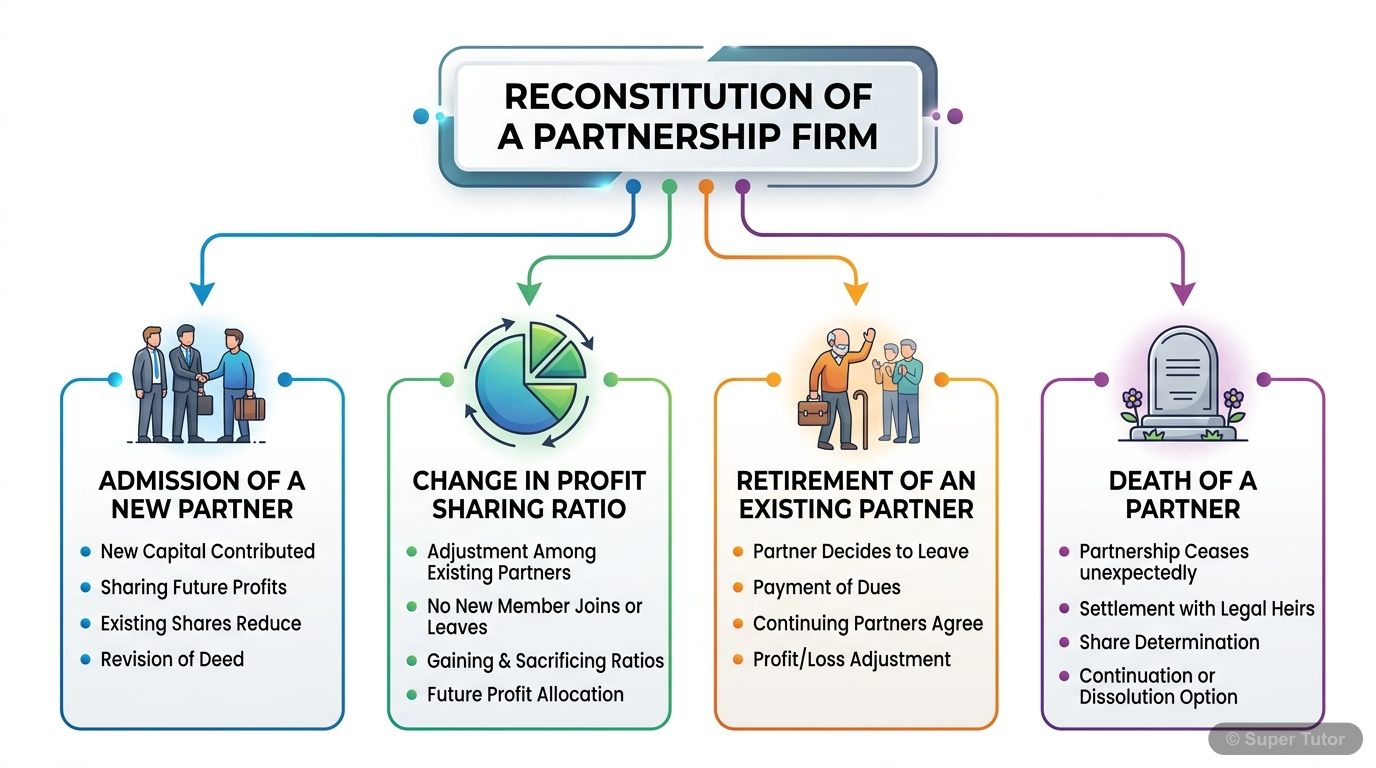
A flowchart illustrating the different ways a partnership firm can be reconstituted, including admission of a new partner, change in profit sharing ratio, retirement, and death of a partner.
Super Tutor

Super Tutor has 15+ illustrations like this for Reconstitution of a Partnership Firm – Admission of a Partner alone — flashcards, concept maps, and step-by-step visuals.

See them all
64 Questions Solved · 7 Sections

Test your Understanding - I

1A and B are partners sharing profits in the ratio of 3:1. They admit C for 1/4 share in the future profits. The new profit sharing ratio will be:
(a) A 9/16, B 3/16, C 4/16
(b) A 8/16, B 4/16, C 4/16
(c) A 10/16, B 2/16, C 4/16
(d) A 8/16, B 9/16, C 10/16
Show solution
Correct Answer: (a) A 916\frac{9}{16}, B 316\frac{3}{16}, C 416\frac{4}{16}

Given:
- Old ratio of A : B = 3 : 1
- C's share = 1/4

Working:

Remaining share for A and B = 114=341 - \frac{1}{4} = \frac{3}{4}

A's new share = 34×34=916\frac{3}{4} \times \frac{3}{4} = \frac{9}{16}

B's new share = 14×34=316\frac{1}{4} \times \frac{3}{4} = \frac{3}{16}

C's share = 14=416\frac{1}{4} = \frac{4}{16}

New profit sharing ratio = A : B : C = 916:316:416\frac{9}{16} : \frac{3}{16} : \frac{4}{16} = 9 : 3 : 4

This matches option (a).
2X and Y share profits in the ratio of 3:2. Z was admitted as a partner who gets 1/5 share. New profit sharing ratio, if Z acquires 3/20 from X and 1/20 from Y would be:
(a) 9:7:4
(b) 8:8:4
(c) 6:10:4
(d) 10:6:4
Show solution
Correct Answer: (a) 9 : 7 : 4

Given:
- Old ratio X : Y = 3 : 2, i.e., X = 3/5, Y = 2/5
- Z's share = 1/5 (acquired 3/20 from X and 1/20 from Y)

Working:

X's new share = 35320=1220320=920\frac{3}{5} - \frac{3}{20} = \frac{12}{20} - \frac{3}{20} = \frac{9}{20}

Y's new share = 25120=820120=720\frac{2}{5} - \frac{1}{20} = \frac{8}{20} - \frac{1}{20} = \frac{7}{20}

Z's share = 15=420\frac{1}{5} = \frac{4}{20}

New profit sharing ratio = X : Y : Z = 920:720:420\frac{9}{20} : \frac{7}{20} : \frac{4}{20} = 9 : 7 : 4
3A and B share profits and losses in the ratio of 3:1. C is admitted into partnership for 1/4 share. The sacrificing ratio of A and B is:
(a) equal
(b) 3:1
(c) 2:1
(d) 3:2
Show solution
Correct Answer: (b) 3 : 1

Reasoning:

When no specific agreement is mentioned about the manner in which C acquires his share, it is assumed that A and B sacrifice in their old profit sharing ratio, i.e., 3 : 1.

Verification:

C's share = 1/4. Remaining share = 3/4 distributed in ratio 3:1.

A's sacrifice = 34×14=316\frac{3}{4} \times \frac{1}{4} = \frac{3}{16}

B's sacrifice = 14×14=116\frac{1}{4} \times \frac{1}{4} = \frac{1}{16}

Sacrificing ratio = 3 : 1 (same as old ratio).

Test your Understanding - II

1At the time of admission of a new partner, general reserve appearing in the old balance sheet is transferred to:
(a) all partner's capital account
(b) new partner's capital account
(c) old partner's capital account
(d) none of the above.
Show solution
Correct Answer: (c) old partner's capital account

Reasoning: General reserve represents accumulated profits earned by the firm before the admission of the new partner. The new partner has no claim over such reserves. Therefore, at the time of admission, general reserve is transferred to the old partners' capital accounts in their old profit sharing ratio.
2Asha and Nisha are partners sharing profit in the ratio of 2:1. Asha's son Ashish was admitted for 1/4 share of which 1/8 was gifted by Asha to her son. The remaining was contributed by Nisha. Goodwill of the firm is valued at Rs. 40,000. How much of the goodwill will be credited to the old partner's capital account?
(a) Rs. 2,500 each
(b) Rs. 5,000 each
(c) Rs. 20,000 each
(d) None of the above.
Show solution
Correct Answer: (b) Rs. 5,000 each

Given:
- Old ratio Asha : Nisha = 2 : 1
- Ashish admitted for 1/4 share
- Asha gifted 1/8 to Ashish; Nisha contributed remaining 1/8
- Goodwill = Rs. 40,000

Working:

Ashish's share = 1/4 = 2/8

Asha's sacrifice = 1/8; Nisha's sacrifice = 1/8

Sacrificing ratio = Asha : Nisha = 1/8 : 1/8 = 1 : 1

Ashish's share of goodwill = 14×40,000=\frac{1}{4} \times 40,000 = Rs. 10,000

This Rs. 10,000 is credited to Asha and Nisha in sacrificing ratio 1:1:

- Asha's share = Rs. 5,000
- Nisha's share = Rs. 5,000
3A, B and C are partners in a firm. If D is admitted as a new partner:
(a) old firm is dissolved
(b) old firm and old partnership is dissolved
(c) old partnership is reconstituted
(d) None of the above.
Show solution
Correct Answer: (c) old partnership is reconstituted

Reasoning: On admission of a new partner, the old partnership agreement comes to an end and a new partnership agreement is formed. However, the firm continues its business — it is not dissolved. Hence, the old partnership is reconstituted (not dissolved).
4On the admission of a new partner increase in the value of assets is debited to:
(a) Profit and Loss Adjustment account
(b) Assets account
(c) Old partner's capital account
(d) None of the above.
Show solution
Correct Answer: (b) Assets account

Reasoning: When the value of an asset increases on revaluation, the asset account is debited (to show the increased value) and the Revaluation Account (Profit and Loss Adjustment Account) is credited. So the debit entry goes to the Assets account.
5At the time of admission of a partner, undistributed profits appearing in the balance sheet of the old firm is transferred to the capital account of:
(a) old partners in old profit sharing ratio
(b) old partners in new profit sharing ratio
(c) all the partners in the new profit sharing ratio.
Show solution
Correct Answer: (a) old partners in old profit sharing ratio

Reasoning: Undistributed profits (e.g., credit balance of Profit & Loss Account) were earned by the firm before the admission of the new partner. The new partner has no right over these profits. Therefore, they are transferred to the old partners' capital accounts in their old profit sharing ratio.

Do It Yourself (Goodwill Valuation)

1A firm's profits for the last three years are Rs. 5,00,000; Rs. 4,00,000 and Rs. 6,00,000. Calculate value of firm's goodwill on the basis of four years' purchase of the average profits for the last three years.Show solution
Given:
- Profits: Rs. 5,00,000; Rs. 4,00,000; Rs. 6,00,000
- Years of purchase = 4

Step 1: Calculate Average Profits
Average Profit=5,00,000+4,00,000+6,00,0003=15,00,0003=Rs. 5,00,000\text{Average Profit} = \frac{5,00,000 + 4,00,000 + 6,00,000}{3} = \frac{15,00,000}{3} = \text{Rs. }5,00,000

Step 2: Calculate Goodwill
Goodwill=Average Profit×Years of Purchase\text{Goodwill} = \text{Average Profit} \times \text{Years of Purchase}
=5,00,000×4=Rs. 20,00,000= 5,00,000 \times 4 = \textbf{Rs. }\mathbf{20,00,000}
2A firm's profits during 2013, 2014, 2015 and 2016 were Rs. 16,000; Rs. 20,000; Rs. 24,000 and Rs. 32,000 respectively. The firm has capital investment of Rs. 1,00,000. A fair rate of return on investment is 18% p.a. Compute goodwill based on three years' purchase of the average super profits for the last four years.Show solution
Given:
- Profits: Rs. 16,000; Rs. 20,000; Rs. 24,000; Rs. 32,000
- Capital Investment = Rs. 1,00,000
- Normal Rate of Return = 18%
- Years of purchase = 3

Step 1: Average Profit
Average Profit=16,000+20,000+24,000+32,0004=92,0004=Rs. 23,000\text{Average Profit} = \frac{16,000 + 20,000 + 24,000 + 32,000}{4} = \frac{92,000}{4} = \text{Rs. }23,000

Step 2: Normal Profit
Normal Profit=1,00,000×18100=Rs. 18,000\text{Normal Profit} = 1,00,000 \times \frac{18}{100} = \text{Rs. }18,000

Step 3: Super Profit
Super Profit=23,00018,000=Rs. 5,000\text{Super Profit} = 23,000 - 18,000 = \text{Rs. }5,000

Step 4: Goodwill
Goodwill=5,000×3=Rs. 15,000\text{Goodwill} = 5,000 \times 3 = \textbf{Rs. }\mathbf{15,000}
3Based on the data given in the above question, calculate goodwill by capitalisation of super profits method. Will the amount of goodwill be different if it is computed by capitalisation of average profits? Confirm your answer by numerical verification.Show solution
Using data from Q2: Average Profit = Rs. 23,000; Normal Profit = Rs. 18,000; Super Profit = Rs. 5,000; Normal Rate = 18%

Method 1: Capitalisation of Super Profits
Goodwill=Super ProfitNormal Rate of Return×100\text{Goodwill} = \frac{\text{Super Profit}}{\text{Normal Rate of Return}} \times 100
=5,00018×100=Rs. 27,778 (approx.)= \frac{5,000}{18} \times 100 = \text{Rs. }27,778 \text{ (approx.)}

Method 2: Capitalisation of Average Profits
Capitalised Value of Firm=Average ProfitNormal Rate×100=23,00018×100=Rs. 1,27,778\text{Capitalised Value of Firm} = \frac{\text{Average Profit}}{\text{Normal Rate}} \times 100 = \frac{23,000}{18} \times 100 = \text{Rs. }1,27,778

Goodwill=Capitalised ValueActual Capital Employed\text{Goodwill} = \text{Capitalised Value} - \text{Actual Capital Employed}
=1,27,7781,00,000=Rs. 27,778= 1,27,778 - 1,00,000 = \textbf{Rs. }\mathbf{27,778}

Conclusion: Both methods give the same result (Rs. 27,778). The amount of goodwill is NOT different under both methods — they are equivalent approaches.
4Giri and Shanta are partners in a firm sharing profits equally. They admit Kachroo into partnership who, in addition to capital, brings Rs. 20,000 as goodwill for 1/5th share of profits in the firm. What shall be journal entries if:
(a) no goodwill appears in the books of the firm.
(b) goodwill appears in the books of the firm at Rs. 40,000.
Show solution
Given:
- Old ratio Giri : Shanta = 1 : 1
- Kachroo's share = 1/5
- Goodwill brought by Kachroo = Rs. 20,000

Sacrificing Ratio (Giri : Shanta = 1 : 1, sacrifice equally)

Goodwill distributed: Giri = Rs. 10,000; Shanta = Rs. 10,000

---

(a) When no goodwill appears in the books:

| Journal Entry | Dr. (Rs.) | Cr. (Rs.) |
|---|---|---|
| Cash/Bank A/c Dr. | 20,000 | |
|  To Premium for Goodwill A/c | | 20,000 |
| *(Goodwill brought in cash by Kachroo)* | | |

| | Dr. (Rs.) | Cr. (Rs.) |
|---|---|---|
| Premium for Goodwill A/c Dr. | 20,000 | |
|  To Giri's Capital A/c | | 10,000 |
|  To Shanta's Capital A/c | | 10,000 |
| *(Goodwill distributed in sacrificing ratio 1:1)* | | |

---

(b) When goodwill appears in the books at Rs. 40,000:

First, write off existing goodwill in old ratio (1:1):

| Journal Entry | Dr. (Rs.) | Cr. (Rs.) |
|---|---|---|
| Giri's Capital A/c Dr. | 20,000 | |
| Shanta's Capital A/c Dr. | 20,000 | |
|  To Goodwill A/c | | 40,000 |
| *(Existing goodwill written off in old ratio)* | | |

Then record Kachroo's goodwill as in part (a):

| Journal Entry | Dr. (Rs.) | Cr. (Rs.) |
|---|---|---|
| Cash/Bank A/c Dr. | 20,000 | |
|  To Premium for Goodwill A/c | | 20,000 |

| | Dr. (Rs.) | Cr. (Rs.) |
|---|---|---|
| Premium for Goodwill A/c Dr. | 20,000 | |
|  To Giri's Capital A/c | | 10,000 |
|  To Shanta's Capital A/c | | 10,000 |

Do It Yourself (Revaluation and Admission)

1Aslam, Jackab, Hari are equal partners with capitals of Rs. 1,500, Rs. 1,750 and Rs. 2,000 respectively. They agree to admit Satnam into equal partnership upon payment in cash of Rs. 1,500 for one-fourth share of the goodwill and Rs. 1,800 as his capital, both sums to remain in the business. The liabilities of the old firm amount Rs. 3,000 and the assets, apart from cash, consist of Motors Rs. 1,200, Furniture Rs. 400, Stock Rs. 2,650, Debtors of Rs. 3,780. The Motors and Furniture were revalued at Rs. 950 and Rs. 380 respectively, and the depreciation written-off. Ascertain cash in hand and prepare the balance sheet of the firm after Satnam's admission.Show solution
Given:
- Old partners: Aslam, Jackab, Hari — equal ratio (1:1:1)
- Capitals: Aslam Rs. 1,500; Jackab Rs. 1,750; Hari Rs. 2,000
- Satnam pays Rs. 1,500 for 1/4 goodwill + Rs. 1,800 as capital
- Liabilities = Rs. 3,000
- Assets (excluding cash): Motors Rs. 1,200; Furniture Rs. 400; Stock Rs. 2,650; Debtors Rs. 3,780
- Revalued: Motors Rs. 950; Furniture Rs. 380

Step 1: Find Cash in Hand (before Satnam's admission)

Total Assets = Total Liabilities + Capital
=3,000+1,500+1,750+2,000=Rs. 8,250= 3,000 + 1,500 + 1,750 + 2,000 = \text{Rs. }8,250

Assets excluding cash = 1,200 + 400 + 2,650 + 3,780 = Rs. 8,030

Cash in hand=8,2508,030=Rs. 220\text{Cash in hand} = 8,250 - 8,030 = \text{Rs. }220

Step 2: Revaluation Loss
- Motors: 1,200 − 950 = Rs. 250 (loss)
- Furniture: 400 − 380 = Rs. 20 (loss)
- Total Revaluation Loss = Rs. 270

Shared equally: Rs. 90 each (Aslam, Jackab, Hari)

Step 3: Adjusted Capitals (after revaluation)
- Aslam: 1,500 − 90 = Rs. 1,410
- Jackab: 1,750 − 90 = Rs. 1,660
- Hari: 2,000 − 90 = Rs. 1,910

Step 4: Goodwill Treatment

Satnam pays Rs. 1,500 for 1/4 share of goodwill → Total goodwill = Rs. 6,000

Goodwill credited to old partners equally: Rs. 500 each

- Aslam: 1,410 + 500 = Rs. 1,910
- Jackab: 1,660 + 500 = Rs. 2,160
- Hari: 1,910 + 500 = Rs. 2,410
- Satnam's Capital = Rs. 1,800

Step 5: Cash in Hand after admission
Cash=220+1,500+1,800=Rs. 3,520\text{Cash} = 220 + 1,500 + 1,800 = \text{Rs. }3,520

Balance Sheet of the New Firm after Satnam's Admission

| Liabilities | Rs. | Assets | Rs. |
|---|---|---|---|
| Creditors | 3,000 | Cash in Hand | 3,520 |
| Capital — Aslam | 1,910 | Debtors | 3,780 |
| Capital — Jackab | 2,160 | Stock | 2,650 |
| Capital — Hari | 2,410 | Motors | 950 |
| Capital — Satnam | 1,800 | Furniture | 380 |
| Total | 11,280 | Total | 11,280 |
2Benu and Sunil are partners sharing profits in the ratio of 3:2 on April 1, 2017. Ina was admitted for 1/4 share who paid Rs. 2,00,000 as capital and Rs. 1,00,000 for premium for goodwill in cash. At the time of admission, general reserve amounting to Rs. 1,20,000 and profit and loss account amounting to Rs. 60,000 appeared on the liability side of the balance sheet. Required: Record necessary journal entries to record the above transactions.Show solution
Given:
- Old ratio Benu : Sunil = 3 : 2
- Ina admitted for 1/4 share
- Ina brings: Capital Rs. 2,00,000 + Goodwill Rs. 1,00,000
- General Reserve = Rs. 1,20,000; P&L (Cr.) = Rs. 60,000

Sacrificing Ratio = Old ratio = 3 : 2

Goodwill distributed: Benu = 35×1,00,000\frac{3}{5} \times 1,00,000 = Rs. 60,000; Sunil = Rs. 40,000

Journal Entries:

1. Ina's capital and goodwill brought in:
Bank A/c Dr.3,00,000\text{Bank A/c Dr.} \quad 3,00,000
To Ina’s Capital A/c2,00,000\quad \text{To Ina's Capital A/c} \quad 2,00,000
To Premium for Goodwill A/c1,00,000\quad \text{To Premium for Goodwill A/c} \quad 1,00,000
*(Being capital and goodwill premium brought in by Ina)*

2. Goodwill distributed to old partners:
Premium for Goodwill A/c Dr.1,00,000\text{Premium for Goodwill A/c Dr.} \quad 1,00,000
To Benu’s Capital A/c60,000\quad \text{To Benu's Capital A/c} \quad 60,000
To Sunil’s Capital A/c40,000\quad \text{To Sunil's Capital A/c} \quad 40,000
*(Being goodwill premium credited to old partners in sacrificing ratio 3:2)*

3. General Reserve transferred to old partners:
General Reserve A/c Dr.1,20,000\text{General Reserve A/c Dr.} \quad 1,20,000
To Benu’s Capital A/c72,000\quad \text{To Benu's Capital A/c} \quad 72,000
To Sunil’s Capital A/c48,000\quad \text{To Sunil's Capital A/c} \quad 48,000
*(Being general reserve distributed in old ratio 3:2)*

4. Profit & Loss Account transferred to old partners:
Profit & Loss A/c Dr.60,000\text{Profit \& Loss A/c Dr.} \quad 60,000
To Benu’s Capital A/c36,000\quad \text{To Benu's Capital A/c} \quad 36,000
To Sunil’s Capital A/c24,000\quad \text{To Sunil's Capital A/c} \quad 24,000
*(Being P&L credit balance distributed in old ratio 3:2)*
3Ashoo and Rahul are partners sharing profits in the ratio of 5:3. Gaurav was admitted for 1/5 share and was asked to contribute proportionate capital and Rs. 4,000 for premium (goodwill). The Capitals of Ashoo and Rahul, after all adjustments relating to revaluation, goodwill etc., worked out to be Rs. 45,000 and Rs. 35,000 respectively. Required: Calculate New Profit sharing ratio, capital to be brought in by Gaurav and record necessary journal entries for the same.Show solution
Given:
- Old ratio Ashoo : Rahul = 5 : 3
- Gaurav's share = 1/5
- Goodwill brought by Gaurav = Rs. 4,000
- Adjusted capitals: Ashoo = Rs. 45,000; Rahul = Rs. 35,000

Step 1: New Profit Sharing Ratio

Remaining share = 115=451 - \frac{1}{5} = \frac{4}{5}

Ashoo's new share = 58×45=2040=12\frac{5}{8} \times \frac{4}{5} = \frac{20}{40} = \frac{1}{2}

Rahul's new share = 38×45=1240=310\frac{3}{8} \times \frac{4}{5} = \frac{12}{40} = \frac{3}{10}

Gaurav's share = 15=420\frac{1}{5} = \frac{4}{20}

Converting to common denominator (40):
- Ashoo = 20/40; Rahul = 12/40; Gaurav = 8/40

New ratio = 20 : 12 : 8 = 5 : 3 : 2

Step 2: Capital to be brought in by Gaurav

Total capital of new firm (based on old partners' adjusted capitals):

Old partners hold 4/5 of total capital = 45,000 + 35,000 = Rs. 80,000

Total Capital=80,0004×5=Rs. 1,00,000\text{Total Capital} = \frac{80,000}{4} \times 5 = \text{Rs. }1,00,000

Gaurav's capital = 15×1,00,000=Rs. 20,000\frac{1}{5} \times 1,00,000 = \textbf{Rs. }\mathbf{20,000}

Step 3: Sacrificing Ratio = Old ratio = 5 : 3

Goodwill: Ashoo = 58×4,000\frac{5}{8} \times 4,000 = Rs. 2,500; Rahul = 38×4,000\frac{3}{8} \times 4,000 = Rs. 1,500

Journal Entries:

1. Gaurav brings capital and goodwill:
Bank A/c Dr.24,000\text{Bank A/c Dr.} \quad 24,000
To Gaurav’s Capital A/c20,000\quad \text{To Gaurav's Capital A/c} \quad 20,000
To Premium for Goodwill A/c4,000\quad \text{To Premium for Goodwill A/c} \quad 4,000

2. Goodwill distributed to old partners:
Premium for Goodwill A/c Dr.4,000\text{Premium for Goodwill A/c Dr.} \quad 4,000
To Ashoo’s Capital A/c2,500\quad \text{To Ashoo's Capital A/c} \quad 2,500
To Rahul’s Capital A/c1,500\quad \text{To Rahul's Capital A/c} \quad 1,500

Short Answer Questions

1Identify various matters that need adjustments at the time of admission of a new partner.Show solution
At the time of admission of a new partner, the following matters require adjustments:

1. New Profit Sharing Ratio and Sacrificing Ratio: The new profit sharing ratio of all partners (old and new) must be determined. The sacrificing ratio of old partners must also be calculated.

2. Goodwill: The goodwill of the firm must be valued and the new partner must compensate the old partners for their sacrifice. Adjustments are made through the new partner's capital account or cash brought in.

3. Revaluation of Assets and Liabilities: Assets and liabilities are revalued to reflect their current fair values. Any gain or loss on revaluation is shared among old partners in their old profit sharing ratio.

4. Accumulated Profits and Losses (Reserves): Any undistributed profits, general reserves, or accumulated losses appearing in the balance sheet are transferred to old partners' capital accounts in their old profit sharing ratio.

5. Adjustment of Partners' Capitals: If agreed, the capitals of all partners are adjusted to be proportionate to their new profit sharing ratio.
2Why it is necessary to ascertain new profit sharing ratio even for old partners when a new partner is admitted?Show solution
When a new partner is admitted, he acquires a share in the profits of the firm. This share is contributed (sacrificed) by the old partners. As a result, the old partners' shares in profits change (reduce).

It is necessary to ascertain the new profit sharing ratio for old partners because:

1. Future profit distribution must be done in the correct new ratio.
2. Goodwill adjustment — the sacrificing ratio (derived from old and new shares) determines how much goodwill credit each old partner receives.
3. Capital adjustments — if capitals are to be proportionate to profit sharing ratio, the new ratio is needed.
4. Correct accounting — all future transactions, drawings, and settlements depend on the new ratio.

Without determining the new ratio, it would be impossible to distribute profits correctly among all partners.
3What is sacrificing ratio? Why is it calculated?Show solution
Sacrificing Ratio:

Sacrificing ratio is the ratio in which the old partners agree to give up (sacrifice) a part of their share in profits in favour of the new partner. It is calculated as:

Sacrificing Ratio=Old ShareNew Share\text{Sacrificing Ratio} = \text{Old Share} - \text{New Share}

Why it is calculated:

1. Goodwill distribution: The premium for goodwill brought in by the new partner is distributed among the old partners in their sacrificing ratio. Each old partner is compensated in proportion to the share they have sacrificed.

2. Fairness: It ensures that each old partner is compensated fairly for the share of profit they have given up to the new partner.

3. Hidden goodwill adjustment: Even when goodwill is not brought in cash, the adjustment entry for goodwill is made using the sacrificing ratio.

Usually, the sacrificing ratio is the same as the old profit sharing ratio, but it can differ based on the agreement between partners.
4On what occasions sacrificing ratio is used?Show solution
Sacrificing ratio is used on the following occasions:

1. At the time of admission of a new partner: The premium for goodwill brought in by the new partner is credited to the old partners' capital accounts in their sacrificing ratio.

2. When the new partner cannot bring goodwill in cash: The new partner's capital account is debited and the old partners' capital accounts are credited in the sacrificing ratio.

3. When goodwill already exists in the books: After writing off existing goodwill, the new goodwill premium is distributed in the sacrificing ratio.

4. When there is a change in profit sharing ratio among existing partners: The partner who gains in profit share compensates the partner who sacrifices, and the sacrificing ratio determines the amount of compensation.
5If some goodwill already exists in the books and the new partner brings in his share of goodwill in cash, how will you deal with existing amount of goodwill?Show solution
Treatment of Existing Goodwill when New Partner Brings Goodwill in Cash:

When goodwill already appears in the books of the firm and the new partner brings his share of goodwill in cash, the following procedure is followed:

Step 1: Write off the existing goodwill by debiting the old partners' capital accounts in their old profit sharing ratio:
Old Partners’ Capital A/cs Dr. (in old ratio)\text{Old Partners' Capital A/cs Dr. (in old ratio)}
To Goodwill A/c\quad \text{To Goodwill A/c}

Step 2: Record the goodwill brought in by the new partner:
Bank/Cash A/c Dr.\text{Bank/Cash A/c Dr.}
To Premium for Goodwill A/c\quad \text{To Premium for Goodwill A/c}

Step 3: Distribute the premium for goodwill among old partners in their sacrificing ratio:
Premium for Goodwill A/c Dr.\text{Premium for Goodwill A/c Dr.}
To Old Partners’ Capital A/cs (in sacrificing ratio)\quad \text{To Old Partners' Capital A/cs (in sacrificing ratio)}

This ensures that the goodwill account does not appear in the new firm's balance sheet (as per AS-26), and old partners are compensated for their sacrifice.
6Why there is need for the revaluation of assets and liabilities on the admission of a partner?Show solution
Need for Revaluation of Assets and Liabilities on Admission of a Partner:

At the time of admission of a new partner, assets and liabilities are revalued for the following reasons:

1. Fair representation: The book values of assets and liabilities may not reflect their current market values. Revaluation ensures that the balance sheet shows true and fair values.

2. Equity among partners: Any increase or decrease in the value of assets and liabilities that occurred during the period when only the old partners were in the firm should benefit or be borne by the old partners only. The new partner should neither gain nor lose on account of changes that occurred before his admission.

3. Correct capital accounts: The old partners' capital accounts are adjusted for the gain or loss on revaluation before the new partner joins, ensuring that the new partner starts with a fair position.

4. Unrecorded assets/liabilities: Sometimes certain assets or liabilities may be unrecorded. Revaluation helps bring them into the books.

The gain or loss on revaluation is transferred to old partners' capital accounts in their old profit sharing ratio.

Long Answer Questions

1Do you advise that assets and liabilities must be revalued at the time of admission of a partner? If so, why? Also describe how is this treated in the book of account?Show solution
Yes, it is advisable to revalue assets and liabilities at the time of admission of a partner.

Reasons:

1. True and fair view: Book values may differ from current market values due to price changes, depreciation, or appreciation. Revaluation ensures the balance sheet reflects true values.

2. Protection of old partners' interests: Any appreciation or depreciation in asset values that occurred before the new partner's admission belongs to the old partners. If not revalued, the new partner would share in gains/losses that are not his.

3. Correct profit/loss sharing: Without revaluation, future profits/losses would be distorted because unrealised gains or losses would be mixed with post-admission profits.

4. Unrecorded items: Revaluation helps identify and record previously unrecorded assets or liabilities.

Accounting Treatment — Revaluation Account (Profit & Loss Adjustment Account):

| Revaluation Account | |
|---|---|
| Dr. side: Decrease in asset values; Increase in liability values; Unrecorded liabilities | Cr. side: Increase in asset values; Decrease in liability values; Unrecorded assets |

- If Credit side > Debit side → Gain on Revaluation → Credited to old partners' capital accounts in old ratio.
- If Debit side > Credit side → Loss on Revaluation → Debited to old partners' capital accounts in old ratio.

Journal Entries:

For increase in asset value:
Asset A/c Dr.To Revaluation A/c\text{Asset A/c Dr.} \quad \text{To Revaluation A/c}

For decrease in asset value:
Revaluation A/c Dr.To Asset A/c\text{Revaluation A/c Dr.} \quad \text{To Asset A/c}

For gain on revaluation:
Revaluation A/c Dr.To Old Partners’ Capital A/cs (old ratio)\text{Revaluation A/c Dr.} \quad \text{To Old Partners' Capital A/cs (old ratio)}

For loss on revaluation:
Old Partners’ Capital A/cs Dr. (old ratio)To Revaluation A/c\text{Old Partners' Capital A/cs Dr. (old ratio)} \quad \text{To Revaluation A/c}
2What is goodwill? What factors affect goodwill?Show solution
Meaning of Goodwill:

Goodwill is the value of the reputation, good name, and business connections of a firm that enables it to earn profits in excess of the normal rate of return. It is an intangible asset that arises from the favourable impression a business has created in the minds of its customers, suppliers, and the public over a period of time.

In accounting terms: Goodwill = Capitalised Value of Firm − Net Assets (Capital Employed)

Or: Goodwill = Super Profit × Years of Purchase

Factors Affecting Goodwill:

1. Nature of business: Firms with stable and regular demand (e.g., essential goods) have higher goodwill.

2. Location: A business situated at a prime or convenient location enjoys higher goodwill.

3. Quality of products/services: Superior quality products and after-sales service enhance goodwill.

4. Management efficiency: Competent and experienced management leads to higher profits and goodwill.

5. Favourable contracts: Long-term contracts with suppliers or customers add to goodwill.

6. Capital required: Businesses requiring less capital to earn the same profit have higher goodwill.

7. Trend of profits: A consistent upward trend in profits increases goodwill.

8. Reputation and brand name: A well-known brand or trademark enhances goodwill significantly.

9. Market position: Monopoly or dominant market position increases goodwill.

10. Risk involved: Lower risk businesses command higher goodwill.
3Explain various methods of valuation of goodwill.Show solution
Methods of Valuation of Goodwill:

1. Average Profits Method:

Goodwill is calculated as a certain number of years' purchase of the average profits.

Average Profit=Sum of Profits of past yearsNumber of years\text{Average Profit} = \frac{\text{Sum of Profits of past years}}{\text{Number of years}}

Goodwill=Average Profit×Number of Years’ Purchase\text{Goodwill} = \text{Average Profit} \times \text{Number of Years' Purchase}

*Example:* If average profit = Rs. 50,000 and years of purchase = 3, then Goodwill = Rs. 1,50,000.

---

2. Super Profits Method:

Super profit is the excess of actual/average profit over normal profit.

Normal Profit=Capital Employed×Normal Rate of Return100\text{Normal Profit} = \text{Capital Employed} \times \frac{\text{Normal Rate of Return}}{100}

Super Profit=Average ProfitNormal Profit\text{Super Profit} = \text{Average Profit} - \text{Normal Profit}

Goodwill=Super Profit×Number of Years’ Purchase\text{Goodwill} = \text{Super Profit} \times \text{Number of Years' Purchase}

---

3. Capitalisation Method:

This has two sub-methods:

(a) Capitalisation of Average Profits:

Capitalised Value of Firm=Average ProfitNormal Rate of Return×100\text{Capitalised Value of Firm} = \frac{\text{Average Profit}}{\text{Normal Rate of Return}} \times 100

Goodwill=Capitalised ValueNet Assets (Capital Employed)\text{Goodwill} = \text{Capitalised Value} - \text{Net Assets (Capital Employed)}

(b) Capitalisation of Super Profits:

Goodwill=Super ProfitNormal Rate of Return×100\text{Goodwill} = \frac{\text{Super Profit}}{\text{Normal Rate of Return}} \times 100

Both sub-methods give the same result.

---

Note: The choice of method depends on the agreement between the partners. Each method may give a different value of goodwill.
4If it is agreed that the capital of all the partners should be proportionate to the new profit sharing ratio, how will you work out the new capital of each partner? Give examples and state how necessary adjustments will be made.Show solution
Adjustment of Capitals in Proportion to New Profit Sharing Ratio:

When partners agree that their capitals should be proportionate to the new profit sharing ratio, the following steps are followed:

Step 1: Determine the new profit sharing ratio.

Step 2: Use the new partner's capital as the base (or total capital as given) to calculate the required capital of each partner.

Required Capital of a Partner=New Partner’s Capital×Partner’s shareNew Partner’s share\text{Required Capital of a Partner} = \text{New Partner's Capital} \times \frac{\text{Partner's share}}{\text{New Partner's share}}

OR if total capital is given:
Required Capital=Total Capital×Partner’s share in new ratio\text{Required Capital} = \text{Total Capital} \times \text{Partner's share in new ratio}

Step 3: Compare required capital with actual capital (after all adjustments for goodwill, revaluation, reserves).

- If Required > Actual → Partner brings in the shortfall (debit Bank, credit Capital)
- If Required < Actual → Partner withdraws the excess (debit Capital, credit Bank or Current A/c)

Example:

A and B share profits 2:1. C is admitted for 1/4 share. New ratio = 2:1:1. C brings Rs. 20,000 as capital. Adjusted capitals: A = Rs. 45,000; B = Rs. 15,000.

Total capital based on C = 20,000×4=20,000 \times 4 = Rs. 80,000

Required: A = 24×80,000=\frac{2}{4} \times 80,000 = Rs. 40,000; B = 14×80,000=\frac{1}{4} \times 80,000 = Rs. 20,000

- A has Rs. 45,000 but needs Rs. 40,000 → Withdraw Rs. 5,000
- B has Rs. 15,000 but needs Rs. 20,000 → Bring in Rs. 5,000

Journal Entries:
A’s Capital A/c Dr.5,000To Bank A/c5,000\text{A's Capital A/c Dr.} \quad 5,000 \quad \text{To Bank A/c} \quad 5,000
Bank A/c Dr.5,000To B’s Capital A/c5,000\text{Bank A/c Dr.} \quad 5,000 \quad \text{To B's Capital A/c} \quad 5,000
5Explain how will you deal with goodwill when new partner is not in a position to bring his share of goodwill in cash.Show solution
Treatment of Goodwill when New Partner Cannot Bring it in Cash:

When the new partner is unable to bring his share of goodwill premium in cash, the adjustment is made through capital accounts without any cash transaction. Two methods are used:

Method 1: Through Goodwill Account (Raising and Writing Off)

*Step 1:* Raise goodwill in the books by crediting old partners in old ratio:
Goodwill A/c Dr.\text{Goodwill A/c Dr.}
To Old Partners’ Capital A/cs (old ratio)\quad \text{To Old Partners' Capital A/cs (old ratio)}

*Step 2:* Write off goodwill by debiting all partners (including new) in new ratio:
All Partners’ Capital A/cs Dr. (new ratio)\text{All Partners' Capital A/cs Dr. (new ratio)}
To Goodwill A/c\quad \text{To Goodwill A/c}

The net effect is that the new partner's capital account is debited for his share of goodwill and old partners are credited in their sacrificing ratio.

---

Method 2: Direct Adjustment (Without Opening Goodwill Account)

The new partner's capital account is directly debited and old partners' capital accounts are credited in their sacrificing ratio:

New Partner’s Capital A/c Dr.\text{New Partner's Capital A/c Dr.}
To Old Partners’ Capital A/cs (sacrificing ratio)\quad \text{To Old Partners' Capital A/cs (sacrificing ratio)}

This method is simpler and does not create a goodwill account in the books, which is in line with AS-26 (goodwill should not be shown as an asset unless purchased).

Both methods produce the same net effect on the capital accounts of all partners.
6Explain various methods for the treatment of goodwill on the admission of a new partner.Show solution
Methods for Treatment of Goodwill on Admission of a New Partner:

Case 1: New Partner Brings Goodwill in Cash (Premium Method)

Bank A/c Dr.\text{Bank A/c Dr.}
To Premium for Goodwill A/c\quad \text{To Premium for Goodwill A/c}

Premium for Goodwill A/c Dr.\text{Premium for Goodwill A/c Dr.}
To Old Partners’ Capital A/cs (sacrificing ratio)\quad \text{To Old Partners' Capital A/cs (sacrificing ratio)}

If old partners withdraw the amount: Debit their capital accounts and credit Bank.

---

Case 2: New Partner Brings Part of Goodwill in Cash

Record cash received, credit old partners for full goodwill in sacrificing ratio, and debit new partner's capital for the balance not brought in cash.

---

Case 3: New Partner Cannot Bring Goodwill in Cash

*Method A — Raising and Writing Off Goodwill:*
- Raise goodwill: Credit old partners in old ratio
- Write off goodwill: Debit all partners in new ratio

*Method B — Direct Adjustment:*
New Partner’s Capital A/c Dr.\text{New Partner's Capital A/c Dr.}
To Old Partners’ Capital A/cs (sacrificing ratio)\quad \text{To Old Partners' Capital A/cs (sacrificing ratio)}

---

Case 4: Goodwill Already Exists in Books

- First write off existing goodwill by debiting old partners in old ratio
- Then treat new goodwill as per Cases 1, 2, or 3 above

---

Case 5: Hidden Goodwill

When goodwill is not given, it is inferred:
Total Capital (implied)=New Partner’s CapitalNew Partner’s Share\text{Total Capital (implied)} = \frac{\text{New Partner's Capital}}{\text{New Partner's Share}}
Goodwill=Implied Total CapitalActual Total Capital\text{Goodwill} = \text{Implied Total Capital} - \text{Actual Total Capital}
7How will you deal with the accumulated profits and losses and reserves on the admission of a new partner?Show solution
Treatment of Accumulated Profits, Losses and Reserves on Admission:

At the time of admission of a new partner, any accumulated profits, reserves, or losses appearing in the balance sheet must be dealt with as follows:

1. Accumulated Profits / General Reserve / Reserve Fund (Credit Balance):

These belong to the old partners as they were earned before the new partner's admission. They are transferred to old partners' capital accounts in their old profit sharing ratio:

General Reserve A/c Dr.\text{General Reserve A/c Dr.}
To Old Partners’ Capital A/cs (old ratio)\quad \text{To Old Partners' Capital A/cs (old ratio)}

Profit &amp; Loss A/c Dr. (if Cr. balance)\text{Profit \&amp; Loss A/c Dr. (if Cr. balance)}
To Old Partners’ Capital A/cs (old ratio)\quad \text{To Old Partners' Capital A/cs (old ratio)}

2. Accumulated Losses (Debit Balance of P&L Account) / Deferred Revenue Expenditure:

These are losses incurred before the new partner's admission and must be borne by old partners only:

Old Partners’ Capital A/cs Dr. (old ratio)\text{Old Partners' Capital A/cs Dr. (old ratio)}
To Profit &amp; Loss A/c (if Dr. balance)\quad \text{To Profit \&amp; Loss A/c (if Dr. balance)}

Reason: The new partner should neither benefit from past profits nor bear past losses. All such items must be cleared before the new partner joins, ensuring a clean start for the reconstituted firm.

Note: The new profit sharing ratio is NOT used for this adjustment — only the old profit sharing ratio is used.
8At what figures the value of assets and liabilities appear in the books of the firm after revaluation has been done. Show with the help of an imaginary balance sheet.Show solution
Values of Assets and Liabilities After Revaluation:

After revaluation, assets and liabilities appear at their revised (revalued) figures in the new balance sheet. The old book values are replaced by the new revalued amounts.

Example:

Suppose A and B are partners (old ratio 2:1). C is admitted. The following revaluations are made:
- Land & Building: increased from Rs. 50,000 to Rs. 60,000
- Stock: decreased from Rs. 20,000 to Rs. 18,000
- Provision for Doubtful Debts: created at Rs. 1,000 on Debtors of Rs. 20,000

Revaluation Account:

| Dr. | Rs. | Cr. | Rs. |
|---|---|---|---|
| Stock A/c | 2,000 | Land & Building A/c | 10,000 |
| Provision for D.D. | 1,000 | | |
| Gain (A: 4,667; B: 2,333) | 7,000 | | |
| Total | 10,000 | Total | 10,000 |

Balance Sheet (Extract) After Revaluation:

| Assets | Rs. |
|---|---|
| Land & Building | 60,000 *(revalued up)* |
| Stock | 18,000 *(revalued down)* |
| Debtors | 20,000 |
| Less: Provision for D.D. | (1,000) |
| Net Debtors | 19,000 |

Conclusion: After revaluation, assets appear at their new revalued figures (not original book values), and liabilities are adjusted to reflect their current obligations. The gain/loss on revaluation is distributed among old partners before the new partner joins.

Numerical Questions

1A and B were partners in a firm sharing profits and losses in the ratio of 3:2. They admit C into the partnership with 1/6 share in the profits. Calculate the new profit sharing ratio.Show solution
Given:
- Old ratio A : B = 3 : 2
- C's share = 1/6

Working:

Remaining share for A and B = 116=561 - \frac{1}{6} = \frac{5}{6}

A's new share = 35×56=1530=12\frac{3}{5} \times \frac{5}{6} = \frac{15}{30} = \frac{1}{2}

B's new share = 25×56=1030=13\frac{2}{5} \times \frac{5}{6} = \frac{10}{30} = \frac{1}{3}

C's share = 16=530\frac{1}{6} = \frac{5}{30}

New ratio = 1530:1030:530\frac{15}{30} : \frac{10}{30} : \frac{5}{30} = 3 : 2 : 1
2A, B, C were partners in a firm sharing profits in 3:2:1 ratio. They admitted D for 10% profits. Calculate the new profit sharing ratio.Show solution
Given:
- Old ratio A : B : C = 3 : 2 : 1
- D's share = 10% = 1/10

Working:

Remaining share = 1110=9101 - \frac{1}{10} = \frac{9}{10}

A's new share = 36×910=2760=920\frac{3}{6} \times \frac{9}{10} = \frac{27}{60} = \frac{9}{20}

B's new share = 26×910=1860=620\frac{2}{6} \times \frac{9}{10} = \frac{18}{60} = \frac{6}{20}

C's new share = 16×910=960=320\frac{1}{6} \times \frac{9}{10} = \frac{9}{60} = \frac{3}{20}

D's share = 110=220\frac{1}{10} = \frac{2}{20}

New ratio = 920:620:320:220\frac{9}{20} : \frac{6}{20} : \frac{3}{20} : \frac{2}{20} = 9 : 6 : 3 : 2
3X and Y are partners sharing profits in 5:3 ratio admitted Z for 1/10 share which he acquired equally from X and Y. Calculate new profit sharing ratio.Show solution
Given:
- Old ratio X : Y = 5 : 3
- Z's share = 1/10, acquired equally from X and Y
- X's sacrifice = Y's sacrifice = 110×12=120\frac{1}{10} \times \frac{1}{2} = \frac{1}{20}

Working:

X's new share = 58120=2540240=2340\frac{5}{8} - \frac{1}{20} = \frac{25}{40} - \frac{2}{40} = \frac{23}{40}

Y's new share = 38120=1540240=1340\frac{3}{8} - \frac{1}{20} = \frac{15}{40} - \frac{2}{40} = \frac{13}{40}

Z's share = 110=440\frac{1}{10} = \frac{4}{40}

New ratio = X : Y : Z = 23 : 13 : 4
4A, B and C are partners sharing profits in 2:2:1 ratio admitted D for 1/8 share which he acquired entirely from A. Calculate new profit sharing ratio.Show solution
Given:
- Old ratio A : B : C = 2 : 2 : 1
- D's share = 1/8, acquired entirely from A

Working:

A's new share = 2518=1640540=1140\frac{2}{5} - \frac{1}{8} = \frac{16}{40} - \frac{5}{40} = \frac{11}{40}

B's new share = 25=1640\frac{2}{5} = \frac{16}{40}

C's new share = 15=840\frac{1}{5} = \frac{8}{40}

D's share = 18=540\frac{1}{8} = \frac{5}{40}

New ratio = A : B : C : D = 11 : 16 : 8 : 5
5P and Q are partners sharing profits in 2:1 ratio. They admitted R into partnership giving him 1/5 share which he acquired from P and Q in 1:2 ratio. Calculate new profit sharing ratio.Show solution
Given:
- Old ratio P : Q = 2 : 1
- R's share = 1/5, acquired from P and Q in ratio 1:2

Working:

P's sacrifice = 15×13=115\frac{1}{5} \times \frac{1}{3} = \frac{1}{15}

Q's sacrifice = 15×23=215\frac{1}{5} \times \frac{2}{3} = \frac{2}{15}

P's new share = 23115=1015115=915=35\frac{2}{3} - \frac{1}{15} = \frac{10}{15} - \frac{1}{15} = \frac{9}{15} = \frac{3}{5}

Q's new share = 13215=515215=315=15\frac{1}{3} - \frac{2}{15} = \frac{5}{15} - \frac{2}{15} = \frac{3}{15} = \frac{1}{5}

R's share = 15\frac{1}{5}

New ratio = 35:15:15\frac{3}{5} : \frac{1}{5} : \frac{1}{5} = 3 : 1 : 1
6A, B and C are partners sharing profits in 3:2:2 ratio. They admitted D as a new partner for 1/5 share which he acquired from A, B and C in 2:2:1 ratio respectively. Calculate new profit sharing ratio.Show solution
Given:
- Old ratio A : B : C = 3 : 2 : 2
- D's share = 1/5, acquired from A, B, C in ratio 2:2:1

Working:

Total parts of sacrifice = 2 + 2 + 1 = 5

A's sacrifice = 25×15=225\frac{2}{5} \times \frac{1}{5} = \frac{2}{25}

B's sacrifice = 25×15=225\frac{2}{5} \times \frac{1}{5} = \frac{2}{25}

C's sacrifice = 15×15=125\frac{1}{5} \times \frac{1}{5} = \frac{1}{25}

A's new share = 37225=7517514175=61175\frac{3}{7} - \frac{2}{25} = \frac{75}{175} - \frac{14}{175} = \frac{61}{175}

B's new share = 27225=5017514175=36175\frac{2}{7} - \frac{2}{25} = \frac{50}{175} - \frac{14}{175} = \frac{36}{175}

C's new share = 27125=501757175=43175\frac{2}{7} - \frac{1}{25} = \frac{50}{175} - \frac{7}{175} = \frac{43}{175}

D's share = 15=35175\frac{1}{5} = \frac{35}{175}

New ratio = A : B : C : D = 61 : 36 : 43 : 35
7A and B were partners in a firm sharing profits in 3:2 ratio. They admitted C for 3/7 share which he took 2/7 from A and 1/7 from B. Calculate new profit sharing ratio.Show solution
Given:
- Old ratio A : B = 3 : 2
- C's share = 3/7 (2/7 from A and 1/7 from B)

Working:

A's new share = 3527=21351035=1135\frac{3}{5} - \frac{2}{7} = \frac{21}{35} - \frac{10}{35} = \frac{11}{35}

B's new share = 2517=1435535=935\frac{2}{5} - \frac{1}{7} = \frac{14}{35} - \frac{5}{35} = \frac{9}{35}

C's share = 37=1535\frac{3}{7} = \frac{15}{35}

New ratio = A : B : C = 11 : 9 : 15
8A, B and C were partners in a firm sharing profits in 3:3:2 ratio. They admitted D as a new partner for 4/7 profit. D acquired his share 2/7 from A, 1/7 from B and 1/7 from C. Calculate new profit sharing ratio.Show solution
Given:
- Old ratio A : B : C = 3 : 3 : 2
- D's share = 4/7 (2/7 from A, 1/7 from B, 1/7 from C)

Working:

A's new share = 3827=21561656=556\frac{3}{8} - \frac{2}{7} = \frac{21}{56} - \frac{16}{56} = \frac{5}{56}

B's new share = 3817=2156856=1356\frac{3}{8} - \frac{1}{7} = \frac{21}{56} - \frac{8}{56} = \frac{13}{56}

C's new share = 2817=1456856=656\frac{2}{8} - \frac{1}{7} = \frac{14}{56} - \frac{8}{56} = \frac{6}{56}

D's share = 47=3256\frac{4}{7} = \frac{32}{56}

New ratio = A : B : C : D = 5 : 13 : 6 : 32
9Radha and Rukmani are partners in a firm sharing profits in 3:2 ratio. They admitted Gopi as a new partner. Radha surrendered 1/3 of her share in favour of Gopi and Rukmani surrendered 1/4 of her share in favour of Gopi. Calculate new profit sharing ratio.Show solution
Given:
- Old ratio Radha : Rukmani = 3 : 2
- Radha surrenders 1/3 of her share; Rukmani surrenders 1/4 of her share

Working:

Radha's sacrifice = 13×35=315=15\frac{1}{3} \times \frac{3}{5} = \frac{3}{15} = \frac{1}{5}

Rukmani's sacrifice = 14×25=220=110\frac{1}{4} \times \frac{2}{5} = \frac{2}{20} = \frac{1}{10}

Gopi's share = 15+110=210+110=310\frac{1}{5} + \frac{1}{10} = \frac{2}{10} + \frac{1}{10} = \frac{3}{10}

Radha's new share = 3515=25=410\frac{3}{5} - \frac{1}{5} = \frac{2}{5} = \frac{4}{10}

Rukmani's new share = 25110=410110=310\frac{2}{5} - \frac{1}{10} = \frac{4}{10} - \frac{1}{10} = \frac{3}{10}

New ratio = 410:310:310\frac{4}{10} : \frac{3}{10} : \frac{3}{10} = 4 : 3 : 3
10Singh, Gupta and Khan are partners in a firm sharing profits in 3:2:3 ratio. They admitted Jain as a new partner. Singh surrendered 1/3 of his share in favour of Jain; Gupta surrendered 1/4 of his share in favour of Jain and Khan surrendered 1/5 in favour of Jain. Calculate new profit sharing ratio.Show solution
Given:
- Old ratio Singh : Gupta : Khan = 3 : 2 : 3
- Singh surrenders 1/3 of his share; Gupta surrenders 1/4; Khan surrenders 1/5

Working:

Singh's sacrifice = 13×38=324=18\frac{1}{3} \times \frac{3}{8} = \frac{3}{24} = \frac{1}{8}

Gupta's sacrifice = 14×28=232=116\frac{1}{4} \times \frac{2}{8} = \frac{2}{32} = \frac{1}{16}

Khan's sacrifice = 15×38=340\frac{1}{5} \times \frac{3}{8} = \frac{3}{40}

Jain's share = 18+116+340\frac{1}{8} + \frac{1}{16} + \frac{3}{40}

LCM of 8, 16, 40 = 80

=1080+580+680=2180= \frac{10}{80} + \frac{5}{80} + \frac{6}{80} = \frac{21}{80}

Singh's new share = 3818=28=2080\frac{3}{8} - \frac{1}{8} = \frac{2}{8} = \frac{20}{80}

Gupta's new share = 28116=416116=316=1580\frac{2}{8} - \frac{1}{16} = \frac{4}{16} - \frac{1}{16} = \frac{3}{16} = \frac{15}{80}

Khan's new share = 38340=1540340=1240=2480\frac{3}{8} - \frac{3}{40} = \frac{15}{40} - \frac{3}{40} = \frac{12}{40} = \frac{24}{80}

Jain's share = 2180\frac{21}{80}

New ratio = Singh : Gupta : Khan : Jain = 20 : 15 : 24 : 21
11Sandeep and Navdeep are partners in a firm sharing profits in 5:3 ratio. They admit C into the firm and the new profit sharing ratio was agreed at 4:2:1. Calculate the sacrificing ratio.Show solution
Given:
- Old ratio Sandeep : Navdeep = 5 : 3
- New ratio Sandeep : Navdeep : C = 4 : 2 : 1

Working:

Sandeep's sacrifice = Old share − New share = 5847=35563256=356\frac{5}{8} - \frac{4}{7} = \frac{35}{56} - \frac{32}{56} = \frac{3}{56}

Navdeep's sacrifice = 3827=21561656=556\frac{3}{8} - \frac{2}{7} = \frac{21}{56} - \frac{16}{56} = \frac{5}{56}

Sacrificing Ratio = Sandeep : Navdeep = 356:556\frac{3}{56} : \frac{5}{56} = 3 : 5
12Rao and Swami are partners in a firm sharing profits and losses in 3:2 ratio. They admit Ravi as a new partner for 1/8 share in the profits. The new profit sharing ratio between Rao and Swami is 4:3. Calculate new profit sharing ratio and sacrificing ratio.Show solution
Given:
- Old ratio Rao : Swami = 3 : 2
- Ravi's share = 1/8
- New ratio between Rao and Swami = 4 : 3

Step 1: New Profit Sharing Ratio

Remaining share (Rao + Swami) = 118=781 - \frac{1}{8} = \frac{7}{8}

Rao's new share = 47×78=48=12\frac{4}{7} \times \frac{7}{8} = \frac{4}{8} = \frac{1}{2}

Swami's new share = 37×78=38\frac{3}{7} \times \frac{7}{8} = \frac{3}{8}

Ravi's share = 18\frac{1}{8}

New ratio = Rao : Swami : Ravi = 48:38:18\frac{4}{8} : \frac{3}{8} : \frac{1}{8} = 4 : 3 : 1

Step 2: Sacrificing Ratio

Rao's sacrifice = 3548=24402040=440\frac{3}{5} - \frac{4}{8} = \frac{24}{40} - \frac{20}{40} = \frac{4}{40}

Swami's sacrifice = 2538=16401540=140\frac{2}{5} - \frac{3}{8} = \frac{16}{40} - \frac{15}{40} = \frac{1}{40}

Sacrificing Ratio = Rao : Swami = 4 : 1
13Compute the value of goodwill on the basis of four years' purchase of the average profits based on the last five years. The profits for the last five years were: 2015 — Rs. 40,000; 2016 — Rs. 50,000; 2017 — Rs. 60,000; 2018 — Rs. 50,000; 2019 — Rs. 60,000.Show solution
Given:
- Profits: Rs. 40,000; Rs. 50,000; Rs. 60,000; Rs. 50,000; Rs. 60,000
- Years of purchase = 4

Step 1: Total Profits
=40,000+50,000+60,000+50,000+60,000=Rs. 2,60,000= 40,000 + 50,000 + 60,000 + 50,000 + 60,000 = \text{Rs. }2,60,000

Step 2: Average Profit
=2,60,0005=Rs. 52,000= \frac{2,60,000}{5} = \text{Rs. }52,000

Step 3: Goodwill
=52,000×4=Rs. 2,08,000= 52,000 \times 4 = \textbf{Rs. }\mathbf{2,08,000}
14Firm's Capital in a business is Rs. 2,00,000. The normal rate of return on firm's capital is 15%. During the year 2015 the firm earned a profit of Rs. 48,000. Calculate goodwill on the basis of 3 years purchase of super profit.Show solution
Given:
- Capital = Rs. 2,00,000
- Normal Rate = 15%
- Actual Profit = Rs. 48,000
- Years of purchase = 3

Step 1: Normal Profit
=2,00,000×15100=Rs. 30,000= 2,00,000 \times \frac{15}{100} = \text{Rs. }30,000

Step 2: Super Profit
=48,00030,000=Rs. 18,000= 48,000 - 30,000 = \text{Rs. }18,000

Step 3: Goodwill
=18,000×3=Rs. 54,000= 18,000 \times 3 = \textbf{Rs. }\mathbf{54,000}
15The books of Ram and Bharat showed that the firm's capital on 31.12.2016 was Rs. 5,00,000 and the profits for the last 5 years: 2015 Rs. 40,000; 2014 Rs. 50,000; 2013 Rs. 55,000; 2012 Rs. 70,000 and 2011 Rs. 85,000. Calculate the value of goodwill on the basis of 3 years purchase of the average super profits of the last 5 years assuming that the normal rate of return is 10%.Show solution
Given:
- Capital = Rs. 5,00,000; Normal Rate = 10%
- Profits: Rs. 40,000; Rs. 50,000; Rs. 55,000; Rs. 70,000; Rs. 85,000
- Years of purchase = 3

Step 1: Average Profit
=40,000+50,000+55,000+70,000+85,0005=3,00,0005=Rs. 60,000= \frac{40,000 + 50,000 + 55,000 + 70,000 + 85,000}{5} = \frac{3,00,000}{5} = \text{Rs. }60,000

Step 2: Normal Profit
=5,00,000×10100=Rs. 50,000= 5,00,000 \times \frac{10}{100} = \text{Rs. }50,000

Step 3: Super Profit
=60,00050,000=Rs. 10,000= 60,000 - 50,000 = \text{Rs. }10,000

Step 4: Goodwill
=10,000×3=Rs. 30,000= 10,000 \times 3 = \textbf{Rs. }\mathbf{30,000}
16Rajan and Rajani are partners in a firm. Their capitals were Rajan Rs. 3,00,000; Rajani Rs. 2,00,000. During the year 2015 the firm earned a profit of Rs. 1,50,000. Calculate the value of goodwill of the firm by capitalisation method assuming that the normal rate of return is 20%.Show solution
Given:
- Capital Employed = Rs. 3,00,000 + Rs. 2,00,000 = Rs. 5,00,000
- Actual Profit = Rs. 1,50,000
- Normal Rate = 20%

Method: Capitalisation of Super Profits

Step 1: Normal Profit
=5,00,000×20100=Rs. 1,00,000= 5,00,000 \times \frac{20}{100} = \text{Rs. }1,00,000

Step 2: Super Profit
=1,50,0001,00,000=Rs. 50,000= 1,50,000 - 1,00,000 = \text{Rs. }50,000

Step 3: Goodwill (Capitalisation of Super Profit)
=Super ProfitNormal Rate×100=50,00020×100=Rs. 2,50,000= \frac{\text{Super Profit}}{\text{Normal Rate}} \times 100 = \frac{50,000}{20} \times 100 = \textbf{Rs. }\mathbf{2,50,000}
17A business has earned average profits of Rs. 1,00,000 during the last few years. Find out the value of goodwill by capitalisation method, given that the assets of the business are Rs. 10,00,000 and its external liabilities are Rs. 1,80,000. The normal rate of return is 10%.Show solution
Given:
- Average Profit = Rs. 1,00,000
- Assets = Rs. 10,00,000; External Liabilities = Rs. 1,80,000
- Normal Rate = 10%

Step 1: Capital Employed (Net Assets)
=10,00,0001,80,000=Rs. 8,20,000= 10,00,000 - 1,80,000 = \text{Rs. }8,20,000

Step 2: Capitalised Value of Firm
=Average ProfitNormal Rate×100=1,00,00010×100=Rs. 10,00,000= \frac{\text{Average Profit}}{\text{Normal Rate}} \times 100 = \frac{1,00,000}{10} \times 100 = \text{Rs. }10,00,000

Step 3: Goodwill
=Capitalised ValueCapital Employed= \text{Capitalised Value} - \text{Capital Employed}
=10,00,0008,20,000=Rs. 1,80,000= 10,00,000 - 8,20,000 = \textbf{Rs. }\mathbf{1,80,000}
18Verma and Sharma are partners in a firm sharing profits and losses in the ratio of 5:3. They admitted Ghosh as a new partner for 1/5 share of profits. Ghosh is to bring in Rs. 20,000 as capital and Rs. 4,000 as his share of goodwill premium. Give the necessary journal entries:
a) When the amount of goodwill is retained in the business.
b) When the amount of goodwill is fully withdrawn.
c) When 50% of the amount of goodwill is withdrawn.
d) When goodwill is paid privately.
Show solution
Given:
- Old ratio Verma : Sharma = 5 : 3
- Ghosh's share = 1/5; Goodwill = Rs. 4,000; Capital = Rs. 20,000
- Sacrificing ratio = 5 : 3

Goodwill distribution: Verma = 58×4,000\frac{5}{8} \times 4,000 = Rs. 2,500; Sharma = 38×4,000\frac{3}{8} \times 4,000 = Rs. 1,500

---

(a) Goodwill retained in business:

Bank A/c Dr.24,000\text{Bank A/c Dr.} \quad 24,000
To Ghosh’s Capital A/c20,000\quad \text{To Ghosh's Capital A/c} \quad 20,000
To Premium for Goodwill A/c4,000\quad \text{To Premium for Goodwill A/c} \quad 4,000
*(Ghosh brings capital and goodwill)*

Premium for Goodwill A/c Dr.4,000\text{Premium for Goodwill A/c Dr.} \quad 4,000
To Verma’s Capital A/c2,500\quad \text{To Verma's Capital A/c} \quad 2,500
To Sharma’s Capital A/c1,500\quad \text{To Sharma's Capital A/c} \quad 1,500
*(Goodwill credited to old partners in sacrificing ratio 5:3)*

---

(b) Goodwill fully withdrawn:

Bank A/c Dr.24,000\text{Bank A/c Dr.} \quad 24,000
To Ghosh’s Capital A/c20,000\quad \text{To Ghosh's Capital A/c} \quad 20,000
To Premium for Goodwill A/c4,000\quad \text{To Premium for Goodwill A/c} \quad 4,000

Premium for Goodwill A/c Dr.4,000\text{Premium for Goodwill A/c Dr.} \quad 4,000
To Verma’s Capital A/c2,500\quad \text{To Verma's Capital A/c} \quad 2,500
To Sharma’s Capital A/c1,500\quad \text{To Sharma's Capital A/c} \quad 1,500

Verma’s Capital A/c Dr.2,500\text{Verma's Capital A/c Dr.} \quad 2,500
Sharma’s Capital A/c Dr.1,500\text{Sharma's Capital A/c Dr.} \quad 1,500
To Bank A/c4,000\quad \text{To Bank A/c} \quad 4,000
*(Old partners withdraw their share of goodwill)*

---

(c) 50% of goodwill withdrawn:

First two entries same as (a).

Withdrawal = 50% of Rs. 4,000 = Rs. 2,000

Verma’s Capital A/c Dr.1,250\text{Verma's Capital A/c Dr.} \quad 1,250
Sharma’s Capital A/c Dr.750\text{Sharma's Capital A/c Dr.} \quad 750
To Bank A/c2,000\quad \text{To Bank A/c} \quad 2,000
*(50% of goodwill withdrawn in sacrificing ratio)*

---

(d) Goodwill paid privately (not through firm's books):

When goodwill is paid privately, no entry is made in the firm's books for goodwill.

Bank A/c Dr.20,000\text{Bank A/c Dr.} \quad 20,000
To Ghosh’s Capital A/c20,000\quad \text{To Ghosh's Capital A/c} \quad 20,000
*(Only capital entry is recorded; goodwill settled outside the firm)*
19A and B are partners in a firm sharing profits and losses in the ratio of 3:2. They decide to admit C into partnership with 1/4 share in profits. C will bring in Rs. 30,000 for capital and the requisite amount of goodwill premium in cash. The goodwill of the firm is valued at Rs. 20,000. The new profit sharing ratio is 2:1:1. A and B withdraw their share of goodwill. Give necessary journal entries.Show solution
Given:
- Old ratio A : B = 3 : 2
- New ratio A : B : C = 2 : 1 : 1
- C's share = 1/4; Goodwill = Rs. 20,000
- C brings capital Rs. 30,000 + goodwill premium

Step 1: C's share of goodwill
=14×20,000=Rs. 5,000= \frac{1}{4} \times 20,000 = \text{Rs. }5,000

Step 2: Sacrificing Ratio

A's sacrifice = 3524=12201020=220=110\frac{3}{5} - \frac{2}{4} = \frac{12}{20} - \frac{10}{20} = \frac{2}{20} = \frac{1}{10}

B's sacrifice = 2514=820520=320\frac{2}{5} - \frac{1}{4} = \frac{8}{20} - \frac{5}{20} = \frac{3}{20}

Sacrificing ratio = A : B = 110:320=220:320\frac{1}{10} : \frac{3}{20} = \frac{2}{20} : \frac{3}{20} = 2 : 3

Goodwill distribution: A = 25×5,000\frac{2}{5} \times 5,000 = Rs. 2,000; B = 35×5,000\frac{3}{5} \times 5,000 = Rs. 3,000

Journal Entries:

1. C brings capital and goodwill:
Bank A/c Dr.35,000\text{Bank A/c Dr.} \quad 35,000
To C’s Capital A/c30,000\quad \text{To C's Capital A/c} \quad 30,000
To Premium for Goodwill A/c5,000\quad \text{To Premium for Goodwill A/c} \quad 5,000

2. Goodwill distributed to A and B:
Premium for Goodwill A/c Dr.5,000\text{Premium for Goodwill A/c Dr.} \quad 5,000
To A’s Capital A/c2,000\quad \text{To A's Capital A/c} \quad 2,000
To B’s Capital A/c3,000\quad \text{To B's Capital A/c} \quad 3,000

3. A and B withdraw their share of goodwill:
A’s Capital A/c Dr.2,000\text{A's Capital A/c Dr.} \quad 2,000
B’s Capital A/c Dr.3,000\text{B's Capital A/c Dr.} \quad 3,000
To Bank A/c5,000\quad \text{To Bank A/c} \quad 5,000
20Arti and Bharti are partners in a firm sharing profits in 3:2 ratio. They admitted Sarthi for 1/4 share in the profits of the firm. Sarthi brings Rs. 50,000 for his capital and Rs. 10,000 for his 1/4 share of goodwill. Goodwill already appears in the books of Arti and Bharti at Rs. 5,000. The new profit sharing ratio between Arti, Bharti and Sarthi will be 2:1:1. Record the necessary journal entries in the books of the new firm.Show solution
Given:
- Old ratio Arti : Bharti = 3 : 2
- New ratio Arti : Bharti : Sarthi = 2 : 1 : 1
- Sarthi brings capital Rs. 50,000 + goodwill Rs. 10,000
- Existing goodwill in books = Rs. 5,000

Step 1: Sacrificing Ratio

Arti's sacrifice = 3524=12201020=220\frac{3}{5} - \frac{2}{4} = \frac{12}{20} - \frac{10}{20} = \frac{2}{20}

Bharti's sacrifice = 2514=820520=320\frac{2}{5} - \frac{1}{4} = \frac{8}{20} - \frac{5}{20} = \frac{3}{20}

Sacrificing ratio = 2 : 3

Journal Entries:

1. Write off existing goodwill in old ratio (3:2):
Arti’s Capital A/c Dr.3,000\text{Arti's Capital A/c Dr.} \quad 3,000
Bharti’s Capital A/c Dr.2,000\text{Bharti's Capital A/c Dr.} \quad 2,000
To Goodwill A/c5,000\quad \text{To Goodwill A/c} \quad 5,000

2. Sarthi brings capital and goodwill:
Bank A/c Dr.60,000\text{Bank A/c Dr.} \quad 60,000
To Sarthi’s Capital A/c50,000\quad \text{To Sarthi's Capital A/c} \quad 50,000
To Premium for Goodwill A/c10,000\quad \text{To Premium for Goodwill A/c} \quad 10,000

3. Goodwill distributed in sacrificing ratio (2:3):
Premium for Goodwill A/c Dr.10,000\text{Premium for Goodwill A/c Dr.} \quad 10,000
To Arti’s Capital A/c4,000\quad \text{To Arti's Capital A/c} \quad 4,000
To Bharti’s Capital A/c6,000\quad \text{To Bharti's Capital A/c} \quad 6,000
21X and Y are partners in a firm sharing profits and losses in 4:3 ratio. They admitted Z for 1/8 share. Z brought Rs. 20,000 for his capital and Rs. 7,000 for his 1/8 share of goodwill. Goodwill already appears in the books at Rs. 40,000. Show necessary journal entries in the books of X, Y and Z.Show solution
Given:
- Old ratio X : Y = 4 : 3
- Z's share = 1/8; Z brings capital Rs. 20,000 + goodwill Rs. 7,000
- Existing goodwill = Rs. 40,000
- Sacrificing ratio = old ratio = 4 : 3

Goodwill distribution: X = 47×7,000\frac{4}{7} \times 7,000 = Rs. 4,000; Y = 37×7,000\frac{3}{7} \times 7,000 = Rs. 3,000

Journal Entries:

1. Write off existing goodwill in old ratio (4:3):
X’s Capital A/c Dr.22,857\text{X's Capital A/c Dr.} \quad 22,857
Y’s Capital A/c Dr.17,143\text{Y's Capital A/c Dr.} \quad 17,143
To Goodwill A/c40,000\quad \text{To Goodwill A/c} \quad 40,000

*(X = 47×40,000\frac{4}{7} \times 40,000 = Rs. 22,857; Y = 37×40,000\frac{3}{7} \times 40,000 = Rs. 17,143)*

2. Z brings capital and goodwill:
Bank A/c Dr.27,000\text{Bank A/c Dr.} \quad 27,000
To Z’s Capital A/c20,000\quad \text{To Z's Capital A/c} \quad 20,000
To Premium for Goodwill A/c7,000\quad \text{To Premium for Goodwill A/c} \quad 7,000

3. Goodwill distributed in sacrificing ratio (4:3):
Premium for Goodwill A/c Dr.7,000\text{Premium for Goodwill A/c Dr.} \quad 7,000
To X’s Capital A/c4,000\quad \text{To X's Capital A/c} \quad 4,000
To Y’s Capital A/c3,000\quad \text{To Y's Capital A/c} \quad 3,000
22Aditya and Balan are partners sharing profits and losses in 3:2 ratio. They admitted Christopher for 1/4 share in the profits. The new profit sharing ratio agreed was 2:1:1. Christopher brought Rs. 50,000 for his capital. His share of goodwill was agreed to at Rs. 15,000. Christopher could bring only Rs. 10,000 out of his share of goodwill. Record necessary journal entries in the books of the firm.Show solution
Given:
- Old ratio Aditya : Balan = 3 : 2
- New ratio Aditya : Balan : Christopher = 2 : 1 : 1
- Christopher's goodwill = Rs. 15,000; brought only Rs. 10,000 in cash
- Balance Rs. 5,000 not brought

Step 1: Sacrificing Ratio

Aditya's sacrifice = 3524=12201020=220\frac{3}{5} - \frac{2}{4} = \frac{12}{20} - \frac{10}{20} = \frac{2}{20}

Balan's sacrifice = 2514=820520=320\frac{2}{5} - \frac{1}{4} = \frac{8}{20} - \frac{5}{20} = \frac{3}{20}

Sacrificing ratio = 2 : 3

Journal Entries:

1. Christopher brings capital and partial goodwill:
Bank A/c Dr.60,000\text{Bank A/c Dr.} \quad 60,000
To Christopher’s Capital A/c50,000\quad \text{To Christopher's Capital A/c} \quad 50,000
To Premium for Goodwill A/c10,000\quad \text{To Premium for Goodwill A/c} \quad 10,000

2. Balance goodwill adjusted through Christopher's capital:
Christopher’s Capital A/c Dr.5,000\text{Christopher's Capital A/c Dr.} \quad 5,000
To Aditya’s Capital A/c2,000\quad \text{To Aditya's Capital A/c} \quad 2,000
To Balan’s Capital A/c3,000\quad \text{To Balan's Capital A/c} \quad 3,000
*(Balance Rs. 5,000 in sacrificing ratio 2:3)*

3. Cash goodwill distributed in sacrificing ratio:
Premium for Goodwill A/c Dr.10,000\text{Premium for Goodwill A/c Dr.} \quad 10,000
To Aditya’s Capital A/c4,000\quad \text{To Aditya's Capital A/c} \quad 4,000
To Balan’s Capital A/c6,000\quad \text{To Balan's Capital A/c} \quad 6,000
*(Rs. 10,000 in sacrificing ratio 2:3)*
23Amar and Samar were partners in a firm sharing profits and losses in 3:1 ratio. They admitted Kanwar for 1/4 share of profits. Kanwar could not bring his share of goodwill premium in cash. The Goodwill of the firm was valued at Rs. 80,000 on Kanwar's admission. Record necessary journal entry for goodwill on Kanwar's admission.Show solution
Given:
- Old ratio Amar : Samar = 3 : 1
- Kanwar's share = 1/4
- Goodwill = Rs. 80,000
- Kanwar cannot bring goodwill in cash
- Sacrificing ratio = old ratio = 3 : 1

Kanwar's share of goodwill = 14×80,000\frac{1}{4} \times 80,000 = Rs. 20,000

Distribution: Amar = 34×20,000\frac{3}{4} \times 20,000 = Rs. 15,000; Samar = 14×20,000\frac{1}{4} \times 20,000 = Rs. 5,000

Journal Entry (Direct Adjustment — without opening Goodwill A/c):

Kanwar’s Capital A/c Dr.20,000\text{Kanwar's Capital A/c Dr.} \quad 20,000
To Amar’s Capital A/c15,000\quad \text{To Amar's Capital A/c} \quad 15,000
To Samar’s Capital A/c5,000\quad \text{To Samar's Capital A/c} \quad 5,000
*(Being Kanwar's share of goodwill adjusted through capital accounts as he could not bring it in cash, in sacrificing ratio 3:1)*
24Mohan Lal and Sohan Lal were partners in a firm sharing profits and losses in 3:2 ratio. They admitted Ram Lal for 1/4 share on 1.1.2013. It was agreed that goodwill of the firm will be valued at 3 years purchase of the average profits of last 4 years which were Rs. 50,000 for 2013, Rs. 60,000 for 2014, Rs. 90,000 for 2015 and Rs. 70,000 for 2016. Ram Lal did not bring his share of goodwill premium in cash. Record the necessary journal entries in the books of the firm on Ram Lal's admission when:
a) Goodwill already appears in the books at Rs. 2,02,500.
b) Goodwill appears in the books at Rs. 2,500.
c) Goodwill appears in the books at Rs. 2,05,000.
Show solution
Step 1: Calculate Goodwill of the Firm

Average Profit = 50,000+60,000+90,000+70,0004=2,70,0004\frac{50,000 + 60,000 + 90,000 + 70,000}{4} = \frac{2,70,000}{4} = Rs. 67,500

Goodwill = Rs. 67,500 × 3 = Rs. 2,02,500

Ram Lal's share of goodwill = 14×2,02,500\frac{1}{4} \times 2,02,500 = Rs. 50,625

Sacrificing ratio = Old ratio = 3 : 2

Mohan Lal's share = 35×50,625\frac{3}{5} \times 50,625 = Rs. 30,375

Sohan Lal's share = 25×50,625\frac{2}{5} \times 50,625 = Rs. 20,250

---

(a) Goodwill in books = Rs. 2,02,500 (equal to firm's goodwill):

First write off existing goodwill in old ratio (3:2):
Mohan Lal’s Capital A/c Dr.1,21,500\text{Mohan Lal's Capital A/c Dr.} \quad 1,21,500
Sohan Lal’s Capital A/c Dr.81,000\text{Sohan Lal's Capital A/c Dr.} \quad 81,000
To Goodwill A/c2,02,500\quad \text{To Goodwill A/c} \quad 2,02,500

Then raise goodwill and credit old partners:
Goodwill A/c Dr.2,02,500\text{Goodwill A/c Dr.} \quad 2,02,500
To Mohan Lal’s Capital A/c1,21,500\quad \text{To Mohan Lal's Capital A/c} \quad 1,21,500
To Sohan Lal’s Capital A/c81,000\quad \text{To Sohan Lal's Capital A/c} \quad 81,000

Debit Ram Lal for his share:
Ram Lal’s Capital A/c Dr.50,625\text{Ram Lal's Capital A/c Dr.} \quad 50,625
To Mohan Lal’s Capital A/c30,375\quad \text{To Mohan Lal's Capital A/c} \quad 30,375
To Sohan Lal’s Capital A/c20,250\quad \text{To Sohan Lal's Capital A/c} \quad 20,250

*(Alternatively, since existing goodwill = firm's goodwill, write off and raise cancel out; only the last entry is needed)*

---

(b) Goodwill in books = Rs. 2,500 (less than firm's goodwill):

Write off existing goodwill:
Mohan Lal’s Capital A/c Dr.1,500\text{Mohan Lal's Capital A/c Dr.} \quad 1,500
Sohan Lal’s Capital A/c Dr.1,000\text{Sohan Lal's Capital A/c Dr.} \quad 1,000
To Goodwill A/c2,500\quad \text{To Goodwill A/c} \quad 2,500

Raise full goodwill (Rs. 2,02,500) and credit old partners:
Goodwill A/c Dr.2,02,500\text{Goodwill A/c Dr.} \quad 2,02,500
To Mohan Lal’s Capital A/c1,21,500\quad \text{To Mohan Lal's Capital A/c} \quad 1,21,500
To Sohan Lal’s Capital A/c81,000\quad \text{To Sohan Lal's Capital A/c} \quad 81,000

Debit Ram Lal for his share and write off goodwill:
Ram Lal’s Capital A/c Dr.50,625\text{Ram Lal's Capital A/c Dr.} \quad 50,625
To Mohan Lal’s Capital A/c30,375\quad \text{To Mohan Lal's Capital A/c} \quad 30,375
To Sohan Lal’s Capital A/c20,250\quad \text{To Sohan Lal's Capital A/c} \quad 20,250

Write off goodwill in new ratio:
Mohan Lal’s Capital A/c Dr.\text{Mohan Lal's Capital A/c Dr.}
Sohan Lal’s Capital A/c Dr.\text{Sohan Lal's Capital A/c Dr.}
Ram Lal’s Capital A/c Dr.\text{Ram Lal's Capital A/c Dr.}
To Goodwill A/c2,02,500\quad \text{To Goodwill A/c} \quad 2,02,500

---

(c) Goodwill in books = Rs. 2,05,000 (more than firm's goodwill):

Write off existing goodwill in old ratio:
Mohan Lal’s Capital A/c Dr.1,23,000\text{Mohan Lal's Capital A/c Dr.} \quad 1,23,000
Sohan Lal’s Capital A/c Dr.82,000\text{Sohan Lal's Capital A/c Dr.} \quad 82,000
To Goodwill A/c2,05,000\quad \text{To Goodwill A/c} \quad 2,05,000

Raise goodwill at correct value and credit old partners:
Goodwill A/c Dr.2,02,500\text{Goodwill A/c Dr.} \quad 2,02,500
To Mohan Lal’s Capital A/c1,21,500\quad \text{To Mohan Lal's Capital A/c} \quad 1,21,500
To Sohan Lal’s Capital A/c81,000\quad \text{To Sohan Lal's Capital A/c} \quad 81,000

Debit Ram Lal for his share:
Ram Lal’s Capital A/c Dr.50,625\text{Ram Lal's Capital A/c Dr.} \quad 50,625
To Mohan Lal’s Capital A/c30,375\quad \text{To Mohan Lal's Capital A/c} \quad 30,375
To Sohan Lal’s Capital A/c20,250\quad \text{To Sohan Lal's Capital A/c} \quad 20,250

Write off goodwill in new ratio:
All Partners’ Capital A/cs Dr. (new ratio)\text{All Partners' Capital A/cs Dr. (new ratio)}
To Goodwill A/c2,02,500\quad \text{To Goodwill A/c} \quad 2,02,500
25Rajesh and Mukesh are equal partners in a firm. They admit Hari into partnership and the new profit sharing ratio between Rajesh, Mukesh and Hari is 4:3:2. On Hari's admission goodwill of the firm is valued at Rs. 36,000. Hari is unable to bring his share of goodwill premium in cash. Rajesh, Mukesh and Hari decided not to show goodwill in their balance sheet. Record necessary journal entries for the treatment of goodwill on Hari's admission.Show solution
Given:
- Old ratio Rajesh : Mukesh = 1 : 1
- New ratio Rajesh : Mukesh : Hari = 4 : 3 : 2
- Goodwill = Rs. 36,000; Hari cannot bring in cash
- Goodwill not to appear in balance sheet

Step 1: Sacrificing Ratio

Rajesh's sacrifice = 1249=918818=118\frac{1}{2} - \frac{4}{9} = \frac{9}{18} - \frac{8}{18} = \frac{1}{18}

Mukesh's sacrifice = 1239=918618=318\frac{1}{2} - \frac{3}{9} = \frac{9}{18} - \frac{6}{18} = \frac{3}{18}

Sacrificing ratio = Rajesh : Mukesh = 1 : 3

Step 2: Hari's share of goodwill
=29×36,000=Rs. 8,000= \frac{2}{9} \times 36,000 = \text{Rs. }8,000

Rajesh's share = 14×8,000\frac{1}{4} \times 8,000 = Rs. 2,000; Mukesh's share = 34×8,000\frac{3}{4} \times 8,000 = Rs. 6,000

Method: Raising and Writing Off Goodwill

Entry 1: Raise goodwill (credit old partners in old ratio 1:1):
Goodwill A/c Dr.36,000\text{Goodwill A/c Dr.} \quad 36,000
To Rajesh’s Capital A/c18,000\quad \text{To Rajesh's Capital A/c} \quad 18,000
To Mukesh’s Capital A/c18,000\quad \text{To Mukesh's Capital A/c} \quad 18,000

Entry 2: Write off goodwill (debit all partners in new ratio 4:3:2):
Rajesh’s Capital A/c Dr.16,000\text{Rajesh's Capital A/c Dr.} \quad 16,000
Mukesh’s Capital A/c Dr.12,000\text{Mukesh's Capital A/c Dr.} \quad 12,000
Hari’s Capital A/c Dr.8,000\text{Hari's Capital A/c Dr.} \quad 8,000
To Goodwill A/c36,000\quad \text{To Goodwill A/c} \quad 36,000

Net Effect: Rajesh's capital +2,000; Mukesh's capital +6,000; Hari's capital −8,000 (same as sacrificing ratio 1:3).
26Amar and Akbar are equal partners in a firm. They admitted Anthony as a new partner and the new profit sharing ratio is 4:3:2. Anthony could not bring his share of goodwill Rs. 45,000 in cash. It is decided to do adjustment for goodwill without opening goodwill account. Pass the necessary journal entry for the treatment of goodwill.Show solution
Given:
- Old ratio Amar : Akbar = 1 : 1
- New ratio Amar : Akbar : Anthony = 4 : 3 : 2
- Anthony's share of goodwill = Rs. 45,000 (cannot bring in cash)
- Adjustment without opening Goodwill Account

Step 1: Sacrificing Ratio

Amar's sacrifice = 1249=918818=118\frac{1}{2} - \frac{4}{9} = \frac{9}{18} - \frac{8}{18} = \frac{1}{18}

Akbar's sacrifice = 1239=918618=318\frac{1}{2} - \frac{3}{9} = \frac{9}{18} - \frac{6}{18} = \frac{3}{18}

Sacrificing ratio = Amar : Akbar = 1 : 3

Step 2: Distribution of Rs. 45,000

Amar = 14×45,000\frac{1}{4} \times 45,000 = Rs. 11,250

Akbar = 34×45,000\frac{3}{4} \times 45,000 = Rs. 33,750

Journal Entry (Direct Adjustment):

Anthony’s Capital A/c Dr.45,000\text{Anthony's Capital A/c Dr.} \quad 45,000
To Amar’s Capital A/c11,250\quad \text{To Amar's Capital A/c} \quad 11,250
To Akbar’s Capital A/c33,750\quad \text{To Akbar's Capital A/c} \quad 33,750
*(Being Anthony's share of goodwill adjusted through capital accounts in sacrificing ratio 1:3, without opening Goodwill Account)*
27Given below is the Balance Sheet of A and B, who are carrying on partnership business on 31.12.2016. A and B share profits and losses in the ratio of 2:1. C is admitted as a partner on the date of the balance sheet on the following terms: (i) C will bring in Rs. 1,00,000 as his capital and Rs. 60,000 as his share of goodwill for 1/4 share in the profits. (ii) Plant is to be appreciated to Rs. 1,20,000 and the value of buildings is to be appreciated by 10%. (iii) Stock is found over valued by Rs. 4,000. (iv) A provision for bad and doubtful debts is to be created at 5% of debtors. (v) Creditors were unrecorded to the extent of Rs. 1,000. Pass the necessary journal entries, prepare the revaluation account and partners' capital accounts, and show the Balance Sheet after the admission of C.Show solution
Given Balance Sheet (A and B, 31.12.2016):

| Liabilities | Rs. | Assets | Rs. |
|---|---|---|---|
| Bills Payable | 10,000 | Cash in Hand | 10,000 |
| Creditors | 58,000 | Cash at Bank | 40,000 |
| Outstanding Expenses | 2,000 | Sundry Debtors | 60,000 |
| Capital A | — | Stock | 40,000 |
| Capital B | — | Plant | 1,00,000 |
| | | Buildings | 1,50,000 |
| Total | 4,00,000 | Total | 4,00,000 |

*(Note: Total capital A+B = 4,00,000 − 10,000 − 58,000 − 2,000 = Rs. 3,30,000; ratio 2:1 → A = Rs. 2,20,000; B = Rs. 1,10,000)*

Step 1: Revaluation Account

| Dr. | Rs. | Cr. | Rs. |
|---|---|---|---|
| Stock (overvalued) | 4,000 | Plant A/c | 20,000 |
| Provision for D.D. (5% of 60,000) | 3,000 | Buildings (10% of 1,50,000) | 15,000 |
| Unrecorded Creditors | 1,000 | | |
| Gain transferred: | | | |
| A's Capital (2/3) | 18,000 | | |
| B's Capital (1/3) | 9,000 | | |
| Total | 35,000 | Total | 35,000 |

Gain on Revaluation = Rs. 27,000 (20,000 + 15,000 − 4,000 − 3,000 − 1,000)

A's share = 23×27,000\frac{2}{3} \times 27,000 = Rs. 18,000; B's share = Rs. 9,000

Step 2: Sacrificing Ratio

C's share = 1/4; Old ratio A:B = 2:1; Sacrifice in old ratio

A's sacrifice = 23×14=212\frac{2}{3} \times \frac{1}{4} = \frac{2}{12}; B's sacrifice = 13×14=112\frac{1}{3} \times \frac{1}{4} = \frac{1}{12}

Sacrificing ratio = 2:1

Goodwill distribution: A = 23×60,000\frac{2}{3} \times 60,000 = Rs. 40,000; B = 13×60,000\frac{1}{3} \times 60,000 = Rs. 20,000

Step 3: Partners' Capital Accounts

| | A | B | C |
|---|---|---|---|
| Opening Balance | 2,20,000 | 1,10,000 | — |
| Add: Revaluation Gain | 18,000 | 9,000 | — |
| Add: Goodwill (Premium) | 40,000 | 20,000 | — |
| Add: Capital brought in | — | — | 1,00,000 |
| Closing Balance | 2,78,000 | 1,39,000 | 1,00,000 |

Step 4: Journal Entries

1. Revaluation entries:
Plant A/c Dr.20,000\text{Plant A/c Dr.} \quad 20,000
Buildings A/c Dr.15,000\text{Buildings A/c Dr.} \quad 15,000
To Revaluation A/c35,000\quad \text{To Revaluation A/c} \quad 35,000

Revaluation A/c Dr.8,000\text{Revaluation A/c Dr.} \quad 8,000
To Stock A/c4,000\quad \text{To Stock A/c} \quad 4,000
To Provision for D.D. A/c3,000\quad \text{To Provision for D.D. A/c} \quad 3,000
To Creditors A/c1,000\quad \text{To Creditors A/c} \quad 1,000

Revaluation A/c Dr.27,000\text{Revaluation A/c Dr.} \quad 27,000
To A’s Capital A/c18,000\quad \text{To A's Capital A/c} \quad 18,000
To B’s Capital A/c9,000\quad \text{To B's Capital A/c} \quad 9,000

2. C's admission:
Bank A/c Dr.1,60,000\text{Bank A/c Dr.} \quad 1,60,000
To C’s Capital A/c1,00,000\quad \text{To C's Capital A/c} \quad 1,00,000
To Premium for Goodwill A/c60,000\quad \text{To Premium for Goodwill A/c} \quad 60,000

Premium for Goodwill A/c Dr.60,000\text{Premium for Goodwill A/c Dr.} \quad 60,000
To A’s Capital A/c40,000\quad \text{To A's Capital A/c} \quad 40,000
To B’s Capital A/c20,000\quad \text{To B's Capital A/c} \quad 20,000

Step 5: Balance Sheet after C's Admission

| Liabilities | Rs. | Assets | Rs. |
|---|---|---|---|
| Bills Payable | 10,000 | Cash in Hand | 10,000 |
| Creditors (58,000+1,000) | 59,000 | Cash at Bank (40,000+1,60,000) | 2,00,000 |
| Outstanding Expenses | 2,000 | Sundry Debtors | 60,000 |
| Capital A | 2,78,000 | Less: Provision | (3,000) = 57,000 |
| Capital B | 1,39,000 | Stock (40,000−4,000) | 36,000 |
| Capital C | 1,00,000 | Plant | 1,20,000 |
| | | Buildings (1,50,000+15,000) | 1,65,000 |
| Total | 5,88,000 | Total | 5,88,000 |
28Leela and Meeta were partners in a firm sharing profits and losses in the ratio of 5:3. In April 2017 they admitted Om as a new partner. On the date of Om's admission the balance sheet of Leela and Meeta showed a balance of Rs. 16,000 in general reserve and Rs. 24,000 (Cr) in Profit and Loss Account. Record necessary journal entries for the treatment of these items on Om's admission. The new profit sharing ratio between Leela, Meeta and Om was 5:3:2.Show solution
Given:
- Old ratio Leela : Meeta = 5 : 3
- General Reserve = Rs. 16,000 (Cr.)
- Profit & Loss Account = Rs. 24,000 (Cr.)

Journal Entries:

1. Transfer General Reserve to old partners in old ratio (5:3):

Leela = 58×16,000\frac{5}{8} \times 16,000 = Rs. 10,000; Meeta = 38×16,000\frac{3}{8} \times 16,000 = Rs. 6,000

General Reserve A/c Dr.16,000\text{General Reserve A/c Dr.} \quad 16,000
To Leela’s Capital A/c10,000\quad \text{To Leela's Capital A/c} \quad 10,000
To Meeta’s Capital A/c6,000\quad \text{To Meeta's Capital A/c} \quad 6,000
*(Being general reserve transferred to old partners in old ratio 5:3)*

2. Transfer P&L (Cr. balance) to old partners in old ratio (5:3):

Leela = 58×24,000\frac{5}{8} \times 24,000 = Rs. 15,000; Meeta = 38×24,000\frac{3}{8} \times 24,000 = Rs. 9,000

Profit &amp; Loss A/c Dr.24,000\text{Profit \&amp; Loss A/c Dr.} \quad 24,000
To Leela’s Capital A/c15,000\quad \text{To Leela's Capital A/c} \quad 15,000
To Meeta’s Capital A/c9,000\quad \text{To Meeta's Capital A/c} \quad 9,000
*(Being P&L credit balance transferred to old partners in old ratio 5:3)*
29Amit and Viney are partners in a firm sharing profits and losses in 3:1 ratio. On 1.1.2017 they admitted Ranjan as a partner. On Ranjan's admission the profit and loss account of Amit and Viney showed a debit balance of Rs. 40,000. Record necessary journal entry for the treatment of the same.Show solution
Given:
- Old ratio Amit : Viney = 3 : 1
- P&L Account shows debit balance (loss) of Rs. 40,000

Treatment: Accumulated loss is borne by old partners in their old profit sharing ratio.

Amit's share = 34×40,000\frac{3}{4} \times 40,000 = Rs. 30,000

Viney's share = 14×40,000\frac{1}{4} \times 40,000 = Rs. 10,000

Journal Entry:

Amit’s Capital A/c Dr.30,000\text{Amit's Capital A/c Dr.} \quad 30,000
Viney’s Capital A/c Dr.10,000\text{Viney's Capital A/c Dr.} \quad 10,000
To Profit &amp; Loss A/c40,000\quad \text{To Profit \&amp; Loss A/c} \quad 40,000
*(Being debit balance of P&L Account (accumulated loss) transferred to old partners' capital accounts in old ratio 3:1)*
30A and B share profits in the proportions of 3/4 and 1/4. Their Balance Sheet on March 31, 2016 was given. On April 1, 2017, C was admitted into partnership on the following terms: (a) C pays Rs. 10,000 as his capital. (b) C pays Rs. 5,000 for goodwill. Half of this sum is to be withdrawn by A and B. (c) Stock and fixtures be reduced by 10% and a 5% provision for doubtful debts be created on Sundry Debtors and Bills Receivable. (d) The value of land and buildings be appreciated by 20%. (e) A liability to the extent of Rs. 1,000 should be created for damages. (f) An item of Rs. 650 included in sundry creditors is not likely to be claimed and hence should be written back. Record the above transactions (journal entries) in the books of the firm assuming that the profit sharing ratio between A and B has not changed. Prepare the new Balance Sheet on the admission of C.Show solution
Given Balance Sheet (A and B, March 31, 2016):

| Liabilities | Rs. | Assets | Rs. |
|---|---|---|---|
| Sundry Creditors | 41,500 | Cash at Bank | 26,500 |
| Reserve Fund | 4,000 | Bills Receivable | 3,000 |
| Capital A | 30,000 | Debtors | 16,000 |
| Capital B | 16,000 | Stock | 20,000 |
| | | Fixtures | 1,000 |
| | | Land & Building | 25,000 |
| Total | 91,500 | Total | 91,500 |

Old ratio A : B = 3 : 1

Step 1: Revaluation Account

| Dr. | Rs. | Cr. | Rs. |
|---|---|---|---|
| Stock (10%) | 2,000 | Land & Building (20%) | 5,000 |
| Fixtures (10%) | 100 | Creditors written back | 650 |
| Provision on Debtors (5%) | 800 | | |
| Provision on B/R (5%) | 150 | | |
| Liability for damages | 1,000 | | |
| Gain: | | | |
| A's Capital (3/4) | 1,200 | | |
| B's Capital (1/4) | 400 | | |
| Total | 5,650 | Total | 5,650 |

Gain on Revaluation = 5,650 − 4,050 = Rs. 1,600

A = 34×1,600\frac{3}{4} \times 1,600 = Rs. 1,200; B = 14×1,600\frac{1}{4} \times 1,600 = Rs. 400

Step 2: Reserve Fund transferred to old partners (3:1)

A = Rs. 3,000; B = Rs. 1,000

Step 3: Goodwill

C pays Rs. 5,000 for goodwill. Sacrificing ratio = 3:1.

A = 34×5,000\frac{3}{4} \times 5,000 = Rs. 3,750; B = 14×5,000\frac{1}{4} \times 5,000 = Rs. 1,250

Half withdrawn: A withdraws Rs. 1,875; B withdraws Rs. 625

Step 4: Partners' Capital Accounts

| | A | B | C |
|---|---|---|---|
| Opening | 30,000 | 16,000 | — |
| Reserve Fund | 3,000 | 1,000 | — |
| Revaluation Gain | 1,200 | 400 | — |
| Goodwill (Premium) | 3,750 | 1,250 | — |
| Capital brought | — | — | 10,000 |
| Less: Withdrawal (goodwill) | (1,875) | (625) | — |
| Closing | 36,075 | 18,025 | 10,000 |

Journal Entries:

1. Revaluation:
Land &amp; Building A/c Dr.5,000\text{Land \&amp; Building A/c Dr.} \quad 5,000
To Revaluation A/c5,000\quad \text{To Revaluation A/c} \quad 5,000

Revaluation A/c Dr.650\text{Revaluation A/c Dr.} \quad 650
To Sundry Creditors A/c650\quad \text{To Sundry Creditors A/c} \quad 650

Revaluation A/c Dr.4,050\text{Revaluation A/c Dr.} \quad 4,050
To Stock A/c2,000\quad \text{To Stock A/c} \quad 2,000
To Fixtures A/c100\quad \text{To Fixtures A/c} \quad 100
To Provision for D.D. A/c800\quad \text{To Provision for D.D. A/c} \quad 800
To Provision on B/R A/c150\quad \text{To Provision on B/R A/c} \quad 150
To Liability for Damages A/c1,000\quad \text{To Liability for Damages A/c} \quad 1,000

Revaluation A/c Dr.1,600\text{Revaluation A/c Dr.} \quad 1,600
To A’s Capital A/c1,200\quad \text{To A's Capital A/c} \quad 1,200
To B’s Capital A/c400\quad \text{To B's Capital A/c} \quad 400

2. Reserve Fund:
Reserve Fund A/c Dr.4,000\text{Reserve Fund A/c Dr.} \quad 4,000
To A’s Capital A/c3,000\quad \text{To A's Capital A/c} \quad 3,000
To B’s Capital A/c1,000\quad \text{To B's Capital A/c} \quad 1,000

3. C's admission:
Bank A/c Dr.15,000\text{Bank A/c Dr.} \quad 15,000
To C’s Capital A/c10,000\quad \text{To C's Capital A/c} \quad 10,000
To Premium for Goodwill A/c5,000\quad \text{To Premium for Goodwill A/c} \quad 5,000

Premium for Goodwill A/c Dr.5,000\text{Premium for Goodwill A/c Dr.} \quad 5,000
To A’s Capital A/c3,750\quad \text{To A's Capital A/c} \quad 3,750
To B’s Capital A/c1,250\quad \text{To B's Capital A/c} \quad 1,250

4. Withdrawal of half goodwill:
A’s Capital A/c Dr.1,875\text{A's Capital A/c Dr.} \quad 1,875
B’s Capital A/c Dr.625\text{B's Capital A/c Dr.} \quad 625
To Bank A/c2,500\quad \text{To Bank A/c} \quad 2,500

Balance Sheet after C's Admission:

| Liabilities | Rs. | Assets | Rs. |
|---|---|---|---|
| Sundry Creditors (41,500−650) | 40,850 | Cash at Bank (26,500+15,000−2,500) | 39,000 |
| Liability for Damages | 1,000 | Bills Receivable | 3,000 |
| Capital A | 36,075 | Less: Provision (5%) | (150) = 2,850 |
| Capital B | 18,025 | Debtors | 16,000 |
| Capital C | 10,000 | Less: Provision (5%) | (800) = 15,200 |
| | | Stock (20,000−2,000) | 18,000 |
| | | Fixtures (1,000−100) | 900 |
| | | Land & Building (25,000+5,000) | 30,000 |
| Total | 1,05,950 | Total | 1,05,950 |
31A and B are partners sharing profits and losses in the ratio of 3:1. On 1st April, 2017 they admitted C as a new partner for 1/4 share in the profits of the firm. C brings Rs. 20,000 as for his 1/4 share in the profits of the firm. The capitals of A and B after all adjustments in respect of goodwill, revaluation of assets and liabilities, etc. has been worked out at Rs. 50,000 for A and Rs. 12,000 for B. It is agreed that partner's capitals will be according to new profit sharing ratio. Calculate the new capitals of A and B and pass the necessary journal entries assuming that A and B brought in or withdrew the necessary cash as the case may be for making their capitals in proportion to their profit sharing ratio.Show solution
Given:
- Old ratio A : B = 3 : 1
- C's share = 1/4; C brings Rs. 20,000
- Adjusted capitals: A = Rs. 50,000; B = Rs. 12,000
- Capitals to be proportionate to new profit sharing ratio

Step 1: New Profit Sharing Ratio

Remaining share = 3/4; A : B = 3 : 1

A's new share = 34×34=916\frac{3}{4} \times \frac{3}{4} = \frac{9}{16}; B's new share = 14×34=316\frac{1}{4} \times \frac{3}{4} = \frac{3}{16}; C = 416\frac{4}{16}

New ratio = 9 : 3 : 4

Step 2: Total Capital of New Firm

Based on C's capital: 14\frac{1}{4} of total = Rs. 20,000 → Total = Rs. 80,000

Step 3: Required Capitals

A's required capital = 916×80,000\frac{9}{16} \times 80,000 = Rs. 45,000

B's required capital = 316×80,000\frac{3}{16} \times 80,000 = Rs. 15,000

Step 4: Adjustments

- A has Rs. 50,000 but needs Rs. 45,000 → Withdraw Rs. 5,000
- B has Rs. 12,000 but needs Rs. 15,000 → Bring in Rs. 3,000

Journal Entries:

A’s Capital A/c Dr.5,000\text{A's Capital A/c Dr.} \quad 5,000
To Bank A/c5,000\quad \text{To Bank A/c} \quad 5,000
*(A withdraws excess capital)*

Bank A/c Dr.3,000\text{Bank A/c Dr.} \quad 3,000
To B’s Capital A/c3,000\quad \text{To B's Capital A/c} \quad 3,000
*(B brings in shortfall)*
32Pinky, Qumar and Roopa are partners in a firm sharing profits and losses in the ratio of 3:2:1. S is admitted as a new partner for 1/4 share in the profits of the firm, which she gets 1/8 from Pinky, and 1/16 each from Qumar and Roopa. The total capital of the new firm after Seema's admission will be Rs. 2,40,000. Seema is required to bring in cash equal to 1/4 of the total capital of the new firm. The capitals of the old partners also have to be adjusted in proportion of their profit sharing ratio. The capitals of Pinky, Qumar and Roopa after all adjustments in respect of goodwill and revaluation of assets and liabilities have been made are Pinky Rs. 80,000, Qumar Rs. 30,000 and Roopa Rs. 20,000. Calculate the capitals of all the partners and record the necessary journal entries for doing adjustments in respect of capitals according to the agreement between the partners.Show solution
Given:
- Old ratio Pinky : Qumar : Roopa = 3 : 2 : 1
- S (Seema) admitted for 1/4 share (1/8 from Pinky, 1/16 from Qumar, 1/16 from Roopa)
- Total capital of new firm = Rs. 2,40,000
- Seema brings 1/4 of total capital = Rs. 60,000
- Adjusted capitals: Pinky = Rs. 80,000; Qumar = Rs. 30,000; Roopa = Rs. 20,000

Step 1: New Profit Sharing Ratio

Pinky's new share = 3618=1224324=924\frac{3}{6} - \frac{1}{8} = \frac{12}{24} - \frac{3}{24} = \frac{9}{24}

Qumar's new share = 26116=1648348=1348\frac{2}{6} - \frac{1}{16} = \frac{16}{48} - \frac{3}{48} = \frac{13}{48}

Roopa's new share = 16116=848348=548\frac{1}{6} - \frac{1}{16} = \frac{8}{48} - \frac{3}{48} = \frac{5}{48}

Seema's share = 14=1248\frac{1}{4} = \frac{12}{48}

Converting to common denominator 48:
Pinky = 18/48; Qumar = 13/48; Roopa = 5/48; Seema = 12/48

New ratio = 18 : 13 : 5 : 12

Step 2: Required Capitals (based on total Rs. 2,40,000)

Pinky = 1848×2,40,000\frac{18}{48} \times 2,40,000 = Rs. 90,000

Qumar = 1348×2,40,000\frac{13}{48} \times 2,40,000 = Rs. 65,000

Roopa = 548×2,40,000\frac{5}{48} \times 2,40,000 = Rs. 25,000

Seema = 1248×2,40,000\frac{12}{48} \times 2,40,000 = Rs. 60,000

Step 3: Adjustments

- Pinky: has Rs. 80,000, needs Rs. 90,000 → Bring in Rs. 10,000
- Qumar: has Rs. 30,000, needs Rs. 65,000 → Bring in Rs. 35,000
- Roopa: has Rs. 20,000, needs Rs. 25,000 → Bring in Rs. 5,000
- Seema: brings Rs. 60,000

Journal Entries:

Bank A/c Dr.1,10,000\text{Bank A/c Dr.} \quad 1,10,000
To Pinky’s Capital A/c10,000\quad \text{To Pinky's Capital A/c} \quad 10,000
To Qumar’s Capital A/c35,000\quad \text{To Qumar's Capital A/c} \quad 35,000
To Roopa’s Capital A/c5,000\quad \text{To Roopa's Capital A/c} \quad 5,000
To Seema’s Capital A/c60,000\quad \text{To Seema's Capital A/c} \quad 60,000
*(Being capital brought in by all partners to make capitals proportionate to new profit sharing ratio)*
33The following was the Balance Sheet of Arun, Bablu and Chetan sharing profits and losses in the ratio of 6/14 : 5/14 : 3/14 respectively. They agreed to take Deepak into partnership and give him a share of 1/8 on the following terms: (a) Deepak should bring in Rs. 4,200 as goodwill and Rs. 7,000 as his Capital; (b) furniture be depreciated by 12%; (c) stock be depreciated by 10%; (d) a Reserve of 5% be created for doubtful debts; (e) the value of land and buildings having appreciated be brought upto Rs. 31,000; (f) after making the adjustments the capital accounts of the old partners be adjusted on the basis of the proportion of Deepak's Capital to his share in the business. Prepare Cash Account, Profit and Loss Adjustment Account (Revaluation Account) and the Opening Balance Sheet of the new firm.Show solution
Given Balance Sheet:

| Liabilities | Rs. | Assets | Rs. |
|---|---|---|---|
| Capital Arun | 19,000 | Land and Buildings | 24,000 |
| Capital Bablu | 16,000 | Furniture | 3,500 |
| Capital Chetan | 8,000 | Stock | 14,000 |
| Creditors | 9,000 | Debtors | 12,600 |
| Bills Payable | 3,000 | Cash | 900 |
| Total | 55,000 | Total | 55,000 |

Old ratio = 6 : 5 : 3

Step 1: Revaluation Account

| Dr. | Rs. | Cr. | Rs. |
|---|---|---|---|
| Furniture (12% of 3,500) | 420 | Land & Building (31,000−24,000) | 7,000 |
| Stock (10% of 14,000) | 1,400 | | |
| Provision for D.D. (5% of 12,600) | 630 | | |
| Gain: | | | |
| Arun (6/14) | 2,357 | | |
| Bablu (5/14) | 1,964 | | |
| Chetan (3/14) | 1,179 | | |
| (Rounding: total = 4,550) | | | |
| Total | 7,000 | Total | 7,000 |

Gain on Revaluation = 7,000 − 2,450 = Rs. 4,550

Arun = 614×4,550\frac{6}{14} \times 4,550 = Rs. 1,950; Bablu = 514×4,550\frac{5}{14} \times 4,550 = Rs. 1,625; Chetan = 314×4,550\frac{3}{14} \times 4,550 = Rs. 975

Step 2: Goodwill Distribution

Deepak brings Rs. 4,200 as goodwill. Sacrificing ratio = old ratio = 6:5:3

Arun = 614×4,200\frac{6}{14} \times 4,200 = Rs. 1,800; Bablu = 514×4,200\frac{5}{14} \times 4,200 = Rs. 1,500; Chetan = 314×4,200\frac{3}{14} \times 4,200 = Rs. 900

Step 3: Adjusted Capitals (before capital adjustment)

| | Arun | Bablu | Chetan |
|---|---|---|---|
| Opening | 19,000 | 16,000 | 8,000 |
| Revaluation | 1,950 | 1,625 | 975 |
| Goodwill | 1,800 | 1,500 | 900 |
| Total | 22,750 | 19,125 | 9,875 |

Step 4: Capital Adjustment

Deepak's capital = Rs. 7,000 for 1/8 share

Total capital of firm = 7,000×87,000 \times 8 = Rs. 56,000

Old partners' share = 7/8 of Rs. 56,000 = Rs. 49,000

In ratio 6:5:3:
Arun = 614×49,000\frac{6}{14} \times 49,000 = Rs. 21,000
Bablu = 514×49,000\frac{5}{14} \times 49,000 = Rs. 17,500
Chetan = 314×49,000\frac{3}{14} \times 49,000 = Rs. 10,500

Adjustments:
- Arun: has 22,750, needs 21,000 → Withdraw Rs. 1,750
- Bablu: has 19,125, needs 17,500 → Withdraw Rs. 1,625
- Chetan: has 9,875, needs 10,500 → Bring in Rs. 625

Cash Account:

| Dr. | Rs. | Cr. | Rs. |
|---|---|---|---|
| Opening Balance | 900 | Arun (withdrawal) | 1,750 |
| Deepak's Goodwill | 4,200 | Bablu (withdrawal) | 1,625 |
| Deepak's Capital | 7,000 | | |
| Chetan (brought in) | 625 | | |
| Total | 12,725 | Closing Balance | 9,350 |
| | | Total | 12,725 |

Opening Balance Sheet of New Firm:

| Liabilities | Rs. | Assets | Rs. |
|---|---|---|---|
| Creditors | 9,000 | Cash | 9,350 |
| Bills Payable | 3,000 | Debtors | 12,600 |
| Capital Arun | 21,000 | Less: Provision | (630) = 11,970 |
| Capital Bablu | 17,500 | Stock (14,000−1,400) | 12,600 |
| Capital Chetan | 10,500 | Furniture (3,500−420) | 3,080 |
| Capital Deepak | 7,000 | Land & Building | 31,000 |
| Total | 68,000 | Total | 68,000 |
34Azad and Babli are partners in a firm sharing profits and losses in the ratio of 2:1. Chintan is admitted into the firm with 1/4 share in profits. Chintan will bring in Rs. 30,000 as his capital and the capitals of Azad and Babli are to be adjusted in the profit sharing ratio. The Balance Sheet of Azad and Babli as on March 31, 2016 (before Chintan's admission) was given. It was agreed that: (i) Chintan will bring in Rs. 12,000 as his share of goodwill premium. (ii) Buildings were valued at Rs. 45,000 and Machinery at Rs. 23,000. (iii) A provision for doubtful debts is to be created @ 6% on debtors. (iv) The capital accounts of Azad and Babli are to be adjusted by opening current accounts. Record necessary journal entries, show necessary ledger accounts and prepare the Balance Sheet after admission.Show solution
Given Balance Sheet (Azad and Babli, 31.03.2016):

| Liabilities | Rs. | Assets | Rs. |
|---|---|---|---|
| Creditors | 8,000 | Cash in hand | 2,000 |
| Bills payable | 4,000 | Cash at bank | 10,000 |
| General reserve | 6,000 | Sundry debtors | 8,000 |
| Capital Azad | 50,000 | Stock | 10,000 |
| Capital Babli | 32,000 | Furniture | 5,000 |
| | | Machinery | 25,000 |
| | | Buildings | 40,000 |
| Total | 1,00,000 | Total | 1,00,000 |

Old ratio Azad : Babli = 2 : 1

Step 1: Revaluation Account

| Dr. | Rs. | Cr. | Rs. |
|---|---|---|---|
| Machinery (25,000−23,000) | 2,000 | Buildings (45,000−40,000) | 5,000 |
| Provision for D.D. (6% of 8,000) | 480 | | |
| Gain: | | | |
| Azad (2/3) | 1,680 | | |
| Babli (1/3) | 840 | | |
| Total | 5,000 | Total | 5,000 |

Gain on Revaluation = 5,000 − 2,480 = Rs. 2,520

Azad = 23×2,520\frac{2}{3} \times 2,520 = Rs. 1,680; Babli = 13×2,520\frac{1}{3} \times 2,520 = Rs. 840

Step 2: General Reserve transferred (old ratio 2:1)

Azad = 23×6,000\frac{2}{3} \times 6,000 = Rs. 4,000; Babli = 13×6,000\frac{1}{3} \times 6,000 = Rs. 2,000

Step 3: Goodwill

Chintan brings Rs. 12,000. Sacrificing ratio = 2:1.

Azad = 23×12,000\frac{2}{3} \times 12,000 = Rs. 8,000; Babli = 13×12,000\frac{1}{3} \times 12,000 = Rs. 4,000

Step 4: Adjusted Capitals

| | Azad | Babli |
|---|---|---|
| Opening | 50,000 | 32,000 |
| General Reserve | 4,000 | 2,000 |
| Revaluation Gain | 1,680 | 840 |
| Goodwill | 8,000 | 4,000 |
| Total | 63,680 | 38,840 |

Step 5: Capital Adjustment

New ratio Azad : Babli : Chintan = 2:1:1 (remaining 3/4 in 2:1)

Chintan's capital = Rs. 30,000 for 1/4 share → Total = Rs. 1,20,000

Azad's required = 24×1,20,000\frac{2}{4} \times 1,20,000 = Rs. 60,000

Babli's required = 14×1,20,000\frac{1}{4} \times 1,20,000 = Rs. 30,000

- Azad: has 63,680, needs 60,000 → Excess Rs. 3,680 → transferred to Current A/c
- Babli: has 38,840, needs 30,000 → Excess Rs. 8,840 → transferred to Current A/c

Journal Entries:

1. Revaluation:
Buildings A/c Dr.5,000\text{Buildings A/c Dr.} \quad 5,000
To Revaluation A/c5,000\quad \text{To Revaluation A/c} \quad 5,000

Revaluation A/c Dr.2,480\text{Revaluation A/c Dr.} \quad 2,480
To Machinery A/c2,000\quad \text{To Machinery A/c} \quad 2,000
To Provision for D.D. A/c480\quad \text{To Provision for D.D. A/c} \quad 480

Revaluation A/c Dr.2,520\text{Revaluation A/c Dr.} \quad 2,520
To Azad’s Capital A/c1,680\quad \text{To Azad's Capital A/c} \quad 1,680
To Babli’s Capital A/c840\quad \text{To Babli's Capital A/c} \quad 840

2. General Reserve:
General Reserve A/c Dr.6,000\text{General Reserve A/c Dr.} \quad 6,000
To Azad’s Capital A/c4,000\quad \text{To Azad's Capital A/c} \quad 4,000
To Babli’s Capital A/c2,000\quad \text{To Babli's Capital A/c} \quad 2,000

3. Chintan's admission:
Bank A/c Dr.42,000\text{Bank A/c Dr.} \quad 42,000
To Chintan’s Capital A/c30,000\quad \text{To Chintan's Capital A/c} \quad 30,000
To Premium for Goodwill A/c12,000\quad \text{To Premium for Goodwill A/c} \quad 12,000

Premium for Goodwill A/c Dr.12,000\text{Premium for Goodwill A/c Dr.} \quad 12,000
To Azad’s Capital A/c8,000\quad \text{To Azad's Capital A/c} \quad 8,000
To Babli’s Capital A/c4,000\quad \text{To Babli's Capital A/c} \quad 4,000

4. Capital adjustment (excess to Current A/c):
Azad’s Capital A/c Dr.3,680\text{Azad's Capital A/c Dr.} \quad 3,680
To Azad’s Current A/c3,680\quad \text{To Azad's Current A/c} \quad 3,680

Babli’s Capital A/c Dr.8,840\text{Babli's Capital A/c Dr.} \quad 8,840
To Babli’s Current A/c8,840\quad \text{To Babli's Current A/c} \quad 8,840

Balance Sheet after Chintan's Admission:

| Liabilities | Rs. | Assets | Rs. |
|---|---|---|---|
| Creditors | 8,000 | Cash in hand | 2,000 |
| Bills Payable | 4,000 | Cash at bank (10,000+42,000) | 52,000 |
| Current A/c Azad | 3,680 | Sundry Debtors | 8,000 |
| Current A/c Babli | 8,840 | Less: Provision | (480) = 7,520 |
| Capital Azad | 60,000 | Stock | 10,000 |
| Capital Babli | 30,000 | Furniture | 5,000 |
| Capital Chintan | 30,000 | Machinery | 23,000 |
| | | Buildings | 45,000 |
| Total | 1,44,520 | Total | 1,44,520 |
35Ashish and Dutta were partners in a firm sharing profits in 3:2 ratio. On Jan. 01, 2015 they admitted Vimal for 1/5 share in the profits. The Balance Sheet of Ashish and Dutta as on March 31, 2016 was given. It was agreed that: (i) The value of Land and Building be increased by Rs. 15,000. (ii) The value of plant be increased by Rs. 10,000. (iii) Goodwill of the firm be valued at Rs. 20,000. (iv) Vimal to bring in capital to the extent of 1/5th of the total capital of the new firm. Record the necessary journal entries and prepare the Balance Sheet of the firm after Vimal's admission.Show solution
Given Balance Sheet (Ashish and Dutta, 1.03.2016):

| Liabilities | Rs. | Assets | Rs. |
|---|---|---|---|
| Ashish Capital | 80,000 | Land & Building | 35,000 |
| Dutta's Capital | 35,000 | Plant | 45,000 |
| Creditors | 15,000 | Debtors | 22,000 |
| Bills Payable | 10,000 | Less: Provision | (2,000) = 20,000 |
| | | Stock | 35,000 |
| | | Cash | 5,000 |
| Total | 1,40,000 | Total | 1,40,000 |

Old ratio Ashish : Dutta = 3 : 2

Step 1: Revaluation Account

| Dr. | Rs. | Cr. | Rs. |
|---|---|---|---|
| Gain: | | Land & Building | 15,000 |
| Ashish (3/5) | 15,000 | Plant | 10,000 |
| Dutta (2/5) | 10,000 | | |
| Total | 25,000 | Total | 25,000 |

Gain on Revaluation = Rs. 25,000

Ashish = 35×25,000\frac{3}{5} \times 25,000 = Rs. 15,000; Dutta = 25×25,000\frac{2}{5} \times 25,000 = Rs. 10,000

Step 2: Adjusted Capitals

- Ashish: 80,000 + 15,000 = Rs. 95,000
- Dutta: 35,000 + 10,000 = Rs. 45,000
- Total = Rs. 1,40,000

Step 3: Goodwill

Goodwill = Rs. 20,000; Vimal's share = 1/5

Vimal's share of goodwill = 15×20,000\frac{1}{5} \times 20,000 = Rs. 4,000

Sacrificing ratio = old ratio = 3:2

Ashish = 35×4,000\frac{3}{5} \times 4,000 = Rs. 2,400; Dutta = 25×4,000\frac{2}{5} \times 4,000 = Rs. 1,600

*(Vimal brings goodwill in cash as part of his admission)*

Step 4: Vimal's Capital

Total capital of new firm = Adjusted capitals of old partners + Vimal's capital

Old partners hold 4/5 of total = Rs. 1,40,000

Total capital = 1,40,0004×5\frac{1,40,000}{4} \times 5 = Rs. 1,75,000

Vimal's capital = 15×1,75,000\frac{1}{5} \times 1,75,000 = Rs. 35,000

Journal Entries:

1. Revaluation:
Land &amp; Building A/c Dr.15,000\text{Land \&amp; Building A/c Dr.} \quad 15,000
Plant A/c Dr.10,000\text{Plant A/c Dr.} \quad 10,000
To Revaluation A/c25,000\quad \text{To Revaluation A/c} \quad 25,000

Revaluation A/c Dr.25,000\text{Revaluation A/c Dr.} \quad 25,000
To Ashish’s Capital A/c15,000\quad \text{To Ashish's Capital A/c} \quad 15,000
To Dutta’s Capital A/c10,000\quad \text{To Dutta's Capital A/c} \quad 10,000

2. Vimal's admission (capital + goodwill):
Bank A/c Dr.39,000\text{Bank A/c Dr.} \quad 39,000
To Vimal’s Capital A/c35,000\quad \text{To Vimal's Capital A/c} \quad 35,000
To Premium for Goodwill A/c4,000\quad \text{To Premium for Goodwill A/c} \quad 4,000

3. Goodwill distributed:
Premium for Goodwill A/c Dr.4,000\text{Premium for Goodwill A/c Dr.} \quad 4,000
To Ashish’s Capital A/c2,400\quad \text{To Ashish's Capital A/c} \quad 2,400
To Dutta’s Capital A/c1,600\quad \text{To Dutta's Capital A/c} \quad 1,600

Partners' Capital Accounts:

| | Ashish | Dutta | Vimal |
|---|---|---|---|
| Opening | 80,000 | 35,000 | — |
| Revaluation | 15,000 | 10,000 | — |
| Goodwill | 2,400 | 1,600 | — |
| Capital brought | — | — | 35,000 |
| Closing | 97,400 | 46,600 | 35,000 |

Balance Sheet after Vimal's Admission:

| Liabilities | Rs. | Assets | Rs. |
|---|---|---|---|
| Creditors | 15,000 | Cash (5,000+39,000) | 44,000 |
| Bills Payable | 10,000 | Debtors | 22,000 |
| Capital Ashish | 97,400 | Less: Provision | (2,000) = 20,000 |
| Capital Dutta | 46,600 | Stock | 35,000 |
| Capital Vimal | 35,000 | Plant (45,000+10,000) | 55,000 |
| | | Land & Building (35,000+15,000) | 50,000 |
| Total | 2,04,000 | Total | 2,04,000 |

*(Note: Balance Sheet total = Rs. 2,04,000. The answer given in the book is Rs. 2,05,000 which may include a slightly different treatment of provision on debtors. If existing provision of Rs. 2,000 is already deducted in the balance sheet and no new provision is created, total = Rs. 2,04,000. If debtors are shown gross at Rs. 22,000 without deducting provision, total = Rs. 2,06,000. The approximate answer as per book is Rs. 2,05,000.)*

Stuck on a step?

Ask Super Tutor AI to explain any solution on this page in a simpler way — free, 24x7.

Ask a Doubt Free

Frequently Asked Questions

What are the important topics in Reconstitution of a Partnership Firm – Admission of a Partner for Assam Board Class 12 Accountancy?
Reconstitution of a Partnership Firm – Admission of a Partner covers several key topics that are frequently asked in Assam Board Class 12 board exams. Focus on the core concepts listed on this page and practise related questions to build confidence.
How to score full marks in Reconstitution of a Partnership Firm – Admission of a Partner — Assam Board Class 12 Accountancy?
Understand the core concepts first, then work through the 29 practice questions available for this chapter. Revise formulas and definitions regularly, and use flashcards for quick recall before the exam.
Where can I get free NCERT Solutions for Reconstitution of a Partnership Firm – Admission of a Partner Class 12 Accountancy?
This page has free step-by-step NCERT Solutions for every exercise question in Reconstitution of a Partnership Firm – Admission of a Partner (Assam Board Class 12 Accountancy) — written the way examiners award marks: given, formula, working, answer.

Sources & Official References

Content is aligned to the official syllabus. Refer to the board website for the latest curriculum.

For serious students

Get the full Reconstitution of a Partnership Firm – Admission of a Partner chapter — for free.

Quizzes, flashcards, AI doubt-solver and a step-by-step study plan for Assam Board Class 12 Accountancy.