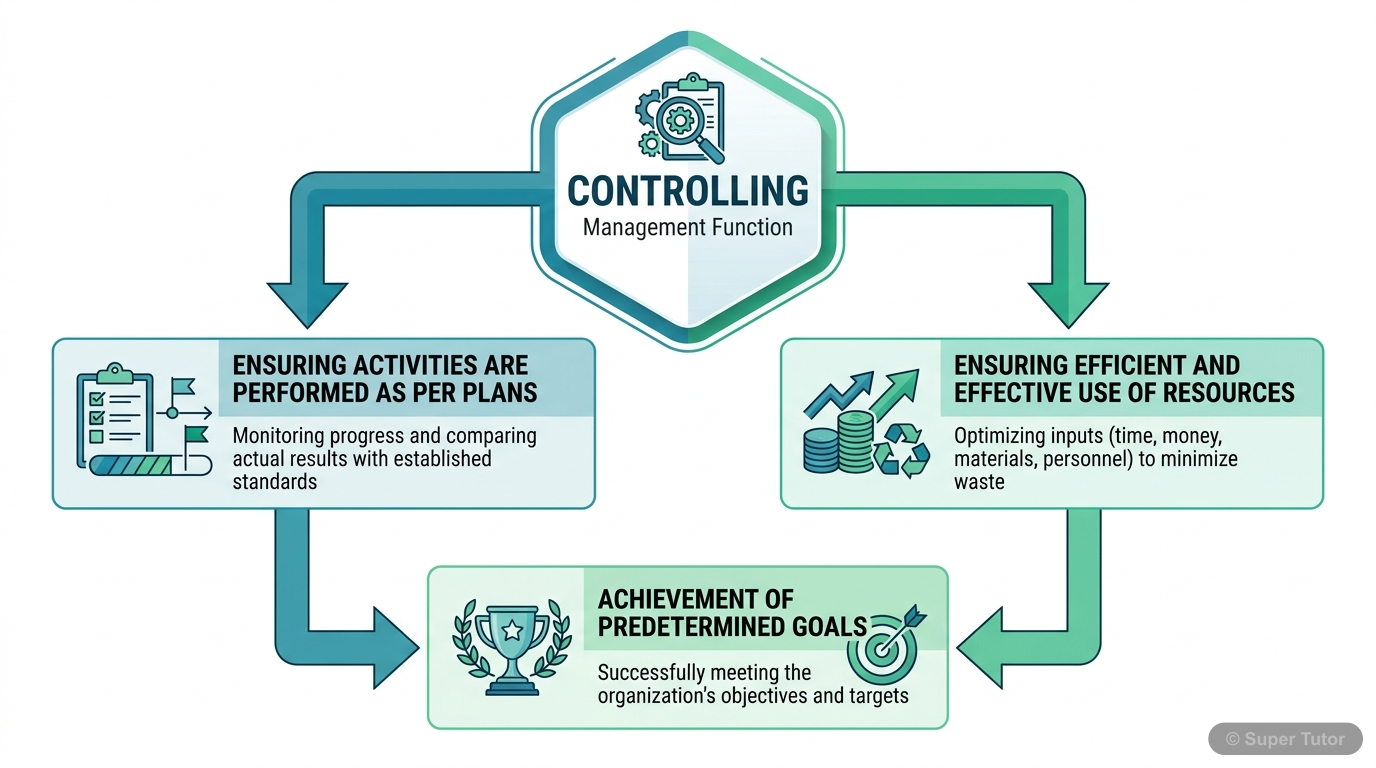
Controlling
Assam Board · Class 12 · Business Studies
NCERT Solutions for Controlling — Assam Board Class 12 Business Studies.
Interactive on Super Tutor
Studying Controlling? Get the full interactive chapter.
Quizzes, flashcards, AI doubt-solver and a step-by-step study plan — built for ncert solutions and more.
1,000+ Class 12 students started this chapter today

Super Tutor has 10+ illustrations like this for Controlling alone — flashcards, concept maps, and step-by-step visuals.
See them allVery Short Answer Type
1State the meaning of controlling.Show solution
Controlling is the managerial process of ensuring that actual activities conform to planned activities. It involves measuring actual performance, comparing it with the set standards, identifying deviations, and taking corrective action to ensure that organisational goals are achieved.
In simple words, controlling means making things happen the way they were planned to happen. It is the last function of management that closes the loop between planning and execution.
2Name the principle that a manager should consider while dealing with deviations effectively.Show solution
A manager should follow the principle of Management by Exception while dealing with deviations effectively.
Explanation: According to this principle, a manager should not try to control each and every deviation. Only significant deviations — those that exceed the acceptable range — should be brought to the manager's attention and corrective action should be taken. Minor or insignificant deviations should be ignored or handled at lower levels.
This allows managers to focus their time and energy on matters that truly require their attention, making the control process more efficient.
3State any one situation in which an organisation's control system loses its effectiveness.Show solution
An organisation's control system loses its effectiveness when it is not possible for management to set quantitative standards of performance.
For example, in areas such as employee morale, job satisfaction, or human relations, it is difficult to set measurable numerical standards. In the absence of clear quantitative benchmarks, the comparison of actual performance with standards becomes subjective and unreliable, thereby reducing the effectiveness of the control system.
*(Other valid situations: resistance from employees, high cost of control in small organisations, or inability to control external factors.)*
4Give any two standards that can be used by a company to evaluate the performance of its Finance & Accounting department.Show solution
1. Cost Standards: The budgeted cost of performing various financial activities (e.g., cost per transaction, administrative expenses as a percentage of revenue) can be set as a standard. Actual costs are then compared with these budgeted figures.
2. Return on Investment (ROI): The expected rate of return on the capital invested can be set as a standard. The actual ROI achieved is compared with the target ROI to evaluate the financial performance of the department.
*(Other valid standards: ratio analysis benchmarks such as current ratio, debt-equity ratio; timely submission of financial reports, etc.)*
5Which term is used to indicate the difference between standard performance and actual performance?Show solution
If actual performance is less than the standard, it is called an unfavourable or negative deviation, and corrective action needs to be taken. If actual performance exceeds the standard, it is a favourable or positive deviation.
Short Answer Type
1'Planning is looking ahead and controlling is looking back.' Comment.Show solution
The statement 'Planning is looking ahead and controlling is looking back' is only partially correct.
Why Planning is 'looking ahead':
Planning is a future-oriented function. It involves deciding in advance what is to be done, how it is to be done, when it is to be done, and by whom. It sets goals and charts the course of action for the future. In this sense, planning does look ahead.
Why Controlling is said to be 'looking back':
Controlling involves measuring actual performance and comparing it with the standards set during planning. Since it reviews what has already happened (past performance), it appears to be backward-looking.
However, the statement is only partially true:
Controlling is not merely backward-looking. While it does review past performance, its ultimate purpose is forward-looking — to take corrective action so that future performance conforms to plans. Without corrective action, control would have no value.
Conclusion:
Planning and controlling are inseparable twins of management. Planning initiates the management process and controlling completes it. Plans provide the basis for control, and control ensures that plans are actually implemented. Together, they form a continuous cycle — plans guide action, and control ensures the action stays on track.
2'An effort to control everything may end up in controlling nothing.' Explain.Show solution
The statement 'An effort to control everything may end up in controlling nothing' highlights the principle of Management by Exception and the concept of Critical Point Control.
Meaning: If a manager tries to monitor and control each and every activity and every minor deviation in an organisation, they will:
- Waste valuable time and energy on trivial matters.
- Be unable to give adequate attention to significant problems.
- Overload themselves with information, leading to confusion and inefficiency.
- Ultimately fail to control even the important deviations effectively.
What should be done instead:
Managers should practise Management by Exception — they should focus only on significant deviations that exceed the acceptable range and require managerial attention. Minor deviations can be handled at lower levels or ignored.
Additionally, Critical Point Control suggests that managers should identify and focus on key result areas (KRAs) — those critical points where deviations are most likely to cause serious harm to the organisation.
Conclusion:
By trying to control everything, a manager spreads their attention too thin and loses focus on what truly matters. Effective control requires selectivity — concentrating on exceptions and critical points — so that managerial effort is directed where it is most needed.
3Explain how management audit serves as an effective technique of controlling.Show solution
Meaning: Management Audit is a systematic and comprehensive appraisal or examination of the overall management of an organisation — its objectives, policies, procedures, personnel, and operations — to evaluate their effectiveness and efficiency.
How it serves as an effective technique of controlling:
1. Evaluates Managerial Performance: It assesses how effectively managers at all levels are performing their functions (planning, organising, directing, and controlling), helping identify weaknesses in management.
2. Identifies Inefficiencies: It helps detect areas where resources are being wasted or where management practices are not aligned with organisational goals, enabling timely corrective action.
3. Ensures Goal Achievement: By reviewing whether management decisions and actions are directed towards achieving organisational objectives, it ensures that the organisation stays on the right path.
4. Improves Decision-Making: The findings of a management audit provide valuable feedback to top management, helping them make better-informed decisions.
5. Promotes Accountability: It creates a sense of accountability among managers, as they know their performance will be reviewed and evaluated.
6. Facilitates Comparison: It allows comparison of the organisation's management practices with best practices in the industry, helping identify areas for improvement.
Conclusion: Management audit is a proactive and comprehensive control tool that goes beyond financial auditing to evaluate the entire management system, making it a highly effective technique of managerial control.
4Mr. Arfaaz had been heading the production department of Writewell Products Ltd., a firm manufacturing stationary items. The firm secured an export order that had to be completed on a priority basis and production targets were defined for all the employees. One of the workers, Mr. Bhanu Prasad, fell short of his daily production target by 10 units for two days consecutively. Mr. Arfaaz approached Ms Vasundhara, the CEO of the Company, to file a complaint against Mr Bhanu Prasad and requested her to terminate his services. Explain the principle of management control that Ms Vasundhara should consider while taking her decision.Show solution
Given: Mr. Bhanu Prasad fell short of his daily production target by only 10 units for two days consecutively. Mr. Arfaaz wants to terminate his services for this minor shortfall.
Principle Ms. Vasundhara should apply: She should consider the principle of Management by Exception (MBE).
Explanation of the Principle:
According to the principle of Management by Exception, only significant deviations from the set standards — those that exceed the acceptable/tolerable range — should be brought to the attention of top management and require corrective action. Minor or insignificant deviations should be handled at lower levels or ignored.
Application to the given situation:
- A shortfall of 10 units for just two days is a minor and insignificant deviation in the context of an export order.
- Terminating an employee for such a small and short-term deviation would be an extreme and disproportionate response.
- Ms. Vasundhara should not terminate Mr. Bhanu Prasad's services. Instead, she should:
- Investigate the reason for the shortfall (e.g., machine breakdown, health issue, lack of materials).
- Provide guidance or support to help him meet his targets.
- Take corrective action only if the deviation is persistent and significant.
Conclusion: Ms. Vasundhara should advise Mr. Arfaaz that termination is not warranted for such a minor deviation. The principle of Management by Exception ensures that managerial time and energy are focused on critical problems, not trivial ones.
Long Answer Type
1Explain the various steps involved in the process of control.Show solution
The control process is a systematic procedure that involves the following steps:
---
Step 1: Setting Performance Standards
- The first step in the control process is to establish standards against which actual performance will be measured.
- Standards are benchmarks or criteria that serve as the basis for comparison.
- Standards can be quantitative (e.g., units produced, sales targets, cost per unit, profit margin) or qualitative (e.g., employee morale, customer satisfaction, product quality).
- Standards should be clear, specific, measurable, and realistic.
- Example: A sales department may set a standard of selling 500 units per month.
---
Step 2: Measurement of Actual Performance
- Once standards are set, the actual performance of employees and departments is measured.
- Performance should be measured in the same units as the standards to facilitate comparison.
- Measurement can be done through personal observation, statistical reports, written reports, or sample checking.
- It is important that measurement is objective, accurate, and timely.
- Example: At the end of the month, it is found that the sales department sold only 420 units.
---
Step 3: Comparison of Actual Performance with Standards
- Actual performance is compared with the set standards to identify deviations.
-
- In the example: Deviation = 500 − 420 = 80 units (unfavourable).
- Not all deviations require attention. Managers use critical point control and management by exception to focus only on significant deviations.
---
Step 4: Analysing Deviations
- Once deviations are identified, their causes are analysed to determine whether corrective action is needed.
- Managers must distinguish between:
- Acceptable deviations (within the tolerable range — no action needed)
- Critical deviations (beyond the tolerable range — immediate action needed)
- The causes of deviation are investigated: Was it due to unrealistic standards, poor planning, lack of resources, employee inefficiency, or external factors?
- Tools like Pareto Analysis (80/20 rule) help identify the most significant causes.
---
Step 5: Taking Corrective Action
- The final and most important step is to take corrective action to eliminate the causes of significant deviations.
- Corrective action may involve:
- Revising standards if they were set unrealistically.
- Providing training to employees if the deviation was due to lack of skill.
- Improving processes or technology if the deviation was due to operational inefficiency.
- Reallocating resources if there was a shortage.
- Corrective action ensures that future performance conforms to plans.
---
Conclusion: The control process is a continuous and dynamic cycle. It ensures that the organisation stays on track towards its goals and that any deviations are detected and corrected in a timely manner.
2Explain the techniques of managerial control.Show solution
Managerial control techniques are broadly classified into two categories:
---
## A. Traditional Techniques
1. Personal Observation
- The manager directly observes the work being done by employees.
- It provides first-hand, unfiltered information about actual performance.
- It also creates a psychological pressure on employees to perform well.
- Limitation: It is time-consuming and cannot be used for large organisations.
2. Statistical Reports
- Performance data is presented in the form of tables, graphs, charts, and diagrams.
- These reports make it easy to identify trends, patterns, and deviations over time.
- They provide a historical record for future reference.
- Limitation: They only show quantitative data and may miss qualitative aspects.
3. Breakeven Analysis
- Also called Cost-Volume-Profit (CVP) Analysis.
- It helps determine the breakeven point — the level of sales at which total revenue equals total cost (no profit, no loss).
-
- It helps managers understand the relationship between costs, volume, and profits and plan accordingly.
4. Budgetary Control
- A budget is a quantitative statement of expected results expressed in financial or numerical terms for a specific future period.
- Budgetary control involves comparing actual performance with the budgeted figures and taking corrective action for deviations.
- Types of budgets: Sales budget, Production budget, Cash budget, Capital expenditure budget.
- It helps in coordinating activities and controlling costs.
---
## B. Modern Techniques
1. Return on Investment (ROI)
- ROI measures the profitability of investment made in the business.
-
- It helps evaluate whether the capital invested is generating adequate returns.
- It is used to compare performance across different departments or divisions.
2. Ratio Analysis
- Financial ratios are calculated from the financial statements (Balance Sheet, P&L Account) to evaluate performance.
- Key ratios include:
- Liquidity Ratios (e.g., Current Ratio) — measure short-term solvency.
- Profitability Ratios (e.g., Net Profit Ratio) — measure earning capacity.
- Solvency Ratios (e.g., Debt-Equity Ratio) — measure long-term financial stability.
- Activity/Turnover Ratios (e.g., Inventory Turnover) — measure efficiency of asset use.
3. Responsibility Accounting
- The organisation is divided into responsibility centres (cost centres, profit centres, investment centres).
- Each centre's manager is held accountable for the performance of their centre.
- It promotes decentralisation and motivates managers to achieve targets.
4. Management Audit
- A systematic appraisal of the overall management of an organisation.
- It evaluates the effectiveness of management policies, procedures, and practices.
- It helps identify weaknesses in management and suggests improvements.
5. PERT and CPM
- PERT (Programme Evaluation and Review Technique) and CPM (Critical Path Method) are network analysis techniques used for planning and controlling complex projects.
- They help in:
- Identifying the critical path (the longest sequence of activities).
- Estimating project completion time.
- Identifying activities where delays would affect the overall project.
- Widely used in construction, research projects, and large-scale operations.
6. Management Information System (MIS)
- MIS is a computer-based system that collects, processes, stores, and disseminates information to managers at all levels.
- It provides timely, accurate, and relevant information for decision-making and control.
- It helps managers monitor performance, identify deviations, and take corrective action quickly.
---
Conclusion: Both traditional and modern techniques of control complement each other. Effective managers use a combination of these techniques depending on the nature of the organisation, the type of activity, and the level of management.
3Explain the importance of controlling in an organisation. What are the problems faced by the organisation in implementing an effective control system?Show solution
1. Accomplishing Organisational Goals
- Controlling ensures that all activities are directed towards the achievement of organisational goals.
- It identifies deviations from plans and takes corrective action, keeping the organisation on track.
2. Judging Accuracy of Standards
- Through the control process, managers can evaluate whether the standards set were realistic and achievable.
- If actual performance consistently falls short or exceeds standards, it signals that standards need to be revised.
3. Making Efficient Use of Resources
- Controlling ensures that all resources — human, financial, physical, and informational — are used efficiently and effectively.
- It minimises wastage and ensures optimal utilisation of resources.
4. Improving Employee Motivation and Morale
- When employees know that their performance is being monitored and evaluated, they are motivated to work harder and more efficiently.
- A fair and transparent control system boosts employee morale and encourages them to meet targets.
5. Ensuring Order and Discipline
- Controlling creates an atmosphere of order and discipline in the organisation.
- Employees are aware of the standards expected of them and the consequences of non-performance.
6. Facilitating Coordination
- Controlling helps in coordinating the activities of different departments and individuals.
- It ensures that all parts of the organisation work together in one direction towards common goals.
7. Facilitating Decentralisation
- An effective control system allows top management to delegate authority with confidence, knowing that performance will be monitored.
- This facilitates decentralisation and empowers lower-level managers.
---
Problems/Limitations in Implementing an Effective Control System:
1. Difficulty in Setting Quantitative Standards
- Control is effective only when performance can be measured against clear standards.
- For activities like employee morale, job satisfaction, or human relations, it is difficult to set quantitative standards, making control less effective.
2. No Control over External Factors
- An organisation cannot control external environmental factors such as changes in government policy, economic conditions, natural calamities, or competition.
- These factors can cause deviations from plans that are beyond the organisation's control.
3. Resistance from Employees
- Employees may resist the control system as they may feel it restricts their freedom, invades their privacy, or reflects a lack of trust.
- This resistance can reduce the effectiveness of the control system.
4. Costly Affair
- Implementing an effective control system requires investment in technology, personnel, and processes.
- For small organisations, the cost of control may outweigh its benefits, making it impractical.
5. Focus on Past Performance
- Traditional control systems are reactive — they identify deviations after they have occurred.
- By the time corrective action is taken, significant damage may already have been done.
---
Conclusion: Despite its limitations, controlling is an indispensable function of management. The problems can be minimised by designing a well-thought-out, flexible, and cost-effective control system that is accepted by employees and aligned with organisational goals.
4Discuss the relationship between planning and controlling.Show solution
Planning and controlling are considered inseparable twins of management. They are so closely interrelated that one cannot function effectively without the other.
---
1. Planning Provides the Basis for Control
- Planning involves setting goals and standards of performance.
- These standards become the benchmarks against which actual performance is measured during the control process.
- Without planning, there would be no standards to compare actual performance against, making control impossible.
- *"Control without planning is like a ship without a rudder."*
2. Controlling Ensures Implementation of Plans
- Plans remain mere intentions unless they are implemented and monitored.
- Controlling ensures that the activities being carried out conform to the plans.
- Without control, even the best-laid plans may go astray.
- *"Planning without control is futile."*
3. Planning is Forward-Looking; Controlling Reviews the Past
- Planning is a future-oriented function — it decides what is to be done.
- Controlling is said to be backward-looking — it reviews what has been done.
- However, controlling is also forward-looking in the sense that corrective action taken today shapes future performance.
4. Controlling Provides Feedback for Future Planning
- The information generated through the control process — about deviations, their causes, and corrective actions — serves as valuable feedback for future planning.
- This feedback helps managers revise standards, update plans, and improve future performance.
- This creates a continuous cycle: Plan → Implement → Control → Revise Plan.
5. Both are Goal-Oriented
- Both planning and controlling are directed towards the achievement of organisational goals.
- Planning sets the goals; controlling ensures they are achieved.
6. They Form a Continuous Cycle
- The relationship between planning and controlling is cyclical and continuous:
- Plans are made → Actions are taken → Performance is measured → Deviations are identified → Corrective action is taken → Plans are revised.
- This cycle repeats continuously, ensuring the organisation remains on track.
---
Conclusion:
Planning and controlling are two sides of the same coin. Planning initiates the management process and controlling completes it. As Peter Drucker said, *"Plans are only good intentions unless they immediately degenerate into hard work."* Controlling is the mechanism that converts plans into results. Together, they ensure that the organisation achieves its objectives efficiently and effectively.
5A company 'M' limited is manufacturing mobile phones both for domestic Indian market as well as for export. It had enjoyed a substantial market share and also had a loyal customer following. But lately it has been experiencing problems because its targets have not been met with regard to sales and customer satisfaction. Also mobile market in India has grown tremendously and new players have come with better technology and pricing. This is causing problems for the company. It is planning to revamp its controlling system and take other steps necessary to rectify the problems it is facing.
a. Identify the benefits the company will derive from a good control system.
b. How can the company relate its planning with control in this line of business to ensure that its plans are actually implemented and targets attained.
c. Give the steps in the control process that the company should follow to remove the problems it is facing.Show solution
---
(a) Benefits M Limited will derive from a good control system:
1. Accomplishing Organisational Goals: A good control system will help M Limited ensure that its sales targets and customer satisfaction goals are actually met by monitoring performance and taking timely corrective action.
2. Efficient Use of Resources: It will ensure that the company's financial, human, and technological resources are used optimally, reducing wastage and improving productivity.
3. Judging Accuracy of Standards: The control system will help M Limited evaluate whether its sales targets and quality standards are realistic in the context of the new competitive environment, and revise them if necessary.
4. Improving Employee Morale: A transparent performance monitoring system will motivate employees to work towards targets, improving overall efficiency.
5. Facilitating Coordination: It will help coordinate the activities of the production, marketing, sales, and customer service departments so that they all work together towards common goals.
6. Competitive Advantage: By monitoring market trends and customer feedback through the control system, M Limited can respond quickly to competition from new players with better technology and pricing.
---
(b) Relating Planning with Control for M Limited:
Planning and controlling are inseparable twins and M Limited must integrate them as follows:
1. Set Clear Plans and Standards: M Limited should set specific, measurable targets for sales volume, market share, customer satisfaction scores, and product quality — both for the domestic and export markets.
2. Align Actions with Plans: All departments (production, marketing, R&D, customer service) should be given clear targets derived from the overall plan.
3. Monitor Performance Continuously: The control system should continuously measure actual sales, customer feedback, and production quality against the planned targets.
4. Use Feedback for Revised Planning: When deviations are found (e.g., sales falling short due to competition), the findings should feed back into the planning process — for example, planning to introduce better technology, revising pricing strategies, or launching new marketing campaigns.
5. Respond to External Changes: Since the mobile market is dynamic, M Limited's plans should be flexible and the control system should flag when external changes (new competitors, technology shifts) require plan revisions.
This creates a continuous planning-control cycle that ensures plans are implemented and targets are achieved.
---
(c) Steps in the Control Process for M Limited:
Step 1: Setting Performance Standards
- M Limited should set clear standards such as:
- Monthly/quarterly sales targets (units and revenue) for domestic and export markets.
- Customer satisfaction score (e.g., minimum 85% satisfaction rating).
- Product quality standards (defect rate below 1%).
- Market share targets.
Step 2: Measurement of Actual Performance
- The company should measure:
- Actual units sold vs. target.
- Customer satisfaction scores from surveys and feedback.
- Market share data from industry reports.
- Quality control data from production.
Step 3: Comparison of Actual Performance with Standards
- Compare actual sales, customer satisfaction, and quality data with the set standards.
- Identify deviations: e.g., actual sales = 350 units vs. target of 500 units → deviation of 150 units (unfavourable).
Step 4: Analysing Deviations
- Investigate the causes of deviations:
- Are sales falling because of pricing issues?
- Is customer dissatisfaction due to product quality or after-sales service?
- Is the competition offering better technology?
- Are there internal inefficiencies in production?
- Focus on significant deviations using the principle of Management by Exception.
Step 5: Taking Corrective Action
- Based on the analysis, M Limited should take corrective action such as:
- Revising pricing strategy to compete with new players.
- Investing in R&D to develop better technology.
- Improving after-sales service to boost customer satisfaction.
- Training employees to improve productivity and quality.
- Revising sales targets if they were set unrealistically given the new competitive environment.
Conclusion: By following these steps systematically, M Limited can identify the root causes of its problems, take timely corrective action, and regain its market share and customer loyalty.
6Mr Shantanu is a chief manager of a reputed company that manufactures garments. He called the production manager and instructed him to keep a constant and continuous check on all the activities related to his department so that everything goes as per the set plan. He also suggested him to keep a track of the performance of all the employees in the organisation so that targets are achieved effectively and efficiently.
a. Describe any two features of Controlling highlighted in the above situation.
b. Explain any four points of importance of Controlling.Show solution
---
(a) Two Features of Controlling highlighted in the above situation:
Feature 1: Controlling is a Continuous Process
- Mr. Shantanu instructed the production manager to keep a 'constant and continuous check' on all activities.
- This highlights that controlling is not a one-time activity. It is an ongoing process that takes place at all times and at all levels of management to ensure that activities conform to plans.
- Controlling continues as long as the organisation is in operation.
Feature 2: Controlling is Goal-Oriented
- Mr. Shantanu emphasised that the check should ensure 'targets are achieved effectively and efficiently' and that 'everything goes as per the set plan'.
- This highlights that controlling is goal-directed — its ultimate purpose is to ensure that organisational goals and targets are achieved.
- All control activities are focused on keeping the organisation on track towards its objectives.
*(Note: 'Pervasive' is also a valid feature — the instruction was given to monitor all employees across the organisation, showing that controlling operates at all levels and in all departments.)*
---
(b) Four Points of Importance of Controlling:
1. Accomplishing Organisational Goals
- Controlling ensures that all activities are directed towards the achievement of organisational goals.
- It identifies deviations from plans and takes corrective action, ensuring that the organisation stays on track.
- For the garment company, it ensures that production targets, quality standards, and delivery schedules are met.
2. Judging Accuracy of Standards
- Through the control process, managers can evaluate whether the performance standards set were realistic and achievable.
- If actual performance consistently falls short or exceeds standards, it signals that standards need to be revised.
- This helps the garment company set more accurate and meaningful targets for future periods.
3. Making Efficient Use of Resources
- Controlling ensures that all resources — labour, raw materials, machinery, and finances — are used efficiently and without wastage.
- In a garment manufacturing company, this means minimising fabric wastage, optimising machine utilisation, and ensuring labour productivity.
4. Improving Employee Morale and Motivation
- When employees know that their performance is being monitored and evaluated fairly, they are motivated to perform better.
- A good control system rewards good performance and identifies areas where employees need support or training.
- This creates a positive work culture and boosts overall productivity in the garment company.
---
Conclusion: Controlling is an indispensable function of management. As highlighted in the situation, a chief manager like Mr. Shantanu must ensure that controlling is continuous, pervasive, and goal-oriented to achieve organisational success.
Stuck on a step?
Ask Super Tutor AI to explain any solution on this page in a simpler way — free, 24x7.
Ask a Doubt FreeFrequently Asked Questions
What are the important topics in Controlling for Assam Board Class 12 Business Studies?
How to score full marks in Controlling — Assam Board Class 12 Business Studies?
Where can I get free NCERT Solutions for Controlling Class 12 Business Studies?
Sources & Official References
Content is aligned to the official syllabus. Refer to the board website for the latest curriculum.
More resources for Controlling
Important Questions
Practice with board exam-style questions
Syllabus
What topics to cover
Revision Notes
Key points for last-minute revision
Study Plan
Step-by-step plan to ace this chapter
Flashcards
Quick-fire cards for active recall
Formula Sheet
All formulas in one place
Chapter Summary
Understand the chapter at a glance
Practice Quiz
Test yourself with a quick quiz
Concept Maps
See how topics connect visually
For serious students
Get the full Controlling chapter — for free.
Quizzes, flashcards, AI doubt-solver and a step-by-step study plan for Assam Board Class 12 Business Studies.