Haloalkanes and Haloarenes — Chapter Summary
Assam Board · Class 12 · Chemistry
Summary of Haloalkanes and Haloarenes for Assam Board Class 12 Chemistry. Part of the Assam Board Class 12 Chemistry syllabus.
Interactive on Super Tutor
Studying Haloalkanes and Haloarenes? Get the full interactive chapter.
Quizzes, flashcards, AI doubt-solver and a step-by-step study plan — built for chapter summary and more.
Free trial, no card needed.
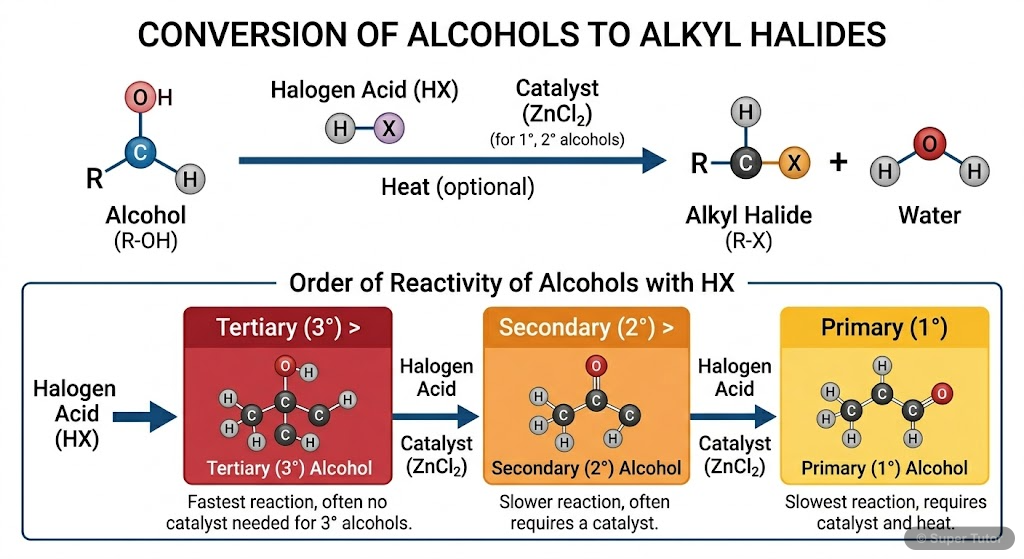
One of 33 illustrations for Haloalkanes and Haloarenes in Super Tutor — alongside flashcards, concept maps and practice questions.
Overview
Haloalkanes and haloarenes are halogenated organic compounds in which hydrogen atoms of hydrocarbons are replaced by halogen atoms. Haloalkanes contain halogen attached to an sp3 hybridised carbon of an alkyl group, while haloarenes contain halogen directly attached to an sp2 hybridised carbon of an
Key Concepts
Halogenated compounds are classified as mono
Halogenated compounds are classified as mono-, di-, or polyhalogen compounds depending on the number of halogen atoms. They may also be grouped as alk
Haloalkanes have halogen attached to sp3
Haloalkanes have halogen attached to sp3 carbon of an alkyl group. Haloarenes have halogen attached directly to sp2 carbon of an aromatic ring. Haloar
Haloalkanes are prepared from alcohols using
Haloalkanes are prepared from alcohols using HCl/ZnCl2, NaBr/H2SO4, phosphorus trihalides, and thionyl chloride. They can also be formed from alkenes
Haloarenes are prepared mainly by electrophilic
Haloarenes are prepared mainly by electrophilic substitution of arenes with halogens in the presence of Lewis acid catalysts, and by Sandmeyer-type re
The carbon
The carbon-halogen bond is polar because halogens are more electronegative than carbon. Bond length increases from C-F to C-I in alkyl halides. In hal
Learning Objectives
- Classify haloalkanes and haloarenes by number of halogen atoms and by the type of carbon-halogen bond.
- Write common and IUPAC names of haloalkanes and haloarenes.
- Explain methods of preparation of haloalkanes and haloarenes.
- Relate structure to physical properties such as boiling point, melting point, density, and solubility.
- Understand nucleophilic substitution through SN1 and SN2 mechanisms.
Frequently Asked Questions
What are the important topics in Haloalkanes and Haloarenes for Assam Board Class 12 Chemistry?
How should I revise Haloalkanes and Haloarenes for the Assam Board Class 12 board exam?
Sources & Official References
Content is aligned to the official syllabus. Refer to the board website for the latest curriculum.
More resources for Haloalkanes and Haloarenes
Practice Quiz
Test yourself with a quick quiz
Important Questions
Exam-style questions with answers
Revision Notes
Key points for last-minute revision
Formula Sheet
The chapter's formulas in one place
Concept Maps
See how topics connect
Study Plan
Step-by-step plan for this chapter
Flashcards
Quick-fire cards for active recall
Syllabus
What topics to cover
NCERT Solutions
Every textbook question solved step by step
For serious students
Get the full Haloalkanes and Haloarenes chapter — start free.
Quizzes, flashcards, an AI doubt solver and a study plan for Assam Board Class 12 Chemistry. Free to start, no card needed.