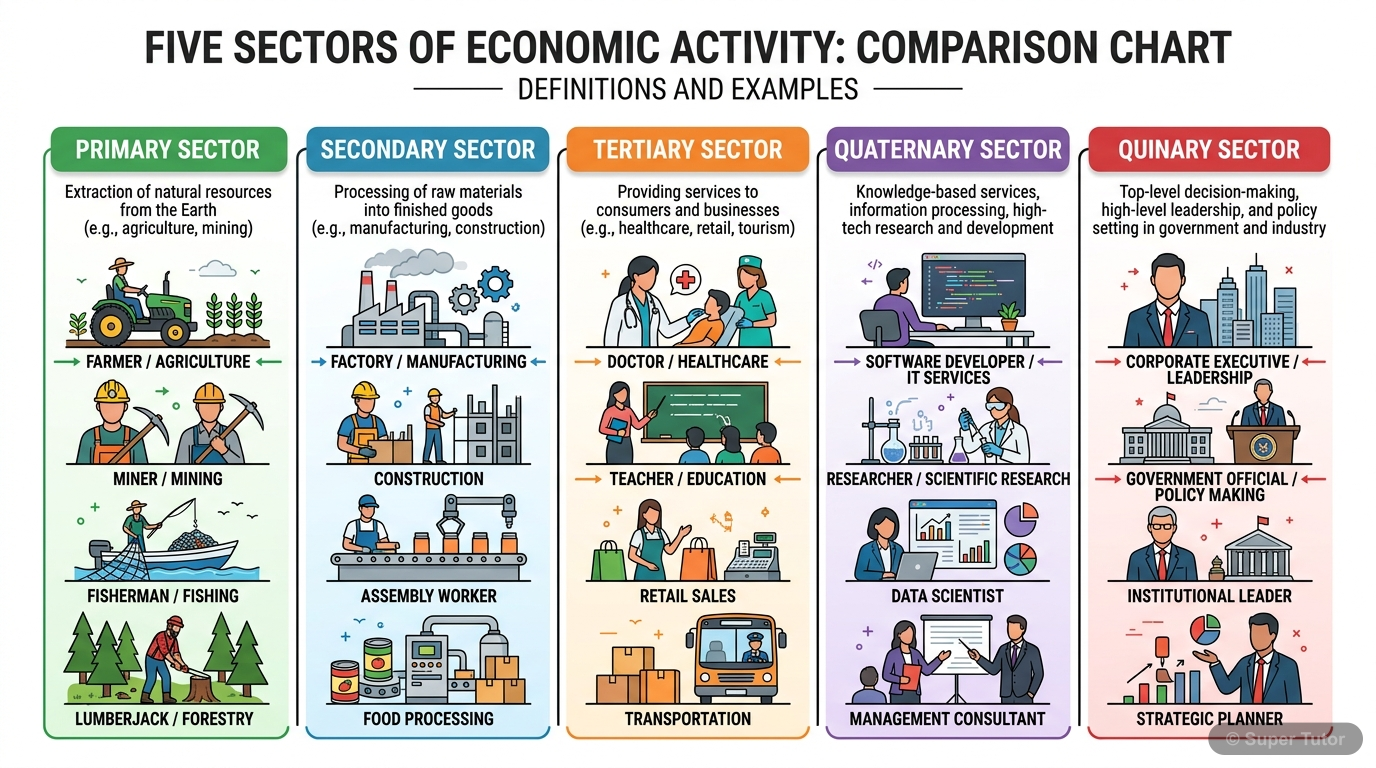
Tertiary and Quaternary Activities
Assam Board · Class 12 · Geography
NCERT Solutions for Tertiary and Quaternary Activities — Assam Board Class 12 Geography.
Interactive on Super Tutor
Studying Tertiary and Quaternary Activities? Get the full interactive chapter.
Quizzes, flashcards, AI doubt-solver and a step-by-step study plan — built for ncert solutions and more.
1,000+ Class 12 students started this chapter today

Super Tutor has 11+ illustrations like this for Tertiary and Quaternary Activities alone — flashcards, concept maps, and step-by-step visuals.
See them allExercises
1(i)Which one of the following is a tertiary activity?
(a) Farming
(b) Trading
(c) Weaving
(d) HuntingShow solution
Justification: Tertiary activities involve the provision of services rather than the production of goods. Trading (buying and selling of goods) is a service activity and hence belongs to the tertiary sector. Farming belongs to the primary sector, weaving to the secondary sector, and hunting to the primary sector.
1(ii)Which one of the following activities is NOT a secondary sector activity?
(a) Iron Smelting
(b) Catching fish
(c) Making garments
(d) Basket WeavingShow solution
Justification: Secondary sector activities involve the processing or manufacturing of raw materials into finished goods. Catching fish is a primary sector activity (extraction of natural resources directly from nature). Iron smelting, making garments, and basket weaving all involve processing/manufacturing, so they belong to the secondary sector.
1(iii)Which one of the following sectors provides most of the employment in Delhi, Mumbai, Chennai and Kolkata?
(a) Primary
(b) Quaternary
(c) Secondary
(d) ServiceShow solution
Justification: Delhi, Mumbai, Chennai, and Kolkata are major metropolitan cities of India. In large urban centres, the service (tertiary) sector — which includes trade, transport, banking, education, health, administration, etc. — provides the maximum employment to the urban workforce.
1(iv)Jobs that involve high degrees and level of innovations are known as:
(a) Secondary activities
(b) Quaternary activities
(c) Quinary activities
(d) Primary activitiesShow solution
Justification: Quinary activities represent the highest level of decision-making in a society or economy. They involve top executives and officials in government, business, education, health, and research who are engaged in the creation, re-arrangement, and interpretation of new and existing ideas. These jobs require the highest level of innovation and specialised knowledge.
1(v)Which one of the following activities is related to quaternary sector?
(a) Manufacturing computers
(b) Paper and Raw pulp production
(c) University teaching
(d) Printing booksShow solution
Justification: Quaternary activities centre on the collection, production, and dissemination of information and knowledge. University teaching involves the generation and transfer of knowledge and is therefore a quaternary activity. Manufacturing computers and printing books are secondary activities, while paper and raw pulp production is also a secondary/primary activity.
1(vi)Which one out of the following statements is not true?
(a) Outsourcing reduces costs and increases efficiency.
(b) At times engineering and manufacturing jobs can also be outsourced.
(c) BPOs have better business opportunities as compared to KPOs.
(d) There may be dissatisfaction among job seekers in the countries that outsource the job.Show solution
Justification: This statement is NOT true. Knowledge Process Outsourcing (KPOs) require higher levels of skill, expertise, and knowledge (e.g., legal services, research and analytics, financial consulting), and therefore offer better business opportunities and higher value than Business Process Outsourcing (BPOs), which handle routine tasks like data entry and customer support.
2(i)Explain retail trading service.Show solution
Answer: Retail trading is the business activity concerned with the sale of goods directly to consumers. It is the last link in the chain of distribution between the producer and the consumer. Retail traders operate through fixed establishments such as shops, stores, and supermarkets, or through mobile vendors and street markets. They buy goods in bulk from wholesalers and sell them in small quantities to individual customers. Modern retail trading also includes e-commerce and online shopping platforms. It provides employment to a large number of people and plays a vital role in making goods accessible to consumers.
2(ii)Describe quaternary services.Show solution
Answer: Quaternary activities involve the collection, production, and dissemination of information and knowledge. They are knowledge-based activities that include education, research and development, information technology, financial and legal services, and consultancy. These activities are carried out by highly skilled and specialised professionals. Unlike primary, secondary, and tertiary activities, quaternary activities are not tied to any specific location and can be performed from anywhere using modern communication technology. They are characteristic of highly developed economies and are growing rapidly in the modern world due to the information revolution.
2(iii)Name the fast emerging countries of medical tourism in the world.Show solution
Answer: The fast emerging countries of medical tourism in the world are:
1. India
2. Thailand
3. Singapore
4. Malaysia
5. South Africa
6. Hungary (in Europe)
These countries attract patients from developed nations because they offer world-class medical facilities, highly qualified doctors, and treatment at a fraction of the cost compared to countries like the USA or UK.
2(iv)What is digital divide?Show solution
Answer: Digital divide refers to the gap or inequality that exists between individuals, communities, or countries in terms of their access to and use of information and communication technologies (ICT) such as the internet, computers, and mobile phones. Those with access to digital technology can benefit from education, employment, and economic opportunities, while those without access are left behind. This divide exists between:
- Developed and developing countries (global level)
- Urban and rural areas (national level)
- Rich and poor sections of society
The digital divide widens socio-economic inequalities and is a major challenge in the modern knowledge-based economy.
3(i)Discuss the significance and growth of the service sector in modern economic development.Show solution
Significance of the Service Sector:
1. Employment Generation: The service sector is the largest employer in most developed and many developing countries. It absorbs a large proportion of the workforce in activities like trade, banking, transport, education, and health.
2. Contribution to GDP: In developed economies, the service sector contributes more than 60–70% of the Gross Domestic Product (GDP). Even in developing countries like India, its share is rapidly increasing.
3. Support to Other Sectors: Services such as banking, insurance, transport, and communication provide essential support to the primary and secondary sectors, enabling them to function efficiently.
4. Improvement in Quality of Life: Services like healthcare, education, and social welfare directly improve the standard of living and human development indices of a country.
5. Globalisation and Trade: The growth of IT, BPO, and KPO services has enabled countries like India to participate actively in the global economy through outsourcing.
6. Innovation and Knowledge Economy: Quaternary and quinary services drive innovation, research, and development, which are the engines of modern economic growth.
Growth of the Service Sector:
- With industrialisation and urbanisation, demand for services has grown enormously.
- The IT revolution has created entirely new service industries (e-commerce, digital media, fintech).
- Globalisation has led to the outsourcing of services across national boundaries.
- Rising incomes have increased demand for tourism, entertainment, and personal services.
- In countries like India, the IT and ITES (IT-enabled services) sector has grown at a remarkable pace, making India a global hub for software and business process outsourcing.
Conclusion: The service sector is the backbone of modern economies. Its growth reflects the transition from agrarian and industrial economies to knowledge-based economies, and it is central to sustainable economic development.
3(ii)Explain in detail the significance of transport and communication services.Show solution
Significance of Transport Services:
1. Movement of Goods and People: Transport enables the movement of raw materials to factories and finished goods to markets. It also facilitates the movement of people for work, trade, and tourism.
2. Integration of Markets: Transport links local, national, and international markets, enabling trade and commerce to flourish. Without transport, regional specialisation and large-scale production would not be possible.
3. Economic Development: Efficient transport networks (roads, railways, airways, waterways) reduce the cost of production and distribution, thereby stimulating economic growth.
4. Agricultural Development: Transport helps farmers to sell their produce in distant markets, reducing post-harvest losses and increasing their income.
5. Regional Development: Transport connects remote and backward regions with developed areas, promoting balanced regional development.
6. Defence and Administration: Transport is essential for the movement of troops, equipment, and administrative personnel, ensuring national security and governance.
Significance of Communication Services:
1. Exchange of Information: Communication services (telephone, internet, postal services, broadcasting) enable the rapid exchange of information across the world, which is essential for business, governance, and social interaction.
2. Business and Commerce: Modern business depends heavily on communication for transactions, marketing, customer service, and coordination. E-commerce and digital banking are entirely dependent on communication networks.
3. Education and Knowledge Dissemination: Communication technologies like the internet and television have revolutionised education, making knowledge accessible to people in remote areas.
4. Social Connectivity: Communication services connect families, communities, and nations, fostering social cohesion and cultural exchange.
5. Outsourcing and Globalisation: Advanced communication infrastructure has made it possible for countries to outsource services globally. India's BPO and IT sector is a direct result of excellent communication networks.
6. Disaster Management: Communication systems are critical during natural disasters for coordination of relief and rescue operations.
Conclusion: Transport and communication are the lifelines of a modern economy. They facilitate the movement of goods, people, and ideas, and are indispensable for economic integration, social development, and national progress. Investment in these sectors is a prerequisite for overall development.
Project(i)Find out the activities of BPO.Show solution
BPO refers to the practice of contracting specific business processes or operations to a third-party service provider, often in another country.
Key activities of BPOs include:
1. Customer Support Services: Handling customer queries, complaints, and feedback through call centres (inbound and outbound calls).
2. Technical Support: Providing IT helpdesk services, troubleshooting software/hardware problems for clients.
3. Data Entry and Data Processing: Entering, managing, and processing large volumes of data for companies.
4. Finance and Accounting: Managing accounts payable/receivable, payroll processing, and financial reporting.
5. Human Resource Management: Recruitment processing, employee record management, and payroll administration.
6. Healthcare Services: Medical transcription, medical billing, and coding for hospitals and clinics.
7. Legal Process Outsourcing (LPO): Drafting legal documents, legal research, and contract management.
8. Back-office Operations: Order processing, logistics support, and supply chain management.
India is one of the world's leading BPO destinations due to its large English-speaking, technically skilled workforce and lower labour costs.
Project(ii)Find out from a travel agent the documents you need to travel abroad.Show solution
1. Passport: A valid passport is the most essential document. It must be valid for at least six months beyond the date of travel.
2. Visa: A visa issued by the embassy or consulate of the destination country is required (except for visa-free or visa-on-arrival countries).
3. Travel Tickets: Confirmed air/rail/sea tickets showing onward and return journey.
4. Travel Insurance: Many countries (especially Schengen zone countries) require proof of travel insurance covering medical emergencies.
5. Hotel/Accommodation Booking: Proof of confirmed accommodation at the destination.
6. Bank Statements/Financial Proof: To show that you have sufficient funds to support yourself during the trip.
7. Invitation Letter (if applicable): Required for visits to friends/relatives or for business travel.
8. Vaccination Certificate: Some countries require proof of vaccination (e.g., Yellow Fever certificate for certain African/South American countries; COVID-19 related documents where applicable).
9. Foreign Exchange: Currency of the destination country or a forex card/traveller's cheques.
10. Emergency Contact Details and Copies of Documents: It is advisable to carry photocopies of all important documents separately.
Note: Requirements may vary depending on the destination country and the purpose of travel (tourism, business, education, medical).
Stuck on a step?
Ask Super Tutor AI to explain any solution on this page in a simpler way — free, 24x7.
Ask a Doubt FreeFrequently Asked Questions
What are the important topics in Tertiary and Quaternary Activities for Assam Board Class 12 Geography?
How to score full marks in Tertiary and Quaternary Activities — Assam Board Class 12 Geography?
Where can I get free NCERT Solutions for Tertiary and Quaternary Activities Class 12 Geography?
Sources & Official References
Content is aligned to the official syllabus. Refer to the board website for the latest curriculum.
More resources for Tertiary and Quaternary Activities
Important Questions
Practice with board exam-style questions
Syllabus
What topics to cover
Revision Notes
Key points for last-minute revision
Study Plan
Step-by-step plan to ace this chapter
Flashcards
Quick-fire cards for active recall
Formula Sheet
All formulas in one place
Chapter Summary
Understand the chapter at a glance
Practice Quiz
Test yourself with a quick quiz
Concept Maps
See how topics connect visually
For serious students
Get the full Tertiary and Quaternary Activities chapter — for free.
Quizzes, flashcards, AI doubt-solver and a step-by-step study plan for Assam Board Class 12 Geography.