Introducing Indian Society
Assam Board · Class 12 · Sociology
Flashcards for Introducing Indian Society — Assam Board Class 12 Sociology. Quick Q&A cards covering key concepts, definitions, and formulas.
Interactive on Super Tutor
Studying Introducing Indian Society? Get the full interactive chapter.
Quizzes, flashcards, AI doubt-solver and a step-by-step study plan — built for flashcards and more.
1,000+ Class 12 students started this chapter today
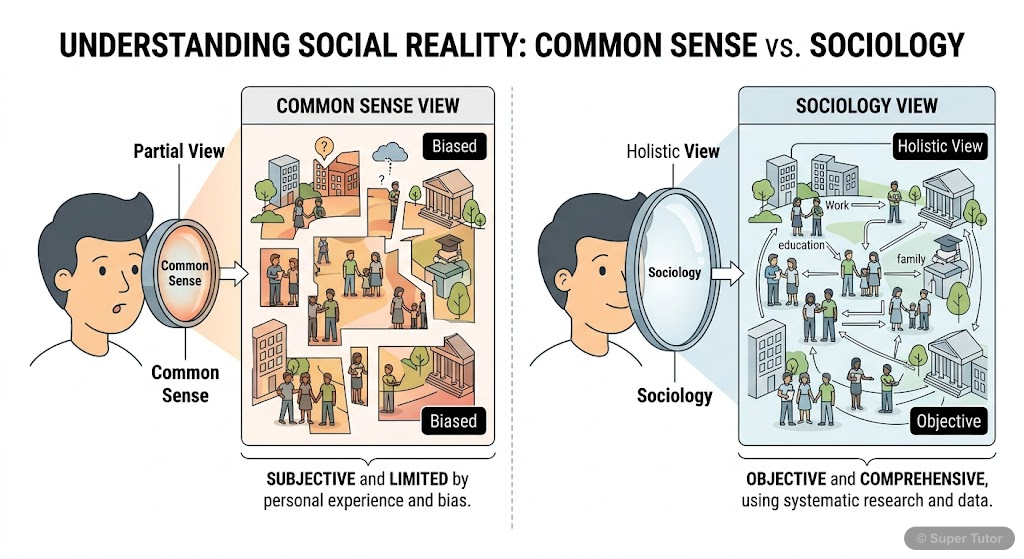
Super Tutor has 5+ illustrations like this for Introducing Indian Society alone — flashcards, concept maps, and step-by-step visuals.
See them allWhy is sociology unlike most other subjects at the start of study?
Answer
Sociology is unlike most other subjects because no one starts from zero. Everyone already knows something about society through daily life, family, and social experience. This prior knowledge can help…
अध्ययन की शुरुआत में समाजशास्त्र अन्य विषयों से अलग क्यों है?
Answer
समाजशास्त्र अन्य विषयों से अलग है क्योंकि कोई भी शून्य से शुरुआत नहीं करता है। हर कोई दैनिक जीवन, परिवार और सामाजिक अनुभव के माध्यम से समाज के बारे में पहले से ही कुछ जानता है। यह पूर्व ज्ञान शुरुआत म…
समाजशास्त्र में समाज के बारे में पूर्व ज्ञान का मुख्य नुकसान क्या है?
Answer
पूर्व ज्ञान एक समस्या बन सकता है क्योंकि यह सामान्य ज्ञान पर आधारित है, जिसे समाजशास्त्र का ठीक से अध्ययन करने से पहले सीखना होगा। सामान्य ज्ञान स्वाभाविक लग सकता है, लेकिन यह अक्सर अधूरा और पक्षपाती …
What is the main disadvantage of prior knowledge about society in sociology?
Answer
Prior knowledge can become a problem because it is based on common sense, which must be unlearned before sociology can be properly studied. Common sense may seem natural, but it is often incomplete an…
What does it mean to unlearn common sense in sociology?
Answer
Unlearning common sense means setting aside familiar assumptions about society and examining them critically. This is the first stage of learning sociology because social facts need careful study, not…
समाजशास्त्र में सामान्य ज्ञान को भूलने का क्या मतलब है?
Answer
सामान्य ज्ञान को भूलने का मतलब है समाज के बारे में परिचित धारणाओं को अलग रखना और उनका आलोचनात्मक परीक्षण करना। समाजशास्त्र सीखने का यह पहला चरण है क्योंकि सामाजिक तथ्यों को केवल रोजमर्रा की राय से नही…
समाज के बारे में सामान्य ज्ञान किस दृष्टिकोण से आता है?
Answer
सामान्य ज्ञान उस सामाजिक समूह और सामाजिक वातावरण के दृष्टिकोण से प्राप्त किया जाता है जिसमें एक व्यक्ति समाजीकृत होता है। यही कारण है कि यह समाज की पूरी तरह से तटस्थ तस्वीर के बजाय एक विशेष सामाजिक स्…
Common sense knowledge about society comes from what viewpoint?
Answer
Common sense knowledge is acquired from the viewpoint of the social group and social environment into which a person is socialised. That is why it reflects a particular social position rather than a c…
+52 more flashcards available
Practice AllFrequently Asked Questions
What are the important topics in Introducing Indian Society for Assam Board Class 12 Sociology?
How to score full marks in Introducing Indian Society — Assam Board Class 12 Sociology?
How many flashcards are available for Introducing Indian Society?
Sources & Official References
Content is aligned to the official syllabus. Refer to the board website for the latest curriculum.
More resources for Introducing Indian Society
Practice Quiz
Test yourself with a quick quiz
Important Questions
Practice with board exam-style questions
Revision Notes
Key points for last-minute revision
Formula Sheet
All formulas in one place
Chapter Summary
Understand the chapter at a glance
Concept Maps
See how topics connect visually
Study Plan
Step-by-step plan to ace this chapter
Syllabus
What topics to cover
NCERT Solutions
Every textbook question solved step by step
For serious students
Get the full Introducing Indian Society chapter — for free.
Quizzes, flashcards, AI doubt-solver and a step-by-step study plan for Assam Board Class 12 Sociology.