Chapter 10 of 13
NCERT Solutions

The Human Eye and the Colourful World

Bihar Board · Class 10 · Science

NCERT Solutions for The Human Eye and the Colourful World — Bihar Board Class 10 Science.

53 questions20 flashcards5 concepts

Interactive on Super Tutor

Studying The Human Eye and the Colourful World? Get the full interactive chapter.

Quizzes, flashcards, AI doubt-solver and a step-by-step study plan — built for ncert solutions and more.

1,000+ Class 10 students started this chapter today

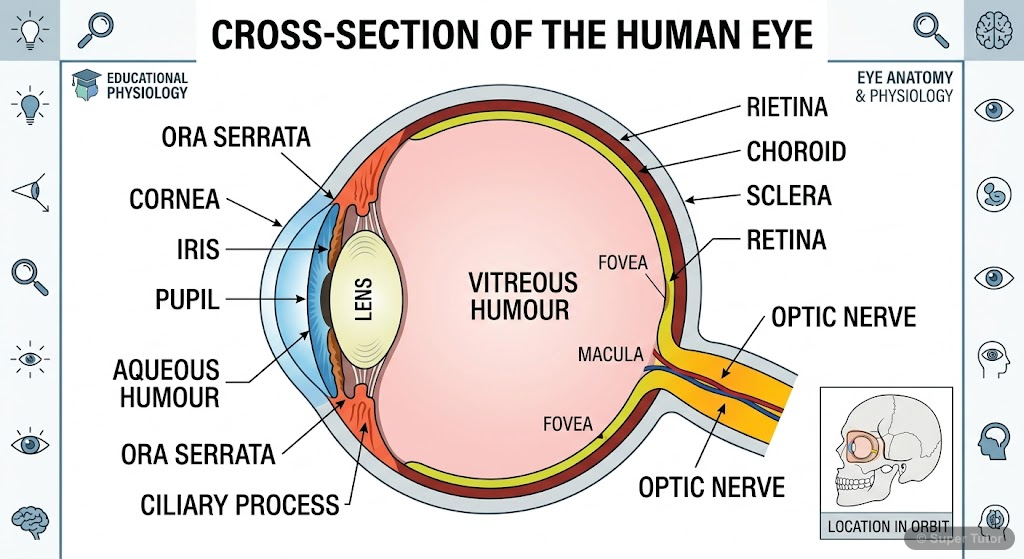
A detailed cross-section of the human eye showing all major parts and their labels.
Super Tutor

This is just one of 14+ visuals inside Super Tutor's The Human Eye and the Colourful World chapter

Explore the full set
12 Questions Solved · 1 Section

EXERCISES

1The human eye can focus on objects at different distances by adjusting the focal length of the eye lens. This is due to (a) presbyopia. (b) accommodation. (c) near-sightedness. (d) far-sightedness.Show solution
Correct option: (b) accommodation.

The ability of the eye to adjust its focal length (by changing the curvature of the eye lens through ciliary muscles) to focus on objects at different distances is called accommodation. Presbyopia is the loss of this ability in old age; near-sightedness and far-sightedness are refractive defects, not the focusing mechanism itself.
2The human eye forms the image of an object at its (a) cornea. (b) iris. (c) pupil. (d) retina.Show solution
Correct option: (d) retina.

The eye lens forms a real, inverted image of the object on the retina, which is the light-sensitive screen at the back of the eye. The retina contains photoreceptor cells (rods and cones) that convert the light signal into electrical signals sent to the brain via the optic nerve.
3The least distance of distinct vision for a young adult with normal vision is about (a) 25 m. (b) 2.5 cm. (c) 25 cm. (d) 2.5 m.Show solution
Correct option: (c) 25 cm.

The least distance of distinct vision (also called the near point) is the minimum distance at which the eye can see an object clearly without strain. For a young adult with normal vision, this distance is approximately 25 cm.
4The change in focal length of an eye lens is caused by the action of the (a) pupil. (b) retina. (c) ciliary muscles. (d) iris.Show solution
Correct option: (c) ciliary muscles.

The ciliary muscles hold the eye lens in position and can contract or relax to change the curvature (and hence the focal length) of the eye lens. When ciliary muscles contract, the lens becomes thicker (shorter focal length) for near objects; when they relax, the lens becomes thinner (longer focal length) for distant objects.
5A person needs a lens of power –5.5 dioptres for correcting his distant vision. For correcting his near vision he needs a lens of power +1.5 dioptre. What is the focal length of the lens required for correcting (i) distant vision, and (ii) near vision?Show solution
Given:
- Power of lens for distant vision, P1=5.5P_1 = -5.5 D
- Power of lens for near vision, P2=+1.5P_2 = +1.5 D

Formula used:
f=1P(where f is in metres and P is in dioptres)f = \frac{1}{P} \quad (\text{where } f \text{ is in metres and } P \text{ is in dioptres})

(i) Focal length for correcting distant vision:
f1=1P1=15.5 mf_1 = \frac{1}{P_1} = \frac{1}{-5.5} \text{ m}
f1=0.182 m18.2 cmf_1 = -0.182 \text{ m} \approx -18.2 \text{ cm}

The negative sign indicates it is a concave (diverging) lens.

(ii) Focal length for correcting near vision:
f2=1P2=1+1.5 mf_2 = \frac{1}{P_2} = \frac{1}{+1.5} \text{ m}
f2=+0.667 m+66.7 cmf_2 = +0.667 \text{ m} \approx +66.7 \text{ cm}

The positive sign indicates it is a convex (converging) lens.

Answers:
- Focal length for distant vision correction = –18.2 cm (concave lens)
- Focal length for near vision correction = +66.7 cm (convex lens)
6The far point of a myopic person is 80 cm in front of the eye. What is the nature and power of the lens required to correct the problem?Show solution
Given:
- Far point of the myopic person = 80 cm = 0.80 m (in front of the eye)
- A myopic person cannot see objects beyond 80 cm clearly.

Concept:
To correct myopia, we need a lens that forms the image of a distant object (at infinity) at the person's far point (80 cm in front of the eye).

So, object distance u=u = -\infty and image distance v=80v = -80 cm =0.80= -0.80 m (image is on the same side as the object, hence negative by sign convention).

Using the lens formula:
1f=1v1u\frac{1}{f} = \frac{1}{v} - \frac{1}{u}
1f=1801\frac{1}{f} = \frac{1}{-80} - \frac{1}{-\infty}
1f=1800=180 cm1\frac{1}{f} = \frac{-1}{80} - 0 = \frac{-1}{80} \text{ cm}^{-1}
f=80 cm=0.80 mf = -80 \text{ cm} = -0.80 \text{ m}

Power of the lens:
P=1f(in metres)=10.80P = \frac{1}{f(\text{in metres})} = \frac{1}{-0.80}
P=1.25 D\boxed{P = -1.25 \text{ D}}

Conclusion: The person requires a concave (diverging) lens of power –1.25 dioptres to correct myopia.
7Make a diagram to show how hypermetropia is corrected. The near point of a hypermetropic eye is 1 m. What is the power of the lens required to correct this defect? Assume that the near point of the normal eye is 25 cm.Show solution
Diagram description:
In hypermetropia, parallel rays from a nearby object (held at 25 cm) converge to a point behind the retina. A convex (converging) lens placed in front of the eye converges the rays before they enter the eye, so the final image falls exactly on the retina.

*(Diagram: Draw a hypermetropic eye where rays from a near object focus behind the retina. Then show a convex lens in front of the eye that brings the focus onto the retina.)*

---

Given:
- Near point of the hypermetropic eye, v=1v = -1 m =100= -100 cm (the eye can see clearly only up to 1 m; image must be formed at 1 m on the same side as the object)
- The object (book/near object) is placed at the normal near point, u=25u = -25 cm =0.25= -0.25 m

Using the lens formula:
1f=1v1u\frac{1}{f} = \frac{1}{v} - \frac{1}{u}
1f=1110.25\frac{1}{f} = \frac{1}{-1} - \frac{1}{-0.25}
1f=1+4=3 m1\frac{1}{f} = -1 + 4 = 3 \text{ m}^{-1}

Power of the lens:
P=+3 D\boxed{P = +3 \text{ D}}

Conclusion: A convex lens of power +3 dioptres is required to correct hypermetropia. The positive power confirms it is a converging lens.
8Why is a normal eye not able to see clearly the objects placed closer than 25 cm?Show solution
Answer:

When an object is placed closer than 25 cm from the eye, the ciliary muscles have to exert maximum force to make the eye lens as thick (most curved) as possible to increase its converging power. However, even at maximum curvature, the eye lens cannot converge the highly diverging rays from such a close object to form a sharp image on the retina.

In other words, 25 cm is the least distance of distinct vision (near point) — the minimum distance at which the ciliary muscles can still adjust the focal length sufficiently. For objects closer than 25 cm, the eye lens cannot shorten its focal length any further, so the image would form behind the retina, resulting in a blurred image.

Therefore, a normal eye cannot see objects placed closer than 25 cm clearly.
9What happens to the image distance in the eye when we increase the distance of an object from the eye?Show solution
Answer:

When the distance of an object from the eye increases, the divergence of light rays entering the eye decreases (rays become more parallel).

To form a clear image on the retina (which is at a fixed distance from the lens), the eye lens must decrease its converging power — i.e., the ciliary muscles relax, making the lens thinner and increasing its focal length.

Despite the change in object distance, the image is always formed on the retina (fixed image distance ≈ 2.5 cm) because the eye continuously adjusts its focal length through accommodation.

Conclusion: The image distance in the eye remains constant (always on the retina, ~2.5 cm from the lens), even as the object distance increases. It is the focal length of the eye lens that changes, not the image distance.
10Why do stars twinkle?Show solution
Answer:

Stars are very far away from the Earth and appear as point sources of light. The light from a star travels through the Earth's atmosphere before reaching our eyes. The atmosphere is not uniform — it consists of layers of air at different temperatures, densities, and refractive indices that are constantly changing due to atmospheric turbulence.

As starlight passes through these continuously changing layers, it undergoes atmospheric refraction — the path of light bends by varying amounts at different instants. This causes the apparent position and brightness of the star to change rapidly and randomly.

Since the star is a point source, even a small change in refraction causes the intensity of light reaching the observer to fluctuate. This rapid variation in the amount of light reaching the eye makes the star appear to twinkle (scintillate).

In short: Twinkling of stars is due to atmospheric refraction of starlight caused by the continuously changing refractive index of the atmosphere.
11Explain why the planets do not twinkle.Show solution
Answer:

Planets are much closer to the Earth compared to stars. Therefore, planets appear as extended sources of light (small discs) rather than point sources.

A planet can be considered as a collection of a very large number of point sources. The light from each individual point on the planet's disc undergoes atmospheric refraction and twinkles independently. However, the net effect — the sum of all these individual fluctuations — averages out to zero. At any instant, some point sources send more light while others send less, but the total amount of light reaching the eye remains nearly constant.

Therefore, the fluctuations in the amount of light from a planet cancel each other out, and the planet does not twinkle.

In short: Planets do not twinkle because they act as extended sources; the individual twinkling effects from different parts of the planet's disc cancel each other out.
12Why does the sky appear dark instead of blue to an astronaut?Show solution
Answer:

The blue colour of the sky as seen from Earth is due to the scattering of sunlight by the molecules of the Earth's atmosphere. Shorter wavelengths (blue light) are scattered much more than longer wavelengths (red light) — this is called Rayleigh scattering. The scattered blue light reaches our eyes from all directions, making the sky appear blue.

However, an astronaut in outer space is above the Earth's atmosphere. There are no air molecules (or any other particles) in outer space to scatter sunlight.

Since there is no scattering of light, no light is directed towards the astronaut's eyes from the surrounding space. Therefore, the sky appears dark (black) to an astronaut in outer space.

In short: The absence of atmosphere (and hence no scattering of light) in outer space causes the sky to appear dark to an astronaut.

Stuck on a step?

Ask Super Tutor AI to explain any solution on this page in a simpler way — free, 24x7.

Ask a Doubt Free

Frequently Asked Questions

What are the important topics in The Human Eye and the Colourful World for Bihar Board Class 10 Science?
Key topics in The Human Eye and the Colourful World include Human Eye and Vision - Complete Chapter Overview, The Human Eye and Colourful World - Complete Overview, The Human Eye and Colourful World - Complete Concept Map. These are the concepts Bihar Board Class 10 examiners draw on most — study them first, then practise related questions.
How to score full marks in The Human Eye and the Colourful World — Bihar Board Class 10 Science?
Understand the core concepts first, then work through the 53 practice questions available for this chapter. Revise formulas and definitions regularly, and use flashcards for quick recall before the exam.
Where can I get free NCERT Solutions for The Human Eye and the Colourful World Class 10 Science?
This page has free step-by-step NCERT Solutions for every exercise question in The Human Eye and the Colourful World (Bihar Board Class 10 Science) — written the way examiners award marks: given, formula, working, answer.

Sources & Official References

Content is aligned to the official syllabus. Refer to the board website for the latest curriculum.

For serious students

Get the full The Human Eye and the Colourful World chapter — for free.

Quizzes, flashcards, AI doubt-solver and a step-by-step study plan for Bihar Board Class 10 Science.