Chapter 11 of 13
NCERT Solutions

Organisms and Populations

Bihar Board · Class 12 · Biology

NCERT Solutions for Organisms and Populations — Bihar Board Class 12 Biology.

45 questions40 flashcards5 concepts

Interactive on Super Tutor

Studying Organisms and Populations? Get the full interactive chapter.

Quizzes, flashcards, AI doubt-solver and a step-by-step study plan — built for ncert solutions and more.

1,000+ Class 12 students started this chapter today

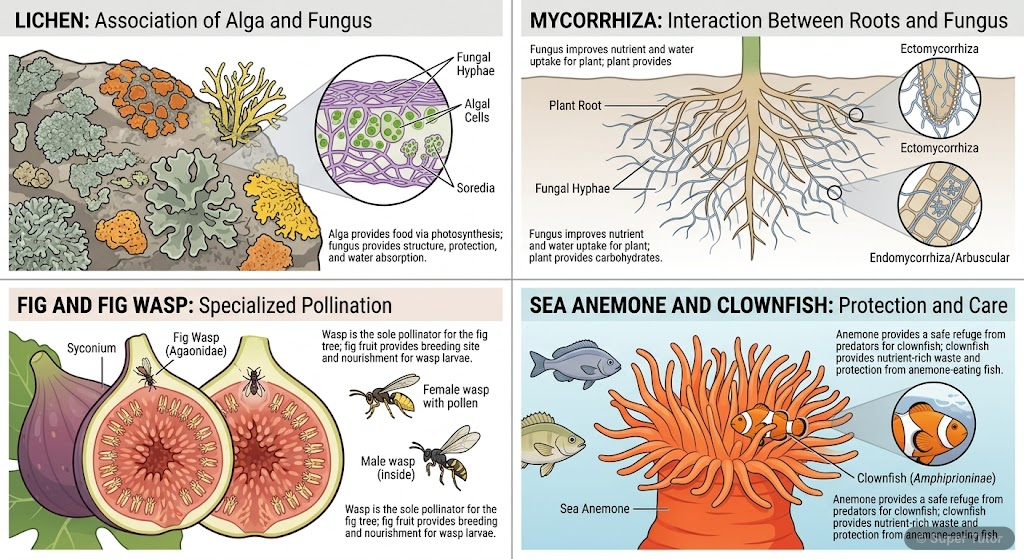
An illustration showcasing various examples of mutualistic relationships, such as lichens, mycorrhizae, fig and fig wasp, and sea anemone and clownfish.
Super Tutor

Learn better with visuals Super Tutor has hundreds of illustrations like this across every chapter — all free to try.

Get started
10 Questions Solved · 1 Section

EXERCISES

1List the attributes that populations possess but not individuals.Show solution
Given/Concept: A population is a group of individuals of the same species in a defined area. Populations have emergent properties that a single individual cannot possess.

Attributes that populations possess but not individuals:

1. Birth Rate (Natality): The number of births per capita in a population per unit time. An individual can give birth, but a 'birth rate' is a property of the whole population.

2. Death Rate (Mortality): The number of deaths per capita in a population per unit time. Similarly, an individual can die, but a 'death rate' belongs to the population.

3. Sex Ratio: The ratio of males to females in a population (e.g., 60% females : 40% males). A single individual has a sex but not a sex ratio.

4. Age Distribution (Age Pyramid): The proportion of individuals in different age groups (pre-reproductive, reproductive, post-reproductive). An individual has an age, but age distribution is a population attribute.

5. Population Density: The number of individuals (or biomass) per unit area or volume at a given time.

6. Population Growth Rate: The rate at which the population size changes over time (expressed as rr or λ\lambda).

Conclusion: Birth rate, death rate, sex ratio, age distribution, population density, and growth rate are all attributes of populations, not of individual organisms.
2If a population growing exponentially doubles in size in 3 years, what is the intrinsic rate of increase (r) of the population?Show solution
Given:
- Population doubles in t=3t = 3 years, i.e., Nt=2N0N_t = 2N_0
- Growth is exponential.

Formula used:
For exponential growth:
Nt=N0ertN_t = N_0 \cdot e^{rt}

Working:

Substituting Nt=2N0N_t = 2N_0:
2N0=N0er×32N_0 = N_0 \cdot e^{r \times 3}

2=e3r2 = e^{3r}

Taking natural logarithm on both sides:
ln2=3r\ln 2 = 3r

r=ln23=0.69313r = \frac{\ln 2}{3} = \frac{0.6931}{3}

r0.231 per year\boxed{r \approx 0.231 \text{ per year}}

Conclusion: The intrinsic rate of natural increase (r)(r) of the population is approximately 0.231 per year.
3Name important defence mechanisms in plants against herbivory.Show solution
Concept: Plants cannot escape herbivores by moving away, so they have evolved a variety of morphological (physical) and chemical defence mechanisms.

Important Defence Mechanisms in Plants Against Herbivory:

A. Morphological / Physical Defences:
1. Thorns and Spines: Sharp thorns (e.g., *Acacia*, *Cactus*) deter herbivores from feeding.
2. Tough / Leathery Leaves: Thick cuticle and tough texture make leaves difficult to chew.
3. Dense Trichomes (Hair): Hairy leaf surfaces make feeding difficult for insects and small herbivores.

B. Chemical Defences:
1. Toxic Alkaloids: Many plants produce alkaloids (e.g., nicotine in tobacco, caffeine in tea) that are poisonous or distasteful to herbivores.
2. Terpenes and Resins: Chemicals like terpenes in conifers repel or poison herbivores.
3. Tannins: Tannins reduce the digestibility of plant tissue.
4. Cardiac Glycosides: Present in plants like *Calotropis*; highly toxic to animals that consume them.
5. Distasteful / Poisonous Chemicals: *Calotropis* produces highly poisonous cardiac glycosides; the weed *Lantana* has chemicals toxic to cattle.

Conclusion: Plants use a combination of physical barriers and toxic/distasteful chemicals to defend themselves against herbivory.
4An orchid plant is growing on the branch of mango tree. How do you describe this interaction between the orchid and the mango tree?Show solution
Identification of Interaction:
The interaction between the orchid and the mango tree is Commensalism.

Definition: Commensalism is an interspecific interaction in which one species benefits and the other species is neither harmed nor benefited (unaffected).

Explanation:
- The orchid (epiphyte) benefits by using the branch of the mango tree as a physical support to grow at a height where it can receive adequate sunlight and moisture. It does not derive nutrition from the mango tree.
- The mango tree is neither harmed nor benefited by the presence of the orchid.

Symbol: (+,0)(+, 0) — where ++ represents the orchid (benefited) and 00 represents the mango tree (unaffected).

Conclusion: This is a classic example of commensalism where the orchid is the commensal and the mango tree is the host.
5What is the ecological principle behind the biological control method of managing with pest insects?Show solution
Ecological Principle:
The ecological principle behind biological control is Predation (and in some cases parasitism) — a natural interspecific interaction where one organism (the predator/parasite) kills or harms another (the prey/host).

Explanation:
- In nature, predators and parasites keep the population of their prey/host under check, preventing any one species from becoming excessively abundant.
- In biological control, a natural enemy (predator, parasite, or pathogen) of the pest is deliberately introduced or encouraged to reduce the pest population to a manageable level.
- This exploits the predator–prey relationship to control pest populations without the use of chemical pesticides.

Example:
- The Cochineal insect (*Dactylopius*) was used to control the invasive prickly pear cactus (*Opuntia*).
- The Gambusia fish is used to control mosquito larvae in ponds.
- *Bacillus thuringiensis* (Bt) is used as a biopesticide against caterpillars.

Conclusion: The principle is that predators/parasites naturally regulate prey/host populations, and this natural regulation is harnessed in biological control methods.
6Define population and community.Show solution
Population:

A population is defined as a group of individuals of the same species living in a well-defined geographical area, sharing or competing for similar resources, and potentially interbreeding.

- Populations have attributes such as birth rate, death rate, sex ratio, age distribution, and population density.
- *Example:* All the tigers in the Sundarbans, or all the mango trees in an orchard.

Community:

A community (also called a biotic community) is defined as an assemblage of populations of different species living in the same geographical area at the same time, interacting with one another.

- A community includes all the plants, animals, fungi, and microorganisms in a given habitat.
- *Example:* All the organisms (plants, animals, microbes) living in a pond or a forest constitute a community.

Key Difference:
| Feature | Population | Community |
|---|---|---|
| Species | Single species | Multiple species |
| Interaction | Intraspecific | Interspecific |
| Example | All frogs in a pond | All organisms in a pond |
7Define the following terms and give one example for each:
(a) Commensalism
(b) Parasitism
(c) Camouflage
(d) Mutualism
(e) Interspecific competition
Show solution
(a) Commensalism:

Definition: An interspecific interaction in which one species benefits and the other species is neither harmed nor benefited (unaffected). It is represented as (+,0)(+, 0).

Example: An orchid (epiphyte) growing on the branch of a mango tree. The orchid benefits by getting support and sunlight; the mango tree is unaffected.

Another example: The barnacles growing on the back of a whale — barnacles benefit (transport, access to food-rich waters) while the whale is unaffected.

---

(b) Parasitism:

Definition: An interspecific interaction in which one species (the parasite) benefits at the expense of the other species (the host), which is harmed. It is represented as (+,)(+, -).

Example: *Cuscuta* (dodder plant) is a parasitic plant that grows on a host plant, deriving water and nutrients from it, thereby harming the host.

Another example: The human liver fluke (*Fasciola hepatica*) parasitises the liver of its host.

---

(c) Camouflage:

Definition: A defence adaptation in which an organism blends with its surrounding environment in terms of colour, shape, or pattern, making it difficult for predators (or prey) to detect it. It is a form of cryptic coloration.

Example: The leaf insect (*Phyllium*) resembles a green leaf so closely that predators cannot distinguish it from real leaves. Similarly, the stick insect (*Carausius*) resembles a twig.

Another example: The Kallima butterfly resembles a dry leaf when it sits with its wings closed.

---

(d) Mutualism:

Definition: An interspecific interaction in which both the interacting species benefit. It is represented as (+,+)(+, +).

Example: Lichens — a mutualistic association between a fungus and a photosynthetic alga/cyanobacterium. The fungus provides shelter and absorbs minerals; the alga provides food through photosynthesis.

Another example: The relationship between the fig tree (*Ficus*) and the fig wasp (*Agaonidae*) — the wasp pollinates the fig flowers and in turn gets a safe site to lay eggs and food for its larvae.

---

(e) Interspecific Competition:

Definition: An interspecific interaction in which two different species compete for the same limited resources (food, space, light, etc.), and both species are adversely affected. It is represented as (,)(-, -).

Example: Flamingoes and resident fishes in South American lakes compete for the same food resource — zooplankton. Both species are negatively affected by the presence of the other.

Another example: Competition between two grass species for soil nutrients and space in a meadow.
8With the help of a suitable diagram describe the logistic population growth curve.Show solution
Concept: When resources are limited, a population cannot grow indefinitely. The growth follows a logistic (sigmoid/S-shaped) pattern.

Logistic Growth — Key Points:

Equation:
dNdt=rN(KNK)\frac{dN}{dt} = rN\left(\frac{K - N}{K}\right)

Where:
- NN = Population size at time tt
- rr = Intrinsic rate of natural increase
- KK = Carrying capacity of the environment
- KNK\frac{K-N}{K} = Environmental resistance (the unused portion of carrying capacity)

Description of the Logistic Growth Curve (S-shaped / Sigmoid Curve):

The curve has three distinct phases:

1. Lag Phase: Initially, the population is small and growth is slow as individuals establish themselves.

2. Log (Exponential) Phase: The population grows rapidly as resources are still relatively abundant. The curve rises steeply.

3. Deceleration Phase: As population size approaches KK, resources become limiting. The growth rate slows down.

4. Plateau (Asymptote) Phase: The population stabilises at the carrying capacity (KK). The growth rate becomes zero (dN/dt=0dN/dt = 0) because N=KN = K.

Diagram:

```
Population
Size (N)
|
K|_ _ _ _ _ _ _ _ _ _ _ _ _ _ (Carrying Capacity)
| /‾‾‾‾‾‾
| /
| /
| /
| /
| /
| / (Lag phase)
|/________________________
Time (t)
```

*(The curve is S-shaped/sigmoid, starting slowly, rising steeply, then levelling off at K)*

Key Features:
- The population never exceeds KK in ideal logistic growth.
- The growth rate is maximum when N=K/2N = K/2.
- This is a more realistic model of population growth in nature compared to exponential growth.
- Also called the Verhulst-Pearl Logistic Growth model.

Conclusion: The logistic growth curve is a sigmoid (S-shaped) curve that shows how a population grows rapidly when small, then slows as it approaches the carrying capacity KK, ultimately stabilising at KK.
9Select the statement which explains best parasitism.
(a) One organism is benefited.
(b) Both the organisms are benefited.
(c) One organism is benefited, other is not affected.
(d) One organism is benefited, other is affected.
Show solution
Correct Answer: (d) One organism is benefited, other is affected.

Justification:
In parasitism, the parasite benefits by deriving nutrition, shelter, or other resources from the host, while the host is harmed (negatively affected) — it loses nutrients, may suffer tissue damage, reduced fitness, or even death. This is represented as a (+,)(+, -) interaction.

- Option (a) is incomplete — it does not mention the effect on the other organism.
- Option (b) describes mutualism (+,+)(+, +).
- Option (c) describes commensalism (+,0)(+, 0).
- Option (d) correctly and completely describes parasitism (+,)(+, -).
10List any three important characteristics of a population and explain.Show solution
Three Important Characteristics of a Population:

---

1. Birth Rate (Natality):

- Birth rate is defined as the number of births per capita (per individual) in a population per unit time.
- It is expressed as: Birth Rate=Number of birthsPopulation size\text{Birth Rate} = \frac{\text{Number of births}}{\text{Population size}}
- It contributes to the increase in population size.
- *Example:* If a pond has 20 water hyacinths and 8 new plants are added in a week, the birth rate = 8/20=0.48/20 = 0.4 offspring per individual per week.

---

2. Death Rate (Mortality):

- Death rate is defined as the number of deaths per capita in a population per unit time.
- It is expressed as: Death Rate=Number of deathsPopulation size\text{Death Rate} = \frac{\text{Number of deaths}}{\text{Population size}}
- It contributes to the decrease in population size.
- *Example:* If 4 out of 40 frogs in a pond die in a week, the death rate = 4/40=0.14/40 = 0.1 individuals per week.
- The difference between birth rate and death rate determines whether a population grows, declines, or remains stable.

---

3. Age Distribution (Age Pyramid):

- A population is composed of individuals of different ages. The proportion of individuals in different age groups (pre-reproductive, reproductive, and post-reproductive) is called age distribution.
- It is graphically represented as an age pyramid.
- Three types of age pyramids:
- Expanding (triangular): Broad base — high proportion of young individuals — rapidly growing population.
- Stable (bell-shaped): Equal proportion of young and middle-aged individuals — stable/stationary population.
- Declining (urn-shaped): Narrow base — low proportion of young individuals — declining population.
- *Example:* India's age pyramid has a broad base, indicating a young, rapidly growing population.

---

Conclusion: Birth rate, death rate, and age distribution are fundamental characteristics of a population that determine its size, growth rate, and future trajectory.

Stuck on a step?

Ask Super Tutor AI to explain any solution on this page in a simpler way — free, 24x7.

Ask a Doubt Free

Frequently Asked Questions

What are the important topics in Organisms and Populations for Bihar Board Class 12 Biology?
Organisms and Populations covers several key topics that are frequently asked in Bihar Board Class 12 board exams. Focus on the core concepts listed on this page and practise related questions to build confidence.
How to score full marks in Organisms and Populations — Bihar Board Class 12 Biology?
Understand the core concepts first, then work through the 45 practice questions available for this chapter. Revise formulas and definitions regularly, and use flashcards for quick recall before the exam.
Where can I get free NCERT Solutions for Organisms and Populations Class 12 Biology?
This page has free step-by-step NCERT Solutions for every exercise question in Organisms and Populations (Bihar Board Class 12 Biology) — written the way examiners award marks: given, formula, working, answer.

Sources & Official References

Content is aligned to the official syllabus. Refer to the board website for the latest curriculum.

For serious students

Get the full Organisms and Populations chapter — for free.

Quizzes, flashcards, AI doubt-solver and a step-by-step study plan for Bihar Board Class 12 Biology.