Chapter 3 of 10
NCERT Solutions

Electrochemistry

Bihar Board · Class 12 · Chemistry

NCERT Solutions for Electrochemistry — Bihar Board Class 12 Chemistry.

32 questions22 flashcards5 concepts

Interactive on Super Tutor

Studying Electrochemistry? Get the full interactive chapter.

Quizzes, flashcards, AI doubt-solver and a step-by-step study plan — built for ncert solutions and more.

1,000+ Class 12 students started this chapter today

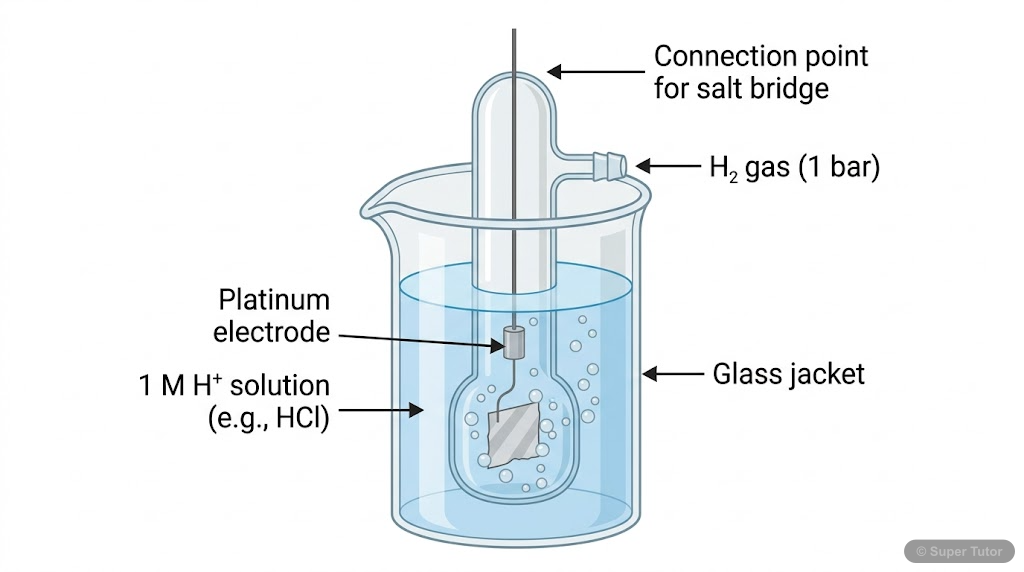
A labeled diagram of the Standard Hydrogen Electrode (SHE), illustrating its components: a platinum electrode, 1 M H+ solution, and hydrogen gas at 1 bar pressure, and how it acts as a reference elect
Super Tutor

Learn better with visuals Super Tutor has hundreds of illustrations like this across every chapter — all free to try.

Get started
33 Questions Solved · 6 Sections

Intext Questions (Section 2.3 — Standard Electrode Potential)

2.1How would you determine the standard electrode potential of the system Mg²⁺|Mg?Show solution
Given/Concept: The standard electrode potential is always measured relative to the Standard Hydrogen Electrode (SHE), whose potential is taken as zero.

Method:
1. Set up a galvanic cell by connecting the Mg²⁺|Mg half-cell with the Standard Hydrogen Electrode (SHE).
- The cell is: Mg(s)Mg2+(1M)H+(1M)H2(1bar)Pt(s)\text{Mg(s)} | \text{Mg}^{2+}(1\,\text{M}) || \text{H}^+(1\,\text{M}) | \text{H}_2(1\,\text{bar}) | \text{Pt(s)}
2. Maintain all species at unit activity (1 M concentration for ions, 1 bar pressure for gases, 298 K).
3. Measure the EMF of the cell using a voltmeter.
4. Since Mg is a stronger reducing agent than H₂, Mg acts as the anode and SHE acts as the cathode.
5. The measured cell potential gives:
Ecell=EcathodeEanodeE^\circ_{\text{cell}} = E^\circ_{\text{cathode}} - E^\circ_{\text{anode}}
Ecell=ESHEEMg2+/MgE^\circ_{\text{cell}} = E^\circ_{\text{SHE}} - E^\circ_{\text{Mg}^{2+}/\text{Mg}}
Ecell=0EMg2+/MgE^\circ_{\text{cell}} = 0 - E^\circ_{\text{Mg}^{2+}/\text{Mg}}

The experimentally measured value is Ecell=+2.37VE^\circ_{\text{cell}} = +2.37\,\text{V}, so EMg2+/Mg=2.37VE^\circ_{\text{Mg}^{2+}/\text{Mg}} = -2.37\,\text{V}.
2.2Can you store copper sulphate solutions in a zinc pot?Show solution
Given: Standard electrode potentials:
- ECu2+/Cu=+0.34VE^\circ_{\text{Cu}^{2+}/\text{Cu}} = +0.34\,\text{V}
- EZn2+/Zn=0.76VE^\circ_{\text{Zn}^{2+}/\text{Zn}} = -0.76\,\text{V}

Concept: A spontaneous reaction occurs when the cell EMF is positive, i.e., the metal with lower (more negative) electrode potential displaces the metal with higher electrode potential from its salt solution.

Working:
If copper sulphate is stored in a zinc pot, the following redox reaction would occur:
Zn(s)+CuSO4(aq)ZnSO4(aq)+Cu(s)\text{Zn(s)} + \text{CuSO}_4(\text{aq}) \rightarrow \text{ZnSO}_4(\text{aq}) + \text{Cu(s)}

Ecell=EcathodeEanode=+0.34(0.76)=+1.10VE^\circ_{\text{cell}} = E^\circ_{\text{cathode}} - E^\circ_{\text{anode}} = +0.34 - (-0.76) = +1.10\,\text{V}

Since E^\circ_{\text{cell}} > 0, the reaction is spontaneous. Zinc will dissolve and copper will be deposited.

Conclusion: No, copper sulphate solution cannot be stored in a zinc pot because zinc is more reactive than copper and will displace copper from the copper sulphate solution, corroding the zinc pot.
2.3Consult the table of standard electrode potentials and suggest three substances that can oxidise ferrous ions (Fe²⁺) under suitable conditions.Show solution
Concept: A substance can oxidise Fe²⁺ to Fe³⁺ if its standard electrode potential is greater than that of the Fe³⁺/Fe²⁺ couple.

Given: EFe3+/Fe2+=+0.77VE^\circ_{\text{Fe}^{3+}/\text{Fe}^{2+}} = +0.77\,\text{V}

Any oxidising agent (species on the left side of a half-reaction) with E^\circ > +0.77\,\text{V} can oxidise Fe²⁺ to Fe³⁺.

Three such substances:

1. Fluorine (F₂): E^\circ_{\text{F}_2/\text{F}^-} = +2.87\,\text{V} > +0.77\,\text{V}
2. Chlorine (Cl₂): E^\circ_{\text{Cl}_2/\text{Cl}^-} = +1.36\,\text{V} > +0.77\,\text{V}
3. Acidified permanganate (MnO₄⁻/Mn²⁺): E^\circ = +1.51\,\text{V} > +0.77\,\text{V}

(Other acceptable answers include Br2\text{Br}_2, Cr2O72\text{Cr}_2\text{O}_7^{2-}, H2O2\text{H}_2\text{O}_2, etc., all having E^\circ > +0.77\,\text{V}.)

Intext Questions (Section 2.3 — Nernst Equation)

2.4Calculate the potential of hydrogen electrode in contact with a solution whose pH is 10.Show solution
Given: pH = 10, so [H+]=1010M[\text{H}^+] = 10^{-10}\,\text{M}

Half-cell reaction:
H+(aq)+e12H2(g)\text{H}^+(\text{aq}) + e^- \rightarrow \frac{1}{2}\text{H}_2(\text{g})

Nernst equation for hydrogen electrode:
EH+/H2=EH+/H20.05911log1[H+]E_{\text{H}^+/\text{H}_2} = E^\circ_{\text{H}^+/\text{H}_2} - \frac{0.0591}{1}\log\frac{1}{[\text{H}^+]}

(At 298 K, RTFln=0.0591nlog\frac{RT}{F}\ln = \frac{0.0591}{n}\log; n=1n = 1; E=0VE^\circ = 0\,\text{V}; pH2=1barp_{\text{H}_2} = 1\,\text{bar})

E=00.0591×log11010E = 0 - 0.0591 \times \log\frac{1}{10^{-10}}

E=0.0591×log(1010)E = -0.0591 \times \log(10^{10})

E=0.0591×10E = -0.0591 \times 10

E=0.591V\boxed{E = -0.591\,\text{V}}
2.5Calculate the emf of the cell in which the following reaction takes place: Ni(s) + 2Ag⁺(0.002 M) → Ni²⁺(0.160 M) + 2Ag(s). Given that Ecell=1.05VE^\circ_{\text{cell}} = 1.05\,\text{V}.Show solution
Given:
- [Ag+]=0.002M[\text{Ag}^+] = 0.002\,\text{M}
- [Ni2+]=0.160M[\text{Ni}^{2+}] = 0.160\,\text{M}
- Ecell=1.05VE^\circ_{\text{cell}} = 1.05\,\text{V}
- n=2n = 2 (2 electrons transferred)
- Temperature = 298 K

Nernst Equation:
Ecell=Ecell0.0591nlogQE_{\text{cell}} = E^\circ_{\text{cell}} - \frac{0.0591}{n}\log Q

Reaction quotient Q:
Q=[Ni2+][Ag+]2=0.160(0.002)2=0.1604×106=4×10⁴Q = \frac{[\text{Ni}^{2+}]}{[\text{Ag}^+]^2} = \frac{0.160}{(0.002)^2} = \frac{0.160}{4 \times 10^{-6}} = 4 \times 10^4

Substituting:
Ecell=1.050.05912log(4×10⁴)E_{\text{cell}} = 1.05 - \frac{0.0591}{2}\log(4 \times 10^4)

=1.050.02955×log(4×10⁴)= 1.05 - 0.02955 \times \log(4 \times 10^4)

log(4×10⁴)=log4+4=0.602+4=4.602\log(4 \times 10^4) = \log 4 + 4 = 0.602 + 4 = 4.602

Ecell=1.050.02955×4.602E_{\text{cell}} = 1.05 - 0.02955 \times 4.602

=1.050.1360= 1.05 - 0.1360

Ecell0.914V\boxed{E_{\text{cell}} \approx 0.914\,\text{V}}

*(The textbook answer is given as 0.91 V.)*
2.6The cell in which the following reaction occurs: 2Fe³⁺(aq) + 2I⁻(aq) → 2Fe²⁺(aq) + I₂(s) has Ecell=0.236VE^\circ_{\text{cell}} = 0.236\,\text{V} at 298 K. Calculate the standard Gibbs energy and the equilibrium constant of the cell reaction.Show solution
Given:
- Ecell=0.236VE^\circ_{\text{cell}} = 0.236\,\text{V}
- n=2n = 2 (2 electrons transferred)
- T=298KT = 298\,\text{K}
- F=96487C mol1F = 96487\,\text{C mol}^{-1}
- R=8.314J K1mol1R = 8.314\,\text{J K}^{-1}\text{mol}^{-1}

Step 1: Calculate ΔrG\Delta_r G^\circ
ΔrG=nFEcell\Delta_r G^\circ = -nFE^\circ_{\text{cell}}
=2×96487×0.236= -2 \times 96487 \times 0.236
=45541.8J mol1= -45541.8\,\text{J mol}^{-1}
ΔrG45.54kJ mol1\boxed{\Delta_r G^\circ \approx -45.54\,\text{kJ mol}^{-1}}

Step 2: Calculate equilibrium constant KcK_c

Using ΔrG=RTlnKc\Delta_r G^\circ = -RT\ln K_c:
lnKc=ΔrGRT=45541.88.314×298=45541.82477.6=18.38\ln K_c = \frac{-\Delta_r G^\circ}{RT} = \frac{45541.8}{8.314 \times 298} = \frac{45541.8}{2477.6} = 18.38

Kc=e18.38K_c = e^{18.38}

Alternatively, using:
logKc=nEcell0.0591=2×0.2360.0591=0.4720.0591=7.987\log K_c = \frac{nE^\circ_{\text{cell}}}{0.0591} = \frac{2 \times 0.236}{0.0591} = \frac{0.472}{0.0591} = 7.987

Kc=107.9879.62×107K_c = 10^{7.987} \approx 9.62 \times 10^7

Kc9.62×107\boxed{K_c \approx 9.62 \times 10^7}

Intext Questions (Section 2.4 — Conductance)

2.7Why does the conductivity of a solution decrease with dilution?Show solution
Concept: Conductivity (κ\kappa) is defined as the conductance of a solution held between electrodes of unit area and unit distance apart. It depends on the number of ions per unit volume of the solution.

Explanation:
Conductivity of an electrolytic solution depends on the number of ions present per unit volume. On dilution, the concentration of the solution decreases, which means the number of ions per unit volume (per cm³ or per m³) decreases. Since fewer ions are available to carry charge per unit volume, the conductivity decreases with dilution.

Conclusion: As dilution increases → concentration decreases → fewer ions per unit volume → conductivity (κ\kappa) decreases.
2.8Suggest a way to determine the Λm\Lambda^\circ_m value of water.Show solution
Concept: Water is a weak electrolyte and its Λm\Lambda^\circ_m cannot be determined by direct extrapolation of Λm\Lambda_m vs c\sqrt{c} plot (as done for strong electrolytes). We use Kohlrausch's Law of Independent Migration of Ions.

Method:
Water dissociates as: H2OH++OH\text{H}_2\text{O} \rightleftharpoons \text{H}^+ + \text{OH}^-

Using Kohlrausch's law:
Λm(H2O)=λ(H+)+λ(OH)\Lambda^\circ_m(\text{H}_2\text{O}) = \lambda^\circ(\text{H}^+) + \lambda^\circ(\text{OH}^-)

This can be obtained from the Λm\Lambda^\circ_m values of strong electrolytes:
Λm(H2O)=Λm(HCl)+Λm(NaOH)Λm(NaCl)\Lambda^\circ_m(\text{H}_2\text{O}) = \Lambda^\circ_m(\text{HCl}) + \Lambda^\circ_m(\text{NaOH}) - \Lambda^\circ_m(\text{NaCl})

All three of these are strong electrolytes whose Λm\Lambda^\circ_m values can be determined by extrapolation of their Λm\Lambda_m vs c\sqrt{c} plots to zero concentration.

Conclusion: Λm\Lambda^\circ_m of water is determined indirectly using Kohlrausch's law by combining the Λm\Lambda^\circ_m values of HCl, NaOH, and NaCl.
2.9The molar conductivity of 0.025 mol L⁻¹ methanoic acid is 46.1 S cm² mol⁻¹. Calculate its degree of dissociation and dissociation constant. Given λ⁰(H⁺) = 349.6 S cm² mol⁻¹ and λ⁰(HCOO⁻) = 54.6 S cm² mol⁻¹.Show solution
Given:
- c=0.025mol L1c = 0.025\,\text{mol L}^{-1}
- Λm=46.1S cm2mol1\Lambda_m = 46.1\,\text{S cm}^2\text{mol}^{-1}
- λ(H+)=349.6S cm2mol1\lambda^\circ(\text{H}^+) = 349.6\,\text{S cm}^2\text{mol}^{-1}
- λ(HCOO)=54.6S cm2mol1\lambda^\circ(\text{HCOO}^-) = 54.6\,\text{S cm}^2\text{mol}^{-1}

Step 1: Calculate Λm\Lambda^\circ_m for methanoic acid (HCOOH)
Λm(HCOOH)=λ(H+)+λ(HCOO)\Lambda^\circ_m(\text{HCOOH}) = \lambda^\circ(\text{H}^+) + \lambda^\circ(\text{HCOO}^-)
=349.6+54.6=404.2S cm2mol1= 349.6 + 54.6 = 404.2\,\text{S cm}^2\text{mol}^{-1}

Step 2: Calculate degree of dissociation (α\alpha)
α=ΛmΛm=46.1404.2=0.114\alpha = \frac{\Lambda_m}{\Lambda^\circ_m} = \frac{46.1}{404.2} = 0.114

α=0.114\boxed{\alpha = 0.114}

Step 3: Calculate dissociation constant (KaK_a)

For HCOOHH++HCOO\text{HCOOH} \rightleftharpoons \text{H}^+ + \text{HCOO}^-:
Ka=cα21αK_a = \frac{c\alpha^2}{1-\alpha}
=0.025×(0.114)210.114= \frac{0.025 \times (0.114)^2}{1 - 0.114}
=0.025×0.0129960.886= \frac{0.025 \times 0.012996}{0.886}
=3.249×1040.886= \frac{3.249 \times 10^{-4}}{0.886}
=3.67×10⁴mol L1= 3.67 \times 10^{-4}\,\text{mol L}^{-1}

Ka=3.67×10⁴mol L1\boxed{K_a = 3.67 \times 10^{-4}\,\text{mol L}^{-1}}

Intext Questions (Section 2.5 — Electrolysis)

2.10If a current of 0.5 ampere flows through a metallic wire for 2 hours, then how many electrons would flow through the wire?Show solution
Given:
- Current, I=0.5AI = 0.5\,\text{A}
- Time, t=2hours=2×3600=7200st = 2\,\text{hours} = 2 \times 3600 = 7200\,\text{s}
- Faraday constant, F=96487C mol1F = 96487\,\text{C mol}^{-1}
- Charge on one electron, e=1.6×10¹⁹Ce = 1.6 \times 10^{-19}\,\text{C}

Step 1: Calculate total charge (Q)
Q=I×t=0.5×7200=3600CQ = I \times t = 0.5 \times 7200 = 3600\,\text{C}

Step 2: Calculate number of electrons
Number of electrons=Qe=36001.6×1019\text{Number of electrons} = \frac{Q}{e} = \frac{3600}{1.6 \times 10^{-19}}

=2.25×10²²electrons= 2.25 \times 10^{22}\,\text{electrons}

ne=2.25×10²²electrons\boxed{n_e = 2.25 \times 10^{22}\,\text{electrons}}
2.11Suggest a list of metals that are extracted electrolytically.Show solution
Concept: Metals that cannot be reduced by chemical reducing agents (because they are highly reactive) are extracted by electrolysis of their molten salts or oxides.

List of metals extracted electrolytically:

1. Sodium (Na) — by electrolysis of molten NaCl (Down's process)
2. Magnesium (Mg) — by electrolysis of molten MgCl₂
3. Aluminium (Al) — by electrolysis of molten Al₂O₃ dissolved in cryolite (Hall-Héroult process)
4. Calcium (Ca) — by electrolysis of molten CaCl₂
5. Potassium (K) — by electrolysis of molten KCl
6. Copper (Cu) — electrolytic refining of impure copper

These are all metals with very negative electrode potentials (highly reactive), making chemical reduction impractical.
2.12Consider the reaction: Cr₂O₇²⁻ + 14H⁺ + 6e⁻ → 2Cr³⁺ + 7H₂O. What is the quantity of electricity in coulombs needed to reduce 1 mol of Cr₂O₇²⁻?Show solution
Given:
- Reaction: Cr2O72+14H++6e2Cr3++7H2O\text{Cr}_2\text{O}_7^{2-} + 14\text{H}^+ + 6e^- \rightarrow 2\text{Cr}^{3+} + 7\text{H}_2\text{O}
- 1 mol of Cr2O72\text{Cr}_2\text{O}_7^{2-} requires 6 moles of electrons
- F=96487C mol1F = 96487\,\text{C mol}^{-1}

Calculation:
Q=n×F=6×96487Q = n \times F = 6 \times 96487
=578922C= 578922\,\text{C}

Q5.79×105C\boxed{Q \approx 5.79 \times 10^5\,\text{C}}

Intext Questions (Section 2.6 — Batteries)

2.13Write the chemistry of recharging the lead storage battery, highlighting all the materials that are involved during recharging.Show solution
During discharging (normal use), the reactions are:
- Anode: Pb(s)+SO42(aq)PbSO4(s)+2e\text{Pb(s)} + \text{SO}_4^{2-}(\text{aq}) \rightarrow \text{PbSO}_4(\text{s}) + 2e^-
- Cathode: PbO2(s)+SO42(aq)+4H+(aq)+2ePbSO4(s)+2H2O(l)\text{PbO}_2(\text{s}) + \text{SO}_4^{2-}(\text{aq}) + 4\text{H}^+(\text{aq}) + 2e^- \rightarrow \text{PbSO}_4(\text{s}) + 2\text{H}_2\text{O}(\text{l})

During recharging, an external electrical energy source reverses the electrode reactions:

- At anode (now acts as cathode during recharge):
PbSO4(s)+2ePb(s)+SO42(aq)\text{PbSO}_4(\text{s}) + 2e^- \rightarrow \text{Pb(s)} + \text{SO}_4^{2-}(\text{aq})

- At cathode (now acts as anode during recharge):
PbSO4(s)+2H2O(l)PbO2(s)+SO42(aq)+4H+(aq)+2e\text{PbSO}_4(\text{s}) + 2\text{H}_2\text{O}(\text{l}) \rightarrow \text{PbO}_2(\text{s}) + \text{SO}_4^{2-}(\text{aq}) + 4\text{H}^+(\text{aq}) + 2e^-

Overall recharging reaction:
2PbSO4(s)+2H2O(l)electrical energyPb(s)+PbO2(s)+2H2SO4(aq)2\text{PbSO}_4(\text{s}) + 2\text{H}_2\text{O}(\text{l}) \xrightarrow{\text{electrical energy}} \text{Pb(s)} + \text{PbO}_2(\text{s}) + 2\text{H}_2\text{SO}_4(\text{aq})

Materials involved: PbSO₄ (at both electrodes), H₂O, Pb (reformed at one electrode), PbO₂ (reformed at other electrode), and H₂SO₄ (electrolyte regenerated).
2.14Suggest two materials other than hydrogen that can be used as fuels in fuel cells.Show solution
Concept: A fuel cell converts chemical energy of a fuel directly into electrical energy through electrochemical reactions. The fuel must be oxidisable and produce a clean reaction.

Two materials (other than hydrogen) that can be used as fuels in fuel cells:

1. Methane (CH₄): Natural gas can be used in solid oxide fuel cells. It undergoes oxidation at the anode to produce CO₂ and H₂O, releasing electrons.

2. Methanol (CH₃OH): Used in Direct Methanol Fuel Cells (DMFC). Methanol is oxidised at the anode:
CH3OH+H2OCO2+6H++6e\text{CH}_3\text{OH} + \text{H}_2\text{O} \rightarrow \text{CO}_2 + 6\text{H}^+ + 6e^-

Other acceptable answers include ethanol, propane, etc.
2.15Explain how rusting of iron is envisaged as setting up of an electrochemical cell.Show solution
Concept: Rusting of iron is an electrochemical process involving oxidation and reduction reactions occurring at different sites on the iron surface, effectively setting up a galvanic cell.

Mechanism:

When iron is exposed to moist air (water containing dissolved CO₂ or O₂), different parts of the iron surface act as anode and cathode:

At the Anode (oxidation — iron dissolves):
Fe(s)Fe2+(aq)+2e\text{Fe(s)} \rightarrow \text{Fe}^{2+}(\text{aq}) + 2e^-

At the Cathode (reduction — oxygen is reduced):
O2(g)+4H+(aq)+4e2H2O(l)\text{O}_2(\text{g}) + 4\text{H}^+(\text{aq}) + 4e^- \rightarrow 2\text{H}_2\text{O}(\text{l})
(In neutral/slightly acidic water with dissolved CO₂ providing H⁺)

Overall: The Fe²⁺ ions formed at the anode are further oxidised by atmospheric oxygen:
4Fe2++O2+4H2O2Fe2O3+8H+4\text{Fe}^{2+} + \text{O}_2 + 4\text{H}_2\text{O} \rightarrow 2\text{Fe}_2\text{O}_3 + 8\text{H}^+

Fe2O3\text{Fe}_2\text{O}_3 combines with water to form hydrated iron(III) oxide, i.e., rust (Fe2O3xH2O\text{Fe}_2\text{O}_3 \cdot x\text{H}_2\text{O}).

The electrons flow through the iron from anode to cathode (like in a galvanic cell), and ions migrate through the moisture film (electrolyte). This is exactly analogous to a galvanic cell.

Exercises

2.1Arrange the following metals in the order in which they displace each other from the solution of their salts: Al, Cu, Fe, Mg and Zn.Show solution
Concept: A metal with a lower (more negative) standard electrode potential is a stronger reducing agent and can displace metals with higher electrode potentials from their salt solutions.

Standard electrode potentials (from Table):
- EMg2+/Mg=2.37VE^\circ_{\text{Mg}^{2+}/\text{Mg}} = -2.37\,\text{V}
- EAl3+/Al=1.66VE^\circ_{\text{Al}^{3+}/\text{Al}} = -1.66\,\text{V}
- EZn2+/Zn=0.76VE^\circ_{\text{Zn}^{2+}/\text{Zn}} = -0.76\,\text{V}
- EFe2+/Fe=0.44VE^\circ_{\text{Fe}^{2+}/\text{Fe}} = -0.44\,\text{V}
- ECu2+/Cu=+0.34VE^\circ_{\text{Cu}^{2+}/\text{Cu}} = +0.34\,\text{V}

Order of increasing electrode potential (increasing oxidising power / decreasing reducing power):
\text{Mg} < \text{Al} < \text{Zn} < \text{Fe} < \text{Cu}

Order in which they displace each other (decreasing reactivity / reducing power):
\boxed{\text{Mg} > \text{Al} > \text{Zn} > \text{Fe} > \text{Cu}}

Mg displaces all others; Al displaces Zn, Fe, Cu; Zn displaces Fe and Cu; Fe displaces Cu; Cu cannot displace any of the above.
2.2Given the standard electrode potentials, K⁺/K = −2.93 V, Ag⁺/Ag = 0.80 V, Hg²⁺/Hg = 0.79 V, Mg²⁺/Mg = −2.37 V, Cr³⁺/Cr = −0.74 V. Arrange these metals in their increasing order of reducing power.Show solution
Concept: Reducing power of a metal is inversely related to its standard electrode potential. A metal with a more negative EE^\circ is a stronger reducing agent (greater tendency to lose electrons).

Given standard electrode potentials:
| Metal | EE^\circ (V) |
|-------|---------------|
| K | −2.93 |
| Mg | −2.37 |
| Cr | −0.74 |
| Hg | +0.79 |
| Ag | +0.80 |

Reducing power increases as EE^\circ decreases (becomes more negative).

Increasing order of reducing power:
\boxed{\text{Ag} < \text{Hg} < \text{Cr} < \text{Mg} < \text{K}}

Ag has the highest electrode potential → weakest reducing agent; K has the lowest electrode potential → strongest reducing agent.
2.3Depict the galvanic cell in which the reaction Zn(s) + 2Ag⁺(aq) → Zn²⁺(aq) + 2Ag(s) takes place. Further show: (i) Which of the electrode is negatively charged? (ii) The carriers of the current in the cell. (iii) Individual reaction at each electrode.Show solution
Cell Representation:
Zn(s)Zn2+(aq)Ag+(aq)Ag(s)\text{Zn(s)} | \text{Zn}^{2+}(\text{aq}) || \text{Ag}^+(\text{aq}) | \text{Ag(s)}

Explanation:
Zn is oxidised (loses electrons) → acts as anode (left).
Ag⁺ is reduced (gains electrons) → acts as cathode (right).

(i) Negatively charged electrode:
The anode (Zn electrode) is negatively charged because it loses electrons, which accumulate on it and flow through the external circuit toward the cathode.

(ii) Carriers of current:
- In the external circuit (metallic wire): Current is carried by electrons flowing from anode (Zn) to cathode (Ag).
- In the electrolytic solution / salt bridge: Current is carried by ions — cations migrate toward the cathode and anions migrate toward the anode.

(iii) Individual electrode reactions:

At Anode (oxidation):
Zn(s)Zn2+(aq)+2e\text{Zn(s)} \rightarrow \text{Zn}^{2+}(\text{aq}) + 2e^-

At Cathode (reduction):
2Ag+(aq)+2e2Ag(s)2\text{Ag}^+(\text{aq}) + 2e^- \rightarrow 2\text{Ag(s)}

Overall cell reaction:
Zn(s)+2Ag+(aq)Zn2+(aq)+2Ag(s)\text{Zn(s)} + 2\text{Ag}^+(\text{aq}) \rightarrow \text{Zn}^{2+}(\text{aq}) + 2\text{Ag(s)}
2.4Calculate the standard cell potentials of galvanic cell in which the following reactions take place: (i) 2Cr(s) + 3Cd²⁺(aq) → 2Cr³⁺(aq) + 3Cd (ii) Fe²⁺(aq) + Ag⁺(aq) → Fe³⁺(aq) + Ag(s). Calculate the ΔᵣG° and equilibrium constant of the reactions.Show solution
Standard electrode potentials (from Table):
- ECr3+/Cr=0.74VE^\circ_{\text{Cr}^{3+}/\text{Cr}} = -0.74\,\text{V}
- ECd2+/Cd=0.40VE^\circ_{\text{Cd}^{2+}/\text{Cd}} = -0.40\,\text{V}
- EFe3+/Fe2+=+0.77VE^\circ_{\text{Fe}^{3+}/\text{Fe}^{2+}} = +0.77\,\text{V}
- EAg+/Ag=+0.80VE^\circ_{\text{Ag}^+/\text{Ag}} = +0.80\,\text{V}

---

(i) 2Cr(s) + 3Cd²⁺(aq) → 2Cr³⁺(aq) + 3Cd(s)

Cr is oxidised → anode; Cd²⁺ is reduced → cathode.

Ecell=EcathodeEanode=0.40(0.74)=+0.34VE^\circ_{\text{cell}} = E^\circ_{\text{cathode}} - E^\circ_{\text{anode}} = -0.40 - (-0.74) = +0.34\,\text{V}

n=6n = 6 electrons transferred.

ΔrG=nFEcell=6×96487×0.34\Delta_r G^\circ = -nFE^\circ_{\text{cell}} = -6 \times 96487 \times 0.34
=196,672J mol1196.67kJ mol1= -196,672\,\text{J mol}^{-1} \approx -196.67\,\text{kJ mol}^{-1}

logKc=nE0.0591=6×0.340.0591=2.040.0591=34.52\log K_c = \frac{nE^\circ}{0.0591} = \frac{6 \times 0.34}{0.0591} = \frac{2.04}{0.0591} = 34.52

Kc=1034.523.31×1034K_c = 10^{34.52} \approx 3.31 \times 10^{34}

---

(ii) Fe²⁺(aq) + Ag⁺(aq) → Fe³⁺(aq) + Ag(s)

Fe²⁺ is oxidised → anode; Ag⁺ is reduced → cathode.

Ecell=EcathodeEanode=0.800.77=+0.03VE^\circ_{\text{cell}} = E^\circ_{\text{cathode}} - E^\circ_{\text{anode}} = 0.80 - 0.77 = +0.03\,\text{V}

n=1n = 1 electron transferred.

ΔrG=nFEcell=1×96487×0.03\Delta_r G^\circ = -nFE^\circ_{\text{cell}} = -1 \times 96487 \times 0.03
=2894.6J mol12.89kJ mol1= -2894.6\,\text{J mol}^{-1} \approx -2.89\,\text{kJ mol}^{-1}

logKc=nE0.0591=1×0.030.0591=0.5076\log K_c = \frac{nE^\circ}{0.0591} = \frac{1 \times 0.03}{0.0591} = 0.5076

Kc=100.50763.22K_c = 10^{0.5076} \approx 3.22
2.5Write the Nernst equation and emf of the following cells at 298 K:
(i) Mg(s)|Mg²⁺(0.001M)||Cu²⁺(0.0001M)|Cu(s)
(ii) Fe(s)|Fe²⁺(0.001M)||H⁺(1M)|H₂(g)(1bar)|Pt(s)
(iii) Sn(s)|Sn²⁺(0.050M)||H⁺(0.020M)|H₂(g)(1bar)|Pt(s)
(iv) Pt(s)|Br⁻(0.010M)|Br₂(l)||H⁺(0.030M)|H₂(g)(1bar)|Pt(s)
Show solution
Standard electrode potentials:
- EMg2+/Mg=2.37VE^\circ_{\text{Mg}^{2+}/\text{Mg}} = -2.37\,\text{V}
- ECu2+/Cu=+0.34VE^\circ_{\text{Cu}^{2+}/\text{Cu}} = +0.34\,\text{V}
- EFe2+/Fe=0.44VE^\circ_{\text{Fe}^{2+}/\text{Fe}} = -0.44\,\text{V}
- EH+/H2=0.00VE^\circ_{\text{H}^+/\text{H}_2} = 0.00\,\text{V}
- ESn2+/Sn=0.14VE^\circ_{\text{Sn}^{2+}/\text{Sn}} = -0.14\,\text{V}
- EBr2/Br=+1.09VE^\circ_{\text{Br}_2/\text{Br}^-} = +1.09\,\text{V}

---

(i) Mg(s)|Mg²⁺(0.001M)||Cu²⁺(0.0001M)|Cu(s)

Cell reaction: Mg+Cu2+Mg2++Cu\text{Mg} + \text{Cu}^{2+} \rightarrow \text{Mg}^{2+} + \text{Cu}; n=2n = 2

Ecell=0.34(2.37)=2.71VE^\circ_{\text{cell}} = 0.34 - (-2.37) = 2.71\,\text{V}

Nernst equation:
Ecell=Ecell0.05912log[Mg2+][Cu2+]E_{\text{cell}} = E^\circ_{\text{cell}} - \frac{0.0591}{2}\log\frac{[\text{Mg}^{2+}]}{[\text{Cu}^{2+}]}

=2.710.05912log0.0010.0001= 2.71 - \frac{0.0591}{2}\log\frac{0.001}{0.0001}

=2.710.02955×log(10)= 2.71 - 0.02955 \times \log(10)

=2.710.02955×1=2.710.02955= 2.71 - 0.02955 \times 1 = 2.71 - 0.02955

Ecell=2.68V\boxed{E_{\text{cell}} = 2.68\,\text{V}}

---

(ii) Fe(s)|Fe²⁺(0.001M)||H⁺(1M)|H₂(g)(1bar)|Pt(s)

Cell reaction: Fe+2H+Fe2++H2\text{Fe} + 2\text{H}^+ \rightarrow \text{Fe}^{2+} + \text{H}_2; n=2n = 2

Ecell=0.00(0.44)=0.44VE^\circ_{\text{cell}} = 0.00 - (-0.44) = 0.44\,\text{V}

Nernst equation:
Ecell=Ecell0.05912log[Fe2+]pH2[H+]2E_{\text{cell}} = E^\circ_{\text{cell}} - \frac{0.0591}{2}\log\frac{[\text{Fe}^{2+}] \cdot p_{\text{H}_2}}{[\text{H}^+]^2}

=0.440.05912log0.001×1(1)2= 0.44 - \frac{0.0591}{2}\log\frac{0.001 \times 1}{(1)^2}

=0.440.02955×log(103)= 0.44 - 0.02955 \times \log(10^{-3})

=0.440.02955×(3)= 0.44 - 0.02955 \times (-3)

=0.44+0.08865= 0.44 + 0.08865

Ecell=0.529V\boxed{E_{\text{cell}} = 0.529\,\text{V}}

---

(iii) Sn(s)|Sn²⁺(0.050M)||H⁺(0.020M)|H₂(g)(1bar)|Pt(s)

Cell reaction: Sn+2H+Sn2++H2\text{Sn} + 2\text{H}^+ \rightarrow \text{Sn}^{2+} + \text{H}_2; n=2n = 2

Ecell=0.00(0.14)=0.14VE^\circ_{\text{cell}} = 0.00 - (-0.14) = 0.14\,\text{V}

Nernst equation:
Ecell=Ecell0.05912log[Sn2+]pH2[H+]2E_{\text{cell}} = E^\circ_{\text{cell}} - \frac{0.0591}{2}\log\frac{[\text{Sn}^{2+}] \cdot p_{\text{H}_2}}{[\text{H}^+]^2}

=0.140.02955×log0.050×1(0.020)2= 0.14 - 0.02955 \times \log\frac{0.050 \times 1}{(0.020)^2}

=0.140.02955×log0.0500.0004= 0.14 - 0.02955 \times \log\frac{0.050}{0.0004}

=0.140.02955×log(125)= 0.14 - 0.02955 \times \log(125)

=0.140.02955×2.097= 0.14 - 0.02955 \times 2.097

=0.140.06197= 0.14 - 0.06197

Ecell=0.078V\boxed{E_{\text{cell}} = 0.078\,\text{V}}

---

(iv) Pt(s)|Br⁻(0.010M)|Br₂(l)||H⁺(0.030M)|H₂(g)(1bar)|Pt(s)

Here Br⁻ is oxidised at anode: 2BrBr2+2e2\text{Br}^- \rightarrow \text{Br}_2 + 2e^-
H⁺ is reduced at cathode: 2H++2eH22\text{H}^+ + 2e^- \rightarrow \text{H}_2

Cell reaction: 2Br(aq)+2H+(aq)Br2(l)+H2(g)2\text{Br}^-(\text{aq}) + 2\text{H}^+(\text{aq}) \rightarrow \text{Br}_2(\text{l}) + \text{H}_2(\text{g}); n=2n = 2

Ecell=EcathodeEanode=0.001.09=1.09VE^\circ_{\text{cell}} = E^\circ_{\text{cathode}} - E^\circ_{\text{anode}} = 0.00 - 1.09 = -1.09\,\text{V}

Nernst equation:
Ecell=Ecell0.05912logpH2[Br]2[H+]2E_{\text{cell}} = E^\circ_{\text{cell}} - \frac{0.0591}{2}\log\frac{p_{\text{H}_2}}{[\text{Br}^-]^2[\text{H}^+]^2}

=1.090.02955×log1(0.010)2(0.030)2= -1.09 - 0.02955 \times \log\frac{1}{(0.010)^2(0.030)^2}

=1.090.02955×log1(104)(9×10⁴)= -1.09 - 0.02955 \times \log\frac{1}{(10^{-4})(9 \times 10^{-4})}

=1.090.02955×log19×108= -1.09 - 0.02955 \times \log\frac{1}{9 \times 10^{-8}}

=1.090.02955×log(1.11×10⁷)= -1.09 - 0.02955 \times \log(1.11 \times 10^7)

=1.090.02955×7.046= -1.09 - 0.02955 \times 7.046

=1.090.2082= -1.09 - 0.2082

Ecell=1.298V\boxed{E_{\text{cell}} = -1.298\,\text{V}}

(The negative value indicates the reaction is non-spontaneous in this direction.)
2.6In the button cells widely used in watches and other devices the following reaction takes place: Zn(s) + Ag₂O(s) + H₂O(l) → Zn²⁺(aq) + 2Ag(s) + 2OH⁻(aq). Determine ΔᵣG° and E° for the reaction.Show solution
Given reaction:
Zn(s)+Ag2O(s)+H2O(l)Zn2+(aq)+2Ag(s)+2OH(aq)\text{Zn(s)} + \text{Ag}_2\text{O(s)} + \text{H}_2\text{O(l)} \rightarrow \text{Zn}^{2+}(\text{aq}) + 2\text{Ag(s)} + 2\text{OH}^-(\text{aq})

Identifying half-reactions:

Anode (oxidation): Zn(s)Zn2+(aq)+2e\text{Zn(s)} \rightarrow \text{Zn}^{2+}(\text{aq}) + 2e^-
EZn2+/Zn=0.76VE^\circ_{\text{Zn}^{2+}/\text{Zn}} = -0.76\,\text{V}

Cathode (reduction): Ag2O(s)+H2O(l)+2e2Ag(s)+2OH(aq)\text{Ag}_2\text{O(s)} + \text{H}_2\text{O(l)} + 2e^- \rightarrow 2\text{Ag(s)} + 2\text{OH}^-(\text{aq})
EAg2O/Ag=+0.34VE^\circ_{\text{Ag}_2\text{O}/\text{Ag}} = +0.34\,\text{V}

*(Note: The standard electrode potential for Ag₂O/Ag in alkaline medium is taken as +0.34 V as given in standard tables for this cell.)*

Standard cell potential:
Ecell=EcathodeEanode=0.34(0.76)=+1.10VE^\circ_{\text{cell}} = E^\circ_{\text{cathode}} - E^\circ_{\text{anode}} = 0.34 - (-0.76) = +1.10\,\text{V}

Number of electrons transferred: n=2n = 2

Standard Gibbs energy:
ΔrG=nFEcell=2×96487×1.10\Delta_r G^\circ = -nFE^\circ_{\text{cell}} = -2 \times 96487 \times 1.10
=212271.4J mol1= -212271.4\,\text{J mol}^{-1}

ΔrG=212.27kJ mol1\boxed{\Delta_r G^\circ = -212.27\,\text{kJ mol}^{-1}}

Ecell=1.10V\boxed{E^\circ_{\text{cell}} = 1.10\,\text{V}}
2.7Define conductivity and molar conductivity for the solution of an electrolyte. Discuss their variation with concentration.Show solution
Conductivity (κ\kappa):
Conductivity of a solution is defined as the conductance of a solution held between two electrodes of unit cross-sectional area (A=1m2A = 1\,\text{m}^2) and unit distance apart (l=1ml = 1\,\text{m}).
κ=G×lA\kappa = G \times \frac{l}{A}
SI unit: S m1\text{S m}^{-1} (or S cm1\text{S cm}^{-1})

Molar Conductivity (Λm\Lambda_m):
Molar conductivity is defined as the conductivity of a solution divided by its molar concentration:
Λm=κc\Lambda_m = \frac{\kappa}{c}
where cc is concentration in mol m⁻³ (or mol L⁻¹). SI unit: S m2mol1\text{S m}^2\text{mol}^{-1} (or S cm2mol1\text{S cm}^2\text{mol}^{-1}).

Variation with Concentration:

Conductivity (κ\kappa):
- Conductivity decreases with decrease in concentration (dilution).
- On dilution, the number of ions per unit volume decreases, so fewer ions are available to carry charge, reducing conductivity.

Molar Conductivity (Λm\Lambda_m):
- Molar conductivity increases with decrease in concentration (dilution).
- For strong electrolytes: Λm\Lambda_m increases slowly and linearly with c\sqrt{c} (Debye-Hückel-Onsager equation: Λm=ΛmAc\Lambda_m = \Lambda^\circ_m - A\sqrt{c}). The increase is due to decreased interionic interactions at lower concentrations.
- For weak electrolytes: Λm\Lambda_m increases steeply at very low concentrations because the degree of dissociation increases significantly on dilution, producing more ions.
2.8The conductivity of 0.20 M solution of KCl at 298 K is 0.0248 S cm⁻¹. Calculate its molar conductivity.Show solution
Given:
- Concentration, c=0.20mol L1=0.20×10³mol cm3c = 0.20\,\text{mol L}^{-1} = 0.20 \times 10^{-3}\,\text{mol cm}^{-3}
- Conductivity, κ=0.0248S cm1\kappa = 0.0248\,\text{S cm}^{-1}

Formula:
Λm=κc\Lambda_m = \frac{\kappa}{c}

Calculation:
Λm=0.0248S cm10.20×103mol cm3\Lambda_m = \frac{0.0248\,\text{S cm}^{-1}}{0.20 \times 10^{-3}\,\text{mol cm}^{-3}}

=0.02482×104= \frac{0.0248}{2 \times 10^{-4}}

=124S cm2mol1= 124\,\text{S cm}^2\text{mol}^{-1}

Λm=124S cm2mol1\boxed{\Lambda_m = 124\,\text{S cm}^2\text{mol}^{-1}}
2.9The resistance of a conductivity cell containing 0.001M KCl solution at 298 K is 1500 Ω. What is the cell constant if conductivity of 0.001M KCl solution at 298 K is 0.146 × 10⁻³ S cm⁻¹?Show solution
Given:
- Resistance, R=1500ΩR = 1500\,\Omega
- Conductivity, κ=0.146×10³S cm1\kappa = 0.146 \times 10^{-3}\,\text{S cm}^{-1}

Formula:
Conductance G=1RG = \frac{1}{R}

Cell constant =lA=κ×R=G= \frac{l}{A} = \kappa \times R = G^*

Cell constant=κ×R\text{Cell constant} = \kappa \times R

Calculation:
Cell constant=0.146×10³S cm1×1500Ω\text{Cell constant} = 0.146 \times 10^{-3}\,\text{S cm}^{-1} \times 1500\,\Omega

=0.146×103×1500cm1= 0.146 \times 10^{-3} \times 1500\,\text{cm}^{-1}

=0.219cm1= 0.219\,\text{cm}^{-1}

Cell constant=0.219cm1\boxed{\text{Cell constant} = 0.219\,\text{cm}^{-1}}
2.10The conductivity of sodium chloride at 298 K has been determined at different concentrations and the results are given below:
Concentration/M: 0.001, 0.010, 0.020, 0.050, 0.100
10² × κ/S m⁻¹: 1.237, 11.85, 23.15, 55.53, 106.74
Calculate Λm for all concentrations and draw a plot between Λm and c^(1/2). Find the value of Λ°m.
Show solution
Formula:
Λm=κc\Lambda_m = \frac{\kappa}{c}

Note: κ\kappa is given as 102×κ10^2 \times \kappa in S m⁻¹, so κ=given value100S m1\kappa = \frac{\text{given value}}{100}\,\text{S m}^{-1}.

Convert to S cm⁻¹: 1S m1=0.01S cm11\,\text{S m}^{-1} = 0.01\,\text{S cm}^{-1}

Concentration in mol cm⁻³: c(mol L1)=c×103mol cm3c\,(\text{mol L}^{-1}) = c \times 10^{-3}\,\text{mol cm}^{-3}

Calculations:

At c = 0.001 M:
κ=1.237×10²S m1=1.237×10⁴S cm1\kappa = 1.237 \times 10^{-2}\,\text{S m}^{-1} = 1.237 \times 10^{-4}\,\text{S cm}^{-1}
Λm=1.237×1040.001×103=1.237×104106=123.7S cm2mol1\Lambda_m = \frac{1.237 \times 10^{-4}}{0.001 \times 10^{-3}} = \frac{1.237 \times 10^{-4}}{10^{-6}} = 123.7\,\text{S cm}^2\text{mol}^{-1}

At c = 0.010 M:
κ=11.85×10²S m1=11.85×10⁴S cm1\kappa = 11.85 \times 10^{-2}\,\text{S m}^{-1} = 11.85 \times 10^{-4}\,\text{S cm}^{-1}
Λm=11.85×1040.010×103=11.85×104105=118.5S cm2mol1\Lambda_m = \frac{11.85 \times 10^{-4}}{0.010 \times 10^{-3}} = \frac{11.85 \times 10^{-4}}{10^{-5}} = 118.5\,\text{S cm}^2\text{mol}^{-1}

At c = 0.020 M:
κ=23.15×10⁴S cm1\kappa = 23.15 \times 10^{-4}\,\text{S cm}^{-1}
Λm=23.15×1040.020×103=23.15×1042×105=115.8S cm2mol1\Lambda_m = \frac{23.15 \times 10^{-4}}{0.020 \times 10^{-3}} = \frac{23.15 \times 10^{-4}}{2 \times 10^{-5}} = 115.8\,\text{S cm}^2\text{mol}^{-1}

At c = 0.050 M:
κ=55.53×10⁴S cm1\kappa = 55.53 \times 10^{-4}\,\text{S cm}^{-1}
Λm=55.53×1040.050×103=55.53×1045×105=111.1S cm2mol1\Lambda_m = \frac{55.53 \times 10^{-4}}{0.050 \times 10^{-3}} = \frac{55.53 \times 10^{-4}}{5 \times 10^{-5}} = 111.1\,\text{S cm}^2\text{mol}^{-1}

At c = 0.100 M:
κ=106.74×10⁴S cm1\kappa = 106.74 \times 10^{-4}\,\text{S cm}^{-1}
Λm=106.74×1040.100×103=106.74×104104=106.74S cm2mol1\Lambda_m = \frac{106.74 \times 10^{-4}}{0.100 \times 10^{-3}} = \frac{106.74 \times 10^{-4}}{10^{-4}} = 106.74\,\text{S cm}^2\text{mol}^{-1}

Summary Table:
| c (M) | c\sqrt{c} (M^½) | Λm\Lambda_m (S cm² mol⁻¹) |
|--------|-----------------|---------------------------|
| 0.001 | 0.0316 | 123.7 |
| 0.010 | 0.1000 | 118.5 |
| 0.020 | 0.1414 | 115.8 |
| 0.050 | 0.2236 | 111.1 |
| 0.100 | 0.3162 | 106.74 |

Plot: Plot Λm\Lambda_m vs c\sqrt{c} — a straight line is obtained. Extrapolate to c=0\sqrt{c} = 0 to get Λm\Lambda^\circ_m.

Finding Λm\Lambda^\circ_m: By extrapolation of the linear plot to zero concentration:
Λm(NaCl)126.4S cm2mol1\boxed{\Lambda^\circ_m(\text{NaCl}) \approx 126.4\,\text{S cm}^2\text{mol}^{-1}}
2.11Conductivity of 0.00241 M acetic acid is 7.896 × 10⁻⁵ S cm⁻¹. Calculate its molar conductivity. If Λ°m for acetic acid is 390.5 S cm² mol⁻¹, what is its dissociation constant?Show solution
Given:
- c=0.00241mol L1=0.00241×10³mol cm3=2.41×10⁶mol cm3c = 0.00241\,\text{mol L}^{-1} = 0.00241 \times 10^{-3}\,\text{mol cm}^{-3} = 2.41 \times 10^{-6}\,\text{mol cm}^{-3}
- κ=7.896×10⁵S cm1\kappa = 7.896 \times 10^{-5}\,\text{S cm}^{-1}
- Λm=390.5S cm2mol1\Lambda^\circ_m = 390.5\,\text{S cm}^2\text{mol}^{-1}

Step 1: Calculate molar conductivity
Λm=κc=7.896×1052.41×106=32.76S cm2mol1\Lambda_m = \frac{\kappa}{c} = \frac{7.896 \times 10^{-5}}{2.41 \times 10^{-6}} = 32.76\,\text{S cm}^2\text{mol}^{-1}

Λm=32.76S cm2mol1\boxed{\Lambda_m = 32.76\,\text{S cm}^2\text{mol}^{-1}}

Step 2: Calculate degree of dissociation
α=ΛmΛm=32.76390.5=0.083890.0839\alpha = \frac{\Lambda_m}{\Lambda^\circ_m} = \frac{32.76}{390.5} = 0.08389 \approx 0.0839

Step 3: Calculate dissociation constant

For CH3COOHCH3COO+H+\text{CH}_3\text{COOH} \rightleftharpoons \text{CH}_3\text{COO}^- + \text{H}^+:
Ka=cα21α=0.00241×(0.0839)210.0839K_a = \frac{c\alpha^2}{1-\alpha} = \frac{0.00241 \times (0.0839)^2}{1 - 0.0839}

=0.00241×7.039×1030.9161= \frac{0.00241 \times 7.039 \times 10^{-3}}{0.9161}

=1.696×1050.9161= \frac{1.696 \times 10^{-5}}{0.9161}

=1.851×10⁵mol L1= 1.851 \times 10^{-5}\,\text{mol L}^{-1}

Ka1.86×105mol L1\boxed{K_a \approx 1.86 \times 10^{-5}\,\text{mol L}^{-1}}
2.12How much charge is required for the following reductions: (i) 1 mol of Al³⁺ to Al? (ii) 1 mol of Cu²⁺ to Cu? (iii) 1 mol of MnO₄⁻ to Mn²⁺?Show solution
Formula: Q=n×FQ = n \times F, where nn = number of moles of electrons, F=96487C mol1F = 96487\,\text{C mol}^{-1}

(i) Al³⁺ + 3e⁻ → Al

3 moles of electrons required per mole of Al³⁺.
Q=3×96487=289461C2.89×105CQ = 3 \times 96487 = 289461\,\text{C} \approx 2.89 \times 10^5\,\text{C}

Q=2.89×10⁵C\boxed{Q = 2.89 \times 10^5\,\text{C}}

(ii) Cu²⁺ + 2e⁻ → Cu

2 moles of electrons required per mole of Cu²⁺.
Q=2×96487=192974C1.93×105CQ = 2 \times 96487 = 192974\,\text{C} \approx 1.93 \times 10^5\,\text{C}

Q=1.93×10⁵C\boxed{Q = 1.93 \times 10^5\,\text{C}}

(iii) MnO₄⁻ + 8H⁺ + 5e⁻ → Mn²⁺ + 4H₂O

5 moles of electrons required per mole of MnO₄⁻.
Q=5×96487=482435C4.82×105CQ = 5 \times 96487 = 482435\,\text{C} \approx 4.82 \times 10^5\,\text{C}

Q=4.82×10⁵C\boxed{Q = 4.82 \times 10^5\,\text{C}}
2.13How much electricity in terms of Faraday is required to produce (i) 20.0 g of Ca from molten CaCl₂? (ii) 40.0 g of Al from molten Al₂O₃?Show solution
(i) Production of Ca from molten CaCl₂

Electrode reaction: Ca2++2eCa\text{Ca}^{2+} + 2e^- \rightarrow \text{Ca}

Molar mass of Ca = 40 g mol⁻¹

Moles of Ca = 20.040=0.5mol\frac{20.0}{40} = 0.5\,\text{mol}

Each mole of Ca requires 2 Faradays.

Electricity required=0.5×2=1F\text{Electricity required} = 0.5 \times 2 = 1\,\text{F}

1Faraday\boxed{1\,\text{Faraday}}

(ii) Production of Al from molten Al₂O₃

Electrode reaction: Al3++3eAl\text{Al}^{3+} + 3e^- \rightarrow \text{Al}

Molar mass of Al = 27 g mol⁻¹

Moles of Al = 40.027=1.481mol\frac{40.0}{27} = 1.481\,\text{mol}

Each mole of Al requires 3 Faradays.

Electricity required=1.481×3=4.44F\text{Electricity required} = 1.481 \times 3 = 4.44\,\text{F}

4.44Faradays\boxed{4.44\,\text{Faradays}}
2.14How much electricity is required in coulombs for the oxidation of (i) 1 mol of H₂O to O₂? (ii) 1 mol of FeO to Fe₂O₃?Show solution
(i) Oxidation of 1 mol of H₂O to O₂

Half-reaction: 2H2OO2+4H++4e2\text{H}_2\text{O} \rightarrow \text{O}_2 + 4\text{H}^+ + 4e^-

For 2 mol H₂O → 4 electrons are transferred.
For 1 mol H₂O → 2 electrons are transferred.

Q=2×96487=192974CQ = 2 \times 96487 = 192974\,\text{C}

Q1.93×105C\boxed{Q \approx 1.93 \times 10^5\,\text{C}}

(ii) Oxidation of 1 mol of FeO to Fe₂O₃

In FeO: Fe is in +2 state. In Fe₂O₃: Fe is in +3 state.

Half-reaction: Fe2+Fe3++e\text{Fe}^{2+} \rightarrow \text{Fe}^{3+} + e^-

For 1 mol of FeO (containing 1 mol Fe²⁺), 1 electron is transferred.

Q=1×96487=96487CQ = 1 \times 96487 = 96487\,\text{C}

Q96487C9.65×104C\boxed{Q \approx 96487\,\text{C} \approx 9.65 \times 10^4\,\text{C}}
2.15A solution of Ni(NO₃)₂ is electrolysed between platinum electrodes using a current of 5 amperes for 20 minutes. What mass of Ni is deposited at the cathode?Show solution
Given:
- Current, I=5AI = 5\,\text{A}
- Time, t=20min=20×60=1200st = 20\,\text{min} = 20 \times 60 = 1200\,\text{s}
- Molar mass of Ni = 58.7 g mol⁻¹
- Electrode reaction: Ni2++2eNi\text{Ni}^{2+} + 2e^- \rightarrow \text{Ni} (n=2n = 2)

Step 1: Calculate charge passed
Q=I×t=5×1200=6000CQ = I \times t = 5 \times 1200 = 6000\,\text{C}

Step 2: Calculate moles of electrons
Moles of electrons=QF=600096487=0.06217mol\text{Moles of electrons} = \frac{Q}{F} = \frac{6000}{96487} = 0.06217\,\text{mol}

Step 3: Calculate moles of Ni deposited
Moles of Ni=moles of electrons2=0.062172=0.03108mol\text{Moles of Ni} = \frac{\text{moles of electrons}}{2} = \frac{0.06217}{2} = 0.03108\,\text{mol}

Step 4: Calculate mass of Ni
m=0.03108×58.7=1.825gm = 0.03108 \times 58.7 = 1.825\,\text{g}

m(Ni)1.825g\boxed{m(\text{Ni}) \approx 1.825\,\text{g}}
2.16Three electrolytic cells A, B, C containing solutions of ZnSO₄, AgNO₃ and CuSO₄, respectively are connected in series. A steady current of 1.5 amperes was passed through them until 1.45 g of silver deposited at the cathode of cell B. How long did the current flow? What mass of copper and zinc were deposited?Show solution
Given:
- Current, I=1.5AI = 1.5\,\text{A}
- Mass of Ag deposited = 1.45 g
- Molar mass: Ag = 108 g mol⁻¹, Cu = 63.5 g mol⁻¹, Zn = 65.4 g mol⁻¹
- Electrode reactions: Ag++eAg\text{Ag}^+ + e^- \rightarrow \text{Ag} (n=1n=1); Cu2++2eCu\text{Cu}^{2+} + 2e^- \rightarrow \text{Cu} (n=2n=2); Zn2++2eZn\text{Zn}^{2+} + 2e^- \rightarrow \text{Zn} (n=2n=2)

Step 1: Find moles of Ag deposited
Moles of Ag=1.45108=0.01343mol\text{Moles of Ag} = \frac{1.45}{108} = 0.01343\,\text{mol}

Step 2: Find charge passed (from Ag)
Since n=1n = 1 for Ag:
Q=0.01343×96487=1295.6CQ = 0.01343 \times 96487 = 1295.6\,\text{C}

Step 3: Find time
t=QI=1295.61.5=863.7s864st = \frac{Q}{I} = \frac{1295.6}{1.5} = 863.7\,\text{s} \approx 864\,\text{s}

t864s14.4minutes\boxed{t \approx 864\,\text{s} \approx 14.4\,\text{minutes}}

Step 4: Mass of Cu deposited (Cell C)
Moles of Cu=Q2F=1295.62×96487=6.713×10³mol\text{Moles of Cu} = \frac{Q}{2F} = \frac{1295.6}{2 \times 96487} = 6.713 \times 10^{-3}\,\text{mol}
m(Cu)=6.713×103×63.5=0.4263gm(\text{Cu}) = 6.713 \times 10^{-3} \times 63.5 = 0.4263\,\text{g}

m(Cu)0.426g\boxed{m(\text{Cu}) \approx 0.426\,\text{g}}

Step 5: Mass of Zn deposited (Cell A)
Moles of Zn=Q2F=6.713×10³mol\text{Moles of Zn} = \frac{Q}{2F} = 6.713 \times 10^{-3}\,\text{mol}
m(Zn)=6.713×103×65.4=0.4390gm(\text{Zn}) = 6.713 \times 10^{-3} \times 65.4 = 0.4390\,\text{g}

m(Zn)0.439g\boxed{m(\text{Zn}) \approx 0.439\,\text{g}}
2.17Using the standard electrode potentials given in Table 3.1, predict if the reaction between the following is feasible: (i) Fe³⁺(aq) and I⁻(aq) (ii) Ag⁺(aq) and Cu(s) (iii) Fe³⁺(aq) and Br⁻(aq) (iv) Ag(s) and Fe³⁺(aq) (v) Br₂(aq) and Fe²⁺(aq).Show solution
Concept: A reaction is feasible (spontaneous) if E^\circ_{\text{cell}} > 0.

Standard electrode potentials:
- EFe3+/Fe2+=+0.77VE^\circ_{\text{Fe}^{3+}/\text{Fe}^{2+}} = +0.77\,\text{V}
- EI2/I=+0.54VE^\circ_{\text{I}_2/\text{I}^-} = +0.54\,\text{V}
- EAg+/Ag=+0.80VE^\circ_{\text{Ag}^+/\text{Ag}} = +0.80\,\text{V}
- ECu2+/Cu=+0.34VE^\circ_{\text{Cu}^{2+}/\text{Cu}} = +0.34\,\text{V}
- EBr2/Br=+1.09VE^\circ_{\text{Br}_2/\text{Br}^-} = +1.09\,\text{V}

---

(i) Fe³⁺(aq) + I⁻(aq)

Possible reaction: 2Fe3++2I2Fe2++I22\text{Fe}^{3+} + 2\text{I}^- \rightarrow 2\text{Fe}^{2+} + \text{I}_2

Ecell=EcathodeEanode=0.770.54=+0.23VE^\circ_{\text{cell}} = E^\circ_{\text{cathode}} - E^\circ_{\text{anode}} = 0.77 - 0.54 = +0.23\,\text{V}

E^\circ_{\text{cell}} > 0Reaction is feasible.

---

(ii) Ag⁺(aq) and Cu(s)

Possible reaction: 2Ag++Cu2Ag+Cu2+2\text{Ag}^+ + \text{Cu} \rightarrow 2\text{Ag} + \text{Cu}^{2+}

Ecell=0.800.34=+0.46VE^\circ_{\text{cell}} = 0.80 - 0.34 = +0.46\,\text{V}

E^\circ_{\text{cell}} > 0Reaction is feasible.

---

(iii) Fe³⁺(aq) and Br⁻(aq)

Possible reaction: 2Fe3++2Br2Fe2++Br22\text{Fe}^{3+} + 2\text{Br}^- \rightarrow 2\text{Fe}^{2+} + \text{Br}_2

Ecell=0.771.09=0.32VE^\circ_{\text{cell}} = 0.77 - 1.09 = -0.32\,\text{V}

E^\circ_{\text{cell}} < 0Reaction is not feasible.

---

(iv) Ag(s) and Fe³⁺(aq)

Possible reaction: Ag+Fe3+Ag++Fe2+\text{Ag} + \text{Fe}^{3+} \rightarrow \text{Ag}^+ + \text{Fe}^{2+}

Ecell=EFe3+/Fe2+EAg+/Ag=0.770.80=0.03VE^\circ_{\text{cell}} = E^\circ_{\text{Fe}^{3+}/\text{Fe}^{2+}} - E^\circ_{\text{Ag}^+/\text{Ag}} = 0.77 - 0.80 = -0.03\,\text{V}

E^\circ_{\text{cell}} < 0Reaction is not feasible.

---

(v) Br₂(aq) and Fe²⁺(aq)

Possible reaction: Br2+2Fe2+2Br+2Fe3+\text{Br}_2 + 2\text{Fe}^{2+} \rightarrow 2\text{Br}^- + 2\text{Fe}^{3+}

Ecell=EBr2/BrEFe3+/Fe2+=1.090.77=+0.32VE^\circ_{\text{cell}} = E^\circ_{\text{Br}_2/\text{Br}^-} - E^\circ_{\text{Fe}^{3+}/\text{Fe}^{2+}} = 1.09 - 0.77 = +0.32\,\text{V}

E^\circ_{\text{cell}} > 0Reaction is feasible.
2.18Predict the products of electrolysis in each of the following: (i) An aqueous solution of AgNO₃ with silver electrodes. (ii) An aqueous solution of AgNO₃ with platinum electrodes. (iii) A dilute solution of H₂SO₄ with platinum electrodes. (iv) An aqueous solution of CuCl₂ with platinum electrodes.Show solution
(i) Aqueous AgNO₃ with silver electrodes:

At Cathode: Ag⁺ ions are preferentially discharged (higher reduction potential than H₂O):
Ag+(aq)+eAg(s)\text{Ag}^+(\text{aq}) + e^- \rightarrow \text{Ag(s)}
Silver is deposited at the cathode.

At Anode: The silver anode dissolves (since silver is an active electrode, it is easier to oxidise Ag than water/NO₃⁻):
Ag(s)Ag+(aq)+e\text{Ag(s)} \rightarrow \text{Ag}^+(\text{aq}) + e^-
Silver dissolves from the anode.

This is the basis of electroplating and electrolytic refining of silver.

---

(ii) Aqueous AgNO₃ with platinum electrodes:

At Cathode: Ag⁺ ions are preferentially reduced:
Ag+(aq)+eAg(s)\text{Ag}^+(\text{aq}) + e^- \rightarrow \text{Ag(s)}
Silver is deposited.

At Anode: Pt is an inert electrode. Water is oxidised (NO₃⁻ is not easily oxidised):
2H2O(l)O2(g)+4H+(aq)+4e2\text{H}_2\text{O}(\text{l}) \rightarrow \text{O}_2(\text{g}) + 4\text{H}^+(\text{aq}) + 4e^-
Oxygen gas is evolved at the anode.

---

(iii) Dilute H₂SO₄ with platinum electrodes:

At Cathode: H⁺ ions are reduced:
2H+(aq)+2eH2(g)2\text{H}^+(\text{aq}) + 2e^- \rightarrow \text{H}_2(\text{g})
Hydrogen gas is evolved.

At Anode: Water is oxidised (in dilute H₂SO₄, SO₄²⁻ is not discharged):
2H2O(l)O2(g)+4H+(aq)+4e2\text{H}_2\text{O}(\text{l}) \rightarrow \text{O}_2(\text{g}) + 4\text{H}^+(\text{aq}) + 4e^-
Oxygen gas is evolved.

Overall: Water is decomposed into H₂ and O₂.

---

(iv) Aqueous CuCl₂ with platinum electrodes:

At Cathode: Cu²⁺ ions are preferentially reduced (higher reduction potential than H₂O):
Cu2+(aq)+2eCu(s)\text{Cu}^{2+}(\text{aq}) + 2e^- \rightarrow \text{Cu(s)}
Copper is deposited.

At Anode: Cl⁻ ions are preferentially oxidised (overpotential considerations favour Cl⁻ over H₂O in concentrated solution):
2Cl(aq)Cl2(g)+2e2\text{Cl}^-(\text{aq}) \rightarrow \text{Cl}_2(\text{g}) + 2e^-
Chlorine gas is evolved at the anode.

Stuck on a step?

Ask Super Tutor AI to explain any solution on this page in a simpler way — free, 24x7.

Ask a Doubt Free

Frequently Asked Questions

What are the important topics in Electrochemistry for Bihar Board Class 12 Chemistry?
Key topics in Electrochemistry include Galvanic vs Electrolytic Cell: Correct Electrode Polarity and Ion/Electron Flow, Electrochemistry - Complete Chapter Mind Map, Electrochemistry — Chapter Overview. These are the concepts Bihar Board Class 12 examiners draw on most — study them first, then practise related questions.
How to score full marks in Electrochemistry — Bihar Board Class 12 Chemistry?
Understand the core concepts first, then work through the 32 practice questions available for this chapter. Revise formulas and definitions regularly, and use flashcards for quick recall before the exam.
Where can I get free NCERT Solutions for Electrochemistry Class 12 Chemistry?
This page has free step-by-step NCERT Solutions for every exercise question in Electrochemistry (Bihar Board Class 12 Chemistry) — written the way examiners award marks: given, formula, working, answer.

Sources & Official References

Content is aligned to the official syllabus. Refer to the board website for the latest curriculum.

For serious students

Get the full Electrochemistry chapter — for free.

Quizzes, flashcards, AI doubt-solver and a step-by-step study plan for Bihar Board Class 12 Chemistry.