Chapter 4 of 12
NCERT Solutions

National Income Accounting

Bihar Board · Class 12 · Economics

NCERT Solutions for National Income Accounting — Bihar Board Class 12 Economics.

32 questions25 flashcards5 concepts

Interactive on Super Tutor

Studying National Income Accounting? Get the full interactive chapter.

Quizzes, flashcards, AI doubt-solver and a step-by-step study plan — built for ncert solutions and more.

1,000+ Class 12 students started this chapter today

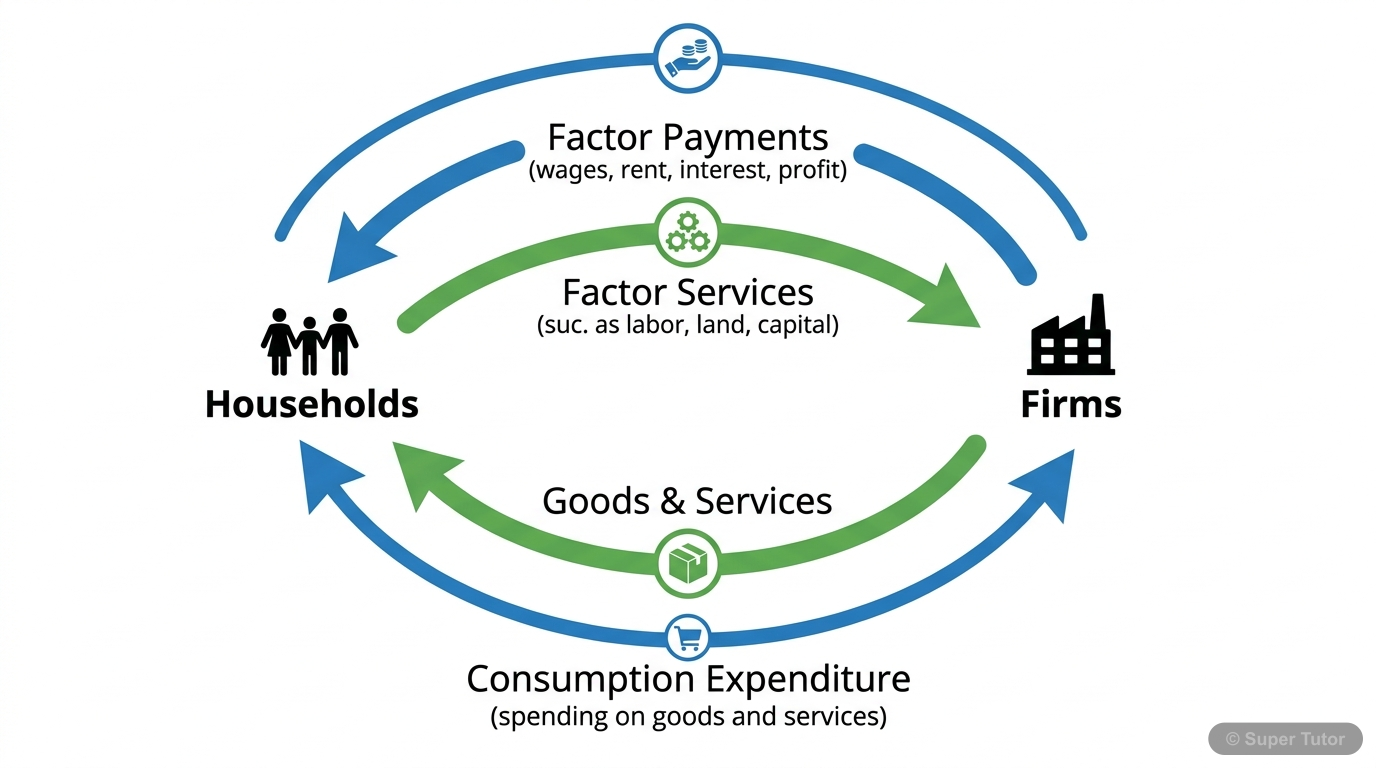
A diagram illustrating the circular flow of income between households and firms in a simple economy without government, external trade, or savings. Shows the flow of goods and services, factors of pro
Super Tutor

Learn better with visuals Super Tutor has hundreds of illustrations like this across every chapter — all free to try.

Get started
12 Questions Solved · 1 Section

National Income Accounting — NCERT Exercises

1What are the four factors of production and what are the remunerations to each of these called?Show solution
Given/Concept: Factors of production are the inputs used in the production process. Each factor earns a specific type of income (remuneration).

The four factors of production and their remunerations are:

| Factor of Production | Remuneration |
|---|---|
| 1. Land | Rent |
| 2. Labour | Wages/Salaries |
| 3. Capital | Interest |
| 4. Entrepreneurship | Profit |

Explanation:
- Land refers to all natural resources. Its reward is rent.
- Labour refers to human effort (physical or mental). Its reward is wages or salaries.
- Capital refers to man-made tools, machinery, and financial assets. Its reward is interest.
- Entrepreneurship refers to the ability to organise the other three factors and bear risk. Its reward is profit.

Conclusion: The aggregate of all these factor payments (rent + wages + interest + profit) constitutes the National Income of a country.
2Why should the aggregate final expenditure of an economy be equal to the aggregate factor payments? Explain.Show solution
Concept: This equality arises from the circular flow of income in a two-sector economy (households and firms).

Explanation:

In a simple economy:
- Firms hire factors of production (land, labour, capital, entrepreneurship) from households.
- In return, firms make factor payments — rent, wages, interest, and profit — to households.
- Households use this income to spend on goods and services produced by firms.
- This spending by households constitutes the final expenditure on goods and services.

Therefore:
Aggregate Final Expenditure=Aggregate Factor Payments\text{Aggregate Final Expenditure} = \text{Aggregate Factor Payments}

Reasoning: Every rupee spent by a buyer (household) on a final good or service becomes income (factor payment) for someone involved in producing it. The value of output produced equals the income generated in producing it, which in turn equals the expenditure made on purchasing it.

This is why all three methods — Product Method, Income Method, and Expenditure Method — give the same value of GDP.

Conclusion: Since all revenue received by firms from selling final goods is ultimately distributed as factor payments to households, aggregate final expenditure must equal aggregate factor payments.
3Distinguish between stock and flow. Between net investment and capital which is a stock and which is a flow? Compare net investment and capital with flow of water into a tank.Show solution
Distinction between Stock and Flow:

| Basis | Stock | Flow |
|---|---|---|
| Definition | A quantity measured at a point of time | A quantity measured over a period of time |
| Time dimension | Has no time dimension | Has a time dimension (per day, per year, etc.) |
| Example | Capital, wealth, money supply | Investment, income, savings |

Net Investment and Capital:
- Capital is a stock — it is the total accumulated value of capital goods at a given point of time.
- Net Investment is a flow — it is the addition to the capital stock over a period of time (e.g., per year).

Net Investment (Flow)=Change in Capital Stock (Stock)\text{Net Investment (Flow)} = \text{Change in Capital Stock (Stock)}

Comparison with Water in a Tank:

This analogy makes the concept very clear:
- The tank holds water — the amount of water in the tank at any moment is a stock → analogous to Capital.
- The flow of water into the tank per unit time (litres per minute) is a flow → analogous to Net Investment.
- Just as the flow of water increases the stock of water in the tank, net investment increases the stock of capital.

Capital (Stock)+Net Investment (Flow over a period)=New Capital Stock\text{Capital (Stock)} + \text{Net Investment (Flow over a period)} = \text{New Capital Stock}

Conclusion: Capital is a stock variable and net investment is a flow variable. Net investment adds to the capital stock just as water flowing into a tank adds to the stock of water in it.
4What is the difference between planned and unplanned inventory accumulation? Write down the relation between change in inventories and value added of a firm.Show solution
Planned vs. Unplanned Inventory Accumulation:

| Basis | Planned Inventory Accumulation | Unplanned Inventory Accumulation |
|---|---|---|
| Definition | Deliberate decision by a firm to increase its stock of unsold goods | Unintended build-up of unsold goods due to unexpected fall in demand |
| Cause | Firm anticipates future demand or plans to expand | Actual sales are less than expected sales |
| Nature | Intentional | Unintentional |
| Example | A firm stocks extra goods before a festive season | Goods remain unsold due to a sudden economic slowdown |

Relation between Change in Inventories and Value Added:

Inventories are goods produced but not yet sold. They are treated as investment by the firm (investment in working capital).

The Value Added by a firm is:
Value Added=Value of OutputValue of Intermediate Goods Used\text{Value Added} = \text{Value of Output} - \text{Value of Intermediate Goods Used}

Now, Value of Output of a firm includes:
Value of Output=Value of Sales+Change in Inventories\text{Value of Output} = \text{Value of Sales} + \text{Change in Inventories}

Therefore:
Value Added=(Value of Sales+Change in Inventories)Value of Intermediate Goods Used\text{Value Added} = (\text{Value of Sales} + \text{Change in Inventories}) - \text{Value of Intermediate Goods Used}

Conclusion: An increase in inventories adds to the value of output and hence to the value added of the firm. A decrease in inventories reduces the value of output and hence the value added.
5Write down the three identities of calculating the GDP of a country by the three methods. Also briefly explain why each of these should give us the same value of GDP.Show solution
The Three Methods and Their Identities:

(i) Product Method (Value Added Method):
GDP=Value Added by all firms in the economy\text{GDP} = \sum \text{Value Added by all firms in the economy}
=(Value of OutputValue of Intermediate Goods)= \sum (\text{Value of Output} - \text{Value of Intermediate Goods})

(ii) Income Method (Factor Payment Method):
GDP=Wages+Rent+Interest+Profit+Depreciation+Net Indirect Taxes\text{GDP} = \text{Wages} + \text{Rent} + \text{Interest} + \text{Profit} + \text{Depreciation} + \text{Net Indirect Taxes}
(i.e., sum of all factor incomes generated within the domestic territory)

(iii) Expenditure Method:
GDP=C+I+G+(XM)\text{GDP} = C + I + G + (X - M)
where:
- CC = Private Final Consumption Expenditure
- II = Gross Investment (including change in inventories)
- GG = Government Final Consumption Expenditure
- XMX - M = Net Exports (Exports minus Imports)

Why all three give the same value of GDP:

All three methods are simply three different ways of looking at the same circular flow of income:

- Every good or service produced (Product Method) must be sold to someone (Expenditure Method), and the revenue from that sale is ultimately distributed as factor incomes (Income Method).
- The value of output produced = the income earned in producing it = the expenditure made in buying it.
- Therefore, by the circular flow identity:
Value of Production=Factor Incomes=Final Expenditure\text{Value of Production} = \text{Factor Incomes} = \text{Final Expenditure}

Conclusion: All three methods measure the same economic activity from different angles, so they must yield the same GDP.
6Define budget deficit and trade deficit. The excess of private investment over saving of a country in a particular year was Rs 2,000 crores. The amount of budget deficit was (–) Rs 1,500 crores. What was the volume of trade deficit of that country?Show solution
Definitions:

- Budget Deficit: When the government's expenditure exceeds its revenue (tax and non-tax receipts), the difference is called the budget deficit.
Budget Deficit=Government ExpenditureGovernment Revenue\text{Budget Deficit} = \text{Government Expenditure} - \text{Government Revenue}

- Trade Deficit: When a country's imports of goods and services exceed its exports, the difference is called the trade deficit.
Trade Deficit=ImportsExports\text{Trade Deficit} = \text{Imports} - \text{Exports}

Calculation:

The macroeconomic identity relating saving, investment, budget deficit, and trade deficit is:
(Private InvestmentPrivate Saving)+Budget Deficit=Trade Deficit\text{(Private Investment} - \text{Private Saving)} + \text{Budget Deficit} = \text{Trade Deficit}

Given:
- Excess of private investment over saving (IS)(I - S) = Rs 2,000 crores
- Budget Deficit = ()(-) Rs 1,500 crores (i.e., there is actually a budget surplus of Rs 1,500 crores)

Applying the identity:
Trade Deficit=(IS)+Budget Deficit\text{Trade Deficit} = (I - S) + \text{Budget Deficit}
Trade Deficit=2000+(1500)\text{Trade Deficit} = 2000 + (-1500)
Trade Deficit=Rs 500 crores\boxed{\text{Trade Deficit} = \text{Rs } 500 \text{ crores}}

Conclusion: The trade deficit of the country was Rs 500 crores.
7Suppose the GDP at market price of a country in a particular year was Rs 1,100 crores. Net Factor Income from Abroad was Rs 100 crores. The value of Indirect taxes – Subsidies was Rs 150 crores and National Income was Rs 850 crores. Calculate the aggregate value of depreciation.Show solution
Given:
- GDP at Market Price = Rs 1,100 crores
- Net Factor Income from Abroad (NFIA) = Rs 100 crores
- Indirect Taxes – Subsidies (Net Indirect Taxes) = Rs 150 crores
- National Income (NNP at Factor Cost) = Rs 850 crores

Step 1: Calculate GNP at Market Price
GNP at Market Price=GDP at Market Price+NFIA\text{GNP at Market Price} = \text{GDP at Market Price} + \text{NFIA}
=1100+100=Rs 1200 crores= 1100 + 100 = \text{Rs } 1200 \text{ crores}

Step 2: Calculate NNP at Market Price
NNP at Market Price=NNP at Factor Cost+Net Indirect Taxes\text{NNP at Market Price} = \text{NNP at Factor Cost} + \text{Net Indirect Taxes}
=850+150=Rs 1000 crores= 850 + 150 = \text{Rs } 1000 \text{ crores}

Step 3: Calculate Depreciation
GNP at Market Price=NNP at Market Price+Depreciation\text{GNP at Market Price} = \text{NNP at Market Price} + \text{Depreciation}
1200=1000+Depreciation1200 = 1000 + \text{Depreciation}
Depreciation=Rs 200 crores\boxed{\text{Depreciation} = \text{Rs } 200 \text{ crores}}

Conclusion: The aggregate value of depreciation is Rs 200 crores.
8Net National Product at Factor Cost of a particular country in a year is Rs 1,900 crores. There are no interest payments made by the households to the firms/government, or by the firms/government to the households. The Personal Disposable Income of the households is Rs 1,200 crores. The personal income taxes paid by them is Rs 600 crores and the value of retained earnings of the firms and government is valued at Rs 200 crores. What is the value of transfer payments made by the government and firms to the households?Show solution
Given:
- NNP at Factor Cost (National Income, NI) = Rs 1,900 crores
- Net Interest Payments by households = 0 (and by firms/government = 0)
- Personal Disposable Income (PDI) = Rs 1,200 crores
- Personal Tax = Rs 600 crores
- Retained Earnings of firms and government = Rs 200 crores
- Transfer Payments = ? (to be found)

Step 1: Find Personal Income (PI)
PDI=PIPersonal Tax\text{PDI} = \text{PI} - \text{Personal Tax}
1200=PI6001200 = \text{PI} - 600
PI=Rs 1800 crores\text{PI} = \text{Rs } 1800 \text{ crores}

Step 2: Use the relation between NI and PI

The formula is:
PI=NIRetained EarningsCorporate Tax+Transfer Payments+Net Interest Received by Households\text{PI} = \text{NI} - \text{Retained Earnings} - \text{Corporate Tax} + \text{Transfer Payments} + \text{Net Interest Received by Households}

Since there are no interest payments in either direction, and corporate tax is not separately given (it is included in retained earnings here, or we treat undistributed profits = retained earnings):

Using the simplified relation:
PI=NIRetained Earnings (undistributed profits + corporate tax)+Transfer Payments\text{PI} = \text{NI} - \text{Retained Earnings (undistributed profits + corporate tax)} + \text{Transfer Payments}

1800=1900200+Transfer Payments1800 = 1900 - 200 + \text{Transfer Payments}
1800=1700+Transfer Payments1800 = 1700 + \text{Transfer Payments}
Transfer Payments=Rs 100 crores\boxed{\text{Transfer Payments} = \text{Rs } 100 \text{ crores}}

Conclusion: The value of transfer payments made by the government and firms to the households is Rs 100 crores.
9From the following data, calculate Personal Income and Personal Disposable Income.
(a) Net Domestic Product at factor cost = Rs 8,000 crore
(b) Net Factor Income from abroad = Rs 200 crore
(c) Undisbursed Profit = Rs 1,000 crore
(d) Corporate Tax = Rs 500 crore
(e) Interest Received by Households = Rs 1,500 crore
(f) Interest Paid by Households = Rs 1,200 crore
(g) Transfer Income = Rs 300 crore
(h) Personal Tax = Rs 500 crore
Show solution
Given:

| Item | Rs (crore) |
|---|---|
| Net Domestic Product at Factor Cost | 8,000 |
| Net Factor Income from Abroad | 200 |
| Undisbursed Profit | 1,000 |
| Corporate Tax | 500 |
| Interest Received by Households | 1,500 |
| Interest Paid by Households | 1,200 |
| Transfer Income | 300 |
| Personal Tax | 500 |

Step 1: Calculate National Income (NNP at Factor Cost)
NI=NDP at Factor Cost+Net Factor Income from Abroad\text{NI} = \text{NDP at Factor Cost} + \text{Net Factor Income from Abroad}
=8000+200=Rs 8200 crores= 8000 + 200 = \text{Rs } 8200 \text{ crores}

Step 2: Calculate Personal Income (PI)

Formula:
PI=NIUndisbursed ProfitsCorporate TaxInterest Paid by Households+Interest Received by Households+Transfer Income\text{PI} = \text{NI} - \text{Undisbursed Profits} - \text{Corporate Tax} - \text{Interest Paid by Households} + \text{Interest Received by Households} + \text{Transfer Income}

PI=820010005001200+1500+300\text{PI} = 8200 - 1000 - 500 - 1200 + 1500 + 300
PI=82002700+1800\text{PI} = 8200 - 2700 + 1800
PI=Rs 7300 crores\boxed{\text{PI} = \text{Rs } 7300 \text{ crores}}

Step 3: Calculate Personal Disposable Income (PDI)

Formula:
PDI=PIPersonal Tax\text{PDI} = \text{PI} - \text{Personal Tax}
=7300500= 7300 - 500
PDI=Rs 6800 crores\boxed{\text{PDI} = \text{Rs } 6800 \text{ crores}}

Conclusion: Personal Income = Rs 7,300 crores and Personal Disposable Income = Rs 6,800 crores.
10In a single day Raju, the barber, collects Rs 500 from haircuts; over this day, his equipment depreciates in value by Rs 50. Of the remaining Rs 450, Raju pays sales tax worth Rs 30, takes home Rs 200 and retains Rs 220 for improvement and buying of new equipment. He further pays Rs 20 as income tax from his income. Based on this information, complete Raju's contribution to the following measures of income: (a) Gross Domestic Product (b) NNP at market price (c) NNP at factor cost (d) Personal income (e) Personal disposable income.Show solution
Given:
- Total revenue from haircuts = Rs 500
- Depreciation of equipment = Rs 50
- Sales tax paid = Rs 30
- Amount taken home (wages) = Rs 200
- Retained earnings (for new equipment) = Rs 220
- Income tax paid = Rs 20

Note: Raju is a sole proprietor. His entire output is a final service (haircut). There are no intermediate goods mentioned. So his value added = Rs 500.

(a) Gross Domestic Product (GDP at Market Price):

GDP includes the value of all final goods and services at market price, before deducting depreciation.
GDP contribution=Total Revenue=Rs 500\text{GDP contribution} = \text{Total Revenue} = \textbf{Rs 500}

(b) NNP at Market Price:

NNP at Market Price=GDPDepreciation\text{NNP at Market Price} = \text{GDP} - \text{Depreciation}
=50050=Rs 450= 500 - 50 = \textbf{Rs 450}

(c) NNP at Factor Cost:

NNP at Factor Cost=NNP at Market PriceNet Indirect Taxes\text{NNP at Factor Cost} = \text{NNP at Market Price} - \text{Net Indirect Taxes}

Here, Net Indirect Tax = Sales Tax = Rs 30 (no subsidies mentioned)
=45030=Rs 420= 450 - 30 = \textbf{Rs 420}

(d) Personal Income (PI):

Personal Income is the income actually received by the individual. Raju takes home Rs 200 as wages/income. Retained earnings (Rs 220) are not taken home and hence not part of personal income. Sales tax and depreciation are also not personal income.

PI=Amount taken home=Rs 200\text{PI} = \text{Amount taken home} = \textbf{Rs 200}

(e) Personal Disposable Income (PDI):

PDI=PIPersonal Tax (Income Tax)\text{PDI} = \text{PI} - \text{Personal Tax (Income Tax)}
=20020=Rs 180= 200 - 20 = \textbf{Rs 180}

Summary Table:

| Measure | Value (Rs) |
|---|---|
| (a) GDP at Market Price | 500 |
| (b) NNP at Market Price | 450 |
| (c) NNP at Factor Cost | 420 |
| (d) Personal Income | 200 |
| (e) Personal Disposable Income | 180 |
11The value of the nominal GNP of an economy was Rs 2,500 crores in a particular year. The value of GNP of that country during the same year, evaluated at the prices of same base year, was Rs 3,000 crores. Calculate the value of the GNP deflator of the year in percentage terms. Has the price level risen between the base year and the year under consideration?Show solution
Given:
- Nominal GNP (GNP at current year prices) = Rs 2,500 crores
- Real GNP (GNP at base year prices) = Rs 3,000 crores

Formula for GNP Deflator:
GNP Deflator=Nominal GNPReal GNP×100\text{GNP Deflator} = \frac{\text{Nominal GNP}}{\text{Real GNP}} \times 100

Calculation:
GNP Deflator=25003000×100\text{GNP Deflator} = \frac{2500}{3000} \times 100
GNP Deflator=83.33%\boxed{\text{GNP Deflator} = 83.33\%}

Interpretation — Has the price level risen?

The GNP Deflator for the base year is always 100 (by definition, since nominal GNP = real GNP in the base year).

The calculated GNP Deflator for the current year is 83.33, which is less than 100.

This means that the price level has actually fallen between the base year and the year under consideration. In other words, prices in the current year are lower than prices in the base year. This is why the nominal GNP (at current lower prices) is less than the real GNP (at higher base year prices).

Conclusion: The GNP Deflator is 83.33%. The price level has not risen; it has fallen compared to the base year.
12Write down some of the limitations of using GDP as an index of welfare of a country.Show solution
Concept: GDP (Gross Domestic Product) measures the total monetary value of all final goods and services produced within a country's domestic territory in a year. However, it is not a perfect measure of economic welfare.

Limitations of using GDP as an index of welfare:

(1) Distribution of Income:
GDP does not tell us how income is distributed among the people. A high GDP may coexist with extreme inequality, where a few are very rich and the majority are poor. In such a case, the welfare of the majority may be low despite a high GDP.

(2) Non-Monetary Transactions:
Many welfare-enhancing activities are not included in GDP because they do not involve monetary transactions. For example, household work done by family members, voluntary services, and subsistence farming are excluded from GDP calculations.

(3) Externalities:
GDP does not account for externalities — the positive or negative side effects of production on third parties.
- Negative externalities (e.g., pollution, environmental degradation) reduce welfare but are not subtracted from GDP.
- Positive externalities (e.g., a beautiful garden) increase welfare but are not added to GDP.
Thus, GDP may overstate welfare by ignoring the costs of pollution.

(4) Composition and Nature of Output:
GDP does not distinguish between goods that enhance welfare and those that do not. For example, expenditure on wars, crime prevention, or cleaning up pollution adds to GDP but does not necessarily improve welfare.

(5) Leisure:
GDP does not account for the value of leisure. If people work longer hours to produce more output, GDP rises, but the reduction in leisure time may reduce overall welfare.

(6) Quality of Life Indicators:
GDP ignores non-economic factors of welfare such as life expectancy, literacy, access to healthcare, political freedom, and social security, which are important determinants of human well-being.

(7) Price Index Problems:
Comparisons of real GDP over time depend on the price index used. Errors in measuring the price index can distort real GDP and hence welfare comparisons.

Conclusion: While GDP is a useful measure of economic activity and productive capacity, it is an inadequate and incomplete measure of the welfare or well-being of a country's citizens. Better indicators like the Human Development Index (HDI) are often used alongside GDP to assess welfare.

Stuck on a step?

Ask Super Tutor AI to explain any solution on this page in a simpler way — free, 24x7.

Ask a Doubt Free

Frequently Asked Questions

What are the important topics in National Income Accounting for Bihar Board Class 12 Economics?
National Income Accounting covers several key topics that are frequently asked in Bihar Board Class 12 board exams. Focus on the core concepts listed on this page and practise related questions to build confidence.
How to score full marks in National Income Accounting — Bihar Board Class 12 Economics?
Understand the core concepts first, then work through the 32 practice questions available for this chapter. Revise formulas and definitions regularly, and use flashcards for quick recall before the exam.
Where can I get free NCERT Solutions for National Income Accounting Class 12 Economics?
This page has free step-by-step NCERT Solutions for every exercise question in National Income Accounting (Bihar Board Class 12 Economics) — written the way examiners award marks: given, formula, working, answer.

Sources & Official References

Content is aligned to the official syllabus. Refer to the board website for the latest curriculum.

For serious students

Get the full National Income Accounting chapter — for free.

Quizzes, flashcards, AI doubt-solver and a step-by-step study plan for Bihar Board Class 12 Economics.