Semiconductor Electronics: Materials, Devices and Simple Circuits — Important Questions
Bihar Board · Class 12 · Physics
105 important questions from Semiconductor Electronics: Materials, Devices and Simple Circuits for Bihar Board Class 12 Physics, with answers.
Interactive on Super Tutor
Studying Semiconductor Electronics: Materials, Devices and Simple Circuits? Get the full interactive chapter.
Quizzes, flashcards, AI doubt-solver and a step-by-step study plan — built for important questions and more.
Free trial, no card needed.
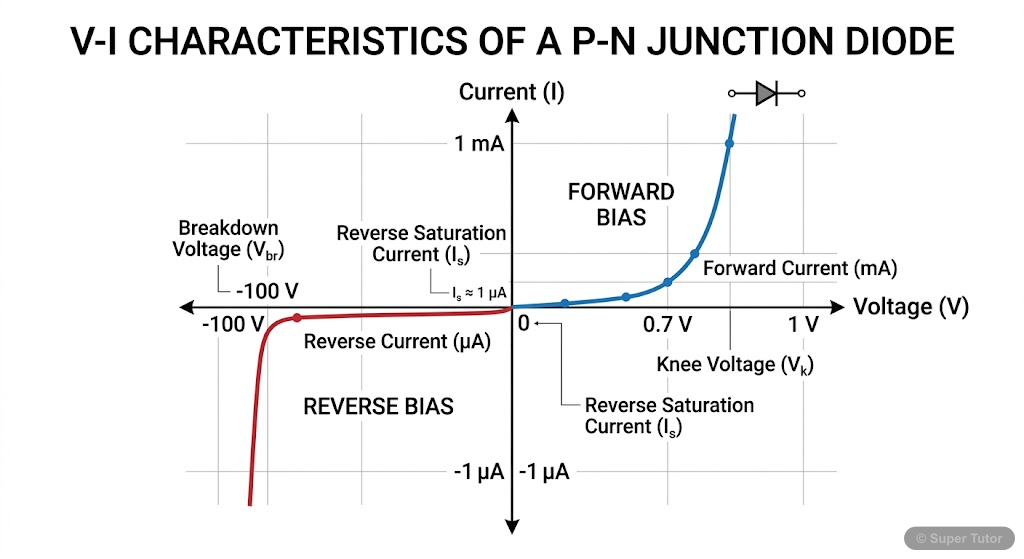
Learn better with visuals Super Tutor pairs illustrations like this with notes and quizzes for Semiconductor Electronics: Materials, Devices and Simple Circuits.
Important Questions from Semiconductor Electronics: Materials, Devices and Simple Circuits
Which impurities are used to create n-type semiconductors?
Show answer
Phosphorus (P), Arsenic (As), Antimony (Sb)
N-type semiconductors are created by doping with pentavalent (5 valence electrons) impurities like P, As, and Sb. These donate extra electrons. Trivalent elements like B, Al, In create p-type semiconductors.
In p-type semiconductors, which are the majority and minority carriers?
Show answer
Majority: holes, Minority: electrons
In p-type semiconductors, doping with trivalent impurities creates more holes than electrons. Holes become majority carriers while electrons are minority carriers (nh >> ne).
What happens when a p-n junction is formed?
Show answer
Electrons diffuse from n to p region, Holes diffuse from p to n region, A depletion region is formed, An electric field develops across the junction
At p-n junction formation, diffusion creates a depletion region with fixed charges, establishing an electric field. At equilibrium, diffusion and drift currents balance, so no net current flows.
The threshold voltage for a Silicon diode is approximately:
Show answer
0.7 V
Silicon diodes have a threshold voltage of approximately 0.7 V in forward bias. Germanium diodes have a lower threshold of about 0.2 V. This is the minimum voltage needed for significant current flow.
+101 more questions on Semiconductor Electronics: Materials, Devices and Simple Circuits (Bihar Board Class 12 Physics)
Practise AllFrequently Asked Questions
What are the important topics in Semiconductor Electronics: Materials, Devices and Simple Circuits for Bihar Board Class 12 Physics?
How many important questions are there in Semiconductor Electronics: Materials, Devices and Simple Circuits?
Sources & Official References
Content is aligned to the official syllabus. Refer to the board website for the latest curriculum.
More resources for Semiconductor Electronics: Materials, Devices and Simple Circuits
Practice Quiz
Test yourself with a quick quiz
Revision Notes
Key points for last-minute revision
Formula Sheet
The chapter's formulas in one place
Chapter Summary
Understand the chapter at a glance
Concept Maps
See how topics connect
Study Plan
Step-by-step plan for this chapter
Flashcards
Quick-fire cards for active recall
Syllabus
What topics to cover
NCERT Solutions
Every textbook question solved step by step
For serious students
Get the full Semiconductor Electronics: Materials, Devices and Simple Circuits chapter — start free.
Quizzes, flashcards, an AI doubt solver and a study plan for Bihar Board Class 12 Physics. Free to start, no card needed.