Electromagnetic Waves — NCERT Solutions
Bihar Board · Class 12 · Physics
NCERT Solutions for Electromagnetic Waves, Bihar Board Class 12 Physics: 10 textbook questions solved step by step. Covers Exercises.
Interactive on Super Tutor
Studying Electromagnetic Waves? Get the full interactive chapter.
Quizzes, flashcards, AI doubt-solver and a step-by-step study plan — built for NCERT solutions and more.
Free trial, no card needed.
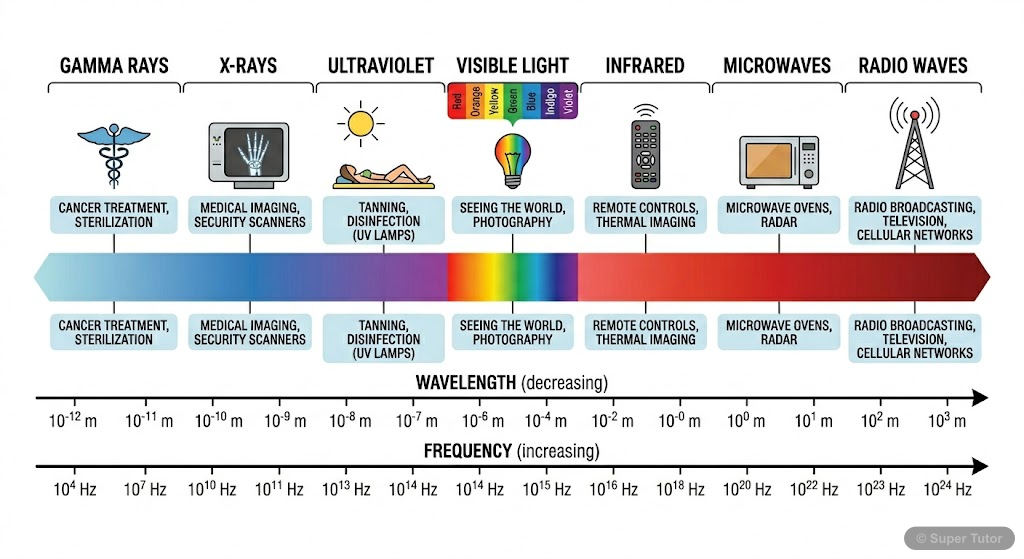
One of 11 illustrations for Electromagnetic Waves in Super Tutor — alongside flashcards, concept maps and practice questions.
The first 5 solutions are open to read. The other 5 are free with a Super Tutor account.
Exercises
8.1Figure 8.5 shows a capacitor made of two circular plates each of radius 12 cm, and separated by 5.0 cm. The capacitor is being charged by an external source (not shown in the figure). The charging current is constant and equal to 0.15A.
(a) Calculate the capacitance and the rate of change of potential difference between the plates.
(b) Obtain the displacement current across the plates.
(c) Is Kirchhoff's first rule (junction rule) valid at each plate of the capacitor? Explain.Show solution
Given radius and separation .
(a) Capacitance and rate of change of potential difference
For a parallel-plate capacitor,
where
So,
Thus, the capacitance is
The charging current is
Hence,
(b) Displacement current
For a charging capacitor, the displacement current equals the conduction current:
(c) Kirchhoff's first rule at each plate
Yes, Kirchhoff's junction rule is valid at each plate. The conduction current arriving at a plate does not disappear; it is matched by the displacement current between the plates. Thus charge conservation is satisfied when both conduction current and displacement current are included.
8.2A parallel plate capacitor (Fig. 8.6) made of circular plates each of radius R = 6.0 cm has a capacitance C = 100 pF. The capacitor is connected to a 230 V ac supply with a (angular) frequency of 300 rad s⁻¹.
(a) What is the rms value of the conduction current?
(b) Is the conduction current equal to the displacement current?
(c) Determine the amplitude of at a point from the axis between the plates.Show solution
Given , , and .
(a) rms conduction current
For an AC capacitor circuit,
So,
So the rms current is
(b) Is conduction current equal to displacement current?
In a capacitor circuit, the conduction current in the wires and the displacement current between the plates have the same instantaneous value. So, yes, they are equal in magnitude.
(c) Amplitude of at
The current amplitude is
For a point inside the plates at radius , Ampere-Maxwell law gives
Since the displacement current is uniformly distributed over the plate area,
with . Thus,
Now
So the magnetic field amplitude is
8.3What physical quantity is the same for X-rays of wavelength , red light of wavelength 6800 Å and radiowaves of wavelength 500m?Show solution
All electromagnetic waves travel in vacuum with the same speed, . Therefore X-rays, red light, and radio waves all have the same speed of light in vacuum.
8.4A plane electromagnetic wave travels in vacuum along -direction. What can you say about the directions of its electric and magnetic field vectors? If the frequency of the wave is , what is its wavelength?Show solution
For a plane electromagnetic wave travelling along the z-direction, the electric field and magnetic field are both perpendicular to the direction of propagation and also perpendicular to each other.
So the fields may be along the x-direction and y-direction respectively, or vice versa.
Given frequency,
Wavelength is
So the wave has wavelength 10 m.
8.5A radio can tune in to any station in the to band. What is the corresponding wavelength band?Show solution
Use
For ,
For ,
So the wavelength band is 40 m to 25 m. This exact value is not among the printed options because none were given; the computed answer is used.
Free with a Super Tutor account
Free with a Super Tutor account
Free with a Super Tutor account
Free with a Super Tutor account
(b) What is the amplitude of the oscillating magnetic field?
(c) Show that the average energy density of the field equals the average energy density of the field.
Free with a Super Tutor account
5 more solved questions in Electromagnetic Waves
They are free with a Super Tutor account, along with practice quizzes and flashcards for this chapter. Free to start, no card needed.
Frequently Asked Questions
What are the important topics in Electromagnetic Waves for Bihar Board Class 12 Physics?
Are these NCERT Solutions for Electromagnetic Waves free?
How should I revise Electromagnetic Waves for the Bihar Board Class 12 board exam?
Sources & Official References
Content is aligned to the official syllabus. Refer to the board website for the latest curriculum.
More resources for Electromagnetic Waves
Practice Quiz
Test yourself with a quick quiz
Important Questions
Exam-style questions with answers
Revision Notes
Key points for last-minute revision
Formula Sheet
The chapter's formulas in one place
Chapter Summary
Understand the chapter at a glance
Concept Maps
See how topics connect
Study Plan
Step-by-step plan for this chapter
Flashcards
Quick-fire cards for active recall
Syllabus
What topics to cover
For serious students
Get the full Electromagnetic Waves chapter — start free.
Quizzes, flashcards, an AI doubt solver and a study plan for Bihar Board Class 12 Physics. Free to start, no card needed.