Attitude and Social Cognition — Flashcards
Bihar Board · Class 12 · Psychology
90 flashcards for Attitude and Social Cognition (Bihar Board Class 12 Psychology) to test yourself on key terms and facts.
Interactive on Super Tutor
Studying Attitude and Social Cognition? Get the full interactive chapter.
Quizzes, flashcards, AI doubt-solver and a step-by-step study plan — built for flashcards and more.
Free trial, no card needed.
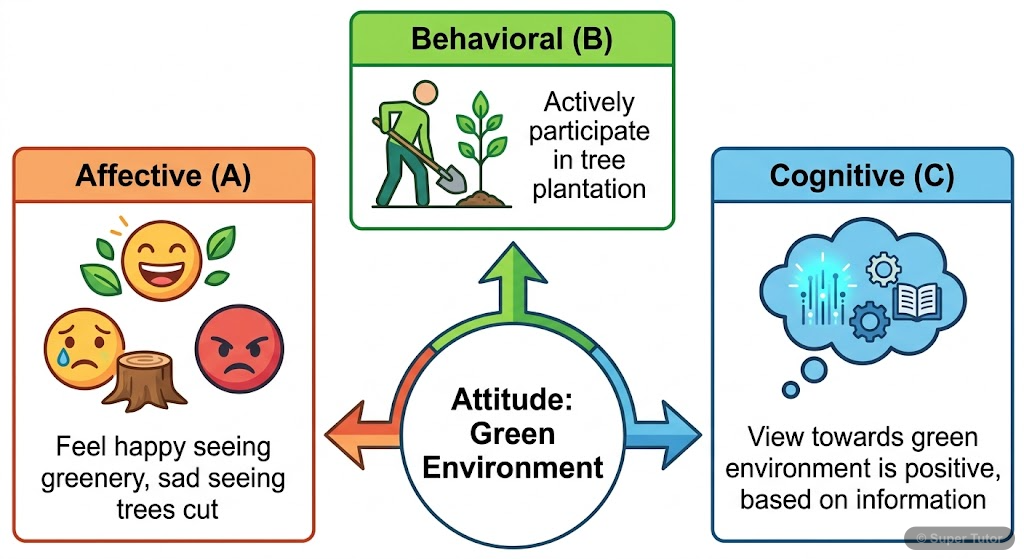
Learn better with visuals Super Tutor pairs illustrations like this with notes and quizzes for Attitude and Social Cognition.
What is social psychology?
Answer
Social psychology investigates how the behaviour of individuals is affected by others and the social environment. It studies how people think about, feel about, and behave in social situations.
सामाजिक मनोविज्ञान क्या है?
Answer
सामाजिक मनोविज्ञान यह जाँच करता है कि व्यक्तियों का व्यवहार दूसरों और सामाजिक वातावरण से कैसे प्रभावित होता है। यह अध्ययन करता है कि लोग सामाजिक परिस्थितियों में कैसे सोचते हैं, महसूस करते हैं और व्यव…
मनोवृत्ति क्या है?
Answer
मनोवृत्ति (attitude) किसी विषय, व्यक्ति या समस्या के बारे में मन की स्थिति या विचारों का समूह होता है जिसमें सकारात्मक, नकारात्मक या तटस्थ गुण हो। इसमें भावनात्मक घटक और एक विशेष तरीके से कार्य करने क…
What is an attitude?
Answer
An attitude is a state of mind or a set of views about a topic, person, or issue that has a positive, negative, or neutral quality. It also includes an emotional component and a tendency to act in a p…
What are the three components of an attitude?
Answer
The three components are cognitive, affective, and behavioural. The cognitive component is the thought or belief part, the affective component is the emotional part, and the behavioural component is t…
मनोवृत्ति के तीन घटक क्या हैं?
Answer
तीन घटक हैं- संज्ञानात्मक, भावात्मक और व्यवहारिक। संज्ञानात्मक घटक विचार या विश्वास का भाग है, भावात्मक घटक भावनात्मक भाग है और व्यवहारिक घटक कार्य करने की प्रवृत्ति है। इन सबको मिलाकर ए-बी-सी घटक कहा…
दृष्टिकोण व्यवहार के समान क्यों नहीं होते हैं?
Answer
मनोवृत्ति केवल व्यवहार करने की प्रवृत्ति है, व्यवहार नहीं। एक व्यक्ति में एक मजबूत मनोवृत्ति हो सकती है लेकिन दबाव, दूसरों द्वारा देखने या अन्य सामाजिक कारकों के कारण इसे क्रिया में नहीं दिखा सकता है।…
Why are attitudes not the same as behaviour?
Answer
Attitudes are only a tendency to behave, not the behaviour itself. A person may have a strong attitude but may not show it in action because of pressure, watching by others, or other social factors.
+82 more flashcards
Practise AllFrequently Asked Questions
What are the important topics in Attitude and Social Cognition for Bihar Board Class 12 Psychology?
How many flashcards are available for Attitude and Social Cognition?
How should I revise Attitude and Social Cognition for the Bihar Board Class 12 board exam?
Sources & Official References
Content is aligned to the official syllabus. Refer to the board website for the latest curriculum.
More resources for Attitude and Social Cognition
Practice Quiz
Test yourself with a quick quiz
Important Questions
Exam-style questions with answers
Revision Notes
Key points for last-minute revision
Chapter Summary
Understand the chapter at a glance
Concept Maps
See how topics connect
Study Plan
Step-by-step plan for this chapter
Syllabus
What topics to cover
NCERT Solutions
Every textbook question solved step by step
For serious students
Get the full Attitude and Social Cognition chapter — start free.
Quizzes, flashcards, an AI doubt solver and a study plan for Bihar Board Class 12 Psychology. Free to start, no card needed.