Patterns of Social Inequality and Exclusion — Chapter Summary
Bihar Board · Class 12 · Sociology
Summary of Patterns of Social Inequality and Exclusion for Bihar Board Class 12 Sociology. Part of the Bihar Board Class 12 Sociology syllabus.
Interactive on Super Tutor
Studying Patterns of Social Inequality and Exclusion? Get the full interactive chapter.
Quizzes, flashcards, AI doubt-solver and a step-by-step study plan — built for chapter summary and more.
Free trial, no card needed.
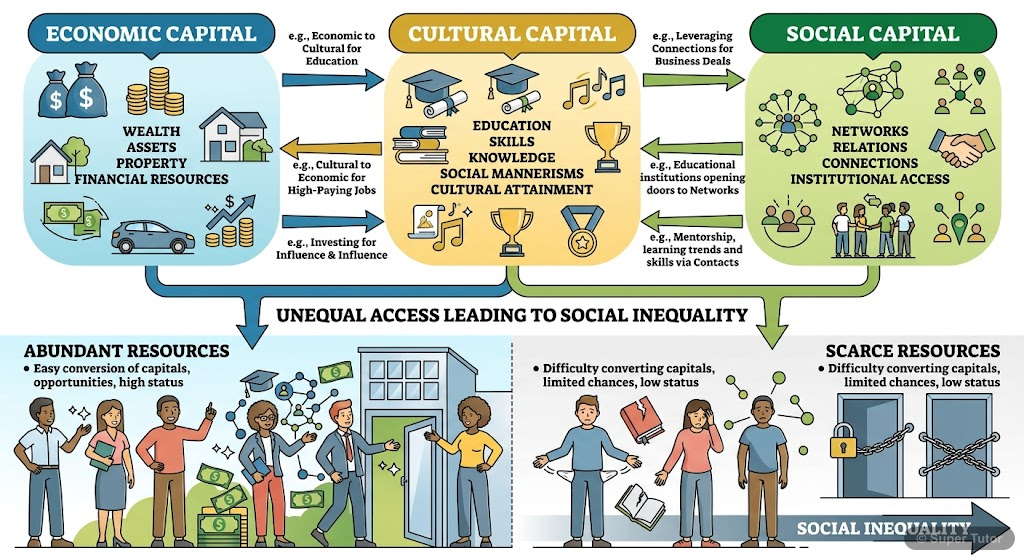
Learn better with visuals Super Tutor pairs illustrations like this with notes and quizzes for Patterns of Social Inequality and Exclusion.
Overview
Social inequality and exclusion are not random. They are built into social groups, institutions, beliefs, and patterns of power. Poverty, caste prejudice, gender discrimination, exclusion of adivasis, and the invisibility of disability all show how society can rank people unequally and deny equal ac
Key Concepts
Unequal access to valued resources such
Unequal access to valued resources such as money, property, education, health, and power. It is shaped by society and not only by personal ability or
A system in which categories
A system in which categories of people are ranked in a hierarchy. It persists across generations, is supported by ideology, and is a characteristic of
Pre
Pre-conceived opinions or attitudes held by members of one group towards another. It can be negative or positive and is often based on hearsay rather
A fixed and inflexible characterisation
A fixed and inflexible characterisation of a group of people. Stereotypes reduce diverse people to one simplified image.
Actual behaviour towards another group
Actual behaviour towards another group or individual that denies equal treatment or opportunity.
Learning Objectives
- Understand why inequality and exclusion are social rather than purely individual problems.
- Explain the difference between prejudice, stereotypes, discrimination, and social exclusion.
- Describe caste discrimination, untouchability, and the idea of Dalit identity.
- Compare caste in India with apartheid in South Africa.
- Explain the situation of Other Backward Classes and the role of reservations.
Frequently Asked Questions
What are the important topics in Patterns of Social Inequality and Exclusion for Bihar Board Class 12 Sociology?
How should I revise Patterns of Social Inequality and Exclusion for the Bihar Board Class 12 board exam?
Sources & Official References
Content is aligned to the official syllabus. Refer to the board website for the latest curriculum.
More resources for Patterns of Social Inequality and Exclusion
Practice Quiz
Test yourself with a quick quiz
Important Questions
Exam-style questions with answers
Revision Notes
Key points for last-minute revision
Concept Maps
See how topics connect
Study Plan
Step-by-step plan for this chapter
Flashcards
Quick-fire cards for active recall
Syllabus
What topics to cover
NCERT Solutions
Every textbook question solved step by step
For serious students
Get the full Patterns of Social Inequality and Exclusion chapter — start free.
Quizzes, flashcards, an AI doubt solver and a study plan for Bihar Board Class 12 Sociology. Free to start, no card needed.