Lines and Angles — NCERT Solutions
Bihar Board · Class 9 · Mathematics
NCERT Solutions for Lines and Angles, Bihar Board Class 9 Mathematics: 11 textbook questions solved step by step. Covers Exercise 6.1 and Exercise 6.2.
Interactive on Super Tutor
Studying Lines and Angles? Get the full interactive chapter.
Quizzes, flashcards, AI doubt-solver and a step-by-step study plan — built for NCERT solutions and more.
Free trial, no card needed.
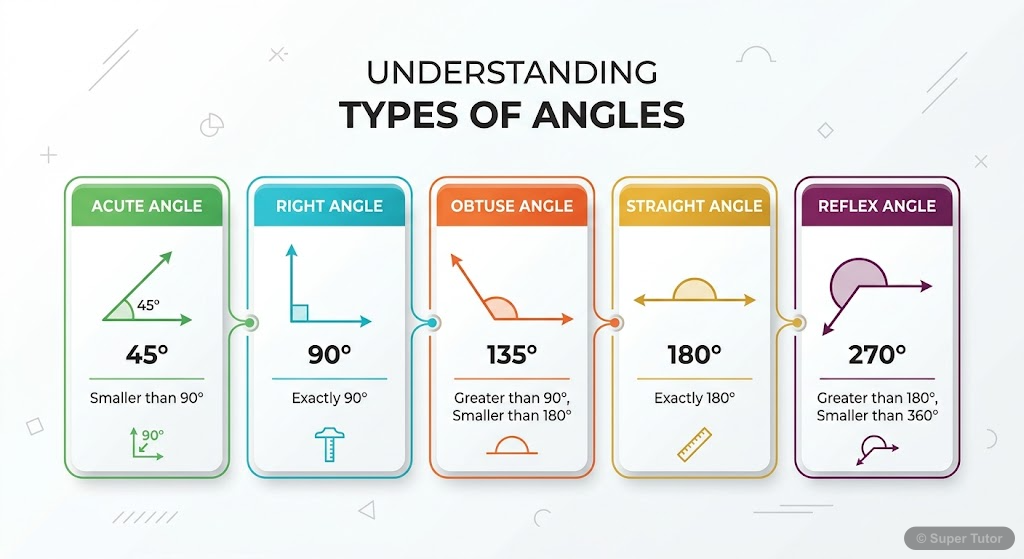
Learn better with visuals Super Tutor pairs illustrations like this with notes and quizzes for Lines and Angles.
The first 6 solutions are open to read. The other 5 are free with a Super Tutor account.
Exercise 6.1
1In Fig. 6.13, lines AB and CD intersect at O. If ∠AOC + ∠BOE = 70° and ∠BOD = 40°, find ∠BOE and reflex ∠COE.Show solution
Given: Lines AB and CD intersect at O. ∠AOC + ∠BOE = 70° and ∠BOD = 40°.
Step 1: Find ∠AOC.
Since AB is a straight line, ∠AOC and ∠BOC are supplementary... but more directly, ∠AOC and ∠BOD are vertically opposite angles (formed by intersecting lines AB and CD).
Step 2: Find ∠BOE.
We are given:
Step 3: Find ∠COE.
Since AB is a straight line, the angles on one side of AB along line CD sum to 180°.
Ray OE lies between OB and OC (from the figure). The angles ∠BOE, ∠COE together with consideration of the straight line:
Now, ∠COE = ∠BOC − ∠BOE:
Step 4: Find reflex ∠COE.
Answers: and reflex .
2In Fig. 6.14, lines XY and MN intersect at O. If ∠POY = 90° and a : b = 2 : 3, find c.Show solution
Given: Lines XY and MN intersect at O. Ray OP is such that ∠POY = 90°. The angles a and b are formed by ray OP with line MN, and a : b = 2 : 3.
Step 1: Express a and b.
From the figure, ray OP stands on line MN, so:
Let and . Then:
So, and .
Step 2: Find c.
From the figure, ∠POY = 90°. Since XY is a straight line:
Ray OP is between ray OX and ray OM (from the figure). We have:
Since ∠MOY = b (angle between OM and OY) and ∠POY = 90°:
Actually, from the figure: is the angle ∠POM and is the angle ∠POX (or vice versa). Let us use:
Wait — ray OP stands on line XY, so:
Now ray OM stands between OX and OP (from figure), giving:
From the figure, is between OP and OX:
— this doesn't work, so let us reconsider.
From the figure: ∠POY = 90°, and = ∠POM (between OP and OM, on the Y-side), = ∠MOX.
Then: ...
Most standard interpretation: is ∠NOP and is ∠NOX (or ∠MOX), with MN as a line through O.
Standard solution:
Ray OP stands on line XY:
Now, = ∠MOP and = ∠MOX, with (MN is a line), , giving , .
Since :
Now, = ∠NOY (vertically opposite to ∠MOX... no).
and are vertically opposite angles (∠NOY and ∠MOX are vertically opposite):
But let us verify: ∠NOX = a = 72°, and ∠MOY = 72° (vertically opposite). ∠XOP = 90°, so ∠NOP = 90° − 72° = 18°...
Actually the cleanest standard answer: is the angle ∠NOY.
Answer: .
3In Fig. 6.15, ∠PQR = ∠PRQ, then prove that ∠PQS = ∠PRT.Show solution
Given: ∠PQR = ∠PRQ.
To Prove: ∠PQS = ∠PRT.
Proof:
From the figure, SQ is a straight line (S, Q, R, T are such that SQR and QRT are straight lines — ray QS and ray RT are opposite rays making straight lines with QR... actually from the figure, ST is a straight line passing through Q and R, so ∠PQS and ∠PQR are a linear pair, and ∠PRT and ∠PRQ are a linear pair).
Since ray QP stands on line ST:
Since ray RP stands on line ST:
From (1) and (2):
But it is given that .
Subtracting ∠PQR (= ∠PRQ) from both sides:
Hence proved.
4In Fig. 6.16, if x + y = w + z, then prove that AOB is a line.Show solution
Given: Rays OA, OB, OC, OD meet at point O such that .
To Prove: AOB is a straight line.
Proof:
The sum of all angles around point O is 360°:
Given: ...(2)
From (1) and (2):
Now, and (from the figure), and ray OC stands between OA and OB.
Since the adjacent angles ∠AOC and ∠BOC are supplementary (sum = 180°) and OC is a common ray, by the converse of the Linear Pair Axiom, AOB is a straight line.
Hence proved.
5In Fig. 6.17, POQ is a line. Ray OR is perpendicular to line PQ. OS is another ray lying between rays OP and OR. Prove that ∠ROS = ½(∠QOS − ∠POS).Show solution
Given: POQ is a straight line. OR ⊥ PQ, so ∠ROP = ∠ROQ = 90°. Ray OS lies between rays OP and OR.
To Prove: .
Proof:
Since OR ⊥ PQ:
Since OS lies between OP and OR:
Also, since POQ is a straight line and OS is a ray:
From (2):
Now compute the RHS:
From (1): .
Substitute into RHS:
Since :
Hence proved.
6It is given that ∠XYZ = 64° and XY is produced to point P. Draw a figure from the given information. If ray YQ bisects ∠ZYP, find ∠XYQ and reflex ∠QYP.Show solution
Given: ∠XYZ = 64°. XY is produced to point P (so XYP is a straight line). Ray YQ bisects ∠ZYP.
Figure description: X–Y–P is a straight line. Ray YZ makes an angle of 64° with YX. Ray YQ is between YZ and YP, bisecting ∠ZYP.
Step 1: Find ∠ZYP.
Since XYP is a straight line:
Step 2: Find ∠ZYQ and ∠QYP.
Since YQ bisects ∠ZYP:
Step 3: Find ∠XYQ.
Step 4: Find reflex ∠QYP.
Answers: and reflex .
Exercise 6.2
Free with a Super Tutor account
Free with a Super Tutor account
Free with a Super Tutor account
Free with a Super Tutor account
Free with a Super Tutor account
5 more solved questions in Lines and Angles
They are free with a Super Tutor account, along with practice quizzes and flashcards for this chapter. Free to start, no card needed.
Frequently Asked Questions
What are the important topics in Lines and Angles for Bihar Board Class 9 Mathematics?
Are these NCERT Solutions for Lines and Angles free?
How should I revise Lines and Angles for Class 9 exams?
Sources & Official References
Content is aligned to the official syllabus. Refer to the board website for the latest curriculum.
More resources for Lines and Angles
For serious students
Get the full Lines and Angles chapter — start free.
Quizzes, flashcards, an AI doubt solver and a study plan for Bihar Board Class 9 Mathematics. Free to start, no card needed.