Footprints without Feet — NCERT Solutions
CBSE · Class 10 · English
NCERT Solutions for Footprints without Feet, CBSE Class 10 English: 5 textbook questions solved step by step. Covers Think about it and Talk about it.
Interactive on Super Tutor
Studying Footprints without Feet? Get the full interactive chapter.
Quizzes, flashcards, AI doubt-solver and a step-by-step study plan — built for NCERT solutions and more.
Free trial, no card needed.
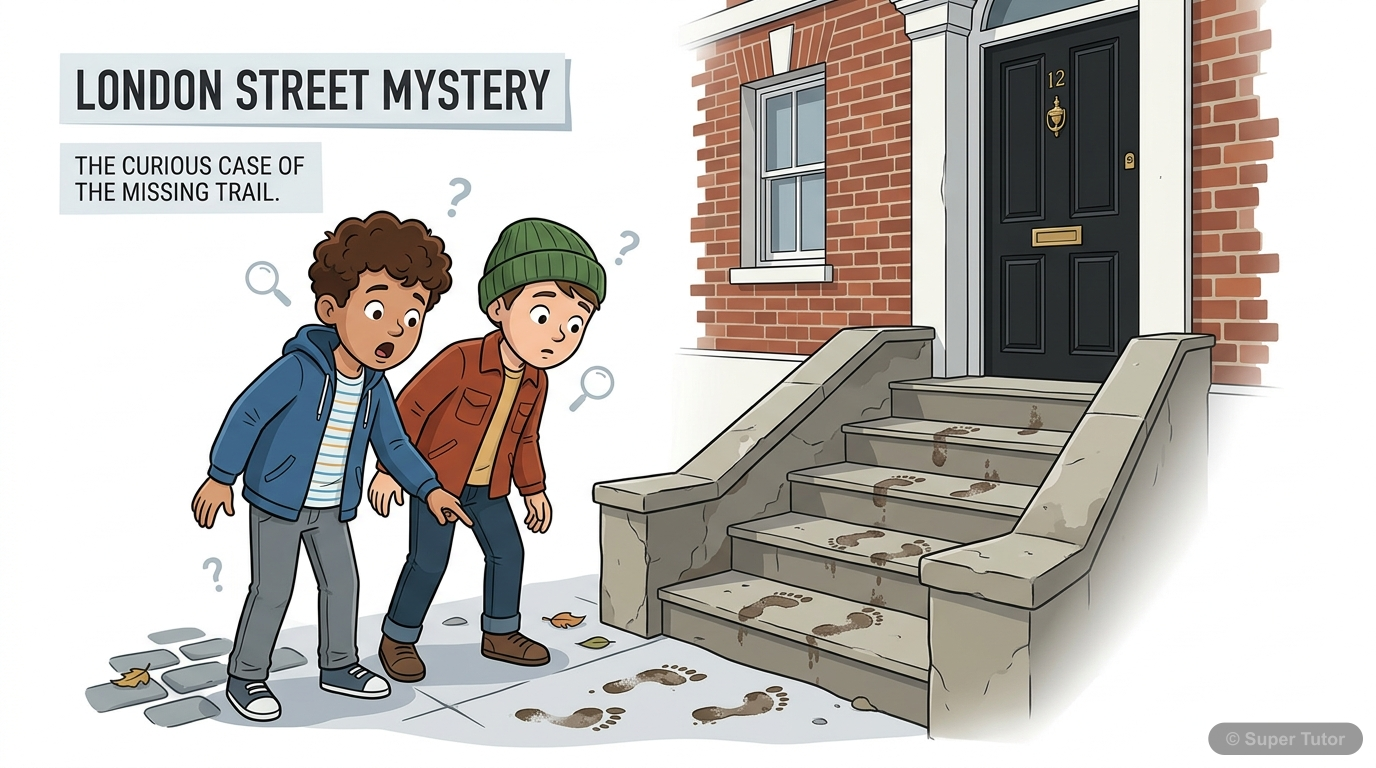
Learn better with visuals Super Tutor pairs illustrations like this with notes and quizzes for Footprints without Feet.
The first 3 solutions are open to read. The other 2 are free with a Super Tutor account.
Think about it
1"Griffin was rather a lawless person." Comment.Show solution
Given/Context: Griffin is the invisible scientist in H.G. Wells' story 'Footprints without Feet.'
Answer:
Griffin was indeed a lawless person. The following incidents from the story support this view:
- Setting fire to his landlord's house: When his landlord tried to evict him, Griffin, instead of leaving peacefully, set the house on fire — an act of arson that shows complete disregard for the law and for others' property.
- Stealing from a London store: After becoming invisible, Griffin entered a big London store, ate and drank whatever he wished, and wore clothes without paying for them. He robbed the store of its goods.
- Robbing a clergyman's house: Griffin broke into the clergyman's house and stole money from the desk. This was outright theft.
- Robbing the theatrical company: He attacked the shopkeeper Marvel and stole money from him as well.
- Attacking Jaffers and others: When the constable Jaffers tried to arrest him, Griffin attacked him and knocked him unconscious. He also hit several other people who tried to stop him.
Thus, Griffin misused his brilliant scientific discovery not for the benefit of humanity but for personal gain and revenge. He had no respect for law, property, or human life. His invisibility, instead of being used constructively, became a tool for crime and violence. This clearly establishes that Griffin was a lawless and irresponsible person.
2How would you assess Griffin as a scientist?Show solution
Given/Context: Griffin is the central character — a scientist who discovered the formula to make the human body transparent/invisible.
Answer:
As a scientist, Griffin was undoubtedly brilliant and ahead of his time. However, his brilliance was overshadowed by his irresponsible and unethical conduct. Here is a balanced assessment:
As a brilliant scientist:
- Griffin carried out extraordinary scientific research and succeeded in discovering a rare scientific formula by which a human body could become invisible.
- He worked on the principle that a human body could be made transparent like glass by changing its refractive index so that it neither reflects nor refracts light.
- This was a remarkable scientific achievement that no one had accomplished before him.
As an irresponsible scientist:
- Griffin used his discovery purely for selfish purposes — to steal, to take revenge, and to escape the law.
- He did not think about the welfare of society or the ethical implications of his invention.
- A true scientist uses knowledge for the betterment of humanity, but Griffin used it to harm others.
- His lack of moral responsibility made him dangerous rather than beneficial to society.
Conclusion: Griffin was a gifted and intelligent scientist, but he lacked moral values and a sense of social responsibility. His genius was wasted because he channelled it into crime and self-interest. A scientist's greatness lies not only in discovery but also in how that discovery is used — and by that measure, Griffin falls short.
Talk about it
1Would you like to become invisible? What advantages and disadvantages do you foresee, if you did?Show solution
This is an open-ended discussion question. A model answer is provided below:
Becoming invisible is a fascinating idea that has captured human imagination for centuries. Here is a balanced view:
Advantages of becoming invisible:
- One could move freely without being noticed, which could be useful in dangerous situations.
- It could help in catching criminals, spies, or terrorists by observing them secretly.
- One could help people in need without seeking recognition or reward.
- It could be useful for scientific exploration in places that are otherwise inaccessible.
- One could avoid unwanted social situations or escape from enemies.
Disadvantages of becoming invisible:
- Invisibility could tempt a person to engage in unethical activities like stealing, spying on others, or breaking the law — as Griffin did.
- It would be difficult to interact normally with family and friends.
- The invisible person could be accidentally hurt since others cannot see them.
- It could lead to loneliness and social isolation.
- The misuse of such a power could cause harm to society.
Personal View: While the idea of invisibility sounds exciting, it comes with great moral responsibility. Like any power, it must be used ethically. The story of Griffin is a warning that scientific power without moral values leads to destruction.
Free with a Super Tutor account
Free with a Super Tutor account
2 more solved questions in Footprints without Feet
They are free with a Super Tutor account, along with practice quizzes and flashcards for this chapter. Free to start, no card needed.
Frequently Asked Questions
What are the important topics in Footprints without Feet for CBSE Class 10 English?
Are these NCERT Solutions for Footprints without Feet free?
How should I revise Footprints without Feet for the CBSE Class 10 board exam?
Sources & Official References
- NCERT Official — ncert.nic.in
- CBSE Academic — cbseacademic.nic.in
- CBSE Official — cbse.gov.in
- National Education Policy 2020 — education.gov.in
Content is aligned to the official syllabus. Refer to the board website for the latest curriculum.
More resources for Footprints without Feet
Practice Quiz
Test yourself with a quick quiz
Important Questions
Exam-style questions with answers
Revision Notes
Key points for last-minute revision
Chapter Summary
Understand the chapter at a glance
Concept Maps
See how topics connect
Study Plan
Step-by-step plan for this chapter
Flashcards
Quick-fire cards for active recall
Syllabus
What topics to cover
For serious students
Get the full Footprints without Feet chapter — start free.
Quizzes, flashcards, an AI doubt solver and a study plan for CBSE Class 10 English. Free to start, no card needed.