Minerals and Energy Resources
CBSE · Class 10 · Social Science
NCERT Solutions for Minerals and Energy Resources — CBSE Class 10 Social Science.
Interactive on Super Tutor
Studying Minerals and Energy Resources? Get the full interactive chapter.
Quizzes, flashcards, AI doubt-solver and a step-by-step study plan — built for ncert solutions and more.
1,000+ Class 10 students started this chapter today

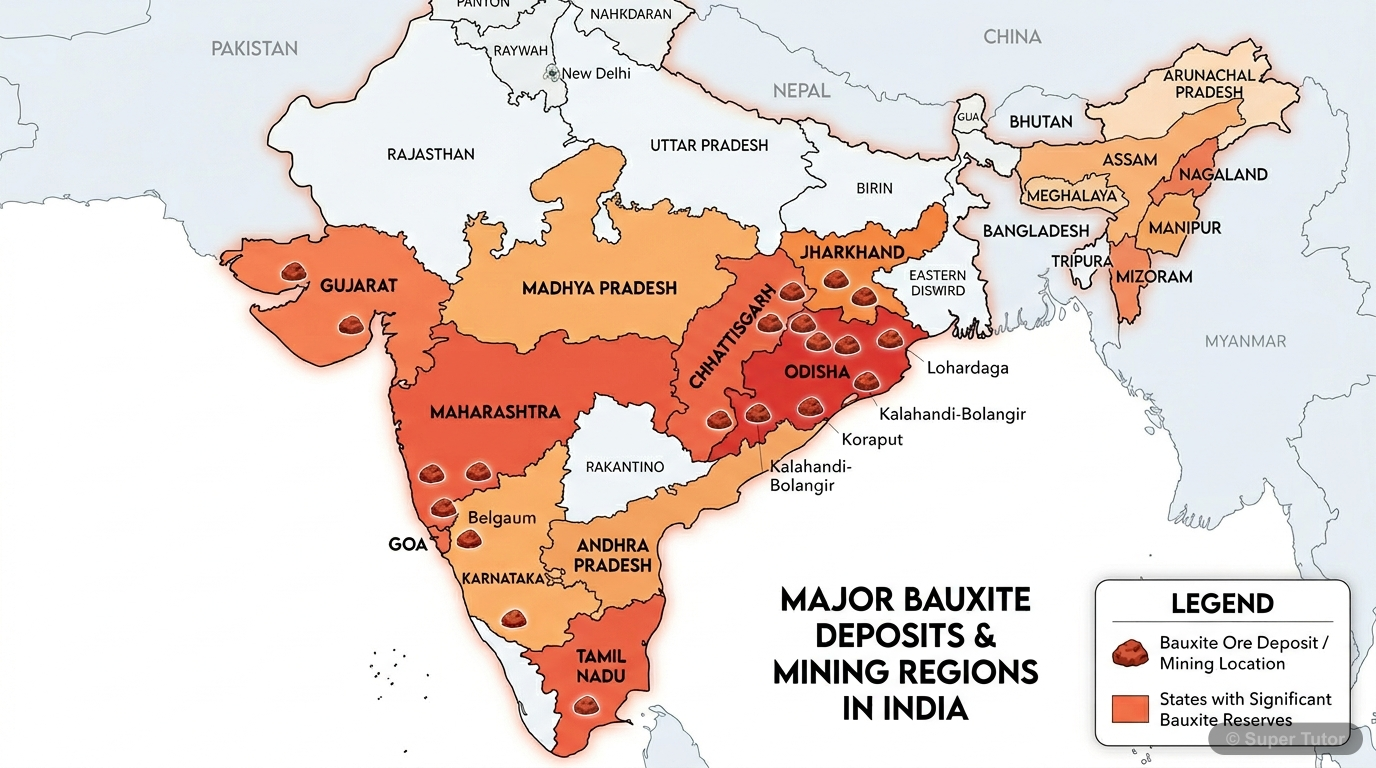
Learn better with visuals Super Tutor has hundreds of illustrations like this across every chapter — all free to try.
Get startedEXERCISES
1(i)Which one of the following minerals is formed by decomposition of rocks, leaving a residual mass of weathered material?
(a) coal
(b) bauxite
(c) gold
(d) zincShow solution
Bauxite is formed by the decomposition (weathering) of rocks over a long period of time. The process leaves behind a residual mass of weathered material rich in aluminium hydroxide. Coal is formed from plant remains, while gold and zinc are found in veins/lodes or sedimentary strata — not as residual weathered masses.
1(ii)Koderma, in Jharkhand is the leading producer of which one of the following minerals?
(a) bauxite
(b) mica
(c) iron ore
(d) copperShow solution
Koderma in Jharkhand is the leading producer of mica in India. The mica belt of Jharkhand (Koderma–Gaya–Hazaribagh belt) is one of the most important mica-producing regions in the world.
1(iii)Minerals are deposited and accumulated in the stratas of which of the following rocks?
(a) sedimentary rocks
(b) metamorphic rocks
(c) igneous rocks
(d) none of the aboveShow solution
In sedimentary rocks, minerals are deposited and accumulated in layers (strata) over millions of years. Minerals such as coal, iron ore, gypsum, potash salt, and sodium salt are found in sedimentary rock formations.
1(iv)Which one of the following minerals is contained in the Monazite sand?
(a) oil
(b) uranium
(c) thorium
(d) coalShow solution
Monazite sand is a placer deposit found along the coast of Kerala and other coastal areas of India. It contains thorium in large quantities, making India one of the world's largest reserves of thorium, which is used as nuclear fuel.
2(i)(a)Distinguish between ferrous and non-ferrous minerals in not more than 30 words.Show solution
Distinction:
| Ferrous Minerals | Non-Ferrous Minerals |
|---|---|
| Contain iron as a constituent. | Do not contain iron. |
| Examples: iron ore, manganese, nickel, cobalt. | Examples: copper, bauxite, lead, gold, silver, tin. |
Ferrous minerals provide a strong base for the development of metallurgical industries, while non-ferrous minerals play a vital role in a number of industries such as electrical, electronics, and aerospace.
2(i)(b)Distinguish between conventional and non-conventional sources of energy in not more than 30 words.Show solution
| Conventional Sources | Non-Conventional Sources |
|---|---|
| Traditional sources used for a long time; mostly non-renewable. | Relatively newer sources; mostly renewable and environment-friendly. |
| Examples: coal, petroleum, natural gas, firewood. | Examples: solar energy, wind energy, tidal energy, biogas, geothermal energy. |
Conventional sources are exhaustible and cause pollution, whereas non-conventional sources are inexhaustible and cleaner alternatives.
2(ii)What is a mineral?Show solution
A mineral is a naturally occurring substance that has a definite chemical composition and physical properties. Minerals are formed by natural processes and are found in various types of rocks — igneous, sedimentary, and metamorphic.
They are homogeneous solids with a definite internal structure. Minerals are indispensable for industrial development. Examples include iron ore, bauxite, mica, coal, and petroleum.
2(iii)How are minerals formed in igneous and metamorphic rocks?Show solution
In Igneous Rocks:
Minerals are formed when magma (molten rock material) cools and solidifies. During the cooling process, minerals crystallise and are deposited. They occur in cracks, crevices, faults, and joints. The smaller occurrences are called veins and the larger ones are called lodes. Examples: tin, copper, zinc, lead.
In Metamorphic Rocks:
Minerals are formed when igneous or sedimentary rocks undergo great heat and pressure, causing recrystallisation of existing minerals into new forms. Examples: corundum, garnet, and some forms of iron ore such as magnetite are found in metamorphic rocks.
Conclusion: In both rock types, minerals are found in veins and lodes formed by the cooling of magma or by recrystallisation under heat and pressure.
2(iv)Why do we need to conserve mineral resources?Show solution
Reasons for Conservation:
1. Limited and non-renewable: Minerals are formed over millions of years by geological processes. Once exhausted, they cannot be replenished in the near future.
2. Rapid depletion: Increasing industrialisation and modernisation have led to rapid consumption of mineral resources.
3. Economic importance: Minerals are the backbone of industrial development. Their depletion would adversely affect the economy.
4. Environmental concerns: Indiscriminate mining causes land degradation, deforestation, and pollution.
5. Future generations: Resources must be conserved so that future generations can also benefit from them.
Measures: Recycling of metals, use of improved technologies to reduce wastage, and finding substitutes are some ways to conserve minerals.
Conclusion: Judicious use of mineral resources is essential for sustainable development.
3(i)Describe the distribution of coal in India.Show solution
Introduction: Coal is the most abundantly found fossil fuel in India. It is the most important source of energy for the country. India is one of the world's largest producers of coal.
Types and Distribution:
1. Gondwana Coal (about 200 million years old):
This is the most important type and accounts for the bulk of India's coal reserves.
- Damodar Valley (West Bengal–Jharkhand): This is the most important coal belt. It includes Raniganj (West Bengal), Jharia, Bokaro, and Giridih (Jharkhand). Jharia is the most important coalfield.
- Godavari, Mahanadi, Son, and Wardha valleys also contain coal deposits.
- Major states: Jharkhand, Odisha, Chhattisgarh, West Bengal, Madhya Pradesh, Telangana, and Maharashtra.
2. Tertiary Coal (about 55 million years old):
Found in the north-eastern states.
- Meghalaya, Assam, Arunachal Pradesh, and Nagaland.
Conclusion: Coal is unevenly distributed in India, with the major reserves concentrated in the peninsular plateau region (Gondwana coalfields). The north-eastern coalfields are smaller but significant for the region.
3(ii)Why do you think that solar energy has a bright future in India?Show solution
Introduction: Solar energy is the energy obtained from the sun's radiation. It is a renewable and non-polluting source of energy.
Reasons why solar energy has a bright future in India:
1. Tropical location: India is a tropical country and receives sunshine for most of the year. It has enormous potential for solar energy development.
2. Vast sunny areas: States like Rajasthan, Gujarat, and other semi-arid regions receive intense solar radiation throughout the year, making them ideal for solar farms.
3. Photovoltaic technology: Solar energy can be converted directly into electricity using photovoltaic cells. This technology is becoming cheaper and more efficient.
4. Rural electrification: Solar energy can be used to provide electricity to remote and rural areas where conventional power supply is difficult and expensive.
5. Reducing dependence on fossil fuels: India imports a large amount of petroleum. Solar energy can reduce this dependence and save foreign exchange.
6. Environment-friendly: Solar energy does not cause pollution and helps in reducing carbon emissions, contributing to a cleaner environment.
7. Government initiatives: The National Solar Mission (part of the National Action Plan on Climate Change) aims to promote solar energy use across the country.
Conclusion: Given India's geographical location, vast land area, and the need for sustainable energy, solar energy indeed has a very bright future in India. It can help meet the growing energy demands while protecting the environment.
ActivityFill the name of the correct mineral in the crossword (ACROSS and DOWN clues given).Show solution
1. A ferrous mineral (9 letters): MANGANESE
2. Raw material for cement industry (9 letters): LIMESTONE
3. Finest iron ore with magnetic properties (9 letters): MAGNETITE
4. Highest quality hard coal (10 letters): ANTHRACITE
5. Aluminium is obtained from this ore (7 letters): BAUXITE
6. Khetri mines are famous for this mineral (6 letters): COPPER
7. Formed due to evaporation (6 letters): GYPSUM
DOWN:
1. Found in placer deposit (4 letters): GOLD
2. Iron ore mined in Bailadila (8 letters): HEMATITE
3. Indispensable for electrical industry (4 letters): MICA
4. Geological Age of coal found in north-east India (8 letters): TERTIARY
5. Formed in veins and lodes (3 letters): TIN
Note: The crossword answers are based on the clues provided and the chapter content on Minerals and Energy Resources.
Stuck on a step?
Ask Super Tutor AI to explain any solution on this page in a simpler way — free, 24x7.
Ask a Doubt FreeFrequently Asked Questions
What are the important topics in Minerals and Energy Resources for CBSE Class 10 Social Science?
How to score full marks in Minerals and Energy Resources — CBSE Class 10 Social Science?
Where can I get free NCERT Solutions for Minerals and Energy Resources Class 10 Social Science?
Sources & Official References
- NCERT Official — ncert.nic.in
- CBSE Academic — cbseacademic.nic.in
- CBSE Official — cbse.gov.in
- National Education Policy 2020 — education.gov.in
Content is aligned to the official syllabus. Refer to the board website for the latest curriculum.
More resources for Minerals and Energy Resources
Important Questions
Practice with board exam-style questions
Syllabus
What topics to cover
Revision Notes
Key points for last-minute revision
Study Plan
Step-by-step plan to ace this chapter
Flashcards
Quick-fire cards for active recall
Formula Sheet
All formulas in one place
Chapter Summary
Understand the chapter at a glance
Practice Quiz
Test yourself with a quick quiz
Concept Maps
See how topics connect visually
For serious students
Get the full Minerals and Energy Resources chapter — for free.
Quizzes, flashcards, AI doubt-solver and a step-by-step study plan for CBSE Class 10 Social Science.