Application of Derivatives
CBSE · Class 12 · Mathematics
Practice quiz for Application of Derivatives — CBSE Class 12 Mathematics. MCQs and questions with answers to test your preparation.
Interactive on Super Tutor
Studying Application of Derivatives? Get the full interactive chapter.
Quizzes, flashcards, AI doubt-solver and a step-by-step study plan — built for practice quiz and more.
1,000+ Class 12 students started this chapter today
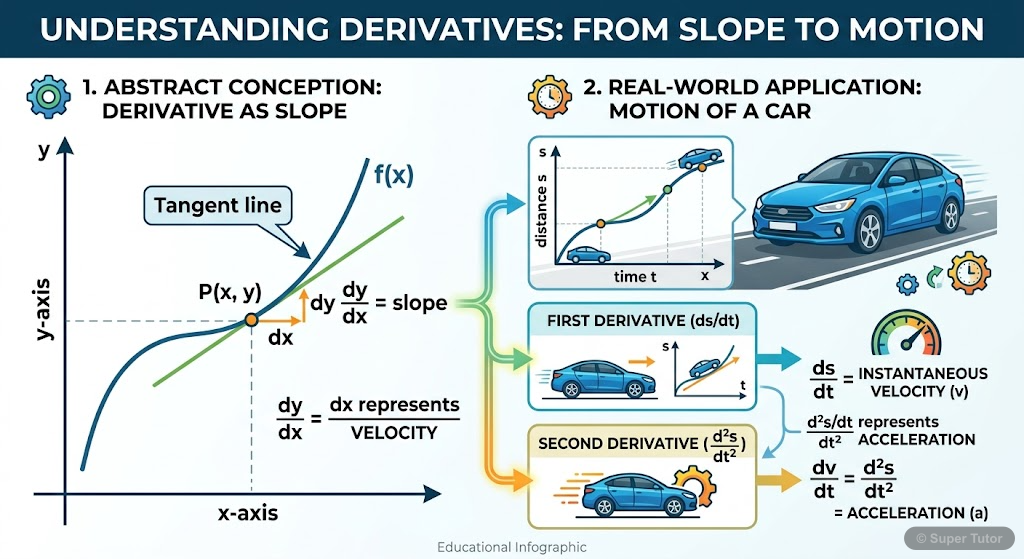
Super Tutor has 9+ illustrations like this for Application of Derivatives alone — flashcards, concept maps, and step-by-step visuals.
See them allQuick Quiz: Application of Derivatives
0/4Tap an answer to check it instantly. No sign-up needed for these 4.
For what values of x is the function f(x) = x³ - 3x + 1 increasing?
Find the critical points of f(x) = x³ - 6x² + 9x - 2.
The area of a square is increasing at 8 cm²/sec. Find the rate at which the side is increasing when the side is 4 cm.
Find the local maximum value of f(x) = -x² + 4x - 3.
Sample Questions
Which of the following are true about the function f(x) = 2x³ - 6x² + 6x - 1?
Show answer
f'(x) = 6x² - 12x + 6, f has a critical point at x = 1, f'(1) = 0, f''(x) = 12x - 12
f'(x) = 6x² - 12x + 6 = 6(x² - 2x + 1) = 6(x - 1)². So f'(1) = 0, making x = 1 a critical point. f''(x) = 12x - 12. Since f'(x) = 6(x - 1)² ≥ 0 for all x, f is always increasing except at x = 1 where it has zero slope.
A ladder 10 m long leans against a vertical wall. If the bottom slides away at 2 m/s, find the rate at which the top is sliding down when the bottom is 6 m from the wall.
Show answer
1.5 m/s
Let x = distance from wall to bottom, y = height up wall. Given: x² + y² = 100, dx/dt = 2 m/s, x = 6 m. Find dy/dt. When x = 6: y = √(100 - 36) = 8 m. Differentiating: 2x(dx/dt) + 2y(dy/dt) = 0. So 2(6)(2) + 2(8)(dy/dt) = 0, giving 24 + 16(dy/dt) = 0, so dy/dt = -1.5 m/s. The top slides down at 1.5 m/s.
Which statements about maxima and minima are correct?
Show answer
At local maxima, f'(x) = 0, If f'(c) = 0 and f''(c) > 0, then c is a local minimum, If f'(c) = 0 and f''(c) < 0, then c is a local maximum
At local extrema of differentiable functions, f'(x) = 0. The second derivative test: f''(c) > 0 indicates local minimum, f''(c) < 0 indicates local maximum. However, some critical points may be inflection points, not extrema. Also, f''(x) need not be zero at extrema.
Find the absolute maximum of f(x) = x³ - 3x on the interval [-2, 2].
Show answer
2
f'(x) = 3x² - 3 = 3(x² - 1). Critical points: x = ±1. Evaluate f at critical points and endpoints: f(-2) = -8 + 6 = -2, f(-1) = -1 + 3 = 2, f(1) = 1 - 3 = -2, f(2) = 8 - 6 = 2. The absolute maximum value is 2, occurring at x = -1 and x = 2.
+141 more questions available
Practice AllFrequently Asked Questions
What are the important topics in Application of Derivatives for CBSE Class 12 Mathematics?
How to score full marks in Application of Derivatives — CBSE Class 12 Mathematics?
Sources & Official References
- NCERT Official — ncert.nic.in
- CBSE Academic — cbseacademic.nic.in
- CBSE Official — cbse.gov.in
- National Education Policy 2020 — education.gov.in
Content is aligned to the official syllabus. Refer to the board website for the latest curriculum.
More resources for Application of Derivatives
Important Questions
Practice with board exam-style questions
Revision Notes
Key points for last-minute revision
Formula Sheet
All formulas in one place
Chapter Summary
Understand the chapter at a glance
Concept Maps
See how topics connect visually
Study Plan
Step-by-step plan to ace this chapter
Flashcards
Quick-fire cards for active recall
Syllabus
What topics to cover
NCERT Solutions
Every textbook question solved step by step
For serious students
Get the full Application of Derivatives chapter — for free.
Quizzes, flashcards, AI doubt-solver and a step-by-step study plan for CBSE Class 12 Mathematics.