Chemical Kinetics — Practice Quiz
Chhattisgarh Board · Class 12 · Chemistry
Try a 4-question quiz on Chemical Kinetics for Chhattisgarh Board Class 12 Chemistry: tap an answer to check it and see why.
Interactive on Super Tutor
Studying Chemical Kinetics? Get the full interactive chapter.
Quizzes, flashcards, AI doubt-solver and a step-by-step study plan — built for practice quiz and more.
Free trial, no card needed.
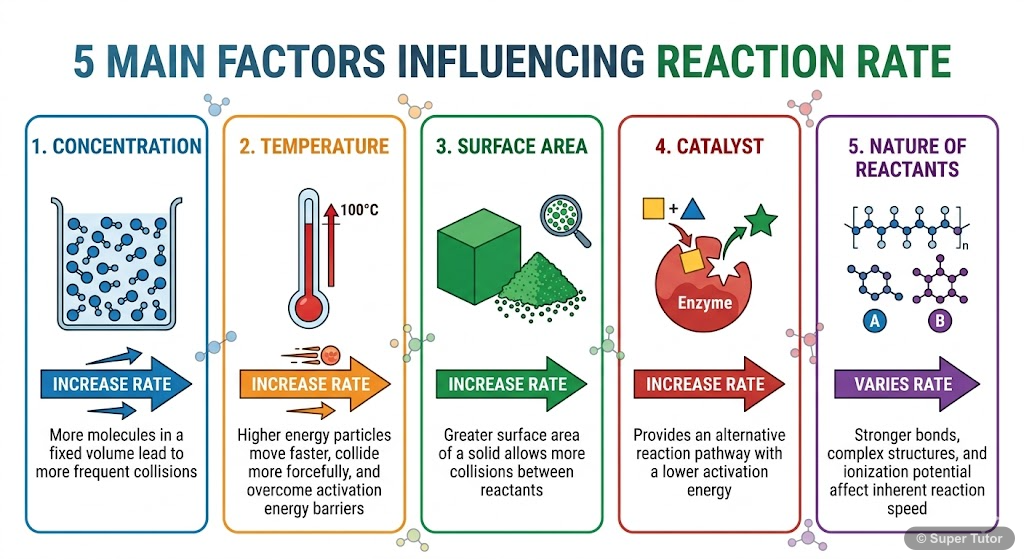
Learn better with visuals Super Tutor pairs illustrations like this with notes and quizzes for Chemical Kinetics.
Quick Quiz: Chemical Kinetics
0/4Tap an answer to check it instantly. No sign-up needed for these 4.
What is the unit of rate constant for a first-order reaction?
For a zero-order reaction, the half-life is:
The Arrhenius equation is k = Ae^(-Ea/RT). What does 'A' represent?
A reaction has the rate law: Rate = k[A]²[B]. What is the overall order of this reaction?
Sample Questions
Which of the following factors affect the rate of a chemical reaction?
Show answer
Temperature, Concentration of reactants, Presence of catalyst, Pressure (for gaseous reactions)
Temperature increases molecular kinetic energy, concentration affects collision frequency, catalysts provide alternate pathways with lower activation energy, and pressure affects concentration of gases. Molecular weight of products does not directly affect reaction rate.
Which of the following statements about molecularity are correct?
Show answer
It is always a whole number, It is defined only for elementary reactions, It represents the number of molecules participating in an elementary reaction
Molecularity is always a positive integer (1, 2, or 3) representing the number of molecules that must collide simultaneously in an elementary reaction. It cannot be zero or fractional, unlike order of reaction.
For a first-order reaction, if the initial concentration is doubled, the half-life will:
Show answer
Remain the same
For first-order reactions, t₁/₂ = 0.693/k, which is independent of initial concentration. This is a characteristic property of first-order reactions - their half-life remains constant.
According to collision theory, which factors determine effective collisions?
Show answer
Sufficient kinetic energy (threshold energy), Proper orientation of molecules
Effective collisions require two main conditions: molecules must have kinetic energy equal to or greater than the threshold energy, and they must collide with proper orientation to facilitate bond breaking and formation.
+106 more questions on Chemical Kinetics (Chhattisgarh Board Class 12 Chemistry)
Practise AllFrequently Asked Questions
What are the important topics in Chemical Kinetics for Chhattisgarh Board Class 12 Chemistry?
How many practice questions are there for Chemical Kinetics?
Sources & Official References
Content is aligned to the official syllabus. Refer to the board website for the latest curriculum.
More resources for Chemical Kinetics
Important Questions
Exam-style questions with answers
Revision Notes
Key points for last-minute revision
Formula Sheet
The chapter's formulas in one place
Chapter Summary
Understand the chapter at a glance
Concept Maps
See how topics connect
Study Plan
Step-by-step plan for this chapter
Flashcards
Quick-fire cards for active recall
Syllabus
What topics to cover
NCERT Solutions
Every textbook question solved step by step
For serious students
Get the full Chemical Kinetics chapter — start free.
Quizzes, flashcards, an AI doubt solver and a study plan for Chhattisgarh Board Class 12 Chemistry. Free to start, no card needed.