Peasants, Zamindars and the State: Agrarian Society and the Mughal Empire — Chapter Summary
Chhattisgarh Board · Class 12 · History
Summary of Peasants, Zamindars and the State: Agrarian Society and the Mughal Empire for Chhattisgarh Board Class 12 History.
Interactive on Super Tutor
Studying Peasants, Zamindars and the State: Agrarian Society and the Mughal Empire? Get the full interactive chapter.
Quizzes, flashcards, AI doubt-solver and a step-by-step study plan — built for chapter summary and more.
Free trial, no card needed.
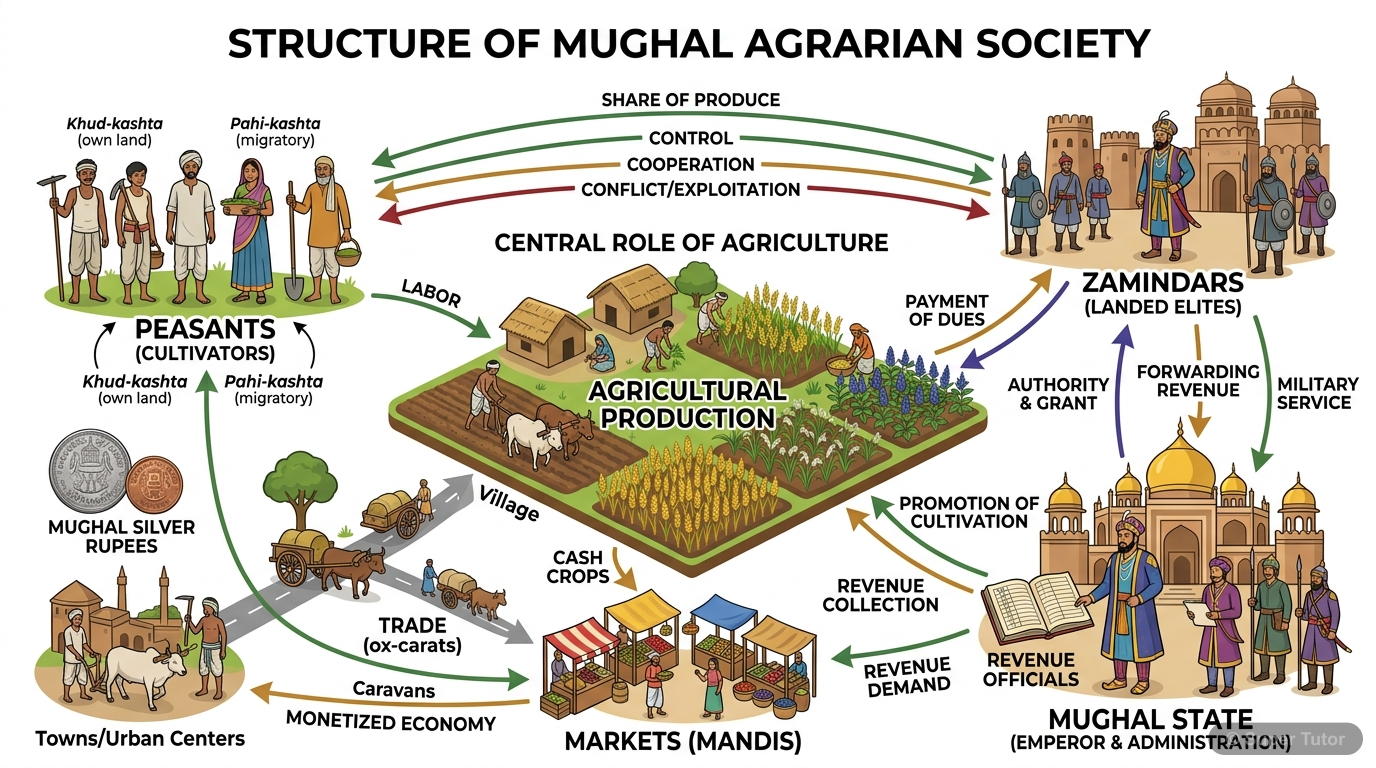
One of 11 illustrations for Peasants, Zamindars and the State: Agrarian Society and the Mughal Empire in Super Tutor — alongside flashcards, concept maps and practice questions.
Overview
Agrarian society in Mughal India was shaped by the interaction of peasants, zamindars, village institutions, forest communities, and the Mughal state. Most people lived in villages, agriculture depended on seasonal labour and irrigation, and revenue from land became the main economic base of the emp
Key Concepts
About 85% of India’s population lived
About 85% of India’s population lived in villages during the 16th and 17th centuries. Peasants performed all major seasonal tasks such as ploughing, s
Khud
Khud-kashta were resident cultivators of the village in which they held land. Pahi-kashta were non-resident cultivators who cultivated land in another
Babur observed that much of Hindustan
Babur observed that much of Hindustan was level land and that cultivation depended on rain, wells, buckets, and wheel devices. The Persian wheel and b
Agriculture was organised around kharif
Agriculture was organised around kharif and rabi seasons. Areas receiving 40 inches or more rainfall annually were generally rice-producing zones, whi
The village panchayat was an assembly
The village panchayat was an assembly of elders with hereditary property rights and was usually a heterogeneous body in mixed-caste villages. The head
Learning Objectives
- Understand the structure of agrarian society in Mughal India
- Explain the difference between peasants, zamindars, village headmen, and panchayats
- Describe irrigation, crops, and agricultural expansion under the Mughals
- Analyse the role of women, artisans, and forest-dwellers in rural society
- Explain how land revenue was assessed and collected
Frequently Asked Questions
What are the important topics in Peasants, Zamindars and the State: Agrarian Society and the Mughal Empire for Chhattisgarh Board Class 12 History?
How should I revise Peasants, Zamindars and the State: Agrarian Society and the Mughal Empire for the Chhattisgarh Board Class 12 board exam?
Sources & Official References
Content is aligned to the official syllabus. Refer to the board website for the latest curriculum.
More resources for Peasants, Zamindars and the State: Agrarian Society and the Mughal Empire
Practice Quiz
Test yourself with a quick quiz
Important Questions
Exam-style questions with answers
Revision Notes
Key points for last-minute revision
Formula Sheet
The chapter's formulas in one place
Concept Maps
See how topics connect
Study Plan
Step-by-step plan for this chapter
Flashcards
Quick-fire cards for active recall
Syllabus
What topics to cover
NCERT Solutions
Every textbook question solved step by step
For serious students
Get the full Peasants, Zamindars and the State: Agrarian Society and the Mughal Empire chapter — start free.
Quizzes, flashcards, an AI doubt solver and a study plan for Chhattisgarh Board Class 12 History. Free to start, no card needed.