Chapter 9 of 13
NCERT Solutions

Continuity and Differentiability

Chhattisgarh Board · Class 12 · Mathematics

NCERT Solutions for Continuity and Differentiability — Chhattisgarh Board Class 12 Mathematics.

43 questions22 flashcards5 concepts

Interactive on Super Tutor

Studying Continuity and Differentiability? Get the full interactive chapter.

Quizzes, flashcards, AI doubt-solver and a step-by-step study plan — built for ncert solutions and more.

1,000+ Class 12 students started this chapter today

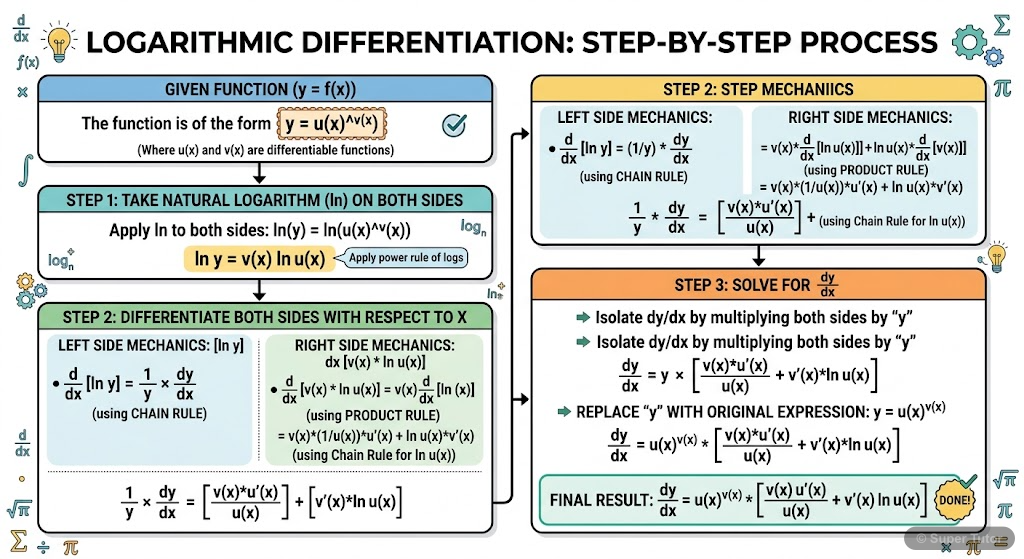
A step-by-step flowchart for applying logarithmic differentiation to functions of the form y = u(x)^v(x) or complex products/quotients.
Super Tutor

Super Tutor has 5+ illustrations like this for Continuity and Differentiability alone — flashcards, concept maps, and step-by-step visuals.

See them all
137 Questions Solved · 8 Sections

Exercise 5.1

1Prove that the function f(x)=5x3f(x) = 5x - 3 is continuous at x=0x = 0, at x=3x = -3 and at x=5x = 5.Show solution
Given: f(x)=5x3f(x) = 5x - 3

Concept: A function ff is continuous at x=cx = c if limxcf(x)=f(c)\lim_{x \to c} f(x) = f(c).

At x=0x = 0:
f(0)=5(0)3=3f(0) = 5(0) - 3 = -3
limx0f(x)=limx0(5x3)=5(0)3=3\lim_{x \to 0} f(x) = \lim_{x \to 0}(5x - 3) = 5(0) - 3 = -3
Since limx0f(x)=f(0)=3\lim_{x \to 0} f(x) = f(0) = -3, ff is continuous at x=0x = 0.

At x=3x = -3:
f(3)=5(3)3=153=18f(-3) = 5(-3) - 3 = -15 - 3 = -18
limx3f(x)=5(3)3=18\lim_{x \to -3} f(x) = 5(-3) - 3 = -18
Since limx3f(x)=f(3)=18\lim_{x \to -3} f(x) = f(-3) = -18, ff is continuous at x=3x = -3.

At x=5x = 5:
f(5)=5(5)3=253=22f(5) = 5(5) - 3 = 25 - 3 = 22
limx5f(x)=5(5)3=22\lim_{x \to 5} f(x) = 5(5) - 3 = 22
Since limx5f(x)=f(5)=22\lim_{x \to 5} f(x) = f(5) = 22, ff is continuous at x=5x = 5.

Hence, f(x)=5x3f(x) = 5x - 3 is continuous at x=0x = 0, x=3x = -3, and x=5x = 5. \blacksquare
2Examine the continuity of the function f(x)=2x21f(x) = 2x^2 - 1 at x=3x = 3.Show solution
Given: f(x)=2x21f(x) = 2x^2 - 1

At x=3x = 3:
f(3)=2(3)21=181=17f(3) = 2(3)^2 - 1 = 18 - 1 = 17
limx3f(x)=2(3)21=17\lim_{x \to 3} f(x) = 2(3)^2 - 1 = 17

Since limx3f(x)=f(3)=17\lim_{x \to 3} f(x) = f(3) = 17, the function ff is continuous at x=3x = 3.
3Examine the following functions for continuity.
(a) f(x)=x5f(x) = x - 5
(b) f(x)=1x5, x5f(x) = \frac{1}{x-5},\ x \neq 5
(c) f(x)=x225x+5, x5f(x) = \frac{x^2-25}{x+5},\ x \neq -5
(d) f(x)=x5f(x) = |x-5|
Show solution
(a) f(x)=x5f(x) = x - 5

ff is a polynomial function. For any cRc \in \mathbb{R}:
limxc(x5)=c5=f(c)\lim_{x \to c}(x-5) = c - 5 = f(c)
Hence ff is continuous at every real number.

---

(b) f(x)=1x5, x5f(x) = \dfrac{1}{x-5},\ x \neq 5

The domain of ff is R{5}\mathbb{R} - \{5\}. For any c5c \neq 5:
limxc1x5=1c5=f(c)\lim_{x \to c} \frac{1}{x-5} = \frac{1}{c-5} = f(c)
Hence ff is continuous at every point of its domain (i.e., at all x5x \neq 5). At x=5x = 5, ff is not defined.

---

(c) f(x)=x225x+5, x5f(x) = \dfrac{x^2-25}{x+5},\ x \neq -5

For x5x \neq -5:
f(x)=(x5)(x+5)x+5=x5f(x) = \frac{(x-5)(x+5)}{x+5} = x - 5
For any c5c \neq -5:
limxcf(x)=c5=f(c)\lim_{x \to c} f(x) = c - 5 = f(c)
Hence ff is continuous at every point of its domain (i.e., at all x5x \neq -5). At x=5x = -5, ff is not defined.

---

(d) f(x)=x5f(x) = |x - 5|

We can write:
f(x)={x5,amp;x5(x5),amp;xlt;5f(x) = \begin{cases} x - 5, & x \geq 5 \\ -(x-5), & x < 5 \end{cases}

For c > 5: limxcx5=c5=f(c)\lim_{x \to c}|x-5| = c - 5 = f(c). ✓

For c < 5: limxcx5=(c5)=f(c)\lim_{x \to c}|x-5| = -(c-5) = f(c). ✓

At c=5c = 5:
limx5x5=0,limx5+x5=0,f(5)=0\lim_{x \to 5^-}|x-5| = 0,\quad \lim_{x \to 5^+}|x-5| = 0,\quad f(5) = 0
All equal. ✓

Hence ff is continuous at every real number.
4Prove that the function f(x)=xnf(x) = x^n is continuous at x=nx = n, where nn is a positive integer.Show solution
Given: f(x)=xnf(x) = x^n, nn is a positive integer.

At x=nx = n:
f(n)=nnf(n) = n^n
limxnf(x)=limxnxn=nn\lim_{x \to n} f(x) = \lim_{x \to n} x^n = n^n

Since limxnf(x)=f(n)=nn\lim_{x \to n} f(x) = f(n) = n^n, the function f(x)=xnf(x) = x^n is continuous at x=nx = n. \blacksquare
5Is the function ff defined by
f(x)={x,amp;if x15,amp;if xgt;1f(x) = \begin{cases} x, & \text{if } x \leq 1 \\ 5, & \text{if } x > 1 \end{cases}
continuous at x=0x = 0? At x=1x = 1? At x=2x = 2?
Show solution
At x=0x = 0:
f(0)=0f(0) = 0
limx0f(x)=0\lim_{x \to 0} f(x) = 0
Since limx0f(x)=f(0)\lim_{x \to 0} f(x) = f(0), ff is continuous at x=0x = 0.

---

At x=1x = 1:
f(1)=1f(1) = 1
limx1f(x)=limx1x=1\lim_{x \to 1^-} f(x) = \lim_{x \to 1^-} x = 1
limx1+f(x)=limx1+5=5\lim_{x \to 1^+} f(x) = \lim_{x \to 1^+} 5 = 5

Since LHL \neq RHL, limx1f(x)\lim_{x \to 1} f(x) does not exist. Hence ff is not continuous at x=1x = 1.

---

At x=2x = 2:
f(2)=5f(2) = 5
limx2f(x)=5\lim_{x \to 2} f(x) = 5
Since limx2f(x)=f(2)=5\lim_{x \to 2} f(x) = f(2) = 5, ff is continuous at x=2x = 2.
6Find all points of discontinuity of ff, where
f(x)={2x+3,amp;if x22x3,amp;if xgt;2f(x) = \begin{cases} 2x+3, & \text{if } x \leq 2 \\ 2x-3, & \text{if } x > 2 \end{cases}
Show solution
The only possible point of discontinuity is x=2x = 2 (where the definition changes).

f(2)=2(2)+3=7f(2) = 2(2)+3 = 7
limx2f(x)=2(2)+3=7\lim_{x \to 2^-} f(x) = 2(2)+3 = 7
limx2+f(x)=2(2)3=1\lim_{x \to 2^+} f(x) = 2(2)-3 = 1

Since LHL \neq RHL, ff is discontinuous at x=2x = 2.

For x < 2: f(x)=2x+3f(x) = 2x+3 is a polynomial, hence continuous.
For x > 2: f(x)=2x3f(x) = 2x-3 is a polynomial, hence continuous.

Conclusion: x=2x = 2 is the only point of discontinuity.
7Find all points of discontinuity of ff, where
f(x)={x+3,amp;if x32x,amp;if 3lt;xlt;36x+2,amp;if x3f(x) = \begin{cases} |x|+3, & \text{if } x \leq -3 \\ -2x, & \text{if } -3 < x < 3 \\ 6x+2, & \text{if } x \geq 3 \end{cases}
Show solution
Possible points of discontinuity: x=3x = -3 and x=3x = 3.

At x=3x = -3:
f(3)=3+3=3+3=6f(-3) = |-3|+3 = 3+3 = 6
limx3f(x)=3+3=6\lim_{x \to -3^-} f(x) = |-3|+3 = 6
limx3+f(x)=2(3)=6\lim_{x \to -3^+} f(x) = -2(-3) = 6
LHL = RHL = f(3)=6f(-3) = 6. Hence ff is continuous at x=3x = -3.

At x=3x = 3:
f(3)=6(3)+2=20f(3) = 6(3)+2 = 20
limx3f(x)=2(3)=6\lim_{x \to 3^-} f(x) = -2(3) = -6
limx3+f(x)=6(3)+2=20\lim_{x \to 3^+} f(x) = 6(3)+2 = 20
LHL \neq RHL. Hence ff is discontinuous at x=3x = 3.

Conclusion: x=3x = 3 is the only point of discontinuity.
8Find all points of discontinuity of ff, where
f(x)={xx,amp;if x00,amp;if x=0f(x) = \begin{cases} \dfrac{|x|}{x}, & \text{if } x \neq 0 \\ 0, & \text{if } x = 0 \end{cases}
Show solution
For x > 0: xx=xx=1\dfrac{|x|}{x} = \dfrac{x}{x} = 1

For x < 0: xx=xx=1\dfrac{|x|}{x} = \dfrac{-x}{x} = -1

At x=0x = 0:
f(0)=0f(0) = 0
limx0f(x)=1\lim_{x \to 0^-} f(x) = -1
limx0+f(x)=1\lim_{x \to 0^+} f(x) = 1
LHL \neq RHL, so ff is discontinuous at x=0x = 0.

For x0x \neq 0: ff equals a constant on each side, hence continuous.

Conclusion: x=0x = 0 is the only point of discontinuity.
9Find all points of discontinuity of ff, where
f(x)={xx,amp;if xlt;01,amp;if x0f(x) = \begin{cases} \dfrac{x}{|x|}, & \text{if } x < 0 \\ -1, & \text{if } x \geq 0 \end{cases}
Show solution
For x < 0: xx=xx=1\dfrac{x}{|x|} = \dfrac{x}{-x} = -1

So f(x)=1f(x) = -1 for all x < 0 and f(x)=1f(x) = -1 for all x0x \geq 0.

At x=0x = 0:
f(0)=1f(0) = -1
limx0f(x)=1\lim_{x \to 0^-} f(x) = -1
limx0+f(x)=1\lim_{x \to 0^+} f(x) = -1
All equal. Hence ff is continuous at x=0x = 0.

For all other points, ff is clearly continuous.

Conclusion: ff has no points of discontinuity.
10Find all points of discontinuity of ff, where
f(x)={x+1,amp;if x1x2+1,amp;if xlt;1f(x) = \begin{cases} x+1, & \text{if } x \geq 1 \\ x^2+1, & \text{if } x < 1 \end{cases}
Show solution
The only possible point of discontinuity is x=1x = 1.

f(1)=1+1=2f(1) = 1+1 = 2
limx1f(x)=(1)2+1=2\lim_{x \to 1^-} f(x) = (1)^2+1 = 2
limx1+f(x)=1+1=2\lim_{x \to 1^+} f(x) = 1+1 = 2

LHL = RHL = f(1)=2f(1) = 2. Hence ff is continuous at x=1x = 1.

For x > 1: f(x)=x+1f(x) = x+1 is a polynomial — continuous.
For x < 1: f(x)=x2+1f(x) = x^2+1 is a polynomial — continuous.

Conclusion: ff has no points of discontinuity.
11Find all points of discontinuity of ff, where
f(x)={x33,amp;if x2x2+1,amp;if xgt;2f(x) = \begin{cases} x^3-3, & \text{if } x \leq 2 \\ x^2+1, & \text{if } x > 2 \end{cases}
Show solution
The only possible point of discontinuity is x=2x = 2.

f(2)=(2)33=83=5f(2) = (2)^3 - 3 = 8 - 3 = 5
limx2f(x)=(2)33=5\lim_{x \to 2^-} f(x) = (2)^3 - 3 = 5
limx2+f(x)=(2)2+1=5\lim_{x \to 2^+} f(x) = (2)^2 + 1 = 5

LHL = RHL = f(2)=5f(2) = 5. Hence ff is continuous at x=2x = 2.

Conclusion: ff has no points of discontinuity.
12Find all points of discontinuity of ff, where
f(x)={x101,amp;if x1x2,amp;if xgt;1f(x) = \begin{cases} x^{10}-1, & \text{if } x \leq 1 \\ x^2, & \text{if } x > 1 \end{cases}
Show solution
The only possible point of discontinuity is x=1x = 1.

f(1)=(1)101=0f(1) = (1)^{10} - 1 = 0
limx1f(x)=(1)101=0\lim_{x \to 1^-} f(x) = (1)^{10} - 1 = 0
limx1+f(x)=(1)2=1\lim_{x \to 1^+} f(x) = (1)^2 = 1

LHL =01== 0 \neq 1 = RHL. Hence ff is discontinuous at x=1x = 1.

Conclusion: x=1x = 1 is the only point of discontinuity.
13Is the function defined by
f(x)={x+5,amp;if x1x5,amp;if xgt;1f(x) = \begin{cases} x+5, & \text{if } x \leq 1 \\ x-5, & \text{if } x > 1 \end{cases}
a continuous function?
Show solution
The only possible point of discontinuity is x=1x = 1.

f(1)=1+5=6f(1) = 1+5 = 6
limx1f(x)=1+5=6\lim_{x \to 1^-} f(x) = 1+5 = 6
limx1+f(x)=15=4\lim_{x \to 1^+} f(x) = 1-5 = -4

LHL =64== 6 \neq -4 = RHL.

Hence ff is not continuous at x=1x = 1.

For x < 1 and x > 1, ff is a polynomial, hence continuous.

Conclusion: ff is not a continuous function (it is discontinuous at x=1x = 1).
14Discuss the continuity of the function ff, where
f(x)={3,amp;if 0x14,amp;if 1lt;xlt;35,amp;if 3x10f(x) = \begin{cases} 3, & \text{if } 0 \leq x \leq 1 \\ 4, & \text{if } 1 < x < 3 \\ 5, & \text{if } 3 \leq x \leq 10 \end{cases}
Show solution
Possible points of discontinuity: x=1x = 1 and x=3x = 3.

At x=1x = 1:
f(1)=3f(1) = 3
limx1f(x)=3,limx1+f(x)=4\lim_{x \to 1^-} f(x) = 3, \quad \lim_{x \to 1^+} f(x) = 4
LHL \neq RHL. Hence ff is discontinuous at x=1x = 1.

At x=3x = 3:
f(3)=5f(3) = 5
limx3f(x)=4,limx3+f(x)=5\lim_{x \to 3^-} f(x) = 4, \quad \lim_{x \to 3^+} f(x) = 5
LHL \neq RHL. Hence ff is discontinuous at x=3x = 3.

At all other points in [0,10][0,10], ff is constant on open intervals, hence continuous.

Conclusion: ff is discontinuous at x=1x = 1 and x=3x = 3.
15Discuss the continuity of the function ff, where
f(x)={2x,amp;if xlt;00,amp;if 0x14x,amp;if xgt;1f(x) = \begin{cases} 2x, & \text{if } x < 0 \\ 0, & \text{if } 0 \leq x \leq 1 \\ 4x, & \text{if } x > 1 \end{cases}
Show solution
Possible points of discontinuity: x=0x = 0 and x=1x = 1.

At x=0x = 0:
f(0)=0f(0) = 0
limx0f(x)=2(0)=0,limx0+f(x)=0\lim_{x \to 0^-} f(x) = 2(0) = 0, \quad \lim_{x \to 0^+} f(x) = 0
LHL = RHL = f(0)=0f(0) = 0. Hence ff is continuous at x=0x = 0.

At x=1x = 1:
f(1)=0f(1) = 0
limx1f(x)=0,limx1+f(x)=4(1)=4\lim_{x \to 1^-} f(x) = 0, \quad \lim_{x \to 1^+} f(x) = 4(1) = 4
LHL \neq RHL. Hence ff is discontinuous at x=1x = 1.

Conclusion: ff is discontinuous only at x=1x = 1.
16Discuss the continuity of the function ff, where
f(x)={2,amp;if x12x,amp;if 1lt;x12,amp;if xgt;1f(x) = \begin{cases} -2, & \text{if } x \leq -1 \\ 2x, & \text{if } -1 < x \leq 1 \\ 2, & \text{if } x > 1 \end{cases}
Show solution
Possible points of discontinuity: x=1x = -1 and x=1x = 1.

At x=1x = -1:
f(1)=2f(-1) = -2
limx1f(x)=2,limx1+f(x)=2(1)=2\lim_{x \to -1^-} f(x) = -2, \quad \lim_{x \to -1^+} f(x) = 2(-1) = -2
LHL = RHL = f(1)=2f(-1) = -2. Hence ff is continuous at x=1x = -1.

At x=1x = 1:
f(1)=2(1)=2f(1) = 2(1) = 2
limx1f(x)=2(1)=2,limx1+f(x)=2\lim_{x \to 1^-} f(x) = 2(1) = 2, \quad \lim_{x \to 1^+} f(x) = 2
LHL = RHL = f(1)=2f(1) = 2. Hence ff is continuous at x=1x = 1.

Conclusion: ff is continuous for all real xx.
17Find the relationship between aa and bb so that the function ff defined by
f(x)={ax+1,amp;if x3bx+3,amp;if xgt;3f(x) = \begin{cases} ax+1, & \text{if } x \leq 3 \\ bx+3, & \text{if } x > 3 \end{cases}
is continuous at x=3x = 3.
Show solution
For ff to be continuous at x=3x = 3:
limx3f(x)=limx3+f(x)=f(3)\lim_{x \to 3^-} f(x) = \lim_{x \to 3^+} f(x) = f(3)

f(3)=3a+1f(3) = 3a + 1
limx3f(x)=3a+1\lim_{x \to 3^-} f(x) = 3a + 1
limx3+f(x)=3b+3\lim_{x \to 3^+} f(x) = 3b + 3

Setting LHL = RHL:
3a+1=3b+33a + 1 = 3b + 3
3a3b=23a - 3b = 2
3a3b=2\boxed{3a - 3b = 2}

This is the required relationship between aa and bb.
18For what value of λ\lambda is the function defined by
f(x)={λ(x22x),amp;if x04x+1,amp;if xgt;0f(x) = \begin{cases} \lambda(x^2-2x), & \text{if } x \leq 0 \\ 4x+1, & \text{if } x > 0 \end{cases}
continuous at x=0x = 0? What about continuity at x=1x = 1?
Show solution
Continuity at x=0x = 0:

f(0)=λ(00)=0f(0) = \lambda(0 - 0) = 0
limx0f(x)=λ(00)=0\lim_{x \to 0^-} f(x) = \lambda(0 - 0) = 0
limx0+f(x)=4(0)+1=1\lim_{x \to 0^+} f(x) = 4(0)+1 = 1

For continuity: LHL = RHL
0=10 = 1
This is a contradiction. Hence no value of λ\lambda makes ff continuous at x=0x = 0.

---

Continuity at x=1x = 1:

Since 1 > 0, f(x)=4x+1f(x) = 4x + 1 near x=1x = 1.
f(1)=4(1)+1=5f(1) = 4(1)+1 = 5
limx1f(x)=4(1)+1=5\lim_{x \to 1} f(x) = 4(1)+1 = 5

Hence ff is continuous at x=1x = 1 for any value of λ\lambda.
19Show that the function defined by g(x)=x[x]g(x) = x - [x] is discontinuous at all integral points. Here [x][x] denotes the greatest integer less than or equal to xx.Show solution
Given: g(x)=x[x]g(x) = x - [x]

Let nn be any integer. We check continuity at x=nx = n.

g(n)=n[n]=nn=0g(n) = n - [n] = n - n = 0

LHL:
limxng(x)=limxn(x[x])\lim_{x \to n^-} g(x) = \lim_{x \to n^-}(x - [x])
For xx slightly less than nn, [x]=n1[x] = n-1, so:
limxng(x)=n(n1)=1\lim_{x \to n^-} g(x) = n - (n-1) = 1

RHL:
limxn+g(x)=limxn+(x[x])\lim_{x \to n^+} g(x) = \lim_{x \to n^+}(x - [x])
For xx slightly greater than nn, [x]=n[x] = n, so:
limxn+g(x)=nn=0\lim_{x \to n^+} g(x) = n - n = 0

Since LHL =10== 1 \neq 0 = RHL, the limit does not exist at x=nx = n.

Hence g(x)=x[x]g(x) = x - [x] is discontinuous at every integer nn. \blacksquare
20Is the function defined by f(x)=x2sinx+5f(x) = x^2 - \sin x + 5 continuous at x=πx = \pi?Show solution
Given: f(x)=x2sinx+5f(x) = x^2 - \sin x + 5

f(π)=π2sinπ+5=π20+5=π2+5f(\pi) = \pi^2 - \sin\pi + 5 = \pi^2 - 0 + 5 = \pi^2 + 5

limxπf(x)=π2sinπ+5=π2+5\lim_{x \to \pi} f(x) = \pi^2 - \sin\pi + 5 = \pi^2 + 5

Since limxπf(x)=f(π)=π2+5\lim_{x \to \pi} f(x) = f(\pi) = \pi^2 + 5, the function is continuous at x=πx = \pi.
21Discuss the continuity of the following functions:
(a) f(x)=sinx+cosxf(x) = \sin x + \cos x
(b) f(x)=sinxcosxf(x) = \sin x - \cos x
(c) f(x)=sinxcosxf(x) = \sin x \cdot \cos x
Show solution
We know that sinx\sin x and cosx\cos x are continuous for all xRx \in \mathbb{R}.

Since the sum, difference, and product of continuous functions are continuous:

(a) f(x)=sinx+cosxf(x) = \sin x + \cos x is continuous for all xRx \in \mathbb{R}.

(b) f(x)=sinxcosxf(x) = \sin x - \cos x is continuous for all xRx \in \mathbb{R}.

(c) f(x)=sinxcosxf(x) = \sin x \cdot \cos x is continuous for all xRx \in \mathbb{R}.
22Discuss the continuity of the cosine, cosecant, secant and cotangent functions.Show solution
Cosine: cosx\cos x is continuous for all xRx \in \mathbb{R}.

Cosecant: cscx=1sinx\csc x = \dfrac{1}{\sin x}

sinx\sin x is continuous everywhere and sinx=0\sin x = 0 at x=nπx = n\pi, nZn \in \mathbb{Z}.
Hence cscx\csc x is continuous for all xR{nπ:nZ}x \in \mathbb{R} - \{n\pi : n \in \mathbb{Z}\}.

Secant: secx=1cosx\sec x = \dfrac{1}{\cos x}

cosx=0\cos x = 0 at x=(2n+1)π2x = (2n+1)\dfrac{\pi}{2}, nZn \in \mathbb{Z}.
Hence secx\sec x is continuous for all xR{(2n+1)π2:nZ}x \in \mathbb{R} - \left\{(2n+1)\dfrac{\pi}{2} : n \in \mathbb{Z}\right\}.

Cotangent: cotx=cosxsinx\cot x = \dfrac{\cos x}{\sin x}

sinx=0\sin x = 0 at x=nπx = n\pi, nZn \in \mathbb{Z}.
Hence cotx\cot x is continuous for all xR{nπ:nZ}x \in \mathbb{R} - \{n\pi : n \in \mathbb{Z}\}.
23Find all points of discontinuity of ff, where
f(x)={sinxx,amp;if xlt;0x+1,amp;if x0f(x) = \begin{cases} \dfrac{\sin x}{x}, & \text{if } x < 0 \\ x+1, & \text{if } x \geq 0 \end{cases}
Show solution
The only possible point of discontinuity is x=0x = 0.

f(0)=0+1=1f(0) = 0 + 1 = 1
limx0f(x)=limx0sinxx=1(standard limit: limx0sinxx=1)\lim_{x \to 0^-} f(x) = \lim_{x \to 0^-} \frac{\sin x}{x} = 1 \quad \left(\text{standard limit: } \lim_{x \to 0}\frac{\sin x}{x} = 1\right)
limx0+f(x)=0+1=1\lim_{x \to 0^+} f(x) = 0 + 1 = 1

LHL = RHL = f(0)=1f(0) = 1. Hence ff is continuous at x=0x = 0.

For x < 0: sinxx\dfrac{\sin x}{x} is continuous (ratio of continuous functions, denominator 0\neq 0).
For x > 0: x+1x + 1 is a polynomial, hence continuous.

Conclusion: ff has no points of discontinuity.
24Determine if ff defined by
f(x)={x2sin1x,amp;if x00,amp;if x=0f(x) = \begin{cases} x^2 \sin\dfrac{1}{x}, & \text{if } x \neq 0 \\ 0, & \text{if } x = 0 \end{cases}
is a continuous function?
Show solution
For x0x \neq 0: f(x)=x2sin1xf(x) = x^2 \sin\dfrac{1}{x} is a product of continuous functions, hence continuous.

At x=0x = 0:
f(0)=0f(0) = 0
We need limx0x2sin1x\lim_{x \to 0} x^2 \sin\dfrac{1}{x}.

Since sin1x1\left|\sin\dfrac{1}{x}\right| \leq 1 for all x0x \neq 0:
x2sin1xx2\left|x^2 \sin\frac{1}{x}\right| \leq x^2

As x0x \to 0, x20x^2 \to 0, so by Squeeze Theorem:
limx0x2sin1x=0=f(0)\lim_{x \to 0} x^2 \sin\frac{1}{x} = 0 = f(0)

Hence ff is continuous at x=0x = 0 and therefore continuous everywhere.
25Examine the continuity of ff, where ff is defined by
f(x)={sinxcosx,amp;if x01,amp;if x=0f(x) = \begin{cases} \sin x - \cos x, & \text{if } x \neq 0 \\ -1, & \text{if } x = 0 \end{cases}
Show solution
At x=0x = 0:
f(0)=1f(0) = -1
limx0f(x)=limx0(sinxcosx)=sin0cos0=01=1\lim_{x \to 0} f(x) = \lim_{x \to 0}(\sin x - \cos x) = \sin 0 - \cos 0 = 0 - 1 = -1

Since limx0f(x)=f(0)=1\lim_{x \to 0} f(x) = f(0) = -1, ff is continuous at x=0x = 0.

For x0x \neq 0: sinxcosx\sin x - \cos x is continuous everywhere.

Conclusion: ff is continuous for all xRx \in \mathbb{R}.
26Find the value of kk so that the function ff is continuous at x=π2x = \dfrac{\pi}{2}:
f(x)={kcosxπ2x,amp;if xπ23,amp;if x=π2f(x) = \begin{cases} \dfrac{k\cos x}{\pi - 2x}, & \text{if } x \neq \dfrac{\pi}{2} \\ 3, & \text{if } x = \dfrac{\pi}{2} \end{cases}
Show solution
For continuity at x=π2x = \dfrac{\pi}{2}:
limxπ/2kcosxπ2x=3\lim_{x \to \pi/2} \frac{k\cos x}{\pi - 2x} = 3

Let x=π2+hx = \dfrac{\pi}{2} + h, so as xπ2x \to \dfrac{\pi}{2}, h0h \to 0.

cosx=cos(π2+h)=sinh\cos x = \cos\left(\frac{\pi}{2}+h\right) = -\sin h
π2x=π2(π2+h)=2h\pi - 2x = \pi - 2\left(\frac{\pi}{2}+h\right) = -2h

limh0k(sinh)2h=limh0ksinh2h=k21=k2\lim_{h \to 0} \frac{k(-\sin h)}{-2h} = \lim_{h \to 0} \frac{k\sin h}{2h} = \frac{k}{2} \cdot 1 = \frac{k}{2}

Setting k2=3\dfrac{k}{2} = 3:
k=6\boxed{k = 6}
27Find the value of kk so that the function ff is continuous at x=2x = 2:
f(x)={kx2,amp;if x23,amp;if xgt;2f(x) = \begin{cases} kx^2, & \text{if } x \leq 2 \\ 3, & \text{if } x > 2 \end{cases}
Show solution
For continuity at x=2x = 2:
limx2f(x)=f(2)=limx2+f(x)\lim_{x \to 2^-} f(x) = f(2) = \lim_{x \to 2^+} f(x)

limx2kx2=k(4)=4k\lim_{x \to 2^-} kx^2 = k(4) = 4k
limx2+f(x)=3\lim_{x \to 2^+} f(x) = 3
f(2)=k(4)=4kf(2) = k(4) = 4k

Setting 4k=34k = 3:
k=34\boxed{k = \frac{3}{4}}
28Find the value of kk so that the function ff is continuous at x=πx = \pi:
f(x)={kx+1,amp;if xπcosx,amp;if xgt;πf(x) = \begin{cases} kx+1, & \text{if } x \leq \pi \\ \cos x, & \text{if } x > \pi \end{cases}
Show solution
For continuity at x=πx = \pi:
limxπf(x)=f(π)=limxπ+f(x)\lim_{x \to \pi^-} f(x) = f(\pi) = \lim_{x \to \pi^+} f(x)

f(π)=kπ+1f(\pi) = k\pi + 1
limxπf(x)=kπ+1\lim_{x \to \pi^-} f(x) = k\pi + 1
limxπ+f(x)=cosπ=1\lim_{x \to \pi^+} f(x) = \cos\pi = -1

Setting kπ+1=1k\pi + 1 = -1:
kπ=2k\pi = -2
k=2π\boxed{k = -\frac{2}{\pi}}
29Find the value of kk so that the function ff is continuous at x=5x = 5:
f(x)={kx+1,amp;if x53x5,amp;if xgt;5f(x) = \begin{cases} kx+1, & \text{if } x \leq 5 \\ 3x-5, & \text{if } x > 5 \end{cases}
Show solution
For continuity at x=5x = 5:
limx5f(x)=f(5)=limx5+f(x)\lim_{x \to 5^-} f(x) = f(5) = \lim_{x \to 5^+} f(x)

f(5)=5k+1f(5) = 5k + 1
limx5f(x)=5k+1\lim_{x \to 5^-} f(x) = 5k + 1
limx5+f(x)=3(5)5=10\lim_{x \to 5^+} f(x) = 3(5) - 5 = 10

Setting 5k+1=105k + 1 = 10:
5k=95k = 9
k=95\boxed{k = \frac{9}{5}}
30Find the values of aa and bb such that the function defined by
f(x)={5,amp;if x2ax+b,amp;if 2lt;xlt;1021,amp;if x10f(x) = \begin{cases} 5, & \text{if } x \leq 2 \\ ax+b, & \text{if } 2 < x < 10 \\ 21, & \text{if } x \geq 10 \end{cases}
is a continuous function.
Show solution
For ff to be continuous, it must be continuous at x=2x = 2 and x=10x = 10.

At x=2x = 2:
f(2)=5f(2) = 5
limx2+f(x)=2a+b\lim_{x \to 2^+} f(x) = 2a + b
Setting equal: 2a+b=52a + b = 5 ... (i)

At x=10x = 10:
f(10)=21f(10) = 21
limx10f(x)=10a+b\lim_{x \to 10^-} f(x) = 10a + b
Setting equal: 10a+b=2110a + b = 21 ... (ii)

Subtracting (i) from (ii):
8a=16    a=28a = 16 \implies a = 2

Substituting in (i):
2(2)+b=5    b=12(2) + b = 5 \implies b = 1

a=2,b=1\boxed{a = 2, \quad b = 1}
31Show that the function defined by f(x)=cos(x2)f(x) = \cos(x^2) is a continuous function.Show solution
Given: f(x)=cos(x2)f(x) = \cos(x^2)

Let g(x)=x2g(x) = x^2 and h(t)=costh(t) = \cos t.

- g(x)=x2g(x) = x^2 is a polynomial, hence continuous for all xRx \in \mathbb{R}.
- h(t)=costh(t) = \cos t is continuous for all tRt \in \mathbb{R}.

Since f(x)=h(g(x))=cos(x2)f(x) = h(g(x)) = \cos(x^2) is a composition of two continuous functions, by the theorem on continuity of composite functions, f(x)f(x) is continuous for all xRx \in \mathbb{R}. \blacksquare
32Show that the function defined by f(x)=cosxf(x) = |\cos x| is a continuous function.Show solution
Given: f(x)=cosxf(x) = |\cos x|

Let g(x)=cosxg(x) = \cos x and h(t)=th(t) = |t|.

- g(x)=cosxg(x) = \cos x is continuous for all xRx \in \mathbb{R}.
- h(t)=th(t) = |t| is continuous for all tRt \in \mathbb{R}.

Since f(x)=h(g(x))=cosxf(x) = h(g(x)) = |\cos x| is a composition of two continuous functions, f(x)f(x) is continuous for all xRx \in \mathbb{R}. \blacksquare
33Examine that sinx\sin|x| is a continuous function.Show solution
Given: f(x)=sinxf(x) = \sin|x|

Let g(x)=xg(x) = |x| and h(t)=sinth(t) = \sin t.

- g(x)=xg(x) = |x| is continuous for all xRx \in \mathbb{R}.
- h(t)=sinth(t) = \sin t is continuous for all tRt \in \mathbb{R}.

Since f(x)=h(g(x))=sinxf(x) = h(g(x)) = \sin|x| is a composition of two continuous functions, f(x)f(x) is continuous for all xRx \in \mathbb{R}.
34Find all the points of discontinuity of ff defined by f(x)=xx+1f(x) = |x| - |x+1|.Show solution
Given: f(x)=xx+1f(x) = |x| - |x+1|

Both x|x| and x+1|x+1| are continuous for all xRx \in \mathbb{R} (modulus of a continuous function is continuous).

The difference of two continuous functions is continuous.

Hence f(x)=xx+1f(x) = |x| - |x+1| is continuous for all xRx \in \mathbb{R}.

Conclusion: ff has no points of discontinuity.

Exercise 5.2

1Differentiate sin(x2+5)\sin(x^2+5) with respect to xx.Show solution
Given: y=sin(x2+5)y = \sin(x^2+5)

Using chain rule: ddx[sin(u)]=cos(u)dudx\dfrac{d}{dx}[\sin(u)] = \cos(u)\cdot\dfrac{du}{dx}, where u=x2+5u = x^2+5.

dydx=cos(x2+5)ddx(x2+5)=cos(x2+5)2x\frac{dy}{dx} = \cos(x^2+5) \cdot \frac{d}{dx}(x^2+5) = \cos(x^2+5) \cdot 2x

dydx=2xcos(x2+5)\boxed{\frac{dy}{dx} = 2x\cos(x^2+5)}
2Differentiate cos(sinx)\cos(\sin x) with respect to xx.Show solution
Given: y=cos(sinx)y = \cos(\sin x)

Using chain rule:
dydx=sin(sinx)ddx(sinx)=sin(sinx)cosx\frac{dy}{dx} = -\sin(\sin x) \cdot \frac{d}{dx}(\sin x) = -\sin(\sin x) \cdot \cos x

dydx=cosxsin(sinx)\boxed{\frac{dy}{dx} = -\cos x \cdot \sin(\sin x)}
3Differentiate sin(ax+b)\sin(ax+b) with respect to xx.Show solution
Given: y=sin(ax+b)y = \sin(ax+b)

Using chain rule:
dydx=cos(ax+b)ddx(ax+b)=cos(ax+b)a\frac{dy}{dx} = \cos(ax+b) \cdot \frac{d}{dx}(ax+b) = \cos(ax+b) \cdot a

dydx=acos(ax+b)\boxed{\frac{dy}{dx} = a\cos(ax+b)}
4Differentiate sec(tan(x))\sec(\tan(\sqrt{x})) with respect to xx.Show solution
Given: y=sec(tan(x))y = \sec(\tan(\sqrt{x}))

Applying chain rule step by step:
dydx=sec(tanx)tan(tanx)ddx(tanx)\frac{dy}{dx} = \sec(\tan\sqrt{x})\cdot\tan(\tan\sqrt{x}) \cdot \frac{d}{dx}(\tan\sqrt{x})
=sec(tanx)tan(tanx)sec2(x)ddx(x)= \sec(\tan\sqrt{x})\cdot\tan(\tan\sqrt{x}) \cdot \sec^2(\sqrt{x}) \cdot \frac{d}{dx}(\sqrt{x})
=sec(tanx)tan(tanx)sec2(x)12x= \sec(\tan\sqrt{x})\cdot\tan(\tan\sqrt{x}) \cdot \sec^2(\sqrt{x}) \cdot \frac{1}{2\sqrt{x}}

dydx=sec(tanx)tan(tanx)sec2x2x\boxed{\frac{dy}{dx} = \frac{\sec(\tan\sqrt{x})\cdot\tan(\tan\sqrt{x})\cdot\sec^2\sqrt{x}}{2\sqrt{x}}}
5Differentiate sin(ax+b)cos(cx+d)\dfrac{\sin(ax+b)}{\cos(cx+d)} with respect to xx.Show solution
Given: y=sin(ax+b)cos(cx+d)y = \dfrac{\sin(ax+b)}{\cos(cx+d)}

Using quotient rule: ddx(uv)=vuuvv2\dfrac{d}{dx}\left(\dfrac{u}{v}\right) = \dfrac{v\,u' - u\,v'}{v^2}

u=sin(ax+b)u=acos(ax+b)u = \sin(ax+b) \Rightarrow u' = a\cos(ax+b)
v=cos(cx+d)v=csin(cx+d)v = \cos(cx+d) \Rightarrow v' = -c\sin(cx+d)

dydx=cos(cx+d)acos(ax+b)sin(ax+b)(csin(cx+d))cos2(cx+d)\frac{dy}{dx} = \frac{\cos(cx+d)\cdot a\cos(ax+b) - \sin(ax+b)\cdot(-c\sin(cx+d))}{\cos^2(cx+d)}

=acos(ax+b)cos(cx+d)+csin(ax+b)sin(cx+d)cos2(cx+d)= \frac{a\cos(ax+b)\cos(cx+d) + c\sin(ax+b)\sin(cx+d)}{\cos^2(cx+d)}
6Differentiate cosx3sin2(x5)\cos x^3 \cdot \sin^2(x^5) with respect to xx.Show solution
Given: y=cos(x3)sin2(x5)y = \cos(x^3)\cdot\sin^2(x^5)

Using product rule: (uv)=uv+uv(uv)' = u'v + uv'

u=cos(x3)u=sin(x3)3x2u = \cos(x^3) \Rightarrow u' = -\sin(x^3)\cdot 3x^2
v=sin2(x5)v=2sin(x5)cos(x5)5x4=10x4sin(x5)cos(x5)v = \sin^2(x^5) \Rightarrow v' = 2\sin(x^5)\cdot\cos(x^5)\cdot 5x^4 = 10x^4\sin(x^5)\cos(x^5)

dydx=3x2sin(x3)sin2(x5)+cos(x3)10x4sin(x5)cos(x5)\frac{dy}{dx} = -3x^2\sin(x^3)\cdot\sin^2(x^5) + \cos(x^3)\cdot 10x^4\sin(x^5)\cos(x^5)

dydx=3x2sin(x3)sin2(x5)+10x4cos(x3)sin(x5)cos(x5)\boxed{\frac{dy}{dx} = -3x^2\sin(x^3)\sin^2(x^5) + 10x^4\cos(x^3)\sin(x^5)\cos(x^5)}
7Differentiate 2cot(x2)2\sqrt{\cot(x^2)} with respect to xx.Show solution
Given: y=2cot(x2)=2[cot(x2)]1/2y = 2\sqrt{\cot(x^2)} = 2[\cot(x^2)]^{1/2}

Using chain rule:
dydx=212[cot(x2)]1/2ddx[cot(x2)]\frac{dy}{dx} = 2 \cdot \frac{1}{2}[\cot(x^2)]^{-1/2} \cdot \frac{d}{dx}[\cot(x^2)]
=1cot(x2)(csc2(x2))2x= \frac{1}{\sqrt{\cot(x^2)}} \cdot (-\csc^2(x^2)) \cdot 2x
=2xcsc2(x2)cot(x2)= \frac{-2x\csc^2(x^2)}{\sqrt{\cot(x^2)}}

dydx=2xcsc2(x2)cot(x2)\boxed{\frac{dy}{dx} = \frac{-2x\csc^2(x^2)}{\sqrt{\cot(x^2)}}}
8Differentiate cos(x)\cos(\sqrt{x}) with respect to xx.Show solution
Given: y=cos(x)y = \cos(\sqrt{x})

Using chain rule:
dydx=sin(x)ddx(x)=sin(x)12x\frac{dy}{dx} = -\sin(\sqrt{x}) \cdot \frac{d}{dx}(\sqrt{x}) = -\sin(\sqrt{x}) \cdot \frac{1}{2\sqrt{x}}

dydx=sinx2x\boxed{\frac{dy}{dx} = \frac{-\sin\sqrt{x}}{2\sqrt{x}}}
9Prove that the function ff given by f(x)=x1, xRf(x) = |x-1|,\ x \in \mathbb{R} is not differentiable at x=1x = 1.Show solution
Given: f(x)=x1f(x) = |x-1|

We can write:
f(x)={x1,amp;x1(x1),amp;xlt;1f(x) = \begin{cases} x-1, & x \geq 1 \\ -(x-1), & x < 1 \end{cases}

Left-hand derivative at x=1x = 1:
LHD=limh0f(1+h)f(1)h=limh0hh=limh0hh=1\text{LHD} = \lim_{h \to 0^-} \frac{f(1+h)-f(1)}{h} = \lim_{h \to 0^-} \frac{|h|}{h} = \lim_{h \to 0^-} \frac{-h}{h} = -1

Right-hand derivative at x=1x = 1:
RHD=limh0+f(1+h)f(1)h=limh0+hh=limh0+hh=1\text{RHD} = \lim_{h \to 0^+} \frac{f(1+h)-f(1)}{h} = \lim_{h \to 0^+} \frac{|h|}{h} = \lim_{h \to 0^+} \frac{h}{h} = 1

Since LHD \neq RHD, f(x)=x1f(x) = |x-1| is not differentiable at x=1x = 1. \blacksquare
10Prove that the greatest integer function defined by f(x) = [x],\ 0 < x < 3 is not differentiable at x=1x = 1 and x=2x = 2.Show solution
At x=1x = 1:

LHD:
limh0f(1+h)f(1)h=limh0[1+h][1]h=limh001h=limh01h=+\lim_{h \to 0^-} \frac{f(1+h)-f(1)}{h} = \lim_{h \to 0^-} \frac{[1+h]-[1]}{h} = \lim_{h \to 0^-} \frac{0-1}{h} = \lim_{h \to 0^-} \frac{-1}{h} = +\infty

(For small h < 0: [1+h]=0[1+h] = 0, [1]=1[1] = 1)

RHD:
limh0+f(1+h)f(1)h=limh0+[1+h]1h=limh0+11h=0\lim_{h \to 0^+} \frac{f(1+h)-f(1)}{h} = \lim_{h \to 0^+} \frac{[1+h]-1}{h} = \lim_{h \to 0^+} \frac{1-1}{h} = 0

Since LHD \neq RHD, ff is not differentiable at x=1x = 1.

At x=2x = 2:

LHD:
limh0[2+h][2]h=limh012h=limh01h=+\lim_{h \to 0^-} \frac{[2+h]-[2]}{h} = \lim_{h \to 0^-} \frac{1-2}{h} = \lim_{h \to 0^-} \frac{-1}{h} = +\infty

RHD:
limh0+[2+h]2h=limh0+22h=0\lim_{h \to 0^+} \frac{[2+h]-2}{h} = \lim_{h \to 0^+} \frac{2-2}{h} = 0

Since LHD \neq RHD, ff is not differentiable at x=2x = 2. \blacksquare

Exercise 5.3

1Find dydx\dfrac{dy}{dx}: 2x+3y=sinx2x + 3y = \sin xShow solution
Differentiating both sides with respect to xx:
2+3dydx=cosx2 + 3\frac{dy}{dx} = \cos x
3dydx=cosx23\frac{dy}{dx} = \cos x - 2
dydx=cosx23\boxed{\frac{dy}{dx} = \frac{\cos x - 2}{3}}
2Find dydx\dfrac{dy}{dx}: 2x+3y=siny2x + 3y = \sin yShow solution
Differentiating both sides with respect to xx:
2+3dydx=cosydydx2 + 3\frac{dy}{dx} = \cos y \cdot \frac{dy}{dx}
2=cosydydx3dydx2 = \cos y \cdot \frac{dy}{dx} - 3\frac{dy}{dx}
2=dydx(cosy3)2 = \frac{dy}{dx}(\cos y - 3)
dydx=2cosy3\boxed{\frac{dy}{dx} = \frac{2}{\cos y - 3}}
3Find dydx\dfrac{dy}{dx}: ax+by2=cosyax + by^2 = \cos yShow solution
Differentiating both sides with respect to xx:
a+2bydydx=sinydydxa + 2by\frac{dy}{dx} = -\sin y \cdot \frac{dy}{dx}
a=sinydydx2bydydxa = -\sin y \cdot \frac{dy}{dx} - 2by\frac{dy}{dx}
a=dydx(siny2by)a = \frac{dy}{dx}(-\sin y - 2by)
dydx=asiny+2by\boxed{\frac{dy}{dx} = \frac{-a}{\sin y + 2by}}
4Find dydx\dfrac{dy}{dx}: xy+y2=tanx+yxy + y^2 = \tan x + yShow solution
Differentiating both sides with respect to xx:
y+xdydx+2ydydx=sec2x+dydxy + x\frac{dy}{dx} + 2y\frac{dy}{dx} = \sec^2 x + \frac{dy}{dx}
dydx(x+2y1)=sec2xy\frac{dy}{dx}(x + 2y - 1) = \sec^2 x - y
dydx=sec2xyx+2y1\boxed{\frac{dy}{dx} = \frac{\sec^2 x - y}{x + 2y - 1}}
5Find dydx\dfrac{dy}{dx}: x2+xy+y2=100x^2 + xy + y^2 = 100Show solution
Differentiating both sides with respect to xx:
2x+y+xdydx+2ydydx=02x + y + x\frac{dy}{dx} + 2y\frac{dy}{dx} = 0
dydx(x+2y)=(2x+y)\frac{dy}{dx}(x + 2y) = -(2x + y)
dydx=(2x+y)x+2y\boxed{\frac{dy}{dx} = \frac{-(2x+y)}{x+2y}}
6Find dydx\dfrac{dy}{dx}: x3+x2y+xy2+y3=81x^3 + x^2y + xy^2 + y^3 = 81Show solution
Differentiating both sides with respect to xx:
3x2+2xy+x2dydx+y2+2xydydx+3y2dydx=03x^2 + 2xy + x^2\frac{dy}{dx} + y^2 + 2xy\frac{dy}{dx} + 3y^2\frac{dy}{dx} = 0
dydx(x2+2xy+3y2)=(3x2+2xy+y2)\frac{dy}{dx}(x^2 + 2xy + 3y^2) = -(3x^2 + 2xy + y^2)
dydx=(3x2+2xy+y2)x2+2xy+3y2\boxed{\frac{dy}{dx} = \frac{-(3x^2 + 2xy + y^2)}{x^2 + 2xy + 3y^2}}
7Find dydx\dfrac{dy}{dx}: sin2y+cosxy=k\sin^2 y + \cos xy = kShow solution
Differentiating both sides with respect to xx:
2sinycosydydx+(sinxy)(y+xdydx)=02\sin y \cos y \cdot \frac{dy}{dx} + (-\sin xy)\left(y + x\frac{dy}{dx}\right) = 0
sin2ydydxysinxyxsinxydydx=0\sin 2y \cdot \frac{dy}{dx} - y\sin xy - x\sin xy \cdot \frac{dy}{dx} = 0
dydx(sin2yxsinxy)=ysinxy\frac{dy}{dx}(\sin 2y - x\sin xy) = y\sin xy
dydx=ysinxysin2yxsinxy\boxed{\frac{dy}{dx} = \frac{y\sin xy}{\sin 2y - x\sin xy}}
8Find dydx\dfrac{dy}{dx}: sin2x+cos2y=1\sin^2 x + \cos^2 y = 1Show solution
Differentiating both sides with respect to xx:
2sinxcosx+2cosy(siny)dydx=02\sin x \cos x + 2\cos y(-\sin y)\frac{dy}{dx} = 0
sin2xsin2ydydx=0\sin 2x - \sin 2y \cdot \frac{dy}{dx} = 0
dydx=sin2xsin2y\boxed{\frac{dy}{dx} = \frac{\sin 2x}{\sin 2y}}
9Find dydx\dfrac{dy}{dx}: y=sin1(2x1+x2)y = \sin^{-1}\left(\dfrac{2x}{1+x^2}\right)Show solution
Substitution: Let x=tanθx = \tan\theta, so θ=tan1x\theta = \tan^{-1}x.

2x1+x2=2tanθ1+tan2θ=sin2θ\frac{2x}{1+x^2} = \frac{2\tan\theta}{1+\tan^2\theta} = \sin 2\theta

y=sin1(sin2θ)=2θ=2tan1xy = \sin^{-1}(\sin 2\theta) = 2\theta = 2\tan^{-1}x

dydx=211+x2\frac{dy}{dx} = 2 \cdot \frac{1}{1+x^2}

dydx=21+x2\boxed{\frac{dy}{dx} = \frac{2}{1+x^2}}
10Find dydx\dfrac{dy}{dx}: y = \tan^{-1}\left(\dfrac{3x-x^3}{1-3x^2}\right),\ -\dfrac{1}{\sqrt{3}} < x < \dfrac{1}{\sqrt{3}}Show solution
Substitution: Let x=tanθx = \tan\theta, so θ=tan1x\theta = \tan^{-1}x.

3xx313x2=3tanθtan3θ13tan2θ=tan3θ\frac{3x-x^3}{1-3x^2} = \frac{3\tan\theta - \tan^3\theta}{1-3\tan^2\theta} = \tan 3\theta

y=tan1(tan3θ)=3θ=3tan1xy = \tan^{-1}(\tan 3\theta) = 3\theta = 3\tan^{-1}x

dydx=31+x2\frac{dy}{dx} = \frac{3}{1+x^2}

dydx=31+x2\boxed{\frac{dy}{dx} = \frac{3}{1+x^2}}
11Find dydx\dfrac{dy}{dx}: y = \cos^{-1}\left(\dfrac{1-x^2}{1+x^2}\right),\ 0 < x < 1Show solution
Substitution: Let x=tanθx = \tan\theta, θ(0,π4)\theta \in \left(0, \dfrac{\pi}{4}\right).

1x21+x2=1tan2θ1+tan2θ=cos2θ\frac{1-x^2}{1+x^2} = \frac{1-\tan^2\theta}{1+\tan^2\theta} = \cos 2\theta

y=cos1(cos2θ)=2θ=2tan1xy = \cos^{-1}(\cos 2\theta) = 2\theta = 2\tan^{-1}x

dydx=21+x2\frac{dy}{dx} = \frac{2}{1+x^2}

dydx=21+x2\boxed{\frac{dy}{dx} = \frac{2}{1+x^2}}
12Find dydx\dfrac{dy}{dx}: y = \sin^{-1}\left(\dfrac{1-x^2}{1+x^2}\right),\ 0 < x < 1Show solution
Substitution: Let x=tanθx = \tan\theta, θ(0,π4)\theta \in \left(0, \dfrac{\pi}{4}\right).

1x21+x2=cos2θ\frac{1-x^2}{1+x^2} = \cos 2\theta

y=sin1(cos2θ)=sin1(sin(π22θ))=π22θ=π22tan1xy = \sin^{-1}(\cos 2\theta) = \sin^{-1}\left(\sin\left(\frac{\pi}{2}-2\theta\right)\right) = \frac{\pi}{2} - 2\theta = \frac{\pi}{2} - 2\tan^{-1}x

dydx=021+x2\frac{dy}{dx} = 0 - \frac{2}{1+x^2}

dydx=21+x2\boxed{\frac{dy}{dx} = \frac{-2}{1+x^2}}
13Find dydx\dfrac{dy}{dx}: y = \cos^{-1}\left(\dfrac{2x}{1+x^2}\right),\ -1 < x < 1Show solution
Substitution: Let x=tanθx = \tan\theta, θ(π4,π4)\theta \in \left(-\dfrac{\pi}{4}, \dfrac{\pi}{4}\right).

2x1+x2=sin2θ\frac{2x}{1+x^2} = \sin 2\theta

y=cos1(sin2θ)=cos1(cos(π22θ))=π22θ=π22tan1xy = \cos^{-1}(\sin 2\theta) = \cos^{-1}\left(\cos\left(\frac{\pi}{2}-2\theta\right)\right) = \frac{\pi}{2} - 2\theta = \frac{\pi}{2} - 2\tan^{-1}x

dydx=21+x2\frac{dy}{dx} = -\frac{2}{1+x^2}

dydx=21+x2\boxed{\frac{dy}{dx} = \frac{-2}{1+x^2}}
14Find dydx\dfrac{dy}{dx}: y = \sin^{-1}\left(2x\sqrt{1-x^2}\right),\ -\dfrac{1}{\sqrt{2}} < x < \dfrac{1}{\sqrt{2}}Show solution
Substitution: Let x=sinθx = \sin\theta, θ(π4,π4)\theta \in \left(-\dfrac{\pi}{4}, \dfrac{\pi}{4}\right).

2x1x2=2sinθcosθ=sin2θ2x\sqrt{1-x^2} = 2\sin\theta\cos\theta = \sin 2\theta

y=sin1(sin2θ)=2θ=2sin1xy = \sin^{-1}(\sin 2\theta) = 2\theta = 2\sin^{-1}x

dydx=21x2\frac{dy}{dx} = \frac{2}{\sqrt{1-x^2}}

dydx=21x2\boxed{\frac{dy}{dx} = \frac{2}{\sqrt{1-x^2}}}
15Find dydx\dfrac{dy}{dx}: y = \sec^{-1}\left(\dfrac{1}{2x^2-1}\right),\ 0 < x < \dfrac{1}{\sqrt{2}}Show solution
Substitution: Let x=cosθx = \cos\theta, θ(0,π4)\theta \in \left(0, \dfrac{\pi}{4}\right).

12x21=12cos2θ1=1cos2θ=sec2θ\frac{1}{2x^2-1} = \frac{1}{2\cos^2\theta - 1} = \frac{1}{\cos 2\theta} = \sec 2\theta

y=sec1(sec2θ)=2θ=2cos1xy = \sec^{-1}(\sec 2\theta) = 2\theta = 2\cos^{-1}x

dydx=211x2=21x2\frac{dy}{dx} = 2 \cdot \frac{-1}{\sqrt{1-x^2}} = \frac{-2}{\sqrt{1-x^2}}

dydx=21x2\boxed{\frac{dy}{dx} = \frac{-2}{\sqrt{1-x^2}}}

Exercise 5.4

1Differentiate exsinx\dfrac{e^x}{\sin x} with respect to xx.Show solution
Given: y=exsinxy = \dfrac{e^x}{\sin x}

Using quotient rule:
dydx=sinxexexcosxsin2x=ex(sinxcosx)sin2x\frac{dy}{dx} = \frac{\sin x \cdot e^x - e^x \cdot \cos x}{\sin^2 x} = \frac{e^x(\sin x - \cos x)}{\sin^2 x}

dydx=ex(sinxcosx)sin2x\boxed{\frac{dy}{dx} = \frac{e^x(\sin x - \cos x)}{\sin^2 x}}
2Differentiate esin1xe^{\sin^{-1}x} with respect to xx.Show solution
Given: y=esin1xy = e^{\sin^{-1}x}

Using chain rule:
dydx=esin1xddx(sin1x)=esin1x11x2\frac{dy}{dx} = e^{\sin^{-1}x} \cdot \frac{d}{dx}(\sin^{-1}x) = e^{\sin^{-1}x} \cdot \frac{1}{\sqrt{1-x^2}}

dydx=esin1x1x2\boxed{\frac{dy}{dx} = \frac{e^{\sin^{-1}x}}{\sqrt{1-x^2}}}
3Differentiate ex3e^{x^3} with respect to xx.Show solution
Given: y=ex3y = e^{x^3}

Using chain rule:
dydx=ex3ddx(x3)=ex33x2\frac{dy}{dx} = e^{x^3} \cdot \frac{d}{dx}(x^3) = e^{x^3} \cdot 3x^2

dydx=3x2ex3\boxed{\frac{dy}{dx} = 3x^2 e^{x^3}}
4Differentiate sin(tan1ex)\sin(\tan^{-1}e^{-x}) with respect to xx.Show solution
Given: y=sin(tan1ex)y = \sin(\tan^{-1}e^{-x})

Using chain rule:
dydx=cos(tan1ex)11+(ex)2ex(1)\frac{dy}{dx} = \cos(\tan^{-1}e^{-x}) \cdot \frac{1}{1+(e^{-x})^2} \cdot e^{-x}\cdot(-1)
=excos(tan1ex)1+e2x= \frac{-e^{-x}\cos(\tan^{-1}e^{-x})}{1+e^{-2x}}

dydx=excos(tan1ex)1+e2x\boxed{\frac{dy}{dx} = \frac{-e^{-x}\cos(\tan^{-1}e^{-x})}{1+e^{-2x}}}
5Differentiate log(cosex)\log(\cos e^x) with respect to xx.Show solution
Given: y=log(cosex)y = \log(\cos e^x)

Using chain rule:
dydx=1cosex(sinex)ex=exsinexcosex\frac{dy}{dx} = \frac{1}{\cos e^x} \cdot (-\sin e^x) \cdot e^x = \frac{-e^x \sin e^x}{\cos e^x}

dydx=extanex\boxed{\frac{dy}{dx} = -e^x \tan e^x}
6Differentiate ex+ex2++ex5e^x + e^{x^2} + \cdots + e^{x^5} with respect to xx.Show solution
Given: y=ex+ex2+ex3+ex4+ex5y = e^x + e^{x^2} + e^{x^3} + e^{x^4} + e^{x^5}

Differentiating term by term using chain rule:
dydx=ex+2xex2+3x2ex3+4x3ex4+5x4ex5\frac{dy}{dx} = e^x + 2xe^{x^2} + 3x^2e^{x^3} + 4x^3e^{x^4} + 5x^4e^{x^5}

dydx=ex+2xex2+3x2ex3+4x3ex4+5x4ex5\boxed{\frac{dy}{dx} = e^x + 2xe^{x^2} + 3x^2e^{x^3} + 4x^3e^{x^4} + 5x^4e^{x^5}}
7Differentiate \sqrt{e^{\sqrt{x}}},\ x > 0 with respect to xx.Show solution
Given: y=ex=ex/2=(ex)1/2y = \sqrt{e^{\sqrt{x}}} = e^{\sqrt{x}/2} = \left(e^{\sqrt{x}}\right)^{1/2}

Using chain rule:
dydx=12ex/2ex/212x\frac{dy}{dx} = \frac{1}{2}e^{\sqrt{x}/2} \cdot e^{\sqrt{x}/2}\cdot\frac{1}{2\sqrt{x}}

Alternatively, let y=ex/2y = e^{\sqrt{x}/2}:
dydx=ex/2ddx(x2)=ex/214x\frac{dy}{dx} = e^{\sqrt{x}/2} \cdot \frac{d}{dx}\left(\frac{\sqrt{x}}{2}\right) = e^{\sqrt{x}/2} \cdot \frac{1}{4\sqrt{x}}

dydx=ex/24x=ex4x\boxed{\frac{dy}{dx} = \frac{e^{\sqrt{x}/2}}{4\sqrt{x}} = \frac{\sqrt{e^{\sqrt{x}}}}{4\sqrt{x}}}
8Differentiate \log(\log x),\ x > 1 with respect to xx.Show solution
Given: y=log(logx)y = \log(\log x)

Using chain rule:
dydx=1logx1x=1xlogx\frac{dy}{dx} = \frac{1}{\log x} \cdot \frac{1}{x} = \frac{1}{x\log x}

dydx=1xlogx\boxed{\frac{dy}{dx} = \frac{1}{x\log x}}
9Differentiate \dfrac{\cos x}{\log x},\ x > 0 with respect to xx.Show solution
Given: y=cosxlogxy = \dfrac{\cos x}{\log x}

Using quotient rule:
dydx=logx(sinx)cosx1x(logx)2\frac{dy}{dx} = \frac{\log x \cdot (-\sin x) - \cos x \cdot \frac{1}{x}}{(\log x)^2}

=xsinxlogxcosxx(logx)2= \frac{-x\sin x \log x - \cos x}{x(\log x)^2}

dydx=(xsinxlogx+cosx)x(logx)2\boxed{\frac{dy}{dx} = \frac{-(x\sin x\log x + \cos x)}{x(\log x)^2}}
10Differentiate \cos(\log x + e^x),\ x > 0 with respect to xx.Show solution
Given: y=cos(logx+ex)y = \cos(\log x + e^x)

Using chain rule:
dydx=sin(logx+ex)ddx(logx+ex)\frac{dy}{dx} = -\sin(\log x + e^x) \cdot \frac{d}{dx}(\log x + e^x)
=sin(logx+ex)(1x+ex)= -\sin(\log x + e^x) \cdot \left(\frac{1}{x} + e^x\right)

dydx=(1x+ex)sin(logx+ex)\boxed{\frac{dy}{dx} = -\left(\frac{1}{x}+e^x\right)\sin(\log x + e^x)}

Exercise 5.5

1Differentiate cosxcos2xcos3x\cos x \cdot \cos 2x \cdot \cos 3x with respect to xx.Show solution
Given: y=cosxcos2xcos3xy = \cos x \cdot \cos 2x \cdot \cos 3x

Taking log\log on both sides:
logy=logcosx+logcos2x+logcos3x\log y = \log\cos x + \log\cos 2x + \log\cos 3x

Differentiating with respect to xx:
1ydydx=sinxcosx+2sin2xcos2x+3sin3xcos3x\frac{1}{y}\frac{dy}{dx} = \frac{-\sin x}{\cos x} + \frac{-2\sin 2x}{\cos 2x} + \frac{-3\sin 3x}{\cos 3x}
=tanx2tan2x3tan3x= -\tan x - 2\tan 2x - 3\tan 3x

dydx=cosxcos2xcos3x[tanx+2tan2x+3tan3x]\frac{dy}{dx} = -\cos x\cos 2x\cos 3x\left[\tan x + 2\tan 2x + 3\tan 3x\right]
2Differentiate (x1)(x2)(x3)(x4)(x5)\sqrt{\dfrac{(x-1)(x-2)}{(x-3)(x-4)(x-5)}} with respect to xx.Show solution
Given: y=(x1)(x2)(x3)(x4)(x5)y = \sqrt{\dfrac{(x-1)(x-2)}{(x-3)(x-4)(x-5)}}

Taking log\log on both sides:
logy=12[log(x1)+log(x2)log(x3)log(x4)log(x5)]\log y = \frac{1}{2}\left[\log(x-1)+\log(x-2)-\log(x-3)-\log(x-4)-\log(x-5)\right]

Differentiating:
1ydydx=12[1x1+1x21x31x41x5]\frac{1}{y}\frac{dy}{dx} = \frac{1}{2}\left[\frac{1}{x-1}+\frac{1}{x-2}-\frac{1}{x-3}-\frac{1}{x-4}-\frac{1}{x-5}\right]

dydx=y2[1x1+1x21x31x41x5]\frac{dy}{dx} = \frac{y}{2}\left[\frac{1}{x-1}+\frac{1}{x-2}-\frac{1}{x-3}-\frac{1}{x-4}-\frac{1}{x-5}\right]

where y=(x1)(x2)(x3)(x4)(x5)y = \sqrt{\dfrac{(x-1)(x-2)}{(x-3)(x-4)(x-5)}}.
3Differentiate (logx)cosx(\log x)^{\cos x} with respect to xx.Show solution
Given: y=(logx)cosxy = (\log x)^{\cos x}

Taking log\log on both sides:
logy=cosxlog(logx)\log y = \cos x \cdot \log(\log x)

Differentiating:
1ydydx=sinxlog(logx)+cosx1logx1x\frac{1}{y}\frac{dy}{dx} = -\sin x \cdot \log(\log x) + \cos x \cdot \frac{1}{\log x} \cdot \frac{1}{x}

dydx=(logx)cosx[cosxxlogxsinxlog(logx)]\frac{dy}{dx} = (\log x)^{\cos x}\left[\frac{\cos x}{x\log x} - \sin x \cdot \log(\log x)\right]
4Differentiate xx2sinxx^x - 2^{\sin x} with respect to xx.Show solution
Given: y=xx2sinxy = x^x - 2^{\sin x}

Let u=xxu = x^x and v=2sinxv = 2^{\sin x}, so y=uvy = u - v.

For u=xxu = x^x: logu=xlogx\log u = x\log x
1ududx=logx+1    dudx=xx(1+logx)\frac{1}{u}\frac{du}{dx} = \log x + 1 \implies \frac{du}{dx} = x^x(1+\log x)

For v=2sinxv = 2^{\sin x}: logv=sinxlog2\log v = \sin x \cdot \log 2
1vdvdx=cosxlog2    dvdx=2sinxcosxlog2\frac{1}{v}\frac{dv}{dx} = \cos x \cdot \log 2 \implies \frac{dv}{dx} = 2^{\sin x}\cos x\log 2

dydx=xx(1+logx)2sinxcosxlog2\frac{dy}{dx} = x^x(1+\log x) - 2^{\sin x}\cos x\log 2
5Differentiate (x+3)2(x+4)3(x+5)4(x+3)^2(x+4)^3(x+5)^4 with respect to xx.Show solution
Given: y=(x+3)2(x+4)3(x+5)4y = (x+3)^2(x+4)^3(x+5)^4

Taking log\log:
logy=2log(x+3)+3log(x+4)+4log(x+5)\log y = 2\log(x+3) + 3\log(x+4) + 4\log(x+5)

Differentiating:
1ydydx=2x+3+3x+4+4x+5\frac{1}{y}\frac{dy}{dx} = \frac{2}{x+3} + \frac{3}{x+4} + \frac{4}{x+5}

dydx=(x+3)2(x+4)3(x+5)4[2x+3+3x+4+4x+5]\frac{dy}{dx} = (x+3)^2(x+4)^3(x+5)^4\left[\frac{2}{x+3}+\frac{3}{x+4}+\frac{4}{x+5}\right]
6Differentiate (x+1x)x+x(1+1x)\left(x+\dfrac{1}{x}\right)^x + x^{\left(1+\frac{1}{x}\right)} with respect to xx.Show solution
Given: y=(x+1x)x+x1+1xy = \left(x+\dfrac{1}{x}\right)^x + x^{1+\frac{1}{x}}

Let u=(x+1x)xu = \left(x+\dfrac{1}{x}\right)^x and v=x1+1xv = x^{1+\frac{1}{x}}.

For uu: logu=xlog(x+1x)\log u = x\log\left(x+\dfrac{1}{x}\right)
1ududx=log(x+1x)+x11x2x+1x\frac{1}{u}\frac{du}{dx} = \log\left(x+\frac{1}{x}\right) + x \cdot \frac{1-\frac{1}{x^2}}{x+\frac{1}{x}}
=log(x+1x)+x21x2+1= \log\left(x+\frac{1}{x}\right) + \frac{x^2-1}{x^2+1}
dudx=(x+1x)x[log(x+1x)+x21x2+1]\frac{du}{dx} = \left(x+\frac{1}{x}\right)^x\left[\log\left(x+\frac{1}{x}\right) + \frac{x^2-1}{x^2+1}\right]

For vv: logv=(1+1x)logx\log v = \left(1+\dfrac{1}{x}\right)\log x
1vdvdx=1x2logx+(1+1x)1x=x+1logxx2\frac{1}{v}\frac{dv}{dx} = -\frac{1}{x^2}\log x + \left(1+\frac{1}{x}\right)\cdot\frac{1}{x} = \frac{x+1-\log x}{x^2}
dvdx=x1+1xx+1logxx2\frac{dv}{dx} = x^{1+\frac{1}{x}}\cdot\frac{x+1-\log x}{x^2}

dydx=dudx+dvdx\frac{dy}{dx} = \frac{du}{dx} + \frac{dv}{dx}
7Differentiate (logx)x+xlogx(\log x)^x + x^{\log x} with respect to xx.Show solution
Given: y=(logx)x+xlogxy = (\log x)^x + x^{\log x}

Let u=(logx)xu = (\log x)^x and v=xlogxv = x^{\log x}.

For uu: logu=xlog(logx)\log u = x\log(\log x)
1ududx=log(logx)+x1xlogx=log(logx)+1logx\frac{1}{u}\frac{du}{dx} = \log(\log x) + x\cdot\frac{1}{x\log x} = \log(\log x) + \frac{1}{\log x}
dudx=(logx)x[log(logx)+1logx]\frac{du}{dx} = (\log x)^x\left[\log(\log x) + \frac{1}{\log x}\right]

For vv: logv=logxlogx=(logx)2\log v = \log x \cdot \log x = (\log x)^2
1vdvdx=2logx1x\frac{1}{v}\frac{dv}{dx} = 2\log x \cdot \frac{1}{x}
dvdx=xlogx2logxx\frac{dv}{dx} = x^{\log x}\cdot\frac{2\log x}{x}

dydx=(logx)x[log(logx)+1logx]+2xlogxlogxx\frac{dy}{dx} = (\log x)^x\left[\log(\log x)+\frac{1}{\log x}\right] + \frac{2x^{\log x}\log x}{x}
8Differentiate (sinx)x+sin1x(\sin x)^x + \sin^{-1}\sqrt{x} with respect to xx.Show solution
Given: y=(sinx)x+sin1xy = (\sin x)^x + \sin^{-1}\sqrt{x}

Let u=(sinx)xu = (\sin x)^x and v=sin1xv = \sin^{-1}\sqrt{x}.

For uu: logu=xlogsinx\log u = x\log\sin x
1ududx=logsinx+xcosxsinx=logsinx+xcotx\frac{1}{u}\frac{du}{dx} = \log\sin x + x\cdot\frac{\cos x}{\sin x} = \log\sin x + x\cot x
dudx=(sinx)x[logsinx+xcotx]\frac{du}{dx} = (\sin x)^x[\log\sin x + x\cot x]

For vv: v=sin1(x1/2)v = \sin^{-1}(x^{1/2})
dvdx=11x12x=12x(1x)\frac{dv}{dx} = \frac{1}{\sqrt{1-x}}\cdot\frac{1}{2\sqrt{x}} = \frac{1}{2\sqrt{x(1-x)}}

dydx=(sinx)x[logsinx+xcotx]+12x(1x)\frac{dy}{dx} = (\sin x)^x[\log\sin x + x\cot x] + \frac{1}{2\sqrt{x(1-x)}}
9Differentiate xsinx+(sinx)cosxx^{\sin x} + (\sin x)^{\cos x} with respect to xx.Show solution
Given: y=xsinx+(sinx)cosxy = x^{\sin x} + (\sin x)^{\cos x}

Let u=xsinxu = x^{\sin x} and v=(sinx)cosxv = (\sin x)^{\cos x}.

For uu: logu=sinxlogx\log u = \sin x \cdot \log x
1ududx=cosxlogx+sinxx\frac{1}{u}\frac{du}{dx} = \cos x\log x + \frac{\sin x}{x}
dudx=xsinx[cosxlogx+sinxx]\frac{du}{dx} = x^{\sin x}\left[\cos x\log x + \frac{\sin x}{x}\right]

For vv: logv=cosxlogsinx\log v = \cos x\log\sin x
1vdvdx=sinxlogsinx+cosxcosxsinx\frac{1}{v}\frac{dv}{dx} = -\sin x\log\sin x + \cos x\cdot\frac{\cos x}{\sin x}
=sinxlogsinx+cosxcotx= -\sin x\log\sin x + \cos x\cot x
dvdx=(sinx)cosx[sinxlogsinx+cosxcotx]\frac{dv}{dx} = (\sin x)^{\cos x}[-\sin x\log\sin x + \cos x\cot x]

dydx=xsinx[cosxlogx+sinxx]+(sinx)cosx[cosxcotxsinxlogsinx]\frac{dy}{dx} = x^{\sin x}\left[\cos x\log x + \frac{\sin x}{x}\right] + (\sin x)^{\cos x}[\cos x\cot x - \sin x\log\sin x]
10Differentiate xxcosx+x2+1x21x^{x\cos x} + \dfrac{x^2+1}{x^2-1} with respect to xx.Show solution
Given: y=xxcosx+x2+1x21y = x^{x\cos x} + \dfrac{x^2+1}{x^2-1}

Let u=xxcosxu = x^{x\cos x} and v=x2+1x21v = \dfrac{x^2+1}{x^2-1}.

For uu: logu=xcosxlogx\log u = x\cos x\log x
1ududx=cosxlogx+x(sinx)logx+xcosx1x\frac{1}{u}\frac{du}{dx} = \cos x\log x + x(-\sin x)\log x + x\cos x\cdot\frac{1}{x}
=cosxlogxxsinxlogx+cosx= \cos x\log x - x\sin x\log x + \cos x
dudx=xxcosx[cosx(1+logx)xsinxlogx]\frac{du}{dx} = x^{x\cos x}[\cos x(1+\log x) - x\sin x\log x]

For vv: Using quotient rule:
dvdx=2x(x21)(x2+1)2x(x21)2=2x(x21x21)(x21)2=4x(x21)2\frac{dv}{dx} = \frac{2x(x^2-1) - (x^2+1)\cdot 2x}{(x^2-1)^2} = \frac{2x(x^2-1-x^2-1)}{(x^2-1)^2} = \frac{-4x}{(x^2-1)^2}

dydx=xxcosx[cosx(1+logx)xsinxlogx]4x(x21)2\frac{dy}{dx} = x^{x\cos x}[\cos x(1+\log x) - x\sin x\log x] - \frac{4x}{(x^2-1)^2}
11Differentiate (xcosx)x+(xsinx)1/x(x\cos x)^x + (x\sin x)^{1/x} with respect to xx.Show solution
Given: y=(xcosx)x+(xsinx)1/xy = (x\cos x)^x + (x\sin x)^{1/x}

Let u=(xcosx)xu = (x\cos x)^x and v=(xsinx)1/xv = (x\sin x)^{1/x}.

For uu: logu=xlog(xcosx)=x[logx+logcosx]\log u = x\log(x\cos x) = x[\log x + \log\cos x]
1ududx=logx+logcosx+x[1xtanx]\frac{1}{u}\frac{du}{dx} = \log x + \log\cos x + x\left[\frac{1}{x} - \tan x\right]
=log(xcosx)+1xtanx= \log(x\cos x) + 1 - x\tan x
dudx=(xcosx)x[1xtanx+log(xcosx)]\frac{du}{dx} = (x\cos x)^x[1 - x\tan x + \log(x\cos x)]

For vv: logv=1xlog(xsinx)=logx+logsinxx\log v = \dfrac{1}{x}\log(x\sin x) = \dfrac{\log x + \log\sin x}{x}
1vdvdx=x(1x+cotx)(logx+logsinx)x2\frac{1}{v}\frac{dv}{dx} = \frac{x\left(\frac{1}{x}+\cot x\right) - (\log x + \log\sin x)}{x^2}
=1+xcotxlog(xsinx)x2= \frac{1 + x\cot x - \log(x\sin x)}{x^2}
dvdx=(xsinx)1/x1+xcotxlog(xsinx)x2\frac{dv}{dx} = (x\sin x)^{1/x}\cdot\frac{1+x\cot x - \log(x\sin x)}{x^2}

dydx=(xcosx)x[1xtanx+log(xcosx)]+(xsinx)1/x1+xcotxlog(xsinx)x2\frac{dy}{dx} = (x\cos x)^x[1-x\tan x+\log(x\cos x)] + (x\sin x)^{1/x}\cdot\frac{1+x\cot x-\log(x\sin x)}{x^2}
12Find dydx\dfrac{dy}{dx}: xy+yx=1x^y + y^x = 1Show solution
Given: xy+yx=1x^y + y^x = 1

Let u=xyu = x^y and v=yxv = y^x, so u+v=1u + v = 1.

For u=xyu = x^y: logu=ylogx\log u = y\log x
1ududx=dydxlogx+yx\frac{1}{u}\frac{du}{dx} = \frac{dy}{dx}\log x + \frac{y}{x}
dudx=xy[yx+logxdydx]\frac{du}{dx} = x^y\left[\frac{y}{x} + \log x\frac{dy}{dx}\right]

For v=yxv = y^x: logv=xlogy\log v = x\log y
1vdvdx=logy+xydydx\frac{1}{v}\frac{dv}{dx} = \log y + \frac{x}{y}\frac{dy}{dx}
dvdx=yx[logy+xydydx]\frac{dv}{dx} = y^x\left[\log y + \frac{x}{y}\frac{dy}{dx}\right]

Since dudx+dvdx=0\dfrac{du}{dx} + \dfrac{dv}{dx} = 0:
xy[yx+logxdydx]+yx[logy+xydydx]=0x^y\left[\frac{y}{x}+\log x\frac{dy}{dx}\right] + y^x\left[\log y + \frac{x}{y}\frac{dy}{dx}\right] = 0

dydx[xylogx+xyxy]=yxyxyxlogy\frac{dy}{dx}\left[x^y\log x + \frac{xy^x}{y}\right] = -\frac{yx^y}{x} - y^x\log y

dydx=yxy1+yxlogyxylogx+xyx1\boxed{\frac{dy}{dx} = -\frac{yx^{y-1} + y^x\log y}{x^y\log x + xy^{x-1}}}
13Find dydx\dfrac{dy}{dx}: yx=xyy^x = x^yShow solution
Given: yx=xyy^x = x^y

Taking log\log on both sides:
xlogy=ylogxx\log y = y\log x

Differentiating with respect to xx:
logy+xydydx=dydxlogx+yx\log y + \frac{x}{y}\frac{dy}{dx} = \frac{dy}{dx}\log x + \frac{y}{x}

dydx(xylogx)=yxlogy\frac{dy}{dx}\left(\frac{x}{y} - \log x\right) = \frac{y}{x} - \log y

dydx=yxlogyxylogx=y(yxlogy)x(xylogx)\frac{dy}{dx} = \frac{\frac{y}{x}-\log y}{\frac{x}{y}-\log x} = \frac{y(y - x\log y)}{x(x - y\log x)}

dydx=y(yxlogy)x(xylogx)\boxed{\frac{dy}{dx} = \frac{y(y-x\log y)}{x(x-y\log x)}}
14Find dydx\dfrac{dy}{dx}: (cosx)y=(cosy)x(\cos x)^y = (\cos y)^xShow solution
Given: (cosx)y=(cosy)x(\cos x)^y = (\cos y)^x

Taking log\log on both sides:
ylogcosx=xlogcosyy\log\cos x = x\log\cos y

Differentiating:
dydxlogcosx+ysinxcosx=logcosy+xsinycosydydx\frac{dy}{dx}\log\cos x + y\cdot\frac{-\sin x}{\cos x} = \log\cos y + x\cdot\frac{-\sin y}{\cos y}\cdot\frac{dy}{dx}

dydxlogcosxytanx=logcosyxtanydydx\frac{dy}{dx}\log\cos x - y\tan x = \log\cos y - x\tan y\frac{dy}{dx}

dydx(logcosx+xtany)=logcosy+ytanx\frac{dy}{dx}(\log\cos x + x\tan y) = \log\cos y + y\tan x

dydx=logcosy+ytanxlogcosx+xtany\boxed{\frac{dy}{dx} = \frac{\log\cos y + y\tan x}{\log\cos x + x\tan y}}
15Find dydx\dfrac{dy}{dx}: xy=e(xy)xy = e^{(x-y)}Show solution
Given: xy=exyxy = e^{x-y}

Taking log\log on both sides:
logx+logy=xy\log x + \log y = x - y

Differentiating:
1x+1ydydx=1dydx\frac{1}{x} + \frac{1}{y}\frac{dy}{dx} = 1 - \frac{dy}{dx}

dydx(1y+1)=11x\frac{dy}{dx}\left(\frac{1}{y}+1\right) = 1 - \frac{1}{x}

dydxy+1y=x1x\frac{dy}{dx}\cdot\frac{y+1}{y} = \frac{x-1}{x}

dydx=y(x1)x(y+1)\boxed{\frac{dy}{dx} = \frac{y(x-1)}{x(y+1)}}
16Find the derivative of the function given by f(x)=(1+x)(1+x2)(1+x4)(1+x8)f(x) = (1+x)(1+x^2)(1+x^4)(1+x^8) and hence find f(1)f'(1).Show solution
Given: f(x)=(1+x)(1+x2)(1+x4)(1+x8)f(x) = (1+x)(1+x^2)(1+x^4)(1+x^8)

Taking log\log:
logf=log(1+x)+log(1+x2)+log(1+x4)+log(1+x8)\log f = \log(1+x)+\log(1+x^2)+\log(1+x^4)+\log(1+x^8)

Differentiating:
ff=11+x+2x1+x2+4x31+x4+8x71+x8\frac{f'}{f} = \frac{1}{1+x}+\frac{2x}{1+x^2}+\frac{4x^3}{1+x^4}+\frac{8x^7}{1+x^8}

f(x)=f(x)[11+x+2x1+x2+4x31+x4+8x71+x8]f'(x) = f(x)\left[\frac{1}{1+x}+\frac{2x}{1+x^2}+\frac{4x^3}{1+x^4}+\frac{8x^7}{1+x^8}\right]

At x=1x = 1:
f(1)=2222=16f(1) = 2\cdot 2\cdot 2\cdot 2 = 16
f(1)=16[12+22+42+82]=16[1+2+4+82]=16152=120f'(1) = 16\left[\frac{1}{2}+\frac{2}{2}+\frac{4}{2}+\frac{8}{2}\right] = 16\left[\frac{1+2+4+8}{2}\right] = 16\cdot\frac{15}{2} = 120

f(1)=120\boxed{f'(1) = 120}
17Differentiate (x25x+8)(x3+7x+9)(x^2-5x+8)(x^3+7x+9) in three ways:
(i) by using product rule
(ii) by expanding the product to obtain a single polynomial
(iii) by logarithmic differentiation
Do they all give the same answer?
Show solution
Let y=(x25x+8)(x3+7x+9)y = (x^2-5x+8)(x^3+7x+9).

(i) Product Rule:

Let u=x25x+8u = x^2-5x+8, v=x3+7x+9v = x^3+7x+9
u=2x5,v=3x2+7u' = 2x-5,\quad v' = 3x^2+7
dydx=uv+uv\frac{dy}{dx} = u'v + uv'
=(2x5)(x3+7x+9)+(x25x+8)(3x2+7)= (2x-5)(x^3+7x+9) + (x^2-5x+8)(3x^2+7)
=2x4+14x2+18x5x335x45+3x4+7x215x335x+24x2+56= 2x^4+14x^2+18x - 5x^3-35x-45 + 3x^4+7x^2-15x^3-35x+24x^2+56
=5x420x3+45x252x+11= 5x^4 - 20x^3 + 45x^2 - 52x + 11

(ii) Expanding first:
y=x5+7x3+9x25x435x245x+8x3+56x+72y = x^5+7x^3+9x^2-5x^4-35x^2-45x+8x^3+56x+72
=x55x4+15x326x2+11x+72= x^5-5x^4+15x^3-26x^2+11x+72
dydx=5x420x3+45x252x+11\frac{dy}{dx} = 5x^4-20x^3+45x^2-52x+11

(iii) Logarithmic Differentiation:
logy=log(x25x+8)+log(x3+7x+9)\log y = \log(x^2-5x+8)+\log(x^3+7x+9)
1ydydx=2x5x25x+8+3x2+7x3+7x+9\frac{1}{y}\frac{dy}{dx} = \frac{2x-5}{x^2-5x+8}+\frac{3x^2+7}{x^3+7x+9}
dydx=y[2x5x25x+8+3x2+7x3+7x+9]\frac{dy}{dx} = y\left[\frac{2x-5}{x^2-5x+8}+\frac{3x^2+7}{x^3+7x+9}\right]
This simplifies to the same result: 5x420x3+45x252x+115x^4-20x^3+45x^2-52x+11.

Yes, all three methods give the same answer: dydx=5x420x3+45x252x+11\dfrac{dy}{dx} = 5x^4-20x^3+45x^2-52x+11.
18If uu, vv and ww are functions of xx, then show that ddx(uvw)=dudxvw+udvdxw+uvdwdx\dfrac{d}{dx}(u\cdot v\cdot w) = \dfrac{du}{dx}v\cdot w + u\cdot\dfrac{dv}{dx}\cdot w + u\cdot v\cdot\dfrac{dw}{dx} in two ways — first by repeated application of product rule, second by logarithmic differentiation.Show solution
Method 1: Repeated Product Rule

Write uvw=(uv)wuvw = (uv)\cdot w.
ddx(uvw)=d(uv)dxw+uvdwdx\frac{d}{dx}(uvw) = \frac{d(uv)}{dx}\cdot w + uv\cdot\frac{dw}{dx}
=(dudxv+udvdx)w+uvdwdx= \left(\frac{du}{dx}v + u\frac{dv}{dx}\right)w + uv\frac{dw}{dx}
=dudxvw+udvdxw+uvdwdx= \frac{du}{dx}vw + u\frac{dv}{dx}w + uv\frac{dw}{dx} \quad \blacksquare

Method 2: Logarithmic Differentiation

Let y=uvwy = uvw. Taking log\log:
logy=logu+logv+logw\log y = \log u + \log v + \log w

Differentiating:
1ydydx=1ududx+1vdvdx+1wdwdx\frac{1}{y}\frac{dy}{dx} = \frac{1}{u}\frac{du}{dx} + \frac{1}{v}\frac{dv}{dx} + \frac{1}{w}\frac{dw}{dx}

dydx=y[1ududx+1vdvdx+1wdwdx]\frac{dy}{dx} = y\left[\frac{1}{u}\frac{du}{dx}+\frac{1}{v}\frac{dv}{dx}+\frac{1}{w}\frac{dw}{dx}\right]
=uvw1ududx+uvw1vdvdx+uvw1wdwdx= uvw\cdot\frac{1}{u}\frac{du}{dx} + uvw\cdot\frac{1}{v}\frac{dv}{dx} + uvw\cdot\frac{1}{w}\frac{dw}{dx}
=vwdudx+uwdvdx+uvdwdx= vw\frac{du}{dx} + uw\frac{dv}{dx} + uv\frac{dw}{dx} \quad \blacksquare

Exercise 5.6

1x=2at2, y=at4x = 2at^2,\ y = at^4. Find dydx\dfrac{dy}{dx}.Show solution
dxdt=4at,dydt=4at3\frac{dx}{dt} = 4at, \quad \frac{dy}{dt} = 4at^3

dydx=dy/dtdx/dt=4at34at=t2\frac{dy}{dx} = \frac{dy/dt}{dx/dt} = \frac{4at^3}{4at} = t^2

dydx=t2\boxed{\frac{dy}{dx} = t^2}
2x=acosθ, y=bcosθx = a\cos\theta,\ y = b\cos\theta. Find dydx\dfrac{dy}{dx}.Show solution
dxdθ=asinθ,dydθ=bsinθ\frac{dx}{d\theta} = -a\sin\theta, \quad \frac{dy}{d\theta} = -b\sin\theta

dydx=bsinθasinθ=ba\frac{dy}{dx} = \frac{-b\sin\theta}{-a\sin\theta} = \frac{b}{a}

dydx=ba\boxed{\frac{dy}{dx} = \frac{b}{a}}
3x=sint, y=cos2tx = \sin t,\ y = \cos 2t. Find dydx\dfrac{dy}{dx}.Show solution
dxdt=cost,dydt=2sin2t=4sintcost\frac{dx}{dt} = \cos t, \quad \frac{dy}{dt} = -2\sin 2t = -4\sin t\cos t

dydx=4sintcostcost=4sint\frac{dy}{dx} = \frac{-4\sin t\cos t}{\cos t} = -4\sin t

dydx=4sint\boxed{\frac{dy}{dx} = -4\sin t}
4x=4t, y=4tx = 4t,\ y = \dfrac{4}{t}. Find dydx\dfrac{dy}{dx}.Show solution
dxdt=4,dydt=4t2\frac{dx}{dt} = 4, \quad \frac{dy}{dt} = -\frac{4}{t^2}

dydx=4/t24=1t2\frac{dy}{dx} = \frac{-4/t^2}{4} = -\frac{1}{t^2}

dydx=1t2\boxed{\frac{dy}{dx} = -\frac{1}{t^2}}
5x=cosθcos2θ, y=sinθsin2θx = \cos\theta - \cos 2\theta,\ y = \sin\theta - \sin 2\theta. Find dydx\dfrac{dy}{dx}.Show solution
dxdθ=sinθ+2sin2θ\frac{dx}{d\theta} = -\sin\theta + 2\sin 2\theta
dydθ=cosθ2cos2θ\frac{dy}{d\theta} = \cos\theta - 2\cos 2\theta

dydx=cosθ2cos2θsinθ+2sin2θ=cosθ2cos2θ2sin2θsinθ\frac{dy}{dx} = \frac{\cos\theta - 2\cos 2\theta}{-\sin\theta + 2\sin 2\theta} = \frac{\cos\theta - 2\cos 2\theta}{2\sin 2\theta - \sin\theta}

dydx=cosθ2cos2θ2sin2θsinθ\boxed{\frac{dy}{dx} = \frac{\cos\theta - 2\cos 2\theta}{2\sin 2\theta - \sin\theta}}
6x=a(θsinθ), y=a(1+cosθ)x = a(\theta - \sin\theta),\ y = a(1+\cos\theta). Find dydx\dfrac{dy}{dx}.Show solution
dxdθ=a(1cosθ)\frac{dx}{d\theta} = a(1-\cos\theta)
dydθ=a(sinθ)=asinθ\frac{dy}{d\theta} = a(-\sin\theta) = -a\sin\theta

dydx=asinθa(1cosθ)=sinθ1cosθ\frac{dy}{dx} = \frac{-a\sin\theta}{a(1-\cos\theta)} = \frac{-\sin\theta}{1-\cos\theta}

Using half-angle: sinθ=2sinθ2cosθ2\sin\theta = 2\sin\frac{\theta}{2}\cos\frac{\theta}{2}, 1cosθ=2sin2θ21-\cos\theta = 2\sin^2\frac{\theta}{2}:

dydx=2sinθ2cosθ22sin2θ2=cotθ2\frac{dy}{dx} = \frac{-2\sin\frac{\theta}{2}\cos\frac{\theta}{2}}{2\sin^2\frac{\theta}{2}} = -\cot\frac{\theta}{2}

dydx=cotθ2\boxed{\frac{dy}{dx} = -\cot\frac{\theta}{2}}
7x=sin3tcos2t, y=cos3tcos2tx = \dfrac{\sin^3 t}{\sqrt{\cos 2t}},\ y = \dfrac{\cos^3 t}{\sqrt{\cos 2t}}. Find dydx\dfrac{dy}{dx}.Show solution
dydx=dy/dtdx/dt\frac{dy}{dx} = \frac{dy/dt}{dx/dt}

Computing dxdt\dfrac{dx}{dt}:
x=sin3t(cos2t)1/2x = \sin^3 t (\cos 2t)^{-1/2}
dxdt=3sin2tcost(cos2t)1/2+sin3t(12)(cos2t)3/2(2sin2t)\frac{dx}{dt} = 3\sin^2 t\cos t\cdot(\cos 2t)^{-1/2} + \sin^3 t\cdot\left(-\frac{1}{2}\right)(\cos 2t)^{-3/2}(-2\sin 2t)
=3sin2tcostcos2t+sin3tsin2t(cos2t)3/2= \frac{3\sin^2 t\cos t}{\sqrt{\cos 2t}} + \frac{\sin^3 t\sin 2t}{(\cos 2t)^{3/2}}
=3sin2tcostcos2t+sin3tsin2t(cos2t)3/2= \frac{3\sin^2 t\cos t\cos 2t + \sin^3 t\sin 2t}{(\cos 2t)^{3/2}}

Computing dydt\dfrac{dy}{dt}:
y=cos3t(cos2t)1/2y = \cos^3 t(\cos 2t)^{-1/2}
dydt=3cos2tsint(cos2t)1/2+cos3tsin2t(cos2t)3/2\frac{dy}{dt} = -3\cos^2 t\sin t\cdot(\cos 2t)^{-1/2} + \cos^3 t\cdot\frac{\sin 2t}{(\cos 2t)^{3/2}}
=3cos2tsintcos2t+cos3tsin2t(cos2t)3/2= \frac{-3\cos^2 t\sin t\cos 2t + \cos^3 t\sin 2t}{(\cos 2t)^{3/2}}

dydx=3cos2tsintcos2t+cos3tsin2t3sin2tcostcos2t+sin3tsin2t\frac{dy}{dx} = \frac{-3\cos^2 t\sin t\cos 2t + \cos^3 t\sin 2t}{3\sin^2 t\cos t\cos 2t + \sin^3 t\sin 2t}

Using sin2t=2sintcost\sin 2t = 2\sin t\cos t:
=cos2t(3sintcos2t+2sintcos2t)sin2t(3costcos2t+2sin2tcost)=cos2tsint(3cos2t+2cos2t)sin2tcost(3cos2t+2sin2t)= \frac{\cos^2 t(-3\sin t\cos 2t + 2\sin t\cos^2 t)}{\sin^2 t(3\cos t\cos 2t + 2\sin^2 t\cos t)} = \frac{\cos^2 t\sin t(-3\cos 2t+2\cos^2 t)}{\sin^2 t\cos t(3\cos 2t+2\sin^2 t)}

dydx=cos2tsin2t3cos2t2cos2t3cos2t+2sin2t=cot2t\boxed{\frac{dy}{dx} = -\frac{\cos^2 t}{\sin^2 t}\cdot\frac{3\cos 2t - 2\cos^2 t}{3\cos 2t + 2\sin^2 t} = -\cot^2 t}

*(After simplification using cos2t=12sin2t=2cos2t1\cos 2t = 1-2\sin^2 t = 2\cos^2 t - 1, the result simplifies to cot2t-\cot^2 t.)*
8x=a(cost+logtant2), y=asintx = a\left(\cos t + \log\tan\dfrac{t}{2}\right),\ y = a\sin t. Find dydx\dfrac{dy}{dx}.Show solution
dydt=acost\frac{dy}{dt} = a\cos t

dxdt=a(sint+1tant2sec2t212)\frac{dx}{dt} = a\left(-\sin t + \frac{1}{\tan\frac{t}{2}}\cdot\sec^2\frac{t}{2}\cdot\frac{1}{2}\right)
=a(sint+cost2sint212cos2t2)= a\left(-\sin t + \frac{\cos\frac{t}{2}}{\sin\frac{t}{2}}\cdot\frac{1}{2\cos^2\frac{t}{2}}\right)
=a(sint+12sint2cost2)= a\left(-\sin t + \frac{1}{2\sin\frac{t}{2}\cos\frac{t}{2}}\right)
=a(sint+1sint)=a1sin2tsint=acos2tsint= a\left(-\sin t + \frac{1}{\sin t}\right) = a\cdot\frac{1-\sin^2 t}{\sin t} = \frac{a\cos^2 t}{\sin t}

dydx=acostacos2tsint=acostsintacos2t=tant\frac{dy}{dx} = \frac{a\cos t}{\frac{a\cos^2 t}{\sin t}} = \frac{a\cos t\sin t}{a\cos^2 t} = \tan t

dydx=tant\boxed{\frac{dy}{dx} = \tan t}
9x=asecθ, y=btanθx = a\sec\theta,\ y = b\tan\theta. Find dydx\dfrac{dy}{dx}.Show solution
dxdθ=asecθtanθ,dydθ=bsec2θ\frac{dx}{d\theta} = a\sec\theta\tan\theta, \quad \frac{dy}{d\theta} = b\sec^2\theta

dydx=bsec2θasecθtanθ=bsecθatanθ=ba1cosθcosθsinθ=basinθ\frac{dy}{dx} = \frac{b\sec^2\theta}{a\sec\theta\tan\theta} = \frac{b\sec\theta}{a\tan\theta} = \frac{b}{a}\cdot\frac{1}{\cos\theta}\cdot\frac{\cos\theta}{\sin\theta} = \frac{b}{a\sin\theta}

dydx=basinθ=bacscθ\boxed{\frac{dy}{dx} = \frac{b}{a\sin\theta} = \frac{b}{a}\csc\theta}
10x=a(cosθ+θsinθ), y=a(sinθθcosθ)x = a(\cos\theta + \theta\sin\theta),\ y = a(\sin\theta - \theta\cos\theta). Find dydx\dfrac{dy}{dx}.Show solution
dxdθ=a(sinθ+sinθ+θcosθ)=aθcosθ\frac{dx}{d\theta} = a(-\sin\theta + \sin\theta + \theta\cos\theta) = a\theta\cos\theta

dydθ=a(cosθcosθ+θsinθ)=aθsinθ\frac{dy}{d\theta} = a(\cos\theta - \cos\theta + \theta\sin\theta) = a\theta\sin\theta

dydx=aθsinθaθcosθ=tanθ\frac{dy}{dx} = \frac{a\theta\sin\theta}{a\theta\cos\theta} = \tan\theta

dydx=tanθ\boxed{\frac{dy}{dx} = \tan\theta}
11If x=asin1t, y=acos1tx = \sqrt{a^{\sin^{-1}t}},\ y = \sqrt{a^{\cos^{-1}t}}, show that dydx=yx\dfrac{dy}{dx} = -\dfrac{y}{x}.Show solution
Given: x=a12sin1tx = a^{\frac{1}{2}\sin^{-1}t}, y=a12cos1ty = a^{\frac{1}{2}\cos^{-1}t}

dxdt=asin1t2loga211t2\frac{dx}{dt} = a^{\frac{\sin^{-1}t}{2}}\cdot\frac{\log a}{2}\cdot\frac{1}{\sqrt{1-t^2}}

dydt=acos1t2loga211t2\frac{dy}{dt} = a^{\frac{\cos^{-1}t}{2}}\cdot\frac{\log a}{2}\cdot\frac{-1}{\sqrt{1-t^2}}

dydx=dy/dtdx/dt=acos1t2asin1t2=yx\frac{dy}{dx} = \frac{dy/dt}{dx/dt} = \frac{-a^{\frac{\cos^{-1}t}{2}}}{a^{\frac{\sin^{-1}t}{2}}} = -\frac{y}{x} \quad \blacksquare

Exercise 5.7

1Find the second order derivative of x2+3x+2x^2 + 3x + 2.Show solution
Let y=x2+3x+2y = x^2 + 3x + 2.

dydx=2x+3\frac{dy}{dx} = 2x + 3

d2ydx2=2\frac{d^2y}{dx^2} = 2
2Find the second order derivative of x20x^{20}.Show solution
Let y=x20y = x^{20}.

dydx=20x19\frac{dy}{dx} = 20x^{19}

d2ydx2=2019x18=380x18\frac{d^2y}{dx^2} = 20 \cdot 19 x^{18} = 380x^{18}
3Find the second order derivative of xcosxx\cos x.Show solution
Let y=xcosxy = x\cos x.

dydx=cosxxsinx\frac{dy}{dx} = \cos x - x\sin x

d2ydx2=sinx(sinx+xcosx)=2sinxxcosx\frac{d^2y}{dx^2} = -\sin x - (\sin x + x\cos x) = -2\sin x - x\cos x
4Find the second order derivative of logx\log x.Show solution
Let y=logxy = \log x.

dydx=1x\frac{dy}{dx} = \frac{1}{x}

d2ydx2=1x2\frac{d^2y}{dx^2} = -\frac{1}{x^2}
5Find the second order derivative of x3logxx^3\log x.Show solution
Let y=x3logxy = x^3\log x.

dydx=3x2logx+x31x=3x2logx+x2\frac{dy}{dx} = 3x^2\log x + x^3\cdot\frac{1}{x} = 3x^2\log x + x^2

d2ydx2=6xlogx+3x21x+2x=6xlogx+3x+2x=6xlogx+5x\frac{d^2y}{dx^2} = 6x\log x + 3x^2\cdot\frac{1}{x} + 2x = 6x\log x + 3x + 2x = 6x\log x + 5x
6Find the second order derivative of exsin5xe^x\sin 5x.Show solution
Let y=exsin5xy = e^x\sin 5x.

dydx=exsin5x+5excos5x=ex(sin5x+5cos5x)\frac{dy}{dx} = e^x\sin 5x + 5e^x\cos 5x = e^x(\sin 5x + 5\cos 5x)

d2ydx2=ex(sin5x+5cos5x)+ex(5cos5x25sin5x)\frac{d^2y}{dx^2} = e^x(\sin 5x + 5\cos 5x) + e^x(5\cos 5x - 25\sin 5x)
=ex(sin5x+5cos5x+5cos5x25sin5x)= e^x(\sin 5x + 5\cos 5x + 5\cos 5x - 25\sin 5x)
=ex(24sin5x+10cos5x)= e^x(-24\sin 5x + 10\cos 5x)
=2ex(5cos5x12sin5x)= 2e^x(5\cos 5x - 12\sin 5x)
7Find the second order derivative of e6xcos3xe^{6x}\cos 3x.Show solution
Let y=e6xcos3xy = e^{6x}\cos 3x.

dydx=6e6xcos3x3e6xsin3x=e6x(6cos3x3sin3x)\frac{dy}{dx} = 6e^{6x}\cos 3x - 3e^{6x}\sin 3x = e^{6x}(6\cos 3x - 3\sin 3x)

d2ydx2=6e6x(6cos3x3sin3x)+e6x(18sin3x9cos3x)\frac{d^2y}{dx^2} = 6e^{6x}(6\cos 3x - 3\sin 3x) + e^{6x}(-18\sin 3x - 9\cos 3x)
=e6x(36cos3x18sin3x18sin3x9cos3x)= e^{6x}(36\cos 3x - 18\sin 3x - 18\sin 3x - 9\cos 3x)
=e6x(27cos3x36sin3x)= e^{6x}(27\cos 3x - 36\sin 3x)
=9e6x(3cos3x4sin3x)= 9e^{6x}(3\cos 3x - 4\sin 3x)
8Find the second order derivative of tan1x\tan^{-1}x.Show solution
Let y=tan1xy = \tan^{-1}x.

dydx=11+x2\frac{dy}{dx} = \frac{1}{1+x^2}

d2ydx2=2x(1+x2)2\frac{d^2y}{dx^2} = \frac{-2x}{(1+x^2)^2}
9Find the second order derivative of log(logx)\log(\log x).Show solution
Let y=log(logx)y = \log(\log x).

dydx=1logx1x=1xlogx\frac{dy}{dx} = \frac{1}{\log x}\cdot\frac{1}{x} = \frac{1}{x\log x}

d2ydx2=ddx[(xlogx)1]=(xlogx)2ddx(xlogx)\frac{d^2y}{dx^2} = \frac{d}{dx}\left[(x\log x)^{-1}\right] = -(x\log x)^{-2}\cdot\frac{d}{dx}(x\log x)
=logx+1(xlogx)2=1+logxx2(logx)2= -\frac{\log x + 1}{(x\log x)^2} = -\frac{1+\log x}{x^2(\log x)^2}
10Find the second order derivative of sin(logx)\sin(\log x).Show solution
Let y=sin(logx)y = \sin(\log x).

dydx=cos(logx)1x=cos(logx)x\frac{dy}{dx} = \cos(\log x)\cdot\frac{1}{x} = \frac{\cos(\log x)}{x}

d2ydx2=sin(logx)1xxcos(logx)x2=sin(logx)cos(logx)x2\frac{d^2y}{dx^2} = \frac{-\sin(\log x)\cdot\frac{1}{x}\cdot x - \cos(\log x)}{x^2} = \frac{-\sin(\log x) - \cos(\log x)}{x^2}
11If y=5cosx3sinxy = 5\cos x - 3\sin x, prove that d2ydx2+y=0\dfrac{d^2y}{dx^2} + y = 0.Show solution
Given: y=5cosx3sinxy = 5\cos x - 3\sin x

dydx=5sinx3cosx\frac{dy}{dx} = -5\sin x - 3\cos x

d2ydx2=5cosx+3sinx=(5cosx3sinx)=y\frac{d^2y}{dx^2} = -5\cos x + 3\sin x = -(5\cos x - 3\sin x) = -y

Therefore:
d2ydx2+y=y+y=0\frac{d^2y}{dx^2} + y = -y + y = 0 \quad \blacksquare
12If y=cos1xy = \cos^{-1}x, find d2ydx2\dfrac{d^2y}{dx^2} in terms of yy alone.Show solution
Given: y=cos1xy = \cos^{-1}x, so x=cosyx = \cos y.

dydx=11x2\frac{dy}{dx} = \frac{-1}{\sqrt{1-x^2}}

d2ydx2=ddx(11x2)=(12)(1x2)3/2(2x)1\frac{d^2y}{dx^2} = \frac{d}{dx}\left(\frac{-1}{\sqrt{1-x^2}}\right) = \frac{-(- \frac{1}{2})(1-x^2)^{-3/2}(-2x)}{1}
=x(1x2)3/2= \frac{-x}{(1-x^2)^{3/2}}

Since x=cosyx = \cos y, 1x2=sin2y1-x^2 = \sin^2 y:
d2ydx2=cosysin3y=cosysin3y\frac{d^2y}{dx^2} = \frac{-\cos y}{\sin^3 y} = -\frac{\cos y}{\sin^3 y}

d2ydx2=cosysin3y\boxed{\frac{d^2y}{dx^2} = -\frac{\cos y}{\sin^3 y}}
13If y=3cos(logx)+4sin(logx)y = 3\cos(\log x) + 4\sin(\log x), show that x2y2+xy1+y=0x^2y_2 + xy_1 + y = 0.Show solution
Given: y=3cos(logx)+4sin(logx)y = 3\cos(\log x) + 4\sin(\log x)

y1=dydx=3sin(logx)x+4cos(logx)x=3sin(logx)+4cos(logx)xy_1 = \frac{dy}{dx} = \frac{-3\sin(\log x)}{x} + \frac{4\cos(\log x)}{x} = \frac{-3\sin(\log x)+4\cos(\log x)}{x}

xy1=3sin(logx)+4cos(logx)xy_1 = -3\sin(\log x)+4\cos(\log x)

Differentiating xy1xy_1 with respect to xx:
y1+xy2=3cos(logx)x4sin(logx)xy_1 + xy_2 = \frac{-3\cos(\log x)}{x} - \frac{4\sin(\log x)}{x}

xy2=3cos(logx)4sin(logx)xy1xy_2 = \frac{-3\cos(\log x)-4\sin(\log x)}{x} - y_1

x2y2=[3cos(logx)+4sin(logx)]xy1=yxy1x^2y_2 = -[3\cos(\log x)+4\sin(\log x)] - xy_1 = -y - xy_1

Hence: x2y2+xy1+y=0x^2y_2 + xy_1 + y = 0 \blacksquare
14If y=Aemx+Benxy = Ae^{mx} + Be^{nx}, show that d2ydx2(m+n)dydx+mny=0\dfrac{d^2y}{dx^2} - (m+n)\dfrac{dy}{dx} + mny = 0.Show solution
Given: y=Aemx+Benxy = Ae^{mx} + Be^{nx}

dydx=Amemx+Bnenx\frac{dy}{dx} = Ame^{mx} + Bne^{nx}

d2ydx2=Am2emx+Bn2enx\frac{d^2y}{dx^2} = Am^2e^{mx} + Bn^2e^{nx}

Now:
d2ydx2(m+n)dydx+mny\frac{d^2y}{dx^2} - (m+n)\frac{dy}{dx} + mny
=Am2emx+Bn2enx(m+n)(Amemx+Bnenx)+mn(Aemx+Benx)= Am^2e^{mx}+Bn^2e^{nx} - (m+n)(Ame^{mx}+Bne^{nx}) + mn(Ae^{mx}+Be^{nx})
=Aemx[m2m(m+n)+mn]+Benx[n2n(m+n)+mn]= Ae^{mx}[m^2 - m(m+n) + mn] + Be^{nx}[n^2 - n(m+n) + mn]
=Aemx[m2m2mn+mn]+Benx[n2mnn2+mn]= Ae^{mx}[m^2 - m^2 - mn + mn] + Be^{nx}[n^2 - mn - n^2 + mn]
=Aemx[0]+Benx[0]=0= Ae^{mx}[0] + Be^{nx}[0] = 0 \quad \blacksquare
15If y=500e7x+600e7xy = 500e^{7x} + 600e^{-7x}, show that d2ydx2=49y\dfrac{d^2y}{dx^2} = 49y.Show solution
Given: y=500e7x+600e7xy = 500e^{7x} + 600e^{-7x}

dydx=3500e7x4200e7x\frac{dy}{dx} = 3500e^{7x} - 4200e^{-7x}

d2ydx2=24500e7x+29400e7x=49(500e7x+600e7x)=49y\frac{d^2y}{dx^2} = 24500e^{7x} + 29400e^{-7x} = 49(500e^{7x}+600e^{-7x}) = 49y \quad \blacksquare
16If ey(x+1)=1e^y(x+1) = 1, show that d2ydx2=(dydx)2\dfrac{d^2y}{dx^2} = \left(\dfrac{dy}{dx}\right)^2.Show solution
Given: ey(x+1)=1e^y(x+1) = 1

Taking log\log: y+log(x+1)=0y + \log(x+1) = 0, so y=log(x+1)y = -\log(x+1).

dydx=1x+1\frac{dy}{dx} = \frac{-1}{x+1}

d2ydx2=1(x+1)2\frac{d^2y}{dx^2} = \frac{1}{(x+1)^2}

Also:
(dydx)2=1(x+1)2\left(\frac{dy}{dx}\right)^2 = \frac{1}{(x+1)^2}

Hence d2ydx2=(dydx)2\dfrac{d^2y}{dx^2} = \left(\dfrac{dy}{dx}\right)^2 \blacksquare
17If y=(tan1x)2y = (\tan^{-1}x)^2, show that (x2+1)2y2+2x(x2+1)y1=2(x^2+1)^2y_2 + 2x(x^2+1)y_1 = 2.Show solution
Given: y=(tan1x)2y = (\tan^{-1}x)^2

y1=2tan1x11+x2y_1 = 2\tan^{-1}x\cdot\frac{1}{1+x^2}

(1+x2)y1=2tan1x(1+x^2)y_1 = 2\tan^{-1}x

Differentiating both sides:
2xy1+(1+x2)y2=21+x22xy_1 + (1+x^2)y_2 = \frac{2}{1+x^2}

Multiplying both sides by (1+x2)(1+x^2):
2x(1+x2)y1+(1+x2)2y2=22x(1+x^2)y_1 + (1+x^2)^2y_2 = 2

Hence (x2+1)2y2+2x(x2+1)y1=2(x^2+1)^2y_2 + 2x(x^2+1)y_1 = 2 \blacksquare

Miscellaneous Exercise on Chapter 5

1Differentiate (3x29x+5)9(3x^2-9x+5)^9 with respect to xx.Show solution
Given: y=(3x29x+5)9y = (3x^2-9x+5)^9

Using chain rule:
dydx=9(3x29x+5)8(6x9)=9(6x9)(3x29x+5)8\frac{dy}{dx} = 9(3x^2-9x+5)^8 \cdot (6x-9) = 9(6x-9)(3x^2-9x+5)^8
=27(2x3)(3x29x+5)8= 27(2x-3)(3x^2-9x+5)^8
2Differentiate sin3x+cos6x\sin^3 x + \cos^6 x with respect to xx.Show solution
Given: y=sin3x+cos6xy = \sin^3 x + \cos^6 x

dydx=3sin2xcosx+6cos5x(sinx)\frac{dy}{dx} = 3\sin^2 x\cos x + 6\cos^5 x(-\sin x)
=3sin2xcosx6sinxcos5x= 3\sin^2 x\cos x - 6\sin x\cos^5 x
=3sinxcosx(sinx2cos4x)= 3\sin x\cos x(\sin x - 2\cos^4 x)
3Differentiate (5x)3cos2x(5x)^{3\cos 2x} with respect to xx.Show solution
Given: y=(5x)3cos2xy = (5x)^{3\cos 2x}

Taking log\log:
logy=3cos2xlog(5x)\log y = 3\cos 2x \cdot \log(5x)

Differentiating:
1ydydx=3(2sin2x)log(5x)+3cos2x1x\frac{1}{y}\frac{dy}{dx} = 3(-2\sin 2x)\log(5x) + 3\cos 2x\cdot\frac{1}{x}
=6sin2xlog(5x)+3cos2xx= -6\sin 2x\log(5x) + \frac{3\cos 2x}{x}

dydx=(5x)3cos2x[3cos2xx6sin2xlog(5x)]\frac{dy}{dx} = (5x)^{3\cos 2x}\left[\frac{3\cos 2x}{x} - 6\sin 2x\log(5x)\right]
4Differentiate sin1(xx), 0x1\sin^{-1}(x\sqrt{x}),\ 0 \leq x \leq 1 with respect to xx.Show solution
Given: y=sin1(x3/2)y = \sin^{-1}(x^{3/2})

dydx=11x332x1/2=3x21x3\frac{dy}{dx} = \frac{1}{\sqrt{1-x^3}}\cdot\frac{3}{2}x^{1/2} = \frac{3\sqrt{x}}{2\sqrt{1-x^3}}
5Differentiate \dfrac{\cos^{-1}\frac{x}{2}}{\sqrt{2x+7}},\ -2 < x < 2 with respect to xx.Show solution
Given: y=cos1x22x+7y = \dfrac{\cos^{-1}\frac{x}{2}}{\sqrt{2x+7}}

Using quotient rule with u=cos1x2u = \cos^{-1}\dfrac{x}{2} and v=2x+7v = \sqrt{2x+7}:

u=11x2412=14x2u' = \frac{-1}{\sqrt{1-\frac{x^2}{4}}}\cdot\frac{1}{2} = \frac{-1}{\sqrt{4-x^2}}

v=12x+7v' = \frac{1}{\sqrt{2x+7}}

dydx=2x+714x2cos1x212x+72x+7\frac{dy}{dx} = \frac{\sqrt{2x+7}\cdot\frac{-1}{\sqrt{4-x^2}} - \cos^{-1}\frac{x}{2}\cdot\frac{1}{\sqrt{2x+7}}}{2x+7}

=2x+74x2(2x+7)cos1x2(2x+7)3/2= \frac{-\sqrt{2x+7}}{\sqrt{4-x^2}(2x+7)} - \frac{\cos^{-1}\frac{x}{2}}{(2x+7)^{3/2}}

=1(4x2)(2x+7)cos1x2(2x+7)3/2= \frac{-1}{\sqrt{(4-x^2)(2x+7)}} - \frac{\cos^{-1}\frac{x}{2}}{(2x+7)^{3/2}}
6Differentiate \cot^{-1}\left[\dfrac{\sqrt{1+\sin x}+\sqrt{1-\sin x}}{\sqrt{1+\sin x}-\sqrt{1-\sin x}}\right],\ 0 < x < \dfrac{\pi}{2} with respect to xx.Show solution
Given: y=cot1[1+sinx+1sinx1+sinx1sinx]y = \cot^{-1}\left[\dfrac{\sqrt{1+\sin x}+\sqrt{1-\sin x}}{\sqrt{1+\sin x}-\sqrt{1-\sin x}}\right]

Using half-angle identities: 1+sinx=cosx2+sinx2\sqrt{1+\sin x} = \cos\dfrac{x}{2}+\sin\dfrac{x}{2}, 1sinx=cosx2sinx2\sqrt{1-\sin x} = \cos\dfrac{x}{2}-\sin\dfrac{x}{2} (for 0 < x < \pi/2).

1+sinx+1sinx1+sinx1sinx=2cosx22sinx2=cotx2\frac{\sqrt{1+\sin x}+\sqrt{1-\sin x}}{\sqrt{1+\sin x}-\sqrt{1-\sin x}} = \frac{2\cos\frac{x}{2}}{2\sin\frac{x}{2}} = \cot\frac{x}{2}

y=cot1(cotx2)=x2y = \cot^{-1}\left(\cot\frac{x}{2}\right) = \frac{x}{2}

dydx=12\frac{dy}{dx} = \frac{1}{2}
7Differentiate (\log x)^{\log x},\ x > 1 with respect to xx.Show solution
Given: y=(logx)logxy = (\log x)^{\log x}

Taking log\log:
logy=logxlog(logx)\log y = \log x \cdot \log(\log x)

Differentiating:
1ydydx=1xlog(logx)+logx1xlogx=log(logx)x+1x\frac{1}{y}\frac{dy}{dx} = \frac{1}{x}\log(\log x) + \log x\cdot\frac{1}{x\log x} = \frac{\log(\log x)}{x} + \frac{1}{x}

dydx=(logx)logx1+log(logx)x\frac{dy}{dx} = (\log x)^{\log x}\cdot\frac{1+\log(\log x)}{x}
8Differentiate cos(acosx+bsinx)\cos(a\cos x + b\sin x) for some constants aa and bb, with respect to xx.Show solution
Given: y=cos(acosx+bsinx)y = \cos(a\cos x + b\sin x)

Using chain rule:
dydx=sin(acosx+bsinx)(asinx+bcosx)\frac{dy}{dx} = -\sin(a\cos x+b\sin x)\cdot(-a\sin x + b\cos x)
=(asinxbcosx)sin(acosx+bsinx)= (a\sin x - b\cos x)\sin(a\cos x + b\sin x)
9Differentiate (\sin x - \cos x)^{(\sin x - \cos x)},\ \dfrac{\pi}{4} < x < \dfrac{3\pi}{4} with respect to xx.Show solution
Given: y=(sinxcosx)sinxcosxy = (\sin x - \cos x)^{\sin x - \cos x}

Taking log\log:
logy=(sinxcosx)log(sinxcosx)\log y = (\sin x - \cos x)\log(\sin x - \cos x)

Differentiating:
1ydydx=(cosx+sinx)log(sinxcosx)+(sinxcosx)cosx+sinxsinxcosx\frac{1}{y}\frac{dy}{dx} = (\cos x+\sin x)\log(\sin x-\cos x) + (\sin x-\cos x)\cdot\frac{\cos x+\sin x}{\sin x-\cos x}
=(cosx+sinx)log(sinxcosx)+(cosx+sinx)= (\cos x+\sin x)\log(\sin x-\cos x) + (\cos x+\sin x)
=(cosx+sinx)[1+log(sinxcosx)]= (\cos x+\sin x)[1+\log(\sin x-\cos x)]

dydx=(sinxcosx)sinxcosx(sinx+cosx)[1+log(sinxcosx)]\frac{dy}{dx} = (\sin x-\cos x)^{\sin x-\cos x}(\sin x+\cos x)[1+\log(\sin x-\cos x)]
10Differentiate xx+xa+ax+aax^x + x^a + a^x + a^a for some fixed a > 0 and x > 0, with respect to xx.Show solution
Given: y=xx+xa+ax+aay = x^x + x^a + a^x + a^a

- ddx(xx)\dfrac{d}{dx}(x^x): Let u=xxu = x^x, logu=xlogx\log u = x\log x, so dudx=xx(1+logx)\dfrac{du}{dx} = x^x(1+\log x).
- ddx(xa)=axa1\dfrac{d}{dx}(x^a) = ax^{a-1}
- ddx(ax)=axloga\dfrac{d}{dx}(a^x) = a^x\log a
- ddx(aa)=0\dfrac{d}{dx}(a^a) = 0 (constant)

dydx=xx(1+logx)+axa1+axloga\frac{dy}{dx} = x^x(1+\log x) + ax^{a-1} + a^x\log a
11Differentiate xx23+(x3)x2x^{x^2-3} + (x-3)^{x^2} for x > 3, with respect to xx.Show solution
Given: y=xx23+(x3)x2y = x^{x^2-3} + (x-3)^{x^2}

Let u=xx23u = x^{x^2-3} and v=(x3)x2v = (x-3)^{x^2}.

For uu: logu=(x23)logx\log u = (x^2-3)\log x
1ududx=2xlogx+x23x\frac{1}{u}\frac{du}{dx} = 2x\log x + \frac{x^2-3}{x}
dudx=xx23[2xlogx+x23x]\frac{du}{dx} = x^{x^2-3}\left[2x\log x + \frac{x^2-3}{x}\right]

For vv: logv=x2log(x3)\log v = x^2\log(x-3)
1vdvdx=2xlog(x3)+x2x3\frac{1}{v}\frac{dv}{dx} = 2x\log(x-3) + \frac{x^2}{x-3}
dvdx=(x3)x2[2xlog(x3)+x2x3]\frac{dv}{dx} = (x-3)^{x^2}\left[2x\log(x-3)+\frac{x^2}{x-3}\right]

dydx=xx23[2xlogx+x23x]+(x3)x2[2xlog(x3)+x2x3]\frac{dy}{dx} = x^{x^2-3}\left[2x\log x+\frac{x^2-3}{x}\right] + (x-3)^{x^2}\left[2x\log(x-3)+\frac{x^2}{x-3}\right]
12Find dydx\dfrac{dy}{dx}, if y=12(1cost)y = 12(1-\cos t), x=10(tsint)x = 10(t-\sin t), -\dfrac{\pi}{2} < t < \dfrac{\pi}{2}.Show solution
dxdt=10(1cost),dydt=12sint\frac{dx}{dt} = 10(1-\cos t), \quad \frac{dy}{dt} = 12\sin t

dydx=12sint10(1cost)=6sint5(1cost)\frac{dy}{dx} = \frac{12\sin t}{10(1-\cos t)} = \frac{6\sin t}{5(1-\cos t)}

Using half-angle: sint=2sint2cost2\sin t = 2\sin\dfrac{t}{2}\cos\dfrac{t}{2}, 1cost=2sin2t21-\cos t = 2\sin^2\dfrac{t}{2}:

dydx=62sint2cost252sin2t2=6cost25sint2=65cott2\frac{dy}{dx} = \frac{6\cdot 2\sin\frac{t}{2}\cos\frac{t}{2}}{5\cdot 2\sin^2\frac{t}{2}} = \frac{6\cos\frac{t}{2}}{5\sin\frac{t}{2}} = \frac{6}{5}\cot\frac{t}{2}
13Find dydx\dfrac{dy}{dx}, if y=sin1x+sin11x2y = \sin^{-1}x + \sin^{-1}\sqrt{1-x^2}, 0 < x < 1.Show solution
Given: y=sin1x+sin11x2y = \sin^{-1}x + \sin^{-1}\sqrt{1-x^2}

Let x=sinθx = \sin\theta, then 1x2=cosθ\sqrt{1-x^2} = \cos\theta.
y=θ+sin1(cosθ)=θ+π2θ=π2y = \theta + \sin^{-1}(\cos\theta) = \theta + \frac{\pi}{2} - \theta = \frac{\pi}{2}

Since y=π2y = \dfrac{\pi}{2} (constant):
dydx=0\frac{dy}{dx} = 0
14If x1+y+y1+x=0x\sqrt{1+y} + y\sqrt{1+x} = 0, for -1 < x < 1, prove that dydx=1(1+x)2\dfrac{dy}{dx} = -\dfrac{1}{(1+x)^2}.Show solution
Given: x1+y+y1+x=0x\sqrt{1+y} + y\sqrt{1+x} = 0

x1+y=y1+xx\sqrt{1+y} = -y\sqrt{1+x}

Squaring: x2(1+y)=y2(1+x)x^2(1+y) = y^2(1+x)
x2+x2y=y2+y2xx^2 + x^2y = y^2 + y^2x
x2y2=y2xx2y=xy(yx)x^2 - y^2 = y^2x - x^2y = xy(y-x)
(xy)(x+y)=xy(xy)(x-y)(x+y) = -xy(x-y)

Since xyx \neq y: x+y=xyx + y = -xy, so y=x1+xy = \dfrac{-x}{1+x}.

dydx=(1+x)(x)(1+x)2=1(1+x)2\frac{dy}{dx} = \frac{-(1+x) - (-x)}{(1+x)^2} = \frac{-1}{(1+x)^2} \quad \blacksquare
15If (xa)2+(yb)2=c2(x-a)^2 + (y-b)^2 = c^2, for some c > 0, prove that [1+(dydx)2]3/2÷d2ydx2\left[1+\left(\dfrac{dy}{dx}\right)^2\right]^{3/2} \div \dfrac{d^2y}{dx^2} is a constant independent of aa and bb.Show solution
Given: (xa)2+(yb)2=c2(x-a)^2 + (y-b)^2 = c^2

Differentiating with respect to xx:
2(xa)+2(yb)dydx=02(x-a) + 2(y-b)\frac{dy}{dx} = 0
dydx=xayb\frac{dy}{dx} = -\frac{x-a}{y-b}

Differentiating again:
d2ydx2=(yb)(xa)dydx(yb)2\frac{d^2y}{dx^2} = -\frac{(y-b) - (x-a)\frac{dy}{dx}}{(y-b)^2}
=(yb)(xa)(xayb)(yb)2= -\frac{(y-b) - (x-a)\cdot\left(-\frac{x-a}{y-b}\right)}{(y-b)^2}
=(yb)2+(xa)2(yb)3=c2(yb)3= -\frac{(y-b)^2 + (x-a)^2}{(y-b)^3} = -\frac{c^2}{(y-b)^3}

Now:
1+(dydx)2=1+(xa)2(yb)2=(yb)2+(xa)2(yb)2=c2(yb)21+\left(\frac{dy}{dx}\right)^2 = 1 + \frac{(x-a)^2}{(y-b)^2} = \frac{(y-b)^2+(x-a)^2}{(y-b)^2} = \frac{c^2}{(y-b)^2}

[1+(dydx)2]3/2=c3(yb)3\left[1+\left(\frac{dy}{dx}\right)^2\right]^{3/2} = \frac{c^3}{(y-b)^3}

[1+(dydx)2]3/2d2ydx2=c3/(yb)3c2/(yb)3=c\frac{\left[1+\left(\frac{dy}{dx}\right)^2\right]^{3/2}}{\frac{d^2y}{dx^2}} = \frac{c^3/(y-b)^3}{-c^2/(y-b)^3} = -c

This is a constant independent of aa and bb. \blacksquare
16If cosy=xcos(a+y)\cos y = x\cos(a+y), with cosa±1\cos a \neq \pm 1, prove that dydx=cos2(a+y)sina\dfrac{dy}{dx} = \dfrac{\cos^2(a+y)}{\sin a}.Show solution
Given: cosy=xcos(a+y)\cos y = x\cos(a+y), so x=cosycos(a+y)x = \dfrac{\cos y}{\cos(a+y)}.

Differentiating with respect to yy:
dxdy=sinycos(a+y)cosy(sin(a+y))cos2(a+y)\frac{dx}{dy} = \frac{-\sin y\cos(a+y) - \cos y\cdot(-\sin(a+y))}{\cos^2(a+y)}
=sinycos(a+y)+cosysin(a+y)cos2(a+y)= \frac{-\sin y\cos(a+y)+\cos y\sin(a+y)}{\cos^2(a+y)}
=sin(a+yy)cos2(a+y)=sinacos2(a+y)= \frac{\sin(a+y-y)}{\cos^2(a+y)} = \frac{\sin a}{\cos^2(a+y)}

Therefore:
dydx=cos2(a+y)sina\frac{dy}{dx} = \frac{\cos^2(a+y)}{\sin a} \quad \blacksquare
17If x=a(cost+tsint)x = a(\cos t + t\sin t) and y=a(sinttcost)y = a(\sin t - t\cos t), find d2ydx2\dfrac{d^2y}{dx^2}.Show solution
dxdt=a(sint+sint+tcost)=atcost\frac{dx}{dt} = a(-\sin t + \sin t + t\cos t) = at\cos t
dydt=a(costcost+tsint)=atsint\frac{dy}{dt} = a(\cos t - \cos t + t\sin t) = at\sin t

dydx=atsintatcost=tant\frac{dy}{dx} = \frac{at\sin t}{at\cos t} = \tan t

d2ydx2=ddx(tant)=ddt(tant)dxdt=sec2tatcost=sec3tat\frac{d^2y}{dx^2} = \frac{d}{dx}(\tan t) = \frac{\frac{d}{dt}(\tan t)}{\frac{dx}{dt}} = \frac{\sec^2 t}{at\cos t} = \frac{\sec^3 t}{at}

d2ydx2=sec3tat\boxed{\frac{d^2y}{dx^2} = \frac{\sec^3 t}{at}}
18If f(x)=x3f(x) = |x|^3, show that f(x)f''(x) exists for all real xx and find it.Show solution
Case 1: x > 0: f(x)=x3f(x) = x^3
f(x)=3x2,f(x)=6xf'(x) = 3x^2, \quad f''(x) = 6x

Case 2: x < 0: f(x)=x3f(x) = -x^3
f(x)=3x2,f(x)=6xf'(x) = -3x^2, \quad f''(x) = -6x

Case 3: x=0x = 0:
f(0)=limh0h3h=limh0h2hh=0f'(0) = \lim_{h\to 0}\frac{|h|^3}{h} = \lim_{h\to 0}|h|^2\cdot\frac{h}{|h|} = 0

f(0)=limh0f(h)f(0)hf''(0) = \lim_{h\to 0}\frac{f'(h)-f'(0)}{h}
For h > 0: 3h2h=3h0\dfrac{3h^2}{h} = 3h \to 0
For h < 0: 3h2h=3h0\dfrac{-3h^2}{h} = -3h \to 0

So f(0)=0f''(0) = 0.

Conclusion:
f(x)={6x,amp;xgt;00,amp;x=06x,amp;xlt;0=6xf''(x) = \begin{cases} 6x, & x > 0 \\ 0, & x = 0 \\ -6x, & x < 0 \end{cases} = 6|x|

f(x)f''(x) exists for all real xx.
19Using the fact that sin(A+B)=sinAcosB+cosAsinB\sin(A+B) = \sin A\cos B + \cos A\sin B and differentiation, obtain the sum formula for cosines.Show solution
Given: sin(A+B)=sinAcosB+cosAsinB\sin(A+B) = \sin A\cos B + \cos A\sin B

Differentiating both sides with respect to AA (treating BB as constant):
ddA[sin(A+B)]=ddA[sinAcosB+cosAsinB]\frac{d}{dA}[\sin(A+B)] = \frac{d}{dA}[\sin A\cos B + \cos A\sin B]

cos(A+B)=cosAcosBsinAsinB\cos(A+B) = \cos A\cos B - \sin A\sin B

This is the sum formula for cosines. \blacksquare
20Does there exist a function which is continuous everywhere but not differentiable at exactly two points? Justify your answer.Show solution
Yes, such a function exists.

Example: f(x)=x+x1f(x) = |x| + |x-1|

- x|x| is continuous everywhere but not differentiable at x=0x = 0.
- x1|x-1| is continuous everywhere but not differentiable at x=1x = 1.

Their sum f(x)=x+x1f(x) = |x| + |x-1| is continuous everywhere (sum of continuous functions) but not differentiable at exactly x=0x = 0 and x=1x = 1.

At x=0x = 0: LHD =1+(1)=2= -1 + (-1) = -2, RHD =1+(1)=0= 1 + (-1) = 0. Not differentiable.
At x=1x = 1: LHD =1+(1)=0= 1 + (-1) = 0, RHD =1+1=2= 1 + 1 = 2. Not differentiable.

For all other points, ff is differentiable. Hence the answer is yes.
21If y=f(x)amp;g(x)amp;h(x)lamp;mamp;naamp;bamp;cy = \begin{vmatrix} f(x) & g(x) & h(x) \\ l & m & n \\ a & b & c \end{vmatrix}, prove that dydx=f(x)amp;g(x)amp;h(x)lamp;mamp;naamp;bamp;c\dfrac{dy}{dx} = \begin{vmatrix} f'(x) & g'(x) & h'(x) \\ l & m & n \\ a & b & c \end{vmatrix}.Show solution
Expanding the determinant along the first row:
y=f(x)(mcnb)g(x)(lcna)+h(x)(lbma)y = f(x)(mc - nb) - g(x)(lc - na) + h(x)(lb - ma)

Differentiating:
dydx=f(x)(mcnb)g(x)(lcna)+h(x)(lbma)\frac{dy}{dx} = f'(x)(mc-nb) - g'(x)(lc-na) + h'(x)(lb-ma)

This is exactly the expansion of:
f(x)amp;g(x)amp;h(x)lamp;mamp;naamp;bamp;c\begin{vmatrix} f'(x) & g'(x) & h'(x) \\ l & m & n \\ a & b & c \end{vmatrix}

Hence proved. \blacksquare
22If y=eacos1xy = e^{a\cos^{-1}x}, 1x1-1 \leq x \leq 1, show that (1x2)d2ydx2xdydxa2y=0(1-x^2)\dfrac{d^2y}{dx^2} - x\dfrac{dy}{dx} - a^2y = 0.Show solution
Given: y=eacos1xy = e^{a\cos^{-1}x}

dydx=eacos1xa11x2=ay1x2\frac{dy}{dx} = e^{a\cos^{-1}x}\cdot a\cdot\frac{-1}{\sqrt{1-x^2}} = \frac{-ay}{\sqrt{1-x^2}}

Squaring: (1x2)(dydx)2=a2y2(1-x^2)\left(\dfrac{dy}{dx}\right)^2 = a^2y^2 ... (i)

Differentiating (i) with respect to xx:
2x(dydx)2+(1x2)2dydxd2ydx2=2a2ydydx-2x\left(\frac{dy}{dx}\right)^2 + (1-x^2)\cdot 2\frac{dy}{dx}\frac{d^2y}{dx^2} = 2a^2y\frac{dy}{dx}

Dividing by 2dydx2\dfrac{dy}{dx} (assuming dydx0\dfrac{dy}{dx} \neq 0):
xdydx+(1x2)d2ydx2=a2y-x\frac{dy}{dx} + (1-x^2)\frac{d^2y}{dx^2} = a^2y

(1x2)d2ydx2xdydxa2y=0(1-x^2)\frac{d^2y}{dx^2} - x\frac{dy}{dx} - a^2y = 0 \quad \blacksquare

Stuck on a step?

Ask Super Tutor AI to explain any solution on this page in a simpler way — free, 24x7.

Ask a Doubt Free

Frequently Asked Questions

What are the important topics in Continuity and Differentiability for Chhattisgarh Board Class 12 Mathematics?
Continuity and Differentiability covers several key topics that are frequently asked in Chhattisgarh Board Class 12 board exams. Focus on the core concepts listed on this page and practise related questions to build confidence.
How to score full marks in Continuity and Differentiability — Chhattisgarh Board Class 12 Mathematics?
Understand the core concepts first, then work through the 43 practice questions available for this chapter. Revise formulas and definitions regularly, and use flashcards for quick recall before the exam.
Where can I get free NCERT Solutions for Continuity and Differentiability Class 12 Mathematics?
This page has free step-by-step NCERT Solutions for every exercise question in Continuity and Differentiability (Chhattisgarh Board Class 12 Mathematics) — written the way examiners award marks: given, formula, working, answer.

Sources & Official References

Content is aligned to the official syllabus. Refer to the board website for the latest curriculum.

For serious students

Get the full Continuity and Differentiability chapter — for free.

Quizzes, flashcards, AI doubt-solver and a step-by-step study plan for Chhattisgarh Board Class 12 Mathematics.