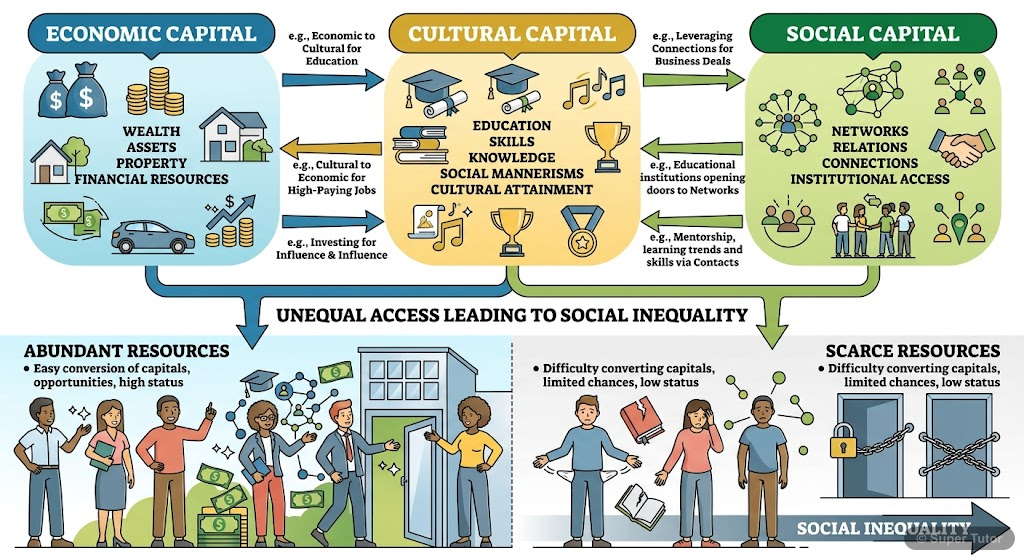
Patterns of Social Inequality and Exclusion
Chhattisgarh Board · Class 12 · Sociology
NCERT Solutions for Patterns of Social Inequality and Exclusion — Chhattisgarh Board Class 12 Sociology.
Interactive on Super Tutor
Studying Patterns of Social Inequality and Exclusion? Get the full interactive chapter.
Quizzes, flashcards, AI doubt-solver and a step-by-step study plan — built for ncert solutions and more.
1,000+ Class 12 students started this chapter today

This is just one of 12+ visuals inside Super Tutor's Patterns of Social Inequality and Exclusion chapter
Explore the full setPatterns of Social Inequality and Exclusion — Exercise Questions
1How is social inequality different from the inequality of individuals?Show solution
Individual Inequality refers to differences between persons based on their unique, personal attributes — such as talent, intelligence, physical strength, or effort. These differences are natural and vary from person to person. For example, one person may be a better singer than another.
Social Inequality, on the other hand, refers to systematic differences between groups of people that are produced and maintained by the social structure itself — not by individual characteristics. Social inequality is:
- Structured: It follows a pattern based on group membership (caste, class, gender, race, etc.).
- Persistent: It is reproduced across generations through social institutions.
- Consequential: It determines access to resources, opportunities, and power.
Key Difference: Individual inequality is random and personal; social inequality is patterned, group-based, and socially produced. For example, the fact that Dalits as a group have historically faced discrimination in education and employment is a form of social inequality — it is not explained by individual differences in ability or effort, but by the social structure of caste.
Conclusion: Social inequality is thus a collective, structural phenomenon, whereas individual inequality is a matter of personal variation.
2What are some of the features of social stratification?Show solution
Major Features of Social Stratification:
1. It is Social, not Individual: Stratification is based on group membership (caste, class, gender) rather than individual characteristics. It is a feature of society, not of individuals.
2. It is Ancient and Universal: Some form of stratification has existed in all known human societies across history, though its form varies.
3. It is Consequential: Stratification has real effects on people's life chances — their access to education, health, wealth, and power.
4. It involves a Hierarchy: Society is divided into layers or strata arranged in a ranking from higher to lower (e.g., upper class, middle class, lower class).
5. It is Reproduced across Generations: Inequality tends to be passed on from parents to children through inheritance of property, social status, and cultural capital.
6. It is Supported by Beliefs: Every system of stratification is justified by an ideology — a set of beliefs that makes inequality appear natural or legitimate (e.g., the caste system was justified by religious beliefs).
7. It involves both Objective and Subjective Dimensions: Stratification involves not only actual differences in wealth or power but also people's perceptions of their own and others' positions.
Conclusion: Social stratification is a complex, multi-dimensional, and enduring feature of human societies that shapes life opportunities in profound ways.
3How would you distinguish prejudice from other kinds of opinion or belief?Show solution
Ordinary Opinion or Belief:
- Based on evidence, experience, or reasoning.
- Open to revision when new evidence is presented.
- Directed at specific situations or individuals based on actual observation.
Prejudice:
Prejudice literally means 'pre-judgement' — forming an opinion before examining the facts. It has the following distinctive features:
1. Not based on Evidence: Prejudice is formed without adequate knowledge or experience of the subject. It is a pre-formed judgement.
2. Resistant to Change: Even when confronted with contrary evidence, a prejudiced person does not revise their view. This rigidity distinguishes it from ordinary belief.
3. Directed at Groups: Prejudice is typically directed at entire social groups (e.g., a caste, religion, gender, or race) rather than at specific individuals based on their actual behaviour.
4. Emotional Component: Prejudice is often accompanied by strong feelings — fear, hostility, contempt, or disgust — rather than rational assessment.
5. Linked to Discrimination: Prejudice often leads to discriminatory behaviour — treating members of a group unfairly because of their group membership.
Example: Believing that members of a particular caste are inherently unclean or inferior — without any factual basis and despite evidence to the contrary — is a prejudice.
Conclusion: Prejudice is distinguished from other beliefs by its pre-judgement character, its resistance to evidence, its group-directed nature, and its emotional intensity.
4What is social exclusion?Show solution
Definition: Social exclusion refers to the ways in which certain individuals or groups are systematically blocked from rights, opportunities, and resources that are normally available to members of a society. It is the process by which some people are pushed to the margins of society and prevented from participating fully in the economic, social, political, and cultural life of the community.
Key Aspects of Social Exclusion:
1. It is Active, not Passive: Exclusion is not simply the absence of inclusion — it involves active processes by which dominant groups keep others out. For example, untouchability actively excluded Dalits from temples, wells, and schools.
2. It is Multi-dimensional: Exclusion operates across several dimensions simultaneously — economic (denial of employment), social (denial of dignity and respect), political (denial of voting rights or representation), and cultural (denial of access to cultural spaces).
3. It is Structural: Exclusion is built into the structure of society through laws, customs, norms, and institutions — not just individual prejudice.
4. It is Linked to Power: Those who are excluded typically lack power, while those who exclude hold power and use it to maintain their privilege.
Examples in India: The exclusion of Dalits from certain occupations, the exclusion of women from public spaces, and the exclusion of adivasis from their traditional lands are all forms of social exclusion.
Conclusion: Social exclusion is a structural process of marginalisation that denies certain groups full participation in society.
5What is the relationship between caste and economic inequality today?Show solution
Historical Background: The caste system traditionally assigned occupations on the basis of birth. Upper castes monopolised education, land, and priestly roles, while lower castes were confined to menial, low-paying work. This created a close overlap between caste status and economic status.
Relationship between Caste and Economic Inequality Today:
1. Persistence of Correlation: Even after independence and modernisation, there remains a strong statistical correlation between caste and economic position. Dalits and OBCs are disproportionately represented among the poor, landless labourers, and those in low-wage occupations.
2. Land Ownership: Upper castes continue to own a disproportionate share of agricultural land. Dalits and adivasis remain largely landless, which is a major source of economic vulnerability.
3. Education and Employment: Historical exclusion from education has meant that lower castes have lower levels of human capital, limiting their access to well-paying jobs in the modern economy.
4. Discrimination in Labour Markets: Studies show that even when qualifications are equal, people from lower castes face discrimination in hiring — for example, in urban job markets where upper-caste employers prefer upper-caste candidates.
5. New Forms of Inequality: While some Dalits and OBCs have benefited from reservations and economic growth, the overall gap remains large. The benefits of liberalisation have been unequally distributed, often favouring those who already had capital and education.
6. Caste and Class Overlap: While caste and class are analytically distinct, in practice they overlap significantly in India. Being of a lower caste often means being of a lower economic class as well.
Conclusion: Caste and economic inequality are deeply intertwined in India. Caste continues to shape economic outcomes through historical disadvantage, discrimination, and unequal access to resources, even as the formal legal system prohibits caste discrimination.
6What is untouchability?Show solution
Definition: Untouchability refers to the practice of imposing social disabilities on persons by reason of their birth into certain castes — those placed at the very bottom of the caste hierarchy, traditionally called 'untouchables' (now referred to as Dalits or Scheduled Castes). It involves the belief that the mere physical contact with these persons, or even their shadow or presence, can 'pollute' members of higher castes.
Manifestations of Untouchability:
1. Denial of Access to Public Spaces: Untouchables were denied entry to temples, schools, wells, roads, and other public spaces used by upper castes.
2. Restrictions on Occupation: They were forced to perform the most degrading occupations — manual scavenging, handling of dead bodies, leather work — and were not allowed to take up other work.
3. Social Humiliation: They were required to show deference to upper castes — for example, by removing footwear, not wearing clean clothes, or not drawing water from the same well.
4. Residential Segregation: Untouchable communities were made to live in separate settlements on the outskirts of villages.
5. Denial of Basic Rights: They were denied education, the right to own land, and access to justice.
Legal Status: Untouchability was abolished by Article 17 of the Indian Constitution, and the Practice of Untouchability Act (1955), later strengthened as the Protection of Civil Rights Act (1976) and the SC/ST (Prevention of Atrocities) Act (1989), made it a punishable offence.
Conclusion: Untouchability is a form of extreme social exclusion rooted in the caste system, involving systematic humiliation, denial of rights, and enforced degradation of entire communities.
7Describe some of the policies designed to address caste inequality.Show solution
Major Policies to Address Caste Inequality:
1. Constitutional Provisions:
- Article 15: Prohibits discrimination on grounds of religion, race, caste, sex, or place of birth.
- Article 16: Guarantees equality of opportunity in public employment and allows reservations for backward classes.
- Article 17: Abolishes untouchability and makes its practice a punishable offence.
- Article 46: Directs the state to promote educational and economic interests of Scheduled Castes, Scheduled Tribes, and other weaker sections.
2. Reservation Policy:
- Reservations in educational institutions, government jobs, and legislative bodies (Parliament and State Assemblies) have been provided for Scheduled Castes (15%), Scheduled Tribes (7.5%), and Other Backward Classes (27%) as per the Mandal Commission recommendations.
- This policy aims to ensure representation and provide opportunities to historically disadvantaged groups.
3. Legal Protections:
- Protection of Civil Rights Act, 1976 (amended from the Untouchability Offences Act, 1955): Makes the practice of untouchability a criminal offence.
- Scheduled Castes and Scheduled Tribes (Prevention of Atrocities) Act, 1989: Provides stringent punishment for crimes committed against Dalits and adivasis by non-SC/ST persons.
4. Land Reforms: Various state governments have enacted land reform laws to redistribute land to landless Dalit labourers, though implementation has been uneven.
5. Special Development Programmes: Schemes like the Special Component Plan (for SCs) and Tribal Sub-Plan (for STs) earmark funds specifically for the development of these communities.
6. Educational Scholarships and Hostels: The government provides scholarships, free coaching, and residential facilities for SC/ST students to improve their educational attainment.
Conclusion: India has adopted a comprehensive framework of legal, constitutional, and policy measures to address caste inequality. However, the gap between policy intent and actual implementation remains a significant challenge.
8How are the Other Backward Castes different from the Dalits (or Scheduled Castes)?Show solution
Scheduled Castes (Dalits):
- Dalits are those communities that were traditionally considered 'untouchable' — placed outside and below the four-fold varna hierarchy.
- They faced the most extreme forms of social exclusion, including untouchability, forced degrading labour, and denial of basic rights.
- They are officially listed in the Schedule of the Constitution (hence 'Scheduled Castes').
- They constitute approximately 16–17% of India's population.
- They receive 15% reservation in government jobs and educational institutions.
Other Backward Classes (OBCs):
- OBCs are castes that are considered socially and educationally backward but are not classified as untouchable. They are typically the 'Shudra' castes in the traditional varna system — artisans, cultivators, and service castes.
- They were not subjected to untouchability but faced social discrimination and limited access to education and economic opportunities.
- The Mandal Commission (1980) identified OBCs and recommended 27% reservation for them in central government jobs and educational institutions.
- They constitute a much larger proportion of the population — estimated at around 40–52%.
Key Differences:
| Dimension | Dalits (SCs) | OBCs |
|---|---|---|
| Position in caste hierarchy | Outside/below the varna system | Within the varna system (Shudra) |
| Untouchability | Yes, historically subjected to it | No |
| Reservation | 15% | 27% |
| Degree of exclusion | More extreme | Less extreme but still significant |
Conclusion: While both groups face social disadvantage, Dalits have historically suffered a more severe and dehumanising form of exclusion through untouchability. OBCs, though backward, were not subjected to the same degree of social stigma and exclusion.
9What are the major issues of concern to adivasis today?Show solution
Major Issues Facing Adivasis Today:
1. Land Alienation and Displacement:
- The most critical issue is the loss of land. Adivasis have been displaced from their traditional forest and land-based habitats by development projects — dams, mines, industries, and wildlife sanctuaries.
- It is estimated that adivasis constitute a disproportionately large share of all development-displaced persons in India.
- Land is not just an economic resource for adivasis — it is central to their identity, culture, and way of life.
2. Forest Rights:
- Adivasis have traditionally depended on forests for food, fuel, medicine, and livelihood. Colonial and post-colonial forest laws denied them these rights, criminalising their traditional practices.
- The Forest Rights Act (2006) was passed to address this, but implementation has been slow and contested.
3. Poverty and Economic Marginalisation:
- Adivasis are among the poorest communities in India. They have the highest rates of poverty, malnutrition, and infant mortality.
- They are often exploited as cheap labour in mines, plantations, and construction.
4. Education and Health:
- Adivasi communities have low levels of literacy and poor access to quality education and healthcare, partly due to their geographic isolation and partly due to neglect.
5. Cultural Identity and Autonomy:
- Adivasis face pressure to assimilate into mainstream Hindu culture, which threatens their distinct languages, religions, and cultural practices.
- There are ongoing debates about whether adivasis should be classified as Hindus and about the conversion of adivasis to Christianity or other religions.
6. Political Representation:
- Despite reservations in legislatures, adivasis often lack effective political voice, especially in decisions that directly affect them, such as those regarding mining or dam construction on their lands.
7. Insurgency and State Violence:
- In several adivasi regions (particularly in central India), adivasis are caught between Maoist insurgents and state security forces, suffering violence from both sides.
Conclusion: The central issue for adivasis is the loss of control over their land, forests, and natural resources — which is the foundation of their livelihood and identity. Addressing adivasi concerns requires recognising their rights as indigenous peoples and ensuring their meaningful participation in decisions that affect them.
10What are the major issues taken up by the women's movement over its history?Show solution
Major Issues Taken Up by the Women's Movement:
1. Colonial Period (19th – early 20th century):
- Social Reform Issues: Early reformers (both men and women) campaigned against practices like Sati (widow immolation), child marriage, and the prohibition on widow remarriage.
- Education: Pioneers like Savitribai Phule fought for women's right to education.
- Property Rights: Campaigns for women's right to inherit and own property.
2. Nationalist Period (early–mid 20th century):
- Women's participation in the freedom struggle raised questions about their political rights.
- Suffrage: The demand for women's right to vote.
- The All India Women's Conference (1927) was established to address women's issues.
3. Post-Independence Period:
- Legal Equality: Campaigns to ensure that constitutional guarantees of equality were translated into law — e.g., the Hindu Code Bills (1950s) which gave women rights in marriage, divorce, and inheritance.
- Dowry: The anti-dowry movement led to the Dowry Prohibition Act (1961) and later amendments.
4. Contemporary Women's Movement (1970s onwards):
- Violence against Women: Campaigns against rape, domestic violence, and sexual harassment. The Mathura rape case (1972) galvanised the movement and led to amendments in rape laws.
- The Domestic Violence Act (2005) was a major achievement.
- Sexual Harassment at the Workplace: The Vishakha guidelines (1997) and later the POSH Act (2013) resulted from sustained campaigning.
- Reproductive Rights: The right to make decisions about one's own body, including access to safe contraception and abortion.
- Political Representation: Demand for reservation of seats for women in Parliament and state legislatures (Women's Reservation Bill).
- Economic Rights: Equal pay for equal work, maternity benefits, and rights of women workers in the informal sector.
- Caste and Gender: Recognition that women's experiences are shaped by both gender and caste — Dalit women face a 'double discrimination'.
Conclusion: The women's movement in India has evolved from focusing on social reform to addressing a broad spectrum of issues including legal rights, violence, political representation, and economic equality. It has been instrumental in bringing about significant legislative and social changes.
11In what sense can one say that 'disability' is as much a social as a physical thing?Show solution
The Medical Model of Disability:
The traditional view treats disability as a purely physical or medical condition — a problem located within the individual's body. On this view, a person is disabled because of their physical or mental impairment, and the solution is medical treatment or rehabilitation to 'fix' the individual.
The Social Model of Disability:
Sociologists and disability activists argue that disability is not just a physical condition but is also socially constructed. This means:
1. Society Creates Barriers: A person with a physical impairment is 'disabled' not just by their body but by a society that is not designed to accommodate them. For example:
- A person who uses a wheelchair is disabled by the absence of ramps, lifts, and accessible transport — not just by their inability to walk.
- A person with visual impairment is disabled by the absence of Braille materials and audio aids.
2. Social Attitudes Disable: Prejudice, stigma, and discrimination against people with impairments are major sources of disadvantage. People with disabilities are often treated as incapable, dependent, or objects of pity — attitudes that exclude them from education, employment, and social life.
3. Definition is Social: What counts as a 'disability' varies across cultures and historical periods. Some conditions are disabling in one social context but not in another.
4. Exclusion is Structural: People with disabilities are systematically excluded from mainstream social, economic, and cultural life — not because of their impairments alone, but because of how society is organised.
5. Identity and Dignity: The disability rights movement argues that people with disabilities should not be defined by their impairments. Their marginalisation is a social and political problem, not just a medical one.
Example: A deaf person is not necessarily disadvantaged in a community where sign language is widely used. Their 'disability' is produced by a hearing-centric society that does not accommodate sign language.
Conclusion: Disability is as much a social as a physical phenomenon because it is produced by the interaction between a person's impairment and a society that fails to accommodate difference. Addressing disability requires not just medical intervention but also social change — removing barriers, changing attitudes, and ensuring inclusion.
Stuck on a step?
Ask Super Tutor AI to explain any solution on this page in a simpler way — free, 24x7.
Ask a Doubt FreeFrequently Asked Questions
What are the important topics in Patterns of Social Inequality and Exclusion for Chhattisgarh Board Class 12 Sociology?
How to score full marks in Patterns of Social Inequality and Exclusion — Chhattisgarh Board Class 12 Sociology?
Where can I get free NCERT Solutions for Patterns of Social Inequality and Exclusion Class 12 Sociology?
Sources & Official References
Content is aligned to the official syllabus. Refer to the board website for the latest curriculum.
More resources for Patterns of Social Inequality and Exclusion
Important Questions
Practice with board exam-style questions
Syllabus
What topics to cover
Revision Notes
Key points for last-minute revision
Study Plan
Step-by-step plan to ace this chapter
Flashcards
Quick-fire cards for active recall
Formula Sheet
All formulas in one place
Chapter Summary
Understand the chapter at a glance
Practice Quiz
Test yourself with a quick quiz
Concept Maps
See how topics connect visually
For serious students
Get the full Patterns of Social Inequality and Exclusion chapter — for free.
Quizzes, flashcards, AI doubt-solver and a step-by-step study plan for Chhattisgarh Board Class 12 Sociology.