Social Institutions: Continuity and Change — Study Plan
Chhattisgarh Board · Class 12 · Sociology
A step-by-step study plan for Social Institutions: Continuity and Change, Chhattisgarh Board Class 12 Sociology: what to learn first, what to practise.
Interactive on Super Tutor
Studying Social Institutions: Continuity and Change? Get the full interactive chapter.
Quizzes, flashcards, AI doubt-solver and a step-by-step study plan — built for study plan and more.
Free trial, no card needed.
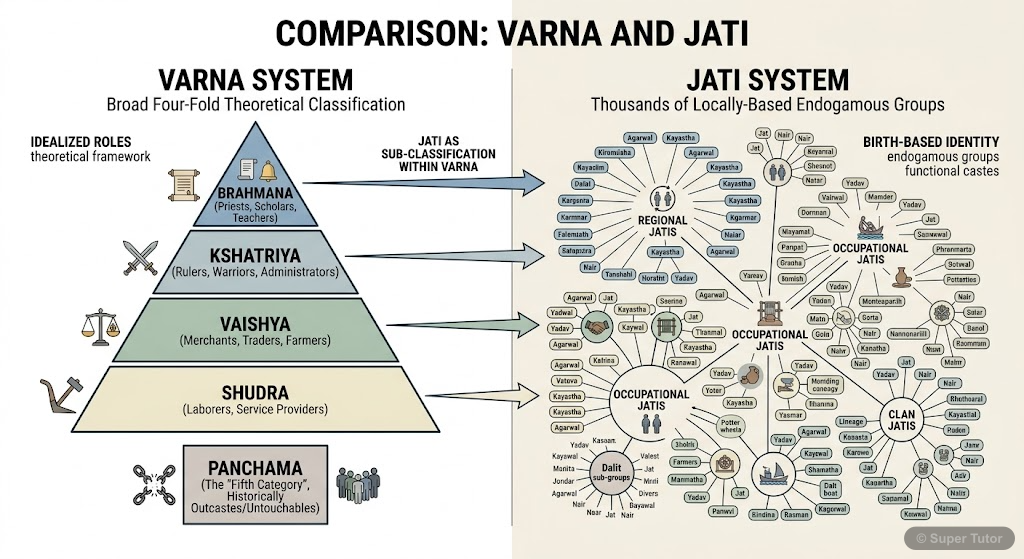
Learn better with visuals Super Tutor pairs illustrations like this with notes and quizzes for Social Institutions: Continuity and Change.
Study Plan
Learn the Theory
Read the textbook chapter carefully. Note down definitions, formulas and key ideas. Focus on: 1. Caste: Meaning, Features, and Historical Change, 2. Social Reformers and Anti-Caste Movements, 3. Caste in the Present: Politics, Class, and Social Visibility.
Practise
Solve the textbook exercises and extra practice questions. There are 43 questions available for this chapter.
Revise & Test
Revise key points without looking at your notes. Take a practice quiz and mark weak areas for another pass.
Spaced Revision
Come back to Social Institutions: Continuity and Change after a week. Use flashcards for quick recall and try past exam questions on this chapter.
What to Focus On
- Caste is uniquely associated with the Indian sub-continent.
- Varna and jati are not the same; varna is the broad four-fold division and jati is the local, more complex subdivision.
- The four varnas are brahmana, kshatriya, vaishya, and shudra.
- Colonial rule transformed caste through surveys, census, and classification.
- The census became a regular ten-year exercise from 1881 onwards.
- Herbert Risley’s 1901 Census collected social hierarchy data on caste.
- Ayyankali fought for road access and school access for Dalits.
- Phule founded the Satyashodhak Samaj in 1873.
- Savitri Bai Phule led girls’ education and work for Shudras and Ati-Shudras.
Common Mistakes to Avoid
Caste has always been rigid and determined by birth in the same way throughout Indian history.
Varna and jati mean the same thing.
The caste system is only a Hindu institution and does not affect any other community.
Memory Tips
Caste identity is based on birth
Endogamy in caste
Occupation tied to caste
Varna is broad, jati is local and complex
Want a personalised study plan?
Super Tutor builds a day-by-day plan for Chhattisgarh Board Class 12 Sociology that fits your exam date and pace.
Create My Study PlanFrequently Asked Questions
What are the important topics in Social Institutions: Continuity and Change for Chhattisgarh Board Class 12 Sociology?
How should I revise Social Institutions: Continuity and Change for the Chhattisgarh Board Class 12 board exam?
Sources & Official References
Content is aligned to the official syllabus. Refer to the board website for the latest curriculum.
More resources for Social Institutions: Continuity and Change
Practice Quiz
Test yourself with a quick quiz
Important Questions
Exam-style questions with answers
Revision Notes
Key points for last-minute revision
Chapter Summary
Understand the chapter at a glance
Concept Maps
See how topics connect
Flashcards
Quick-fire cards for active recall
Syllabus
What topics to cover
NCERT Solutions
Every textbook question solved step by step
For serious students
Get the full Social Institutions: Continuity and Change chapter — start free.
Quizzes, flashcards, an AI doubt solver and a study plan for Chhattisgarh Board Class 12 Sociology. Free to start, no card needed.