Evolution — NCERT Solutions
Gujarat Board · Class 12 · Biology
NCERT Solutions for Evolution, Gujarat Board Class 12 Biology: 10 textbook questions solved step by step. Covers EXERCISES — Chapter: Evolution.
Interactive on Super Tutor
Studying Evolution? Get the full interactive chapter.
Quizzes, flashcards, AI doubt-solver and a step-by-step study plan — built for NCERT solutions and more.
Free trial, no card needed.
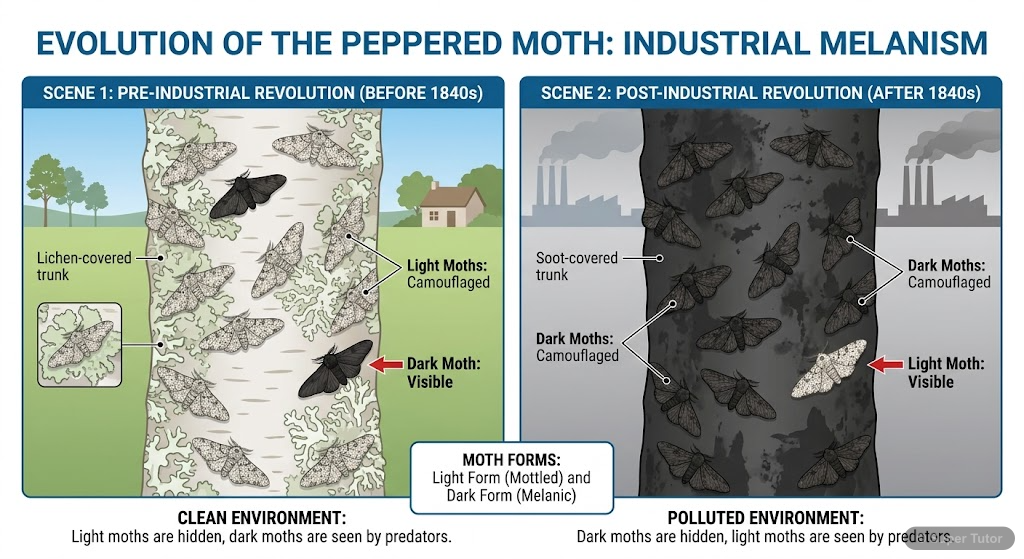
Learn better with visuals Super Tutor pairs illustrations like this with notes and quizzes for Evolution.
The first 5 solutions are open to read. The other 5 are free with a Super Tutor account.
EXERCISES — Chapter: Evolution (Biology, Class 12)
1Explain antibiotic resistance observed in bacteria in light of Darwinian selection theory.Show solution
Given / Concept: Darwinian natural selection states that in any population, individuals show heritable variations. Those with favourable variations survive and reproduce better (survival of the fittest), passing the trait to offspring.
Explanation:
Step 1 – Pre-existing variation: In a large bacterial population, random mutations continuously produce a few individuals that carry a gene conferring resistance to a particular antibiotic (e.g., penicillin). These resistant variants exist even before the antibiotic is introduced.
Step 2 – Selection pressure: When an antibiotic is administered, it acts as a selecting agent (environmental pressure). The non-resistant (sensitive) bacteria are killed, while the rare resistant individuals survive.
Step 3 – Differential reproduction: The surviving resistant bacteria reproduce rapidly (binary fission), passing the resistance gene to all daughter cells. Over successive generations, the resistant type becomes the dominant form in the population.
Step 4 – Result: The entire bacterial population eventually becomes antibiotic-resistant. This is not the antibiotic causing the mutation; the mutation was already present. The antibiotic merely selected the pre-existing resistant variant.
Conclusion: Antibiotic resistance is a classic, real-time demonstration of Darwinian natural selection — variation exists in the population, the environment (antibiotic) selects the fittest variant, and that variant proliferates. This is why over-use of antibiotics accelerates the emergence of multi-drug-resistant (MDR) bacteria such as MRSA.
2Find out from newspapers and popular science articles any new fossil discoveries or controversies about evolution.Show solution
Note: This is an activity-based / research question. A model answer based on well-documented findings is provided below.
Recent Notable Fossil Discoveries & Controversies:
- Homo naledi (2015, South Africa): Fossils discovered in the Rising Star Cave system by Lee Berger's team. H. naledi showed a mosaic of primitive and modern features (small brain, curved fingers, but human-like feet). Controversy: its geological age (~236,000–335,000 years) overlapped with early Homo sapiens, raising questions about coexistence of multiple Homo species.
- Homo luzonensis (2019, Philippines): Fossils from Callao Cave suggested a new small-bodied hominin species, indicating multiple independent migrations and evolution of small body size (island dwarfism), challenging the simple linear model of human evolution.
- Denisovans: DNA extracted from a finger bone in Denisova Cave (Siberia) revealed a distinct hominin group. Interbreeding with H. sapiens is evidenced by Denisovan DNA in modern Melanesians and Tibetans (EPAS1 gene for high-altitude adaptation).
- Tiktaalik roseae: A transitional fossil between fish and tetrapods, supporting the fish-to-land vertebrate transition.
Conclusion: These discoveries show that human evolution was not a straight ladder but a branching bush, with multiple species coexisting and sometimes interbreeding — a continuing area of active research and debate.
3Attempt giving a clear definition of the term species.Show solution
Definition of Species:
A species is a group of organisms that:
- Share a common gene pool,
- Are capable of interbreeding among themselves under natural conditions, and
- Produce fertile (viable) offspring,
- Are reproductively isolated from all other such groups.
This is the Biological Species Concept proposed by Ernst Mayr (1942):
Additional points:
- Members of a species share morphological, physiological, biochemical, and behavioural similarities.
- They occupy a common ecological niche.
- Reproductive isolation (pre-zygotic or post-zygotic barriers) is the key criterion.
Limitation: This definition does not apply to asexually reproducing organisms (bacteria, some plants). For such organisms, a morphological species concept (similarity in structure) or phylogenetic species concept (common ancestry) is used.
Example: All domestic dogs (Canis lupus familiaris) belong to one species because they can interbreed and produce fertile offspring, even though they differ greatly in size and appearance.
4Try to trace the various components of human evolution (hint: brain size and function, skeletal structure, dietary preference, etc.)Show solution
Components of Human Evolution:
| Ancestor | Time (approx.) | Brain Size | Key Features |
|---|---|---|---|
| Dryopithecus | 15 mya | Small | Ape-like, walked on all fours |
| Ramapithecus | 14–7 mya | Small | More man-like face, herbivorous |
| Australopithecus | 3–4 mya | ~400–500 cc | Bipedal, lived in East Africa, used stones as tools |
| Homo habilis | 2 mya | ~650–800 cc | First tool-maker (Oldowan tools), did not eat meat |
| Homo erectus | 1.5 mya | ~900 cc | Ate meat, used fire, migrated out of Africa |
| Homo heidelbergensis | 0.5 mya | ~1100–1400 cc | Transitional form |
| Homo neanderthalensis | 1,00,000–40,000 ya | ~1400 cc | Used hides, buried dead, lived in caves |
| Homo sapiens (modern) | ~75,000–10,000 ya | ~1400–1600 cc | Cave art, agriculture, language, culture |
Key Evolutionary Trends:
- Brain size: Gradual increase from ~400 cc (Australopithecus) to ~1400–1600 cc (H. sapiens). Larger brain enabled complex thinking, language, and tool use.
- Skeletal structure: Shift from quadrupedal to bipedal locomotion; changes in pelvis, femur angle, foramen magnum position (moved to base of skull), and foot arch.
- Dietary preference: From herbivory (Australopithecus) → omnivory (H. erectus onwards). Discovery of fire allowed cooking, improving nutrition and reducing jaw size.
- Tool use: Progression from crude stone tools (Oldowan) → Acheulean hand axes → sophisticated blades and art.
- Language and culture: Developed in H. sapiens sapiens; enabled social organisation, agriculture (~10,000 ya), and civilisation.
Conclusion: Human evolution is characterised by increasing brain complexity, upright posture, refined tool use, and development of language — all interrelated and mutually reinforcing.
5Find out through internet and popular science articles whether animals other than man have self-consciousness.Show solution
Note: This is a research/activity-based question. A model answer is provided.
Self-Consciousness in Non-Human Animals:
Self-consciousness is typically tested using the Mirror Self-Recognition (MSR) Test (developed by Gordon Gallup Jr., 1970): an animal is marked with a spot and placed before a mirror. If it touches the spot on its own body (not the mirror image), it is considered self-aware.
Animals that have passed the MSR test:
| Animal | Evidence |
|---|---|
| Great Apes (chimpanzees, bonobos, orangutans, gorillas) | Recognise themselves in mirrors; show empathy and theory of mind |
| Bottlenose Dolphins | Pass MSR test; complex social behaviour |
| Asian Elephants | Pass MSR test; mourn their dead |
| Eurasian Magpies | First non-mammal to pass MSR test |
| Cleaner Wrasse (fish) | Recent controversial study suggests MSR ability |
Other indicators of self-awareness:
- Chimpanzees plan for the future and deceive others.
- Elephants show grief and altruism.
- Dolphins have individual names (signature whistles).
Conclusion: Self-consciousness, once thought unique to humans, appears to exist in varying degrees in several animal species, suggesting it evolved gradually and is linked to brain complexity and social living.
Free with a Super Tutor account
Free with a Super Tutor account
Free with a Super Tutor account
Free with a Super Tutor account
Free with a Super Tutor account
5 more solved questions in Evolution
They are free with a Super Tutor account, along with practice quizzes and flashcards for this chapter. Free to start, no card needed.
Frequently Asked Questions
What are the important topics in Evolution for Gujarat Board Class 12 Biology?
Are these NCERT Solutions for Evolution free?
How should I revise Evolution for the Gujarat Board Class 12 board exam?
Sources & Official References
Content is aligned to the official syllabus. Refer to the board website for the latest curriculum.
More resources for Evolution
Practice Quiz
Test yourself with a quick quiz
Important Questions
Exam-style questions with answers
Revision Notes
Key points for last-minute revision
Chapter Summary
Understand the chapter at a glance
Concept Maps
See how topics connect
Study Plan
Step-by-step plan for this chapter
Flashcards
Quick-fire cards for active recall
Syllabus
What topics to cover
For serious students
Get the full Evolution chapter — start free.
Quizzes, flashcards, an AI doubt solver and a study plan for Gujarat Board Class 12 Biology. Free to start, no card needed.