Electric Charges and Fields — Practice Quiz
Gujarat Board · Class 12 · Physics
Try a 4-question quiz on Electric Charges and Fields for Gujarat Board Class 12 Physics: tap an answer to check it and see why.
Interactive on Super Tutor
Studying Electric Charges and Fields? Get the full interactive chapter.
Quizzes, flashcards, AI doubt-solver and a step-by-step study plan — built for practice quiz and more.
Free trial, no card needed.
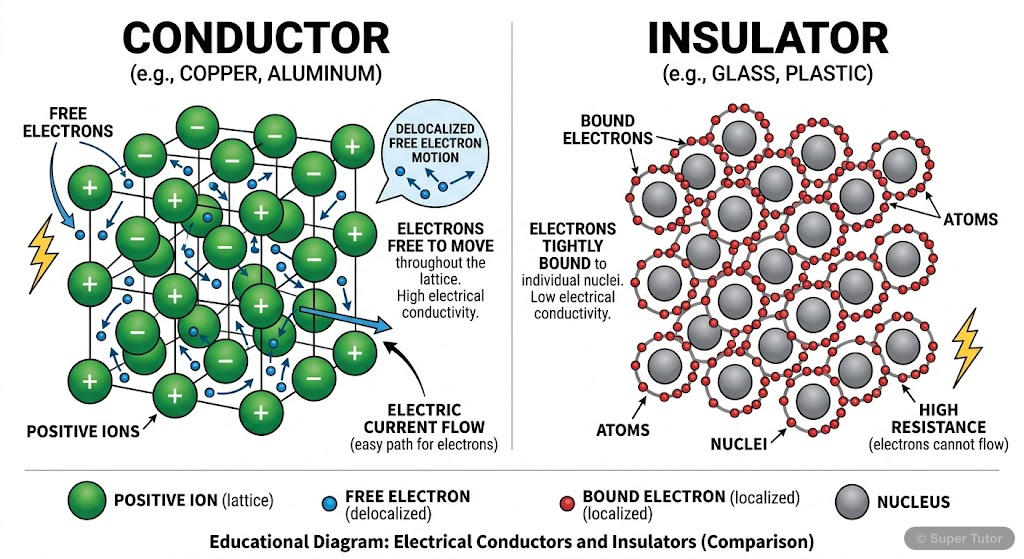
One of 23 illustrations for Electric Charges and Fields in Super Tutor — alongside flashcards, concept maps and practice questions.
Quick Quiz: Electric Charges and Fields
0/4Tap an answer to check it instantly. No sign-up needed for these 4.
What happens when a glass rod is rubbed with silk cloth?
The SI unit of electric charge is:
According to Coulomb's law, the force between two point charges is:
The value of elementary charge e is approximately:
Sample Questions
Which of the following are properties of electric charge?
Show answer
Additivity, Conservation, Quantisation
Electric charge has three fundamental properties: (1) Additivity - charges add algebraically, (2) Conservation - total charge in an isolated system remains constant, and (3) Quantisation - charge exists in integral multiples of elementary charge e.
Which materials are good conductors of electricity?
Show answer
Metals, Human body
Conductors are materials that allow electric charges to move freely through them. Metals and the human body are good conductors because they have free electrons or ions that can move easily. Glass and plastic are insulators that resist the flow of electric charge.
Electric field lines always:
Show answer
Start from positive charges and end at negative charges
Electric field lines always originate from positive charges and terminate at negative charges. They never form closed loops and never cross each other. This is a fundamental property of electrostatic field lines.
The electric field inside a uniformly charged spherical shell is:
Show answer
Zero everywhere
According to Gauss's law, the electric field inside a uniformly charged spherical shell is zero at all points. This is because the Gaussian surface inside the shell encloses no charge, making the electric flux zero.
+137 more questions on Electric Charges and Fields (Gujarat Board Class 12 Physics)
Practise AllFrequently Asked Questions
What are the important topics in Electric Charges and Fields for Gujarat Board Class 12 Physics?
How many practice questions are there for Electric Charges and Fields?
Sources & Official References
Content is aligned to the official syllabus. Refer to the board website for the latest curriculum.
More resources for Electric Charges and Fields
Important Questions
Exam-style questions with answers
Revision Notes
Key points for last-minute revision
Formula Sheet
The chapter's formulas in one place
Chapter Summary
Understand the chapter at a glance
Concept Maps
See how topics connect
Study Plan
Step-by-step plan for this chapter
Flashcards
Quick-fire cards for active recall
Syllabus
What topics to cover
NCERT Solutions
Every textbook question solved step by step
For serious students
Get the full Electric Charges and Fields chapter — start free.
Quizzes, flashcards, an AI doubt solver and a study plan for Gujarat Board Class 12 Physics. Free to start, no card needed.